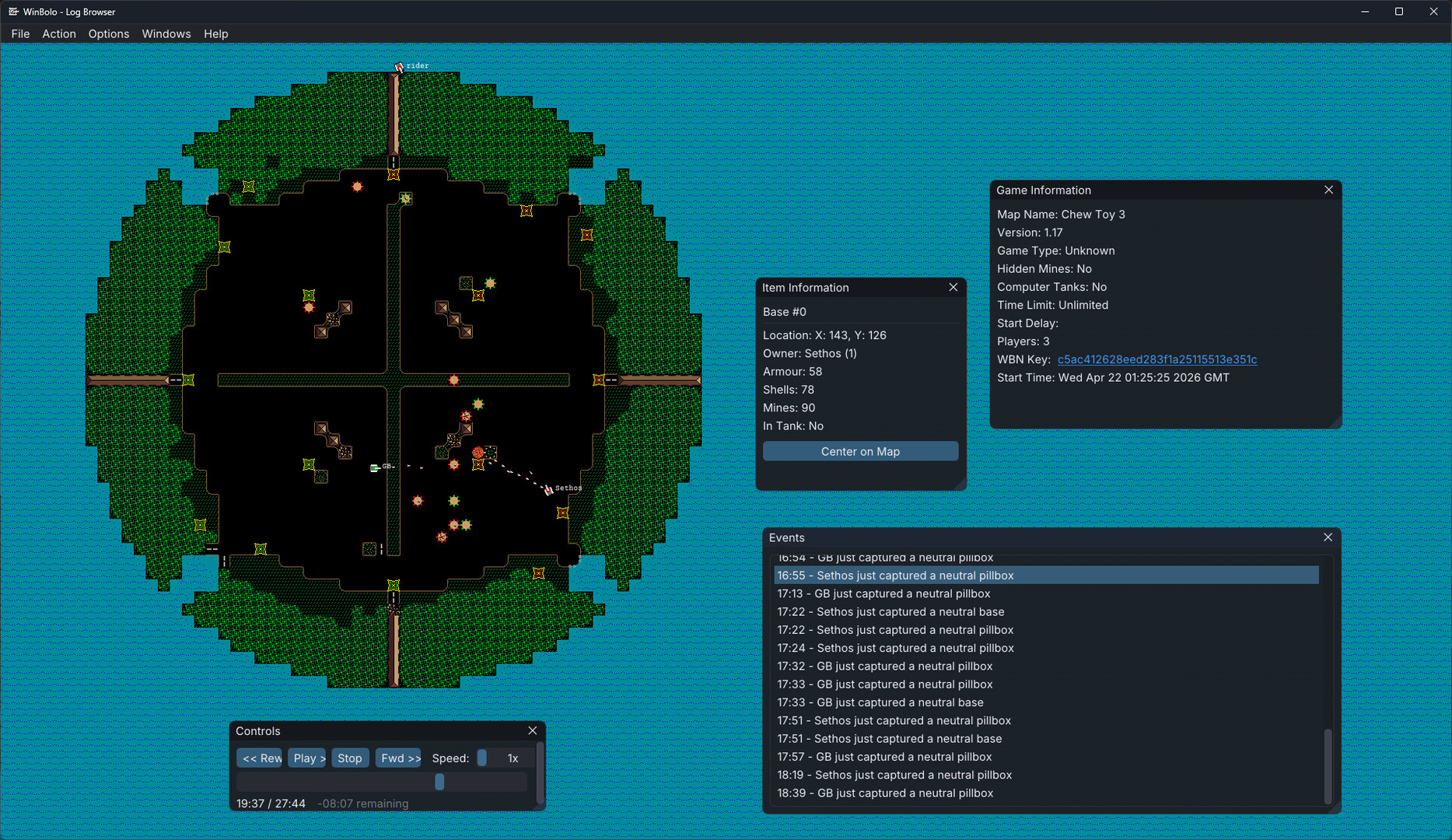


A multiplayer top-down tank game for up to 16 players. Capture bases and pillboxes, harvest trees, build roads and walls, lay mines, and battle for control of the island. The Macintosh classic, rebuilt for modern platforms — free, open source, and cross-platform across desktop, mobile, and web.

Sign in to add this item to your wishlist, follow it, or mark it as ignored

This game is not yet available on Steam

Planned Release Date: June 2026

Interested?
Add to your wishlist and get notified when it becomes available.
 

About This Game

An instant to learn. A lifetime to master. You have to play it to understand.

WinBolo is a multiplayer top-down tank game for up to 16 players. Pilot your tank across the island, capture bases and pillboxes, fortify your position, and battle for control of the map.

Two play styles, one battlefield

Drop into a freeform game where alliances shift hour by hour and a well-timed betrayal is a perfectly respectable move. Or run it tournament-style: teams locked in before the match, no diplomacy, two sides fighting for the island until one holds every base.

Both share the same simple rules and the same surprising depth.

Capture. Build. Win.

Bases are your lifeline — the only place to refuel, rearm, and repair your tank. Pillboxes hold key terrain and rip through anyone foolish enough to cross open ground; capture them, reposition them, turn them on their former owners. Harvest trees to fuel your build orders. Lay down roads to move faster than your enemies. Wall off chokepoints. Mine the approaches.

The world is dynamic Detonated mines leaves a crater. Craters fill with water. Water becomes rivers, rivers reshape the lines of attack, and the battlefield you started on isn't the one you're fighting on an hour later. Trees slowly regrow. Use too many of them and risk being deforested and unable to repair your pillboxes

A 1987 classic, rebuilt

Bolo was created by Stuart Cheshire in 1987 and became one of the defining multiplayer games of the early Macintosh era. In 1998, John Morrison began developing WinBolo — a faithful Windows reimplementation, and the only Bolo port Cheshire ever officially endorsed. Through a decade of active development, WinBolo grew a Linux port, a thriving online community at , and a player base that ran tournaments, shared maps, and shared strategies in the forums.

WinBolo 2.0 carries that work forward — same gameplay you remember, modernized for today's platforms.

What's new in 2.0

  • Cross-platform play — Windows, Mac, Linux, Steam Deck, iOS, Android, and the web, all on the same servers

  • Modern netcode — authoritative server, lag compensation with position-history rewind, client-side prediction, adaptive jitter buffer. Shells hit where you aimed.

  • Easy self-hosting — UPnP and NAT-PMP open ports automatically; UDP hole punching reaches servers behind most home routers

  • Built-in map editor — pencil, fill, magic wand, mazes, four procedural generators (Tournament, Natural, Maze, Fractal), text-as-terrain, image import, full symmetry tools, and a stamp library

  • A new AI Brain — NewAutopilot uses goal priorities, threat trajectories, and territory influence maps. Brains are written in Lua. Train your own with the machine learning tools and export them as in-game opponents. Tools provide to help build them as well.

  • 17 languages including in-game chat and player names

  • Embedded replay viewer with WBN integration — review games, leave rankings, watch other people's matches without leaving the client

Free, open source, and built to last

Bolo was shareware. WinBolo carried that spirit forward. WinBolo 2.0 keeps it going — freely available on Steam, the App Store, and Google Play, with an optional supporter purchase for anyone who wants to help fund development (including, perhaps, the players who never quite got around to sending in their shareware fee back in 2001!)

The full source code will be on GitHub shortly after launch under GPL v2, continuing with when WinBolo first went open source in 2008.

AI Generated Content Disclosure

The developers describe how their game uses AI Generated Content like this:

WinBolo's core engine and gameplay code was originally written by John Morrison between 1998 and 2008. The 2.0 modernization — including build system updates, the networking rewrite and platform ports — was developed with assistance from AI coding tools, with all architectural decisions, code review, and final integration handled by John Morrison.

Some non-gameplay marketing materials — including images and video elements used in trailers, social media, and the store page — were created using AI image generation as a starting point, with composition, editing, effects, and final selection done by hand. Gameplay screenshots and video footage are unedited captures from the actual game.

The game itself contains no generative AI content at runtime. Player-facing in-game assets (graphics, sound, music, text, UI) are human-created. The in-game AI opponents ("Brains," including NewAutopilot and future ML-trained agents) use traditional game AI techniques and trained reinforcement-learning models — they don't generate text, images, or audio during play.

System Requirements

Windows
macOS
SteamOS + Linux
    Minimum:
    • Requires a 64-bit processor and operating system
    • OS: Windows 10/11 (64-bit)
    • Processor: Any x86-64 CPU with SSE2
    • Memory: 1 GB RAM
    • Graphics: Any GPU with a working WDDM driver
    • DirectX: Version 11
    • Network: Broadband Internet connection
    • Storage: 200 MB available space
    • Additional Notes: x64 only — ARM64 runs via emulation. No VC++ Redist install required.
    Recommended:
    • Requires a 64-bit processor and operating system
    • OS: Windows 10/11 (64-bit)
    • Processor: Quad-core 2 GHz or better
    • Memory: 2 GB RAM
    • Graphics: Any GPU from the last decade
    • DirectX: Version 11
    • Network: Broadband Internet connection
    • Storage: 500 MB available space
    • Additional Notes: x64 only — ARM64 runs via emulation. No VC++ Redist install required
    Minimum:
    • OS: macOS 11 Big Sur
    • Processor: Intel x86-64 or Apple Silicon (M1 or later)
    • Memory: 1 GB RAM
    • Graphics: Any Metal-capable GPU (every Mac running macOS 11+)
    • Network: Broadband Internet connection
    • Storage: 200 MB available space
    • Additional Notes: Universal2 binary — runs natively on both Intel and Apple Silicon
    Recommended:
    • OS: macOS 13 Ventura or newer
    • Processor: Apple Silicon (M1 or later)
    • Memory: 2 GB RAM
    • Network: Broadband Internet connection
    • Storage: 500 MB available space
    • Additional Notes: Universal2 binary — runs natively on both Intel and Apple Silicon
    Minimum:
    • OS: Ubuntu 22.04, Debian 12, Fedora 38, Arch
    • Processor: Any x86-64 CPU with SSE2
    • Memory: 1 GB RAM
    • Graphics: OpenGL 3.0-class GPU (Mesa, NVIDIA, or AMD drivers)
    • Network: Broadband Internet connection
    • Storage: 200 MB available space
    • Additional Notes: Requires X11 or Wayland; PulseAudio, PipeWire, or ALSA. System libcurl required. x86-64 only — no prebuilt ARM64
    Recommended:
    • OS: Latest stable distro / SteamOS 3
    • Processor: Quad-core 2 GHz or better
    • Memory: 2 GB RAM
    • Graphics: OpenGL 3.0-class GPU (Mesa, NVIDIA, or AMD drivers)
    • Network: Broadband Internet connection
    • Storage: 500 MB available space
    • Additional Notes: Requires X11 or Wayland; PulseAudio, PipeWire, or ALSA. System libcurl required. x86-64 only — no prebuilt ARM64
There are no reviews for this product

You can write your own review for this product to share your experience with the community. Use the area above the purchase buttons on this page to write your review.