
Release species on a small living planet, tip its balance and watch evolution answer. Populations adapt, split into new species and die out; continents drift, ice ages come and go, and clever species build villages and towns. A sandbox god game of ecology and evolution.

Sign in to add this item to your wishlist, follow it, or mark it as ignored

Coming Soon To Early Access

The developers of this game intend to release as a work in progress, developing with the feedback of players.

Note: Games in Early Access are not complete and may or may not change further. If you are not excited to play this game in its current state, then you should wait to see if the game progresses further in development. Learn more

What the developers have to say:

Why Early Access?

“Equilibria simulates a whole planet: climate, plates, plants, fungi, animals, diseases and the peoples that rise among them. The game is complete and playable today, but the living world still has room to grow. During Early Access we will keep adding new parts to it (new forms of life, new forces of nature, new things for the peoples to do), along with new tools, scenarios and historical moments, shaped by what players most want to see next.”

Approximately how long will this game be in Early Access?

“About 6-9 months.”

How is the full version planned to differ from the Early Access version?

“The full version will bring everything added during Early Access: new parts of the simulation (new kinds of life, new forces of nature, new steps for the peoples), new tools for the player, and more scenarios and historical moments.”

What is the current state of the Early Access version?

“The game is complete and playable from start to end: the free sandbox on generated worlds and on the real Earth, the species, plant and fungus designers, the tutorial, a campaign of scenarios, historical scenarios, the daily challenge and the scenario editor, 22 achievements, mods, and fifteen languages. Worlds you save keep opening in later versions: every update reads the saves of the versions before it.”

Will the game be priced differently during and after Early Access?

“Yes: the price will rise a little with the full release.”

How are you planning on involving the Community in your development process?

“Through the Steam discussions and the community hub: reports of worlds that went wrong come with their seed or share code, so we can open the same world. The game can also keep an optional, local-only play log that players may send us if they want to show where they got stuck.”
Read more
This game is not yet available on Steam

Planned Release Date: Nov 30, 2026

This game plans to unlock in approximately 11 days

Interested?
Add to your wishlist and get notified when it becomes available.
 

Report bugs and leave feedback for this game on the discussion boards

See all discussions

About This Game

A small living planet

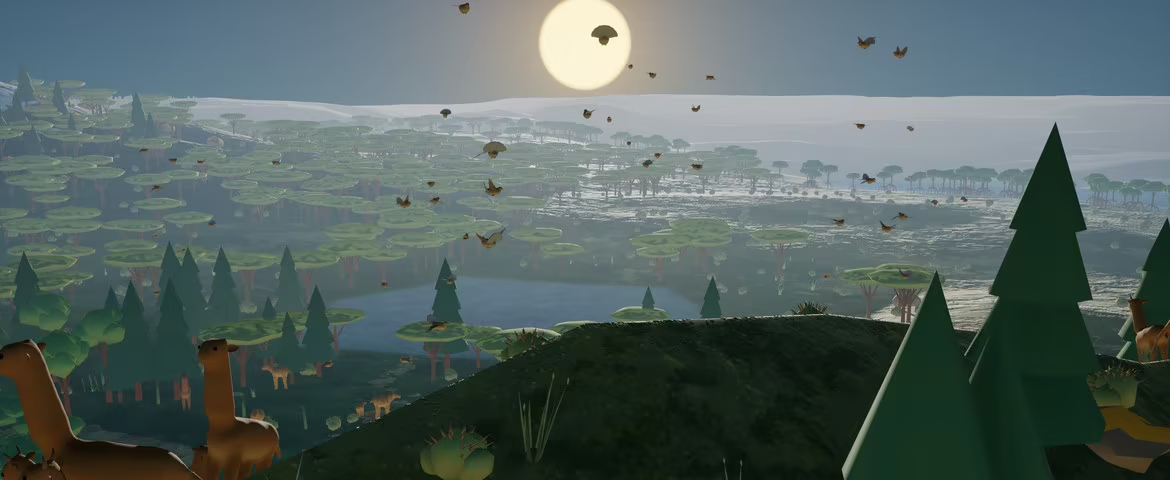
A small round world hangs in space: continents and ice caps, deserts, forests and reefs. Zoom from orbit down to the grass and you find herds grazing, hunters stalking them, fish in the rivers and mushrooms on fallen trees. Everything on it is simulated, place by place, and every change you make ripples through the whole web of life.

Release a species and the balance tips: one multiplies, another starves, the forests retreat. Speed up time and evolution answers. Populations adapt to where they live, groups cut off from each other become new species with names of their own, and others vanish for ever. Over longer spans the continents drift, collide and split, carrying their life with them.

And it goes on both ways: pull back past the highest orbit and the whole star system turns around you; go down past the grass and you dive into the soil, into an animal's blood, and on to its genes.

A world that runs by itself

  • Living geology: tectonic plates move, mountains rise, oceans open; ice ages come and go, supervolcanoes erupt, and the rocks lay down their layers with the fossils of what lived there.
  • Climate and water: seasons, ocean currents, rivers and lakes, clouds, rain and snow, hurricanes and tornadoes, and an atmosphere whose carbon dioxide and oxygen follow what lives below.
  • Sky and sea: day and night, a moon that raises the tides and darkens the sun, comets and shooting stars, flocks that fly away with the seasons, red tides in warm seas and water that glows in the dark.
  • Whole food webs: grazers and hunters, scavengers and parasites, pollinators, and the fungi and soil microbes that return the dead to the soil.
  • Diseases with names: they spread through crowds, jump between related species, grow deadlier or milder, and leave the survivors immune.

Evolution you can watch

  • Every species carries 18 traits (size, diet, speed, warmth, armour, flight, intelligence, life in herds or by night and more), shaped by selection, mutation, drift and migration.
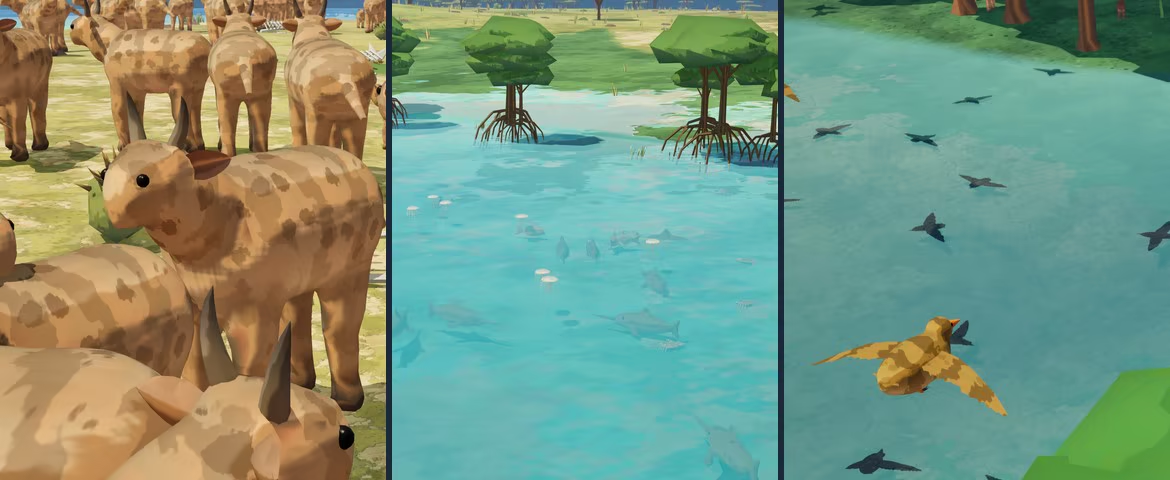
  • Every lineage gets a body built from its genome: horned giants, long-necked browsers, birds and bats, snakes and frogs, crabs, squid and jellyfish. Young and old, males and females, they walk the land, swim and fly, and every species has a call of its own.
  • Plants and fungi evolve too: named species with bodies of their own, forests that spread and burn, mangroves and salt marsh on the tidal shores, blights that sweep through crowded stands.
  • Related species hybridise and sometimes merge back into one, and the family tree records it all.

Be a gentle god, or not

  • Release animals, sow plants, or design species of your own and share them as codes.
  • Sculpt the land, raise or lower the sea, warm or cool the climate, tear a plate in two.
  • Strike with meteors, droughts, plagues, mould and storms, then watch life recover. Changed your mind? Undo.
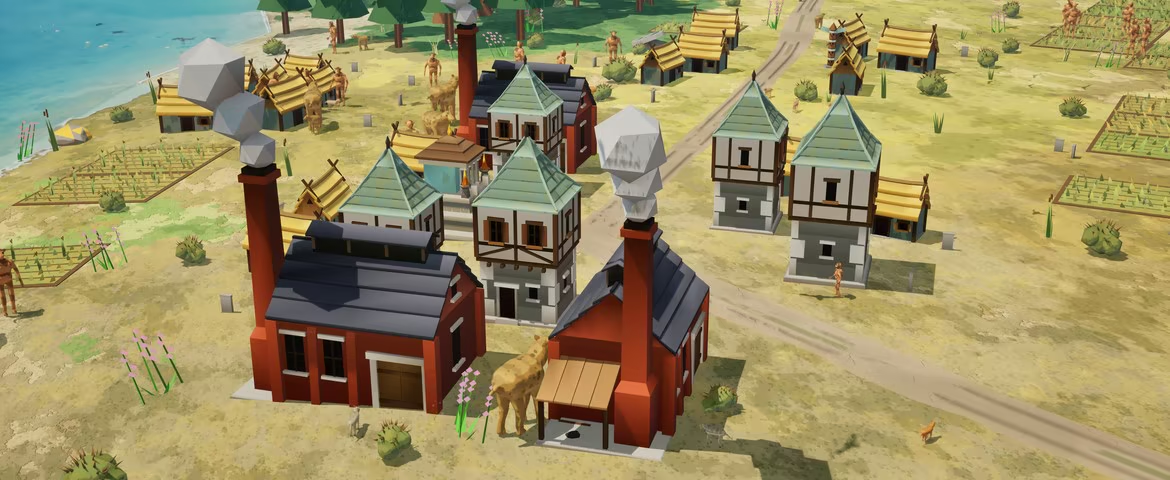
  • Clever species settle down: villages, fields of crops, tamed herds, towns joined by roads, and smoke that warms the air. Their peoples grow apart with names of their own, bury their dead, paint the rocks, learn to write and read the sky. They trade and go to war, remember what you did to them, hear your voice and raise temples to you; one day they send a satellite round their world and land on their moon.

From the stars down to the genes

  • The star system: zoom out past the highest orbit and four to eight worlds circle your sun. The peoples name the wandering stars, follow them across the night and send probes to them.
  • Below the grass: dive into the soil and its microbes, into an animal's gut and blood, to a single cell with a virus at its door and the antibodies that hold it, and on to the genes it shares with its kin.
  • Heal what you find: medicine, vaccines and probiotics for the animals, and living soil to make poor land fertile.
  • Choose the sky: no moon, a small one, a big one or two; a round orbit or an eccentric one that deepens the ice ages; a white star, an orange one, or a red dwarf under which the leaves grow near black. Tilt the axis, call a comet, or bring an asteroid down from the belt.

Observe, play, share

  • Food web, balance index, family tree, timeline and 19 map layers; every species card tells what that species dies of.
  • Follow one animal through its life, look closely at a single place, or let the documentary camera find the drama for you.
  • A campaign of scenarios, a daily challenge, a scenario editor, moments from Earth's history (the last day of the giants, the sea that dried, the last ice age, the breath of life) and worlds that might have been: one with no moon, one under a red sun.
  • Play on the real Earth, with its measured relief, plates and climate, or on new worlds: Earth-like, Pangea, archipelagos, ocean, ice and desert planets.
  • Experiment mode: fork the world and see what happens with and without your change.
  • Photo mode, time-lapse videos and GIFs, an encyclopedia that fills as you discover, 22 achievements.
  • Music and sound that follow the state of the world. Mods for species, plants, scenarios and translations.
  • Mouse and keyboard or a controller; colour-blind friendly map layers, interface scaling and rebindable keys.

AI Generated Content Disclosure

The developers describe how their game uses AI Generated Content like this:

Languages other than Turkish and English were created using ai.

System Requirements

    Minimum:
    • Requires a 64-bit processor and operating system
    • OS: 10 64-bit
    • Processor: Intel Core i5-8400 / AMD Ryzen 5 1500X
    • Memory: 2 GB RAM
    • Graphics: NVIDIA GeForce GTX 1060 3GB / AMD Radeon RX 570 4GB
    • Storage: 1 GB available space
    Recommended:
    • Requires a 64-bit processor and operating system