
A first-person descent under a quarry town, one square at a time, with a hand-bell for magic. Everything down there shows its blow before it lands, and the changes you ring keep the dead in their place.

Sign in to add this item to your wishlist, follow it, or mark it as ignored

This game is not yet available on Steam

Planned Release Date: November 2026

Interested?
Add to your wishlist and get notified when it becomes available.
 

About This Game

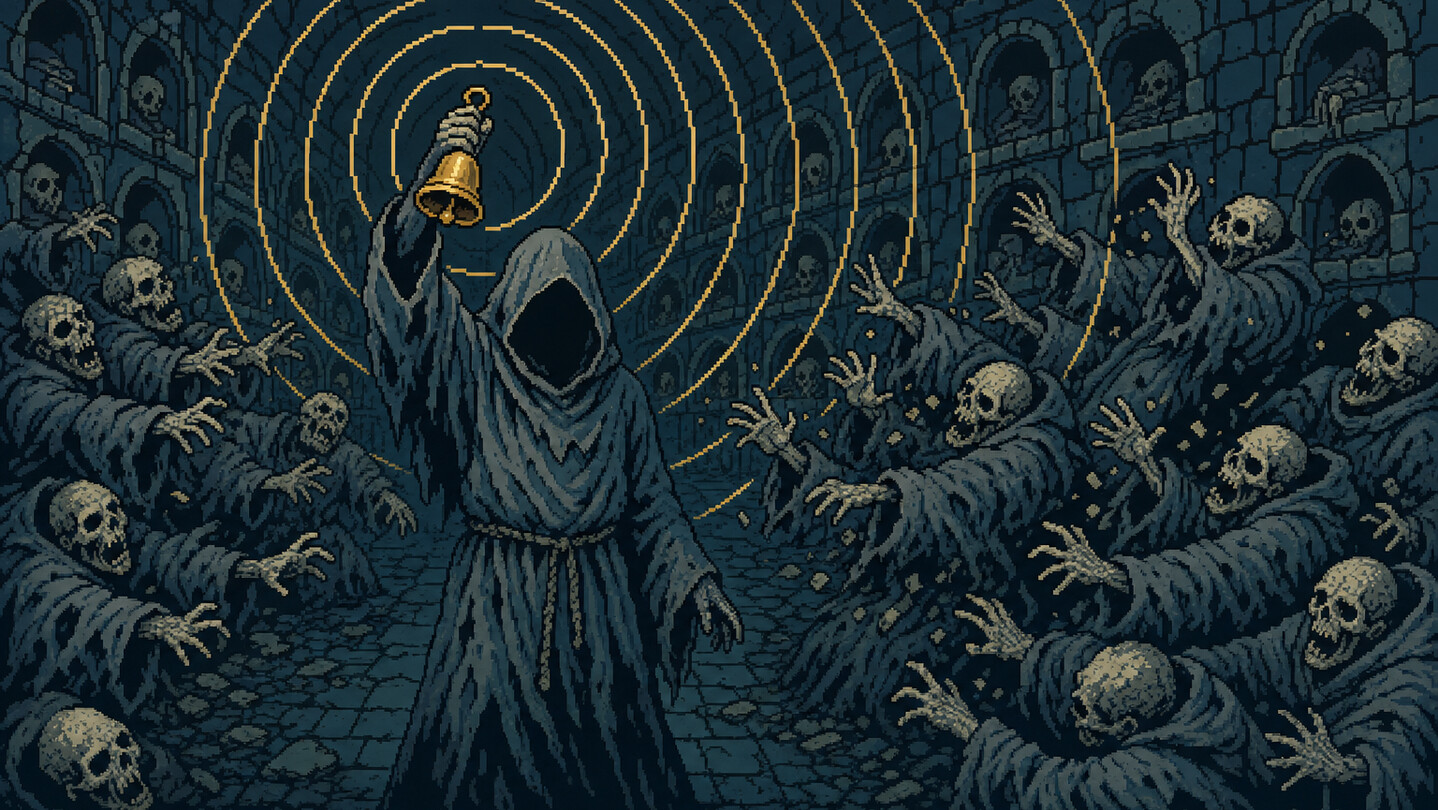
Hollin Cross cuts stone for a living, and under the quarry an old Order laid the town's dead in galleries for four hundred years. Now the bell has started ringing on its own. Every night somebody in town hears their own name in it, and in the morning they go down.

You were taught to ring by the last ringer above. You go down after them.

Below the Bell is a first-person dungeon crawler on a square grid, played in real time. A monster about to strike turns yellow and you hear the blow drawn back at least a beat before it lands, so there is always a moment to step aside, turn to face it, or get the shield up. Your two hands work on their own cooldowns: a weapon in one, and a shield, a knife or a hand-bell in the other.

The hand-bell rings changes, patterns of strokes and rests in time with its own toll that the Order used to keep the dead where they were laid, and each one you learn is written in a book somewhere below. Ringing takes nerve: a step, a blow or a wound breaks it off. Rounds stops the dead near you for three beats. Plain Hunt shows the path of everything that moves. Stedman brings a stopped rope back to life. The fourth change is the one your teacher never taught you. Every boss has one answer, and it is written down somewhere on its floor.

Between descents you walk Hollin Cross itself, at night under the moon, to the people standing at their doors: the chapel, the smithy, Nell's lamp-shop, the Wheatsheaf. The quarry gate takes you down, and the crypt stair and the bell tower open as you go deeper. A Homeward Taper lit below brings you up to town and back down to the same spot, once.

What is in it:

  • 12 floors in three acts, 3 optional floors, and one more for anyone who comes back
  • 49 kinds of monsters and 11 bosses
  • 36 abilities in 3 disciplines: Blade, Bolt and Litany
  • loot with rolled properties, and 30 relics that only named things carry
  • 24 quests from the people still in town, and 4 endings
  • Step mode, where the world waits and moves one beat each time you act
  • three paces, and a Story Mode where you take a third of the damage
  • neither Step mode nor Story Mode locks anything: every achievement and every ending still counts
  • rebindable keys, full controller support, subtitles for the toll and every sound you need to hear, reduced flashes and colour marks
  • English and Brazilian Portuguese

How generative AI was used in this game


All of the game's text, in English and in Brazilian Portuguese, was written with an AI language model under the developer's direction, and checked line by line in both languages.

412 pictures were generated with an OpenAI image model, from prompts written for this game: the monsters, the people of the town, the parts the town's houses are built from, the items, the props and walls of the floors, the skill icons, the quest pictures and the achievement emblems.

Of the 661 monster animation sheets, 589 were animated with PixelLab, some of them finished by a script (the strike after an attack's wind-up, a sway added to a walk, specks cleared from a death), and 72 were drawn from the still picture by a script, with no AI model.

120 side and back views of the monsters were turned from their front pictures with PixelLab.

60 sounds were generated with ElevenLabs: the sound effects and the town's night ambience.

20 pieces of music were generated with ElevenLabs.

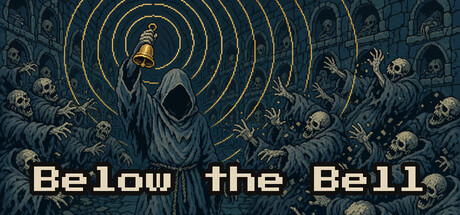
On this store page, the key art behind the title was generated with an OpenAI image model; the title is set on it in the game's font by a script. The trailer is recorded from the game, and its music was written note by note in a script, with no AI model.

No prompt names another game, studio or artist. The font is Press Start 2P, under the SIL Open Font License.

AI Generated Content Disclosure

The developers describe how their game uses AI Generated Content like this:

All of the game's text, in English and in Brazilian Portuguese, was written with an AI language model under the developer's direction, and checked line by line in both languages.

412 pictures were generated with an OpenAI image model, from prompts written for this game: the monsters, the people of the town, the parts the town's houses are built from, the items, the props and walls of the floors, the skill icons, the quest pictures and the achievement emblems.

Of the 661 monster animation sheets, 589 were animated with PixelLab, some of them finished by a script (the strike after an attack's wind-up, a sway added to a walk, specks cleared from a death), and 72 were drawn from the still picture by a script, with no AI model.

120 side and back views of the monsters were turned from their front pictures with PixelLab.

60 sounds were generated with ElevenLabs: the sound effects and the town's night ambience.

20 pieces of music were generated with ElevenLabs.

On this store page, the key art behind the title was generated with an OpenAI image model; the title is set on it in the game's font by a script. The trailer is recorded from the game, and its music was written note by note in a script, with no AI model.

No prompt names another game, studio or artist. The font is Press Start 2P, under the SIL Open Font License.

Mature Content Description

The developers describe the content like this:

Constant real-time combat with medieval weapons against the risen dead, skeletons and a few animals. Blows show arcs of blood and red flashes, and old blood and bodies lie on the dungeon floors. The story deals with death, grief and self-sacrifice: people from the town go down to die, among them a sixteen-year-old boy, whose death is told, not shown. Pixel art; violence is shown plainly and never lingered on.

System Requirements

    Minimum:
    • Requires a 64-bit processor and operating system
    • OS: Windows 10 64-bit
    • Processor: Any x86-64 CPU from 2015 or later
    • Memory: 2048 MB RAM
    • Graphics: OpenGL 3.3 capable GPU with 512 MB video memory
    • Storage: 500 MB available space
    • Additional Notes: Keyboard or gamepad.
    Recommended:
    • Requires a 64-bit processor and operating system
    • OS: Windows 10 or 11 64-bit
    • Processor: Any x86-64 CPU from 2018 or later
    • Memory: 4096 MB RAM
    • Graphics: Any discrete GPU or recent integrated graphics
    • Storage: 500 MB available space
Review Filters