

A cozy cul-de-sac. Twelve neighbors. Everybody lies — and the street writes it all down. Bluff any card, slam LIAR! at the right moment and search the garden of whoever got caught, before the impostor buries a bomb in yours. Social deduction for 4-12, with voice, rooms with friends and bots.

Sign in to add this item to your wishlist, follow it, or mark it as ignored

Download The Neighborhood Liars Demo

This game is not yet available on Steam

Planned Release Date: Nov 19, 2026

This game plans to unlock in approximately 4 weeks

Interested?
Add to your wishlist and get notified when it becomes available.
 

About This Game

Welcome to the friendliest street in the world. Also the most dishonest.


White picket fences. Trimmed lawns. Mailboxes painted to match every house. And somewhere on this cul-de-sac, somebody who spends their nights burying bombs in the neighbors' gardens.

The Neighborhood Liars is social deduction and card bluffing for 4 to 12 people. You get two cards, two hearts, and absolutely no obligation to tell the truth.

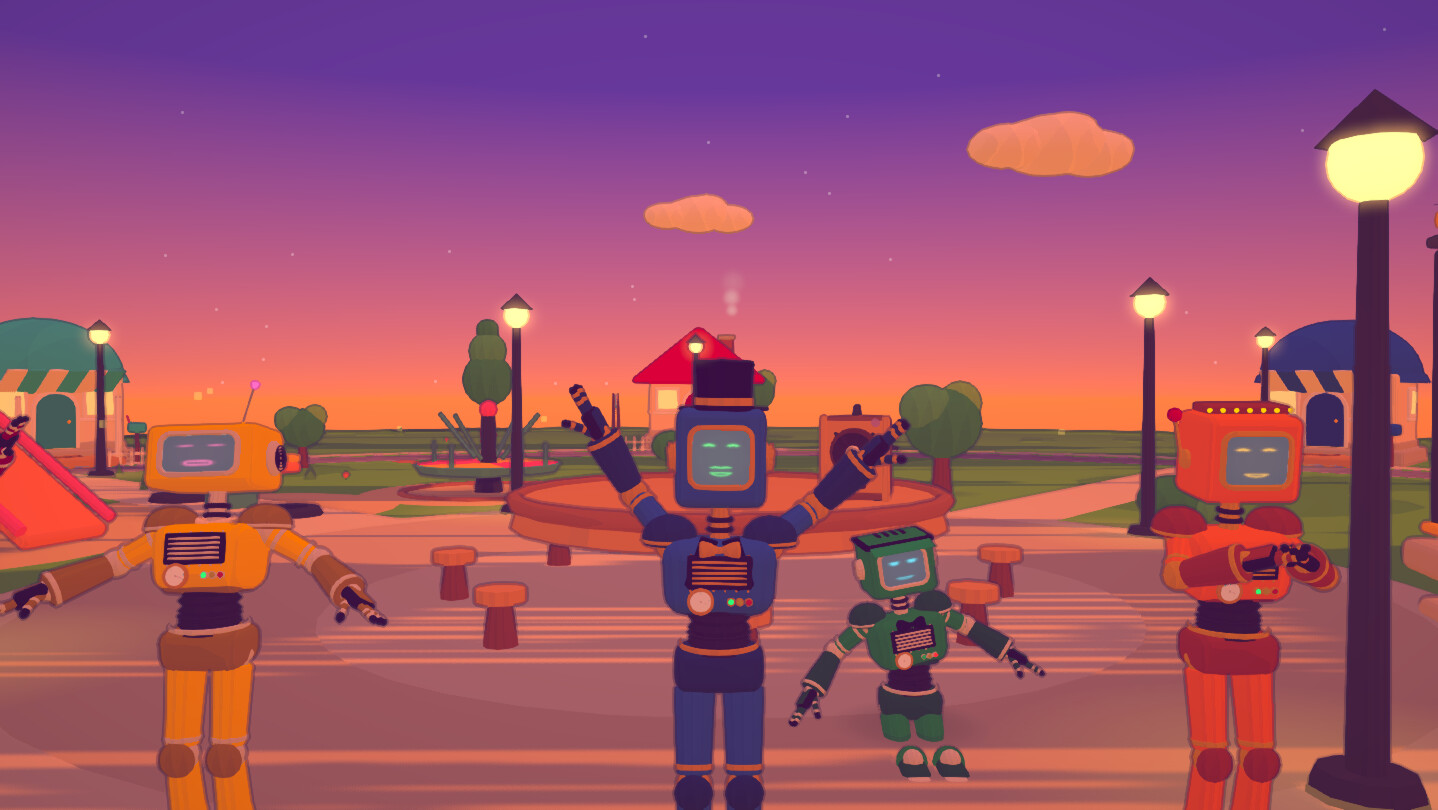
The neighbors are twelve automata: enamelled tin robots with a screen for a face, each with their own head and hat, painted in their player’s color. They walk like wind-up toys, sit on a stool at the plaza table, point at the accused with the whole arm and talk with their screens — the mouth is the wave of your voice. (Prefer the classic beans? They’re in Options.)

Every match opens with the whole table watching the neighborhood from the sky together, each neighbor's name lighting up over their house. Then comes a card only you can see: citizen or impostor — and if you're an impostor, who your accomplices are and how many of you sit at the table.

Say anything. Prove nothing.


On your turn your robot walks itself across the street to the plaza table, climbs up and takes the microphone — only then does your 50-second clock start. You play a card face down and declare what it is. That declaration can be a complete lie. If nobody challenges you, the effect happens anyway — invented or not.

But if someone slams the LIAR! button within the next few seconds, the two of you draw revolvers in the middle of the plaza:

  • You lied? You take the shot, lose a heart, and your real card is revealed to everyone.
  • You told the truth? The accuser goes down instead — and your effect still happens.

Everyone sees which of your two cards you spent, never what it was. The whole table can track your hand. That is entirely on purpose.

The night belongs to the impostor


When the sun sets, everyone acts at the same time, in secret — and now the card is real, no bluffing allowed. You visit houses, shield neighbors, watch doorways, poison whoever went out to do harm, swap someone's whole hand in the dark. Except whoever sleeps in the cell: they spend the night behind bars, doing nothing.

And the Bomber buries one more bomb. Nobody sees where. Not even the other impostors. If he is the only impostor at the table, he may even stay home — and swear in the morning that it was a quiet night.

Come morning the rooster crows, the doors swing open, everyone steps outside together — and that is when you find out whose garden already held two bombs. The house swells, shudders and vanishes in a cartoon mushroom cloud, roof cartwheeling all the way to the plaza.

The doors tell what the night did


In the morning, the report says which doors opened — never where to, never what for. Then every neighbor gives an alibi: "I stayed home", "I went to Ana's", "I went to the casino" — or would rather not say. Swore you stayed home and your door opened? The notebook puts a ⚠ next to your name for the whole table to see. Found the soil in your garden dug up? A bomb went in there — and only you know.

And the doormats talk too: every house that had a visitor wakes up with mud at the door — one pair of footprints per person who came. How many, never who. Three swear they went to Ana's and there are only two prints? The math is off, and the notebook marks the house with a ⚠. A print nobody owns up to? Somebody went out and isn't saying.

The impostor has an answer up their sleeve: Cover Up hides one door from the Doors of the Night — their own or an accomplice's. The door vanishes from the report. The mud they left on a doormat doesn't.

The street remembers


Everything the table sees ends up in the Neighbourhood Notebook: who played what and on which day, who got caught lying and which card flipped, who slept in the cell, which house went up — and since which night it had been mined, on a crooked little sign stuck in the rubble. Nobody has to memorise twelve neighbors: open the notebook and line the day up against the night. It never writes down a secret. Those are still yours, to tell… or to make up.

Call LIAR! and get it right, and you win more than the shot: you cross the street, lean on the fence and search the liar's garden. Bomb or no bomb — only you know. The whole street watched you look.

And when a house blows up, nobody pays a thing: the street shuffles out in its pajamas and walks to the round table for the Assembly. Everyone votes for someone or for SKIP — and only a neighbor with more votes than SKIP and than anyone else dies. Sometimes the table fires. Sometimes it just shrugs — and the impostor heard every word.

When talking stops working, call the meeting


Eight coins stop the day cold. Everyone puffs into a little cloud and reappears at the round table in the plaza, under a dramatic sunset. Almost two minutes of open-voice argument, a quick vote — and whoever the table condemns loses EVERY life to a cartoon firing squad.

Then their role is revealed. Good luck explaining yourself if you got it wrong.

And at the end, the paper tells all


When the match ends, an extra edition of The Neighbourhood News goes out to everybody, living or dead: who was who, what each neighbor declared and what they really held, day by day and night by night, and the headline of the match. That bluff nobody caught? It's in print. With your name on it.

Seven cards, day and night — and a lot more in Advanced


Every card does one thing by day and something completely different at night. The card you burn bluffing in daylight is the one you cannot use for real after dark. In Advanced each one also has a STREET trick — some you trigger, some fire by themselves — and card answers card: every day play but the Citizen's can be RESPONDED to by one specific card. Two triangles to draw in your head, not a table to memorise.

  • Vigilante — sentences someone to the plaza cell by day and walks them in at nightfall, in front of everybody; poisons whoever slipped out to do harm at night; and out on the pavement runs the ROUND: reads a house's bombs, how many and from which night. Answers the Thief.
  • Protector — grants immunity by day; makes a house bomb-proof at night; and simply by sitting in your hand it seals the block: peeks at you, or at any Citizen or Investor beside you, fail in silence. Answers the Reckless.
  • Reckless — by day it is hot potato: the card he just played goes to you and a random one of yours comes back; by night he swaps entire hands — the street only learns that somebody swapped; and every so often a peek slips out of him that even he never sees. Answers the Investigator.
  • Investor — invests this round's coin to collect four later; heads to the casino at night and bets big; and the floor of that bet is how far he walked the neighborhood that day. Answers the Vigilante.
  • Investigator — peeks at one card by day; stakes out a house at night and sees everyone who walked in; and if somebody goes through his hand, he gets their NAME. Answers the Protector.
  • Thief — steals coins by day; sabotages someone at night, and their next play goes off at random targets without a soul noticing; and on the street he has the QUICK EYE: one drawn card out of a neighbor's hand. Answers the Investor.
  • Citizen — rests like a good neighbor and earns a coin. At night he serves lemonade on the porch to his honest visitors — and counts how many crept into the yard to do harm, without knowing who. He answers nobody and nobody answers him. The perfect bait: accuse a real Citizen and you lose a heart for nothing.

Classic or Advanced


Classic is the whole game without the street and the responses: the cards with their day and night, the bluff, the search, the notebook, the assembly and the paper, and nothing else. It is the way in. After five finished matches, Advanced opens up: the Spy, the street tricks and the responses. The host picks in the lobby — and the whole table plays what the host picked.

Your room, your street


Create a room and choose who gets in: Steam friends (they join from an invite or their friends list) or Code only (listed nowhere — only whoever has the code walks in). Everyone else picks Join with a code or accepts the Steam invite. No Steam? The room is hosted on your PC, and anyone on the same network joins with your IP and the code. There are no strangers here: every table is people you brought.

The studio's community lives on Discord , one click away on the title screen and in the menu.

Neighbors who think


The bots do not cheat: each one decides only from what its own seat can see — just like you. They remember what you swore, accuse with a reason, vote on suspicion, bluff at the rate of their role and drop a line in the chat now and then. Any of them might be the impostor. Want bots at your table? In your room, +1 bot seats one more neighbor and the × sends one home. A room with just you and the bots is a whole match — and hosted on this PC, it does not even need the internet.

Voice over Steam, the way a street talks


At a Classic table, the voice belongs to everyone: by day every living neighbor hears every other, from any corner of the street. In Advanced, the day’s voice is proximity: full next to your robot, fading with distance — walking off in pairs is whispering — and whoever is at the table speaks into the microphone to the whole street. At the meeting and the assembly, everyone hears everyone. At night, silence — except on the impostors’ line: with two or more alive, they plot among themselves, by voice and chat, and the city hears nothing. Voice travels over Steam's network through the host, who hands each line only to those allowed to hear it — nobody receives anybody's address. Your mic starts open. A microphone icon on screen always shows whether you are being heard, and Options lets you switch to push-to-talk, test and calibrate your mic and set each neighbor’s volume.

There is something to do out there


Twelve toys scattered down the street — a playground, a trampoline, a fire hydrant, a fallen bicycle — and a neon-lit casino on the corner, with a roulette wheel, a one-armed bandit and dice out on the pavement.

What's in the box


  • 4 to 12 players online: rooms for Steam friends or by code, Steam overlay invites — and local network play without Steam.
  • Bots at your table: one +1 bot per seat; a room with just you and the bots is a whole match, no internet needed when this PC hosts it.
  • Two games: Classic to start with, and Advanced with the street and the responses — unlocked after 5 matches.
  • In-game voice over Steam: the whole table by day in Classic, proximity in Advanced, global at the meetings, muted at night — except the impostors’ line. Push-to-talk optional, a mic icon always in view and per-neighbor volume.
  • Text chat with a separate channel for the dead — who see everything and may tell no one — and an emote wheel.
  • The Neighbourhood Notebook during the match and The Neighbourhood News at the end.
  • Full controller support, from the menu to the victory, with an on-screen keyboard — and it plays on Steam Deck through Proton.
  • Accessibility: interface size, colorblind mode, steady camera and adjustable screen shake, per-channel volume, remappable keys and fast animations.
  • Streamer mode: on your screen, the other players become "Neighbor 1, 2…" and the room code stays hidden — the first switch in Options.
  • 12 colors and 12 accessories unlocked by playing. No in-game purchases, ever.
  • 15 achievements, some more embarrassing than others.
  • A guided tutorial that introduces the seven cards and both games and shows the key for every step, freezing the game while you learn — plus a short course of its own for Advanced. The illustrated manual is one key away.
  • Eight languages — English, Brazilian Portuguese, Spanish (Spain and Latin America), French, German, Russian and Simplified Chinese — interface and subtitles, from day one.

One last thing


You will lie to your friends. They will lie to you. Somebody is going to blow up their own house by mistake — and the paper will put it on the front page.

That's the game.

AI Generated Content Disclosure

The developers describe how their game uses AI Generated Content like this:

We use generative AI to assist with writing and localizing the game's text. All art and audio are procedurally generated by our own code or sourced from CC0 libraries. No content is generated by AI in real time during gameplay.

System Requirements

    Minimum:
    • Requires a 64-bit processor and operating system
    • OS: Windows 10 64-bit
    • Processor: Intel Core i3-6100 / AMD Ryzen 3 1200
    • Memory: 4 GB RAM
    • Graphics: DirectX 11 integrated graphics (Intel HD Graphics 520 / AMD Radeon Vega 8), Low quality
    • DirectX: Version 11
    • Network: Broadband Internet connection
    • Storage: 1 GB available space
    • Sound Card: Any
    • Additional Notes: A room with bots works without internet when it is hosted on this PC. The game starts at the highest graphics quality and never lowers it by itself; if your PC struggles, it asks whether you want to lower it (you can change it in Options). Microphone optional, for voice chat.
    Recommended:
    • Requires a 64-bit processor and operating system
    • OS: Windows 10 / 11 64-bit
    • Processor: Intel Core i5-8400 / AMD Ryzen 5 2600
    • Memory: 8 GB RAM
    • Graphics: GeForce GTX 1050 / Radeon RX 560 or better
    • DirectX: Version 11
    • Network: Broadband Internet connection
    • Storage: 1 GB available space
    • Sound Card: Any
    • Additional Notes: A microphone and headphones — half the game is talking people into things.
Review Filters