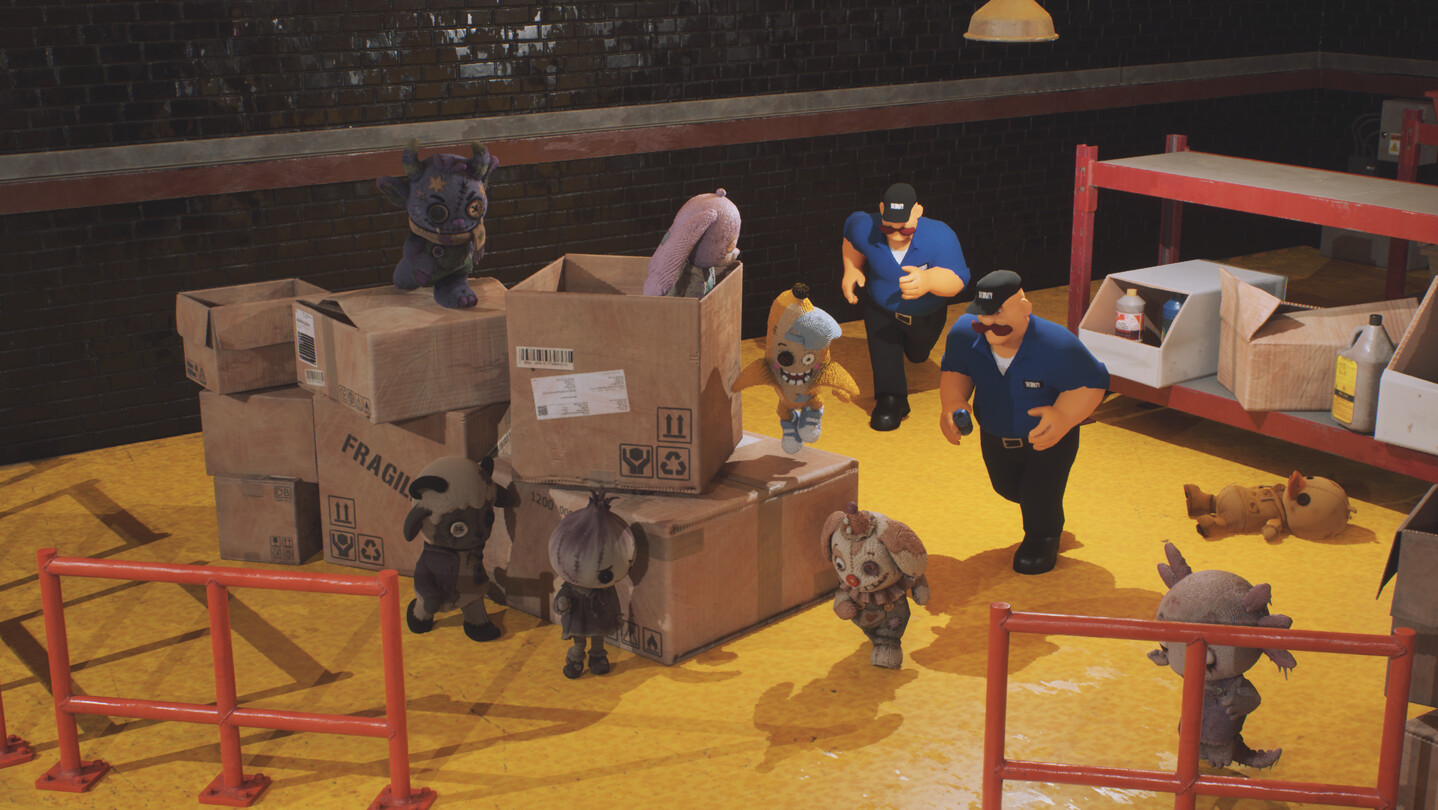


Hide in plain sight or hunt down the impostors in a chaotic toy store. Possess plush toys, mimic their behavior, sabotage the environment, and turn the crowd into your perfect cover — or play as Security and figure out which toys are only pretending to follow the program.

Sign in to add this item to your wishlist, follow it, or mark it as ignored

This game is not yet available on Steam

Planned Release Date: August 2026

Interested?
Add to your wishlist and get notified when it becomes available.
 

About This Game

Something is wrong with the toys.

Welcome to a next-generation toy store, where intelligent plush toys walk, dance, play, interact with visitors, and respond to the world around them.

Tonight, something has gone very wrong.

An emergency diagnostic has been triggered, sending every toy in the store through a series of unpredictable behavior tests.

But the malfunction isn't the real problem.

Something is hiding inside the toys.

And Security has only a few minutes to find it.

HIDE AMONG THE TOYS

As a Mimic, you can possess almost any plush toy in the store.

A bear.

A rabbit.

A walking banana.

An avocado with legs.

Whatever gives you the best chance of blending in.

The problem is that you aren't controlling an ordinary character.

You're pretending to be an AI-controlled toy.

During the emergency diagnostic, every toy follows changing behavioral programs. They may wander through the store, follow people, dance, interact with objects, gather in demonstration areas, play with other toys, or suddenly become completely idle.

Watch them.

Understand what they're doing.

And do your best to look like one of them.

Because somewhere nearby, Security is watching too.

BEHAVE LIKE YOU BELONG HERE

You don't know exactly what every toy is going to do.

You only know the current test protocol.

During a movement test, toys might wander toward different destinations.

During a social test, they may approach each other, wave, point, follow someone, pick up objects, or form small groups.

During a performance test, they might head toward one of the store's demonstration areas.

Your job isn't to perfectly reproduce a predetermined animation.

It's to understand the crowd well enough that your behavior doesn't look suspicious.

Walk somewhere strange.

React too late.

Stare at Security for too long.

Disappear behind a shelf at exactly the wrong moment.

And someone might start following you.

CREATE YOUR OWN COVER

Hiding isn't enough.

The longer the diagnostic runs, the more opportunities Security has to observe the toys and narrow down their suspects.

So change the situation.

The store is filled with systems and objects that affect how its toys behave.

Turn on a music system and nearby toys may start dancing.

Move an interactive object somewhere unexpected and watch toys gather around it.

Trigger a demonstration area.

Lead groups of toys through the store.

Create distractions.

Make normal toys behave suspiciously.

Instead of giving Mimics a list of scripted distractions, the environment is designed as a collection of simple systems that can interact with each other.

You're not choosing a distraction from a menu. You're creating one.

And because ordinary toys interact with many of the same systems on their own, Security can never be completely sure whether something strange was caused by a Mimic...

...or by a particularly stupid toy.

SABOTAGE THE STORE

Sometimes subtlety isn't enough.

Mimics can physically interfere with the store's systems to make Security's job considerably harder.

Disconnect a security camera and create a blind spot.

Damage the power system and plunge part of the store into emergency lighting.

Mess with the control system and trigger an inconvenient behavior test.

Activate speakers to disrupt the current toy behavior.

Move important objects.

Steal useful equipment.

Trigger distractions while another Mimic slips away unnoticed.

Every sabotage has a physical cause somewhere in the level.

And somebody has to go deal with it.

Which means every broken system is also an opportunity to make a Security player leave somewhere you don't want them to be.

SECURITY: FIND WHAT DOESN'T BELONG

Security has the opposite problem.

You know how the store is supposed to behave.

You just don't know which parts of what you're seeing are real.

Observe the toys.

Watch security cameras.

Investigate unusual behavior.

Respond to damaged systems.

Follow suspicious toys without immediately revealing your suspicion.

And coordinate with your partner.

One Security player might notice a camera suddenly go offline while the other heads across the store to investigate.

But that creates another question:

Was the broken camera the sabotage... or was getting you to leave the real sabotage?

DON'T JUST WATCH — TEST THEM

Security can also use the store itself.

Trigger toy behaviors.

Manipulate interactive objects.

Create situations that force nearby toys to react.

Watch how the crowd responds.

A Mimic might perfectly imitate a wandering toy when nobody is paying attention.

It's considerably harder when Security deliberately changes the situation and watches what happens next.

The same environment Mimics use to create confusion can therefore become a tool for exposing them.

TURN THE STORE INTO A PLAYGROUND

The store isn't just scenery.

Shelves create hiding places and obstruct sightlines.

Demonstration areas attract groups of toys.

Interactive displays change their behavior.

Objects can be carried around.

Things can be thrown.

Equipment can be stolen.

Systems can be broken.

And toys can end up doing things that nobody planned.

A Mimic might create a perfectly convincing distraction.

Or accidentally cause twelve plush bananas to gather around a Security guard while another player pelts him with toys from behind a shelf.

Both are valid strategies.

GET OUT OF THAT BODY

Being discovered doesn't necessarily mean you're finished.

Mimics aren't the toys themselves.

They are strange entities hiding inside them.

Abandon your compromised body and escape.

But outside a toy, you're exposed.

You have only a short time to find another body, possess it, and disappear back into the crowd before Security catches you.

That cute rabbit walking past the guard thirty seconds later?

Probably nothing.

Probably.

SURVIVE THE DIAGNOSTIC

Every match begins with a preparation period.

Mimics explore the store and choose their first bodies while Security familiarizes themselves with the environment and its systems.

Then the emergency diagnostic begins.

The toys activate.

Their behavior starts changing.

And the hunt begins.

Security must identify and capture every Mimic before the diagnostic ends.

Mimics only need one of their own to remain hidden.

If every Mimic is captured, Security successfully identifies the source of the malfunction.

If even one survives until the end...

The diagnostic concludes without identifying the cause.

The store returns to normal.

For now.

And Security has some explaining to do.

Key Features

Asymmetric multiplayer hide-and-seek — play as Mimics hiding inside toys or Security trying to expose them.

Possess plush toys — abandon compromised bodies and disappear into new ones.

AI crowds as camouflage — dozens of toys follow changing behavioral programs that players must learn to imitate.

Systemic distractions — manipulate objects and environmental systems to influence the behavior of surrounding toys.

Physical sabotage — disable cameras, interfere with power, activate equipment and force Security to respond.

Play with the crowd — create situations and strange emergent interactions instead of selecting predetermined distractions.

Investigate as Security — observe behavior, use cameras, respond to incidents and deliberately test suspicious toys.

Team deception — one Mimic can cause trouble while another uses the distraction to move or change bodies.

Physical comedy — throw objects, steal equipment, mess with Security and create ridiculous situations with the store's toys.

Short, chaotic matches — Security has limited time to identify every Mimic; a single survivor means the Mimics win.

System Requirements

    Minimum:
    • OS: Windows 10
    • Processor: 2-core / 4-thread CPU
    • Memory: 2 GB RAM
    • Graphics: GTX 1080ti
    • DirectX: Version 11
    • Storage: 2 GB available space
There are no reviews for this product

You can write your own review for this product to share your experience with the community. Use the area above the purchase buttons on this page to write your review.

Review Filters