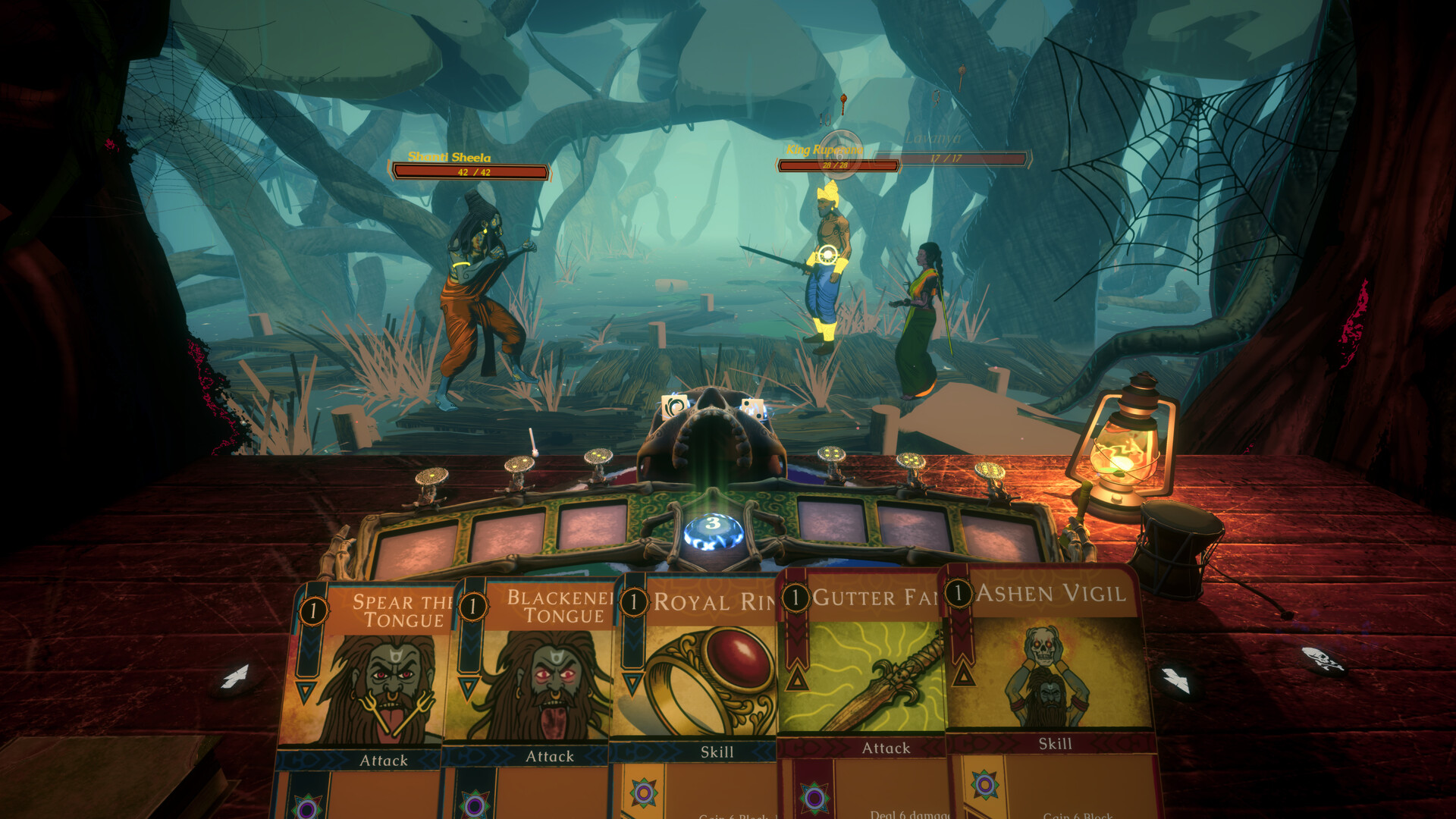



Krodha is a Dice + Deck + Slot-building roguelike rooted in the Indian legend of Vikram and Betaal. Draft your deck, slot cards into a board, roll the dice and piece together a mystery told by three "very" unreliable narrators.

Daftar masuk untuk menambah item ini ke senarai hajat anda, ikuti atau tandakannya sebagai diabaikan

Akan Datang ke Akses Awal

Pembangun permainan ini berhasrat untuk melancarkannya sebagai projek yang sedang berlangsung, dengan perkembangan dipengaruhi oleh maklum balas pemain.

Nota: Permainan dalam Akses Awal belum lengkap dan mungkin akan mengalami perubahan. Jika anda tidak berminat untuk bermain permainan ini dalam versi semasa, anda seharusnya menunggu untuk melihat jika permainan ini akan terus dibangunkan. Ketahui lebih lanjut

Kata-kata daripada pembangun:

Kenapa Akses Awal?

“Krodha is in Early Access because key parts of the game are still being designed and finalized, and we want players to meaningfully influence that outcome. The foundation is playable today, but several big decisions are still open during development, especially around:
Progression + meta systems: how runs evolve over time, how long-term unlocks work, and how the game rewards different playstyles.
Content shape and variety: what kinds of cards/relics/enemies we add next, how many routes/encounters a run should have, and what “good run pacing” feels like.
Difficulty philosophy: how punishing vs forgiving the game should be, how frequent build pivots are, and where the “fun challenge” line sits.
Narrative delivery and structure: how story events trigger, how much story appears per run, and what players find most engaging.
Early Access is a commitment for us to keep building the game alongside players, using community feedback to guide priorities and design choices not just polish”

Berapa lama permainan ini dijangka akan berada dalam Akses Awal?

“We expect Krodha to remain in Early Access for roughly 3-6 months.
This range is based on the amount of system design and content expansion we still plan to do (progression, balance, UX improvements, and additional game content), and we’ll update this estimate on the store page if it changes.”

Apakah perbezaan yang dirancang antara versi penuh dan versi Akses Awal?

“We plan for the final version to be a more complete and refined game, shaped by community feedback. Compared to Early Access, Final version is expected to have:
More content variety (additional cards/relics/enemies/encounters).
A more finalized progression structure and run pacing.
Refined difficulty and balance based on real player strategies and data.
Improved UX/readability/onboarding and overall stability/performance.
We’ll be transparent about what’s in the game at each stage, and we may adjust plans as we learn from feedback”

Bagaimanakah keadaan semasa versi Akses Awal?

“Krodha is playable now and includes the main run-based gameplay loop: combat runs built around deck-building and dice/slot mechanics, plus progression systems and story elements that are actively being expanded and refined during Early Access.
Players should expect balance changes, usability improvements, and content adjustments as we respond to feedback.”

Adakah harga permainan ini berbeza semasa dan selepas Akses Awal?

“We plan to increase the price when we leave Early Access, as the game expands with more content and reaches a final state. The Early Access price is intended to reflect the current amount of content, and early supporters get the best price for jumping in sooner.”

Bagaimana anda merancang untuk melibatkan Komuniti dalam proses pembangunan anda?

“We want the community to directly influence development priorities and parts of the game’s design. We’ll use:
Steam Community Hub (bugs, balance feedback, suggestions, discussions)
Discord (feedback channels, playtest threads, polls)

How feedback affects direction:
We’ll use reports, discussions, and play patterns to choose what to build next (content priorities), what to redesign (progression pacing, difficulty spikes), and what to tune (balance and run flow).
We’ll run community polls on selected design questions (for example: pacing preferences, difficulty expectations, UX priorities, and what content types players want more of).
We’ll publish patch notes explaining what changed and why, so players can see how feedback translates into updates.”
Baca lagi
Bahasa Bahasa Melayu tidak disokong

Produk ini tidak menyokong bahasa tempatan anda. Sila semak senarai bahasa yang disokong di bawah sebelum membuat pembelian

Permainan ini belum tersedia di Steam lagi

Tarikh Keluaran Dirancang: 2027

Berminat?
Tambah ke senarai hajat anda dan terima pemberitahuan apabila permainan sudah tersedia.
 
Lihat semua perbincangan

Laporkan pepijat dan tinggalkan maklum balas untuk permainan ini di papan perbincangan

Tentang Permainan Ini

  • Cards first. 96 cards across five elements. Each has unique symbol and number triggers. Draft them, fuse them, sacrifice them. Where you place them on the board affects how they interact — position matters as much as the card itself. Reshape your slot layout as your deck develops, or lock into a formation that stops working the moment the run changes shape.

  • Then the dice. Roll to match symbol or number and trigger effects. Rig a die to lock in one element and guarantee the trigger, but that die is now committed. It won't cover what your next card needs. Every roll is a small resource decision with compounding consequences.

  • You choose two elements. Build your deck around them. A third enters anyway, through curses and encounters, not choices.

  • Dosha cards (curses), enter your deck mid-run through encounters. They clog your hand and break synergies. Most element pairs can't remove them. You work around them or you lose to them.

  • Enemies signal their moves before they take them. The further you descend, the more it costs to misread one.

  • Ten element pairs. Each one produces a different deck, different dice priorities, a different Dosha problem.

  • The map shifts every run. Layout, enemy pool, and available rewards all change based on how deep you go, not just how many times you've played.

  • 24 milestone relics sit across the map. Collecting them changes what spawns below. Enemy types, difficulty, endgame content. Where you go has consequences further down than you can currently see.

  • The three narrators track run history. Their dialogue changes based on what you've answered before and how far you've gone. Later runs surface things that reframe what happened in earlier ones.

Krodha is built on the Vikram & Betaal tales, a Sanskrit folklore cycle over two thousand years old.

  • A king is cursed to carry a corpse (Betaal) through a haunted forest. The corpse tells stories, asks a question at the end of each one, and escapes if the king answers correctly. The king retrieves him and it starts again.

  • Betaal rides with you as a narrator. He holds information about your character's past that your character doesn't have. Three other figures run through the story. A king whose history overlaps with yours, a celestial observer, and a sorcerer who built the situation you're in.

  • The full picture is spread across runs, not handed to you in one.

  • 96 cards across five elements, Agni, Jal, Vayu, Prithvi, Akasha, each with unique symbol and number triggers

    • Draw from your evolving deck each turn and manage a limited hand of elemental cards

    • Played Cards move to your discard pile, but they have to be recovered using the pipe

    • Your hand size is limited, forcing tough choices about what to play now versus save for later

    • Your dice rolls determine how many card effects you can trigger each round

  • Elemental dice with commitment: rig a die to guarantee one element, at the cost of flexibility for the rest of the roll

  • Positional board: placement affects card interactions; slot layout can be rebuilt across a run

  • Dosha cards: curses that enter through encounters, disrupt synergies, and can't be removed by most element pairs

  • Enemy intent system: telegraphed actions that scale with depth and punish overextension

  • 24-fruit milestone system: relics that modify enemy pool, difficulty, and endgame content as you collect them

  • Shifting map: layout, encounters, and rewards change every run

  • Mirror dialogue system: three narrators with run-persistent memory; dialogue tracks your answers across sessions

  • Rooted in the Vikram & Betaal tales: structure and characters drawn from a Sanskrit folklore cycle

Pendedahan Kandungan Dihasilkan AI

Pembangun menerangkan cara permainan mereka menggunakan Kandungan Dihasilkan AI seperti berikut:

During the development period, AI generated concept art was used to speed up our process.

Keperluan Sistem

    Minimum:
    • OS: Windows 10 (64-bit)
    • Pemproses: Intel Core i5-4460 / AMD FX-8350
    • Memori: 8 GB RAM
    • Grafik: NVIDIA GeForce GTX 960 (4 GB) / AMD Radeon R9 380 (4 GB)
    • DirectX: Versi 11
    • Storan: 8 GB ruang tersedia
    • Kad Bunyi: DirectX compatible
    Dicadangkan:
    • OS: Windows 10/11 (64-bit)
    • Pemproses: Intel Core i5-10400 / AMD Ryzen 5 3600
    • Memori: 16 GB RAM
    • Grafik: NVIDIA GeForce GTX 1660 / AMD Radeon RX 5600 XT (6 GB)
    • DirectX: Versi 12
    • Storan: 12 GB ruang tersedia
    • Kad Bunyi: DirectX compatible
Tiada ulasan untuk produk ini

Anda boleh menulis ulasan anda untuk produk ini untuk berkongsi pengalaman anda dengan komuniti. Untuk menulis ulasan anda, gunakan kawasan di atas butang pembelian pada halaman ini.

Penapis Ulasan