

Keep, feed and breed jumping spiders. A 120-trait genome inherits the way genes actually do -- dominant, recessive, carriers -- and six species cross into hybrids, so a line you breed for is a line you can keep. Level up, play the arcade, and let your favourite live on your desktop.

Sign in to add this item to your wishlist, follow it, or mark it as ignored

This game is not yet available on Steam

Planned Release Date: October 2026

Interested?
Add to your wishlist and get notified when it becomes available.
 

About This Game

A jumping spider is not a houseplant

Feed them. Mist them. Notice when one stops eating, because that is what a spider does in the days before a moult -- and a moult is when it is most fragile. Bring it through, and it comes out a size larger, one instar further along, sometimes down a leg it will spend the next few moults regrowing.

Your first spiders are Phidippus imaginarius -- a fictional jumping spider kept exactly like the real Phidippus regius -- rendered at the size it actually is, doing what it actually does.

The genome does real work

120 traits across colour, morph, markings, chelicerae and behaviour, inherited the way genes are: dominant and recessive alleles, carriers that show you nothing, and lines that take generations to fix.

  • 14 base colours, 40 primary morphs, 25 marking patterns, 15 chelicera types

  • 10 special traits and 16 compound traits that only appear when the parts line up

  • Head masks and leg colour are inherited too, so a line can be bred for its face

  • Draw your own marking on the abdomen, the head and the legs: it is a pattern in the spider's own colours, it breeds true, and the line gets a name

  • The Genetic Lab edits genes with orbs: every change is real and heritable, and some leave a hidden carrier instead of a visible trait

Nothing here is a cosmetic roll dressed up as genetics. A rare morph is rare because the alleles for it are, and because somebody bred for it.

Six species, and what happens when you cross them

Five more species wait behind your levels: fabulosus, somniorum, mirabilis, ficticius and phantasma. Every spider carries its lineage, every sling inherits a share of both parents', and each of the fifteen possible crosses has a colour tell that only its hybrids show.

  • The pairing preview tells you before you commit: the slings' species mix, whether they will show a hybrid tell, and how big the clutch should be

  • A clutch hatches and you keep three. Choosing which three is the point

  • Keeper level rises as you raise spiders through their moults; Breeder level as you lay, hatch and keep clutches. Both unlock a founder female of a new species

There is a whole yard out there

  • Expeditions -- send a spider out to hunt, and decide when to walk back before something bigger finds it

  • CritterList -- sell rare lines to other keepers, put a male up at stud, or shop by species for the hybrid you are missing

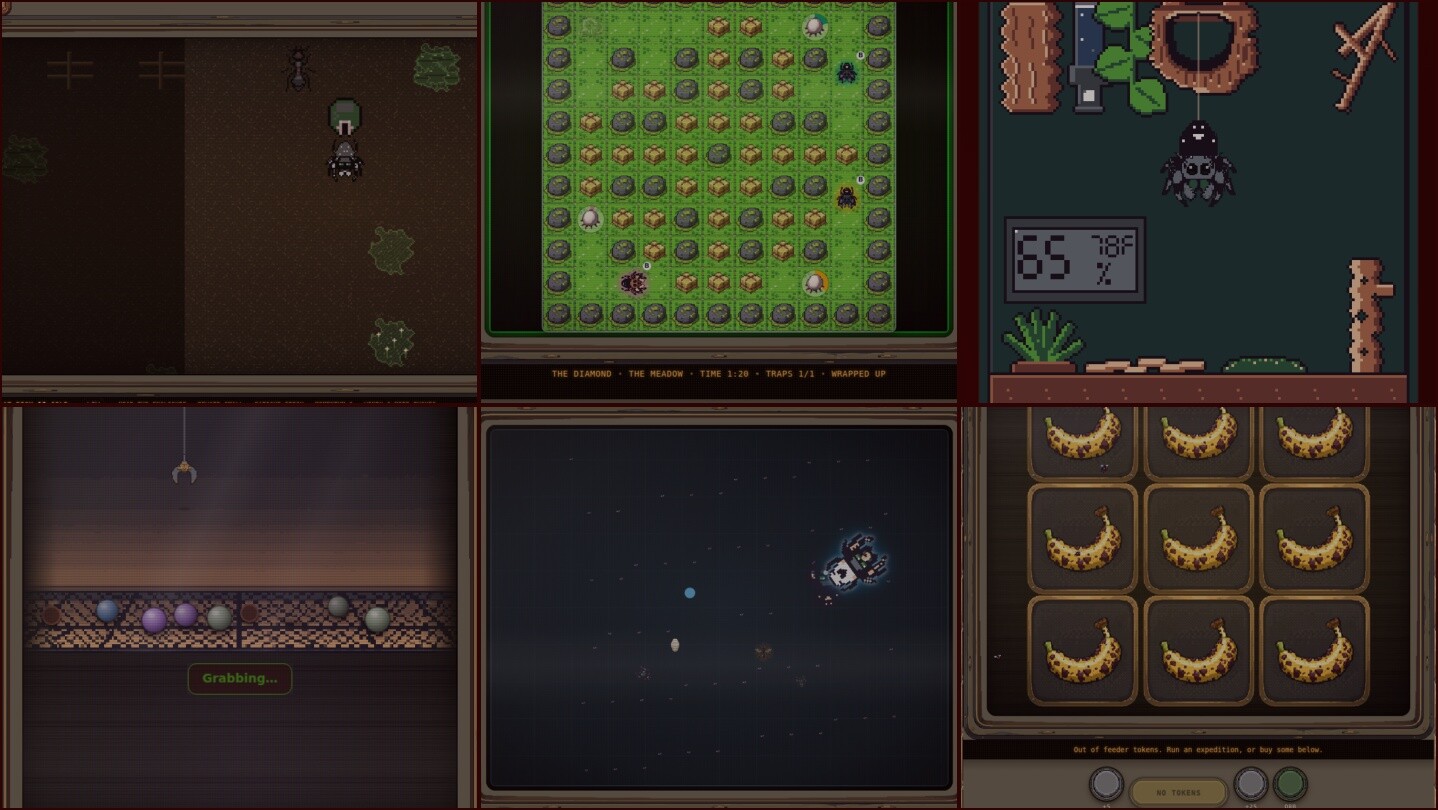
  • Trapline -- live, four keepers, one board

  • The Nursery -- live: eat, grow, moult, pounce, on a floor of living prey drawn to real size -- fruit flies, house flies, crickets, mealworms, and one roach a match for whoever is big enough. Every moult is a level-up, with a stat point and one of sixteen genetics to pick that changes how your spider plays and how it looks, so everyone in the arena can read your build

One of them can come and live on your desktop

Pick a spider and turn it on: it hangs from its dragline on your Windows desktop, climbs back up, wanders down to the clock and back, and moults in its cocoon there just as it does in the enclosure -- because it is the same spider, drawn from its own genome. Free, optional, and off until you switch it on.

And an arcade, for when you have had enough husbandry

Feeder Drop, The Manipulator, Feeder Frenzy, Specimen Scratch and the Genetics Draft -- five cabinets on the floor, each one paying out in things a keeper actually needs.

AI Generated Content Disclosure

The developers describe how their game uses AI Generated Content like this:

Salticidae Story uses pre-generated, AI-assisted art. The spider sprites were first drawn with an AI pixel-art tool (PixelLab), and their idle, walk, groom and threat animations with an AI animation tool (PixMiniMax); each was then checked and adjusted by the developer. Some arcade mini-game art and some store-page and icon art were made the same way. The genetics, the game design and the remaining art are made by the developer. Nothing is generated by AI while you play, and the game never connects to an AI service.

System Requirements

Windows
SteamOS + Linux
    Minimum:
    • Requires a 64-bit processor and operating system
    • OS: Windows 10 (64-bit) or Windows 11
    • Processor: Dual-core 2.0 GHz
    • Memory: 4 GB RAM
    • Graphics: Any graphics device with hardware-accelerated 2D (integrated graphics is fine)
    • Network: Broadband Internet connection
    • Storage: 200 MB available space
    • Additional Notes: Internet connection required: the game runs on a server and nothing is stored locally. Requires the Microsoft Edge WebView2 Runtime (built into Windows 11 and current Windows 10; free from Microsoft if missing).
    Recommended:
    • Requires a 64-bit processor and operating system
    Minimum:
      Recommended:
      Review Filters