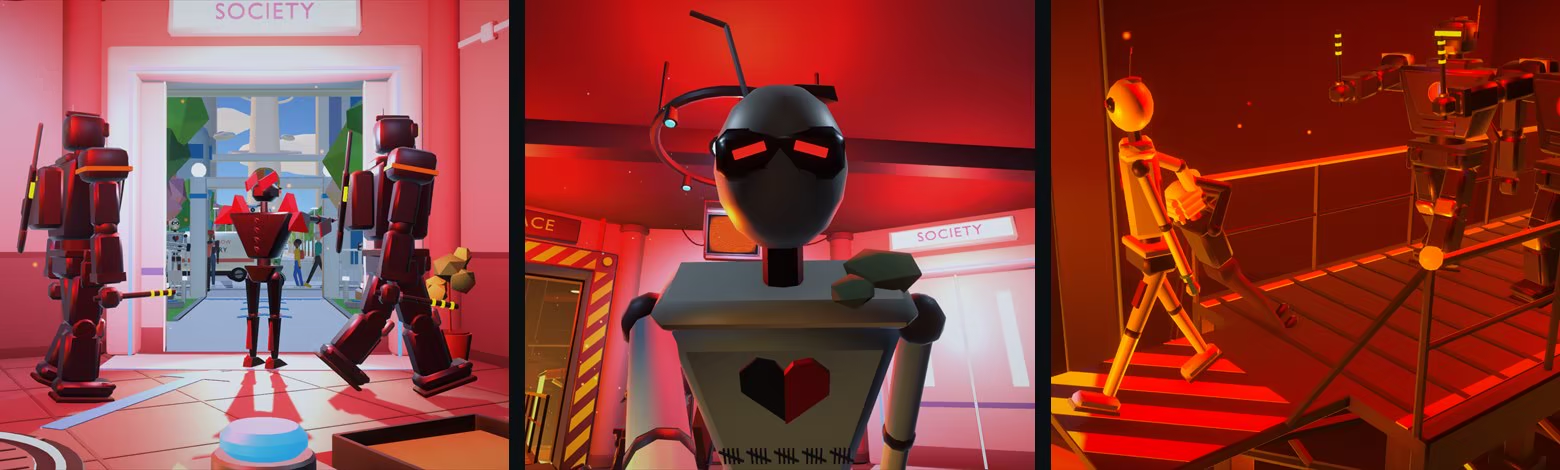

Read the case files, interrogate the robots, and decide their fate: back to society, or into the furnace. Your verdicts genuinely shape how the city develops — and watch out for the robots who refuse to jump.

Sign in to add this item to your wishlist, follow it, or mark it as ignored

Free Demo

Play The Last Interview: Into the Furnace Demo

Check out the full game


About This Demo

In 2050, robots take on more and more social roles and are deeply woven into human society. In theory, a robot can keep running forever as long as it is repaired and upgraded. But as models change and technology advances, some robots lose their repair value; even dismantling and recycling them costs more than it saves. So people choose to melt them straight down into steel in a furnace. But who decides whether a robot lives or dies? That is why the office of Robot Judge was created.

The law requires the Judge to be a real human: you, the Interviewer at the Bureau of Robot Affairs. Robots are brought to your desk one at a time. You read the file, you ask your questions, and you decide. The door on the right returns a unit to society. The door on the left goes to the furnace.

Read the file. It will not give you the answer.

Every unit arrives with a case file: its service record, the condition of its hardware, the diagnostic notes, the requirements it meets and the ones it fails, and who — or what — is waiting for it at the gate. Some files are spotless, and the details will still worry you. Some are damning, and yet this robot is the only one in the city who can do its job. The file tells you what is true. It does not tell you what is right.

Fifteen units. Fifteen arguments.

The demo includes fifteen playable cases.

A labourer eleven years past its service life. A carer with a seven-year-old waiting at the gate. A stray built from scrap, with a bucket for a head and no registration at all. A toy nobody plays with any more. A sergeant, a chef, a painter who has never sold a painting, and a machine in perfect working order that tells you, politely, what it is for — each with a full personality and history. Each one stands on the pad, makes its statement and answers what you ask. For some of them, it may be the last interview they ever have.

Hold the button.

A verdict is not a click. You hold the button down until it takes, and until it does you can still let go. Once the verdict takes, you see the effect your decision has on the robot and on the fate of the city.

Right is society.

Approve a unit and the right-hand door opens on daylight: the release path, the gate, the city going about its morning, and whoever came to wait. Sometimes that is a child with a balloon and a dog. Sometimes it is an old foreman who said he would be there. Sometimes nobody came, and the unit goes out alone to find out what the street has for it.

Left is the furnace.

Reject a unit and the other door opens instead: a gantry over the foundry pool, a handrail that stops short of the end, and a plank. Some walk it without a word. Some stop at the threshold and ask you to think again — or you can just give the robot a kick to speed things up.

You do not have to stay in the chair.

Stand up. Walk the room. Follow a unit through whichever door your verdict opened and see for yourself where it leads: down the gantry in the heat, or out along the path to the fence where the families wait. If that is the kind of Interviewer you turn out to be, you can hurry a unit along with your boot. Nobody will stop you from watching. But don't go too far — the confidentiality agreement does not allow you to stray far from your post during working hours.

Tomorrow's broadcast will say what today did.

Every morning the television reports on the city, and the city is what you made of it. Burn the harbour's strongest labourer and the cranes slow down. Release a unit nobody could vouch for and find out how it spent the night. Industry, science, care, culture and order rise and fall with your stamp, and the news tells you what your verdicts caused. People respond to your judgment, and your decisions truly shape the city's fate.

The Director is watching you too.

You are in that chair because a law says there has to be a real human here. Your Director does not agree with that law — paying a person's salary bothers him a great deal. Midweek he comes down to share those views.

Not every unit goes quietly.

Most robots walk where you send them. But not all of them.

Key features

A desk, two doors and a file. Read each unit's dossier, hear its statement, put your own questions to it, and hold down a verdict that cannot be taken back.
Every case, each its own argument. There are no correct answers to find, only what you can live with.
Leave the chair. Explore the interview room, the foundry gantry and the release path on foot, and follow any unit through the door you opened for it.
A city that answers back. A morning broadcast and a five-part city index show what your verdicts did; the city changes with your decisions and affects the story.
When it goes wrong, it goes wrong fast. Special scenes have extra interactions.
Your own file. At the end of the demo the Bureau issues the Interviewer's performance review: every verdict, every file you did not read, and what the city made of you. Save it as an image and share it.
The Last Interview: Into the Furnace Demo is a playable demo of a first-person narrative game about judgment. This demo contains four playable days, fifteen cases and several interactive scenes; the full version will offer much more.

AI Generated Content Disclosure

The developers describe how their game uses AI Generated Content like this:

This game was developed with AI assistance under the developer's direction and aesthetic, used for asset generation and development such as multilingual localization; no AI runs during gameplay.

System Requirements

    Minimum:
    • OS: Win10
    • Processor: 2-core / 4-thread CPU
    • Memory: 4 GB RAM
    • Graphics: NVIDIA GTX 1050ti
    • Storage: 4 GB available space
    Recommended:
    • OS: Windows (64-bit) 10
    • Processor: i5 7600K / Ryzen 5 2600x
    • Memory: 8 GB RAM
    • Graphics: NVIDIA GTX 1060 3GB
    • Storage: 8 GB available space