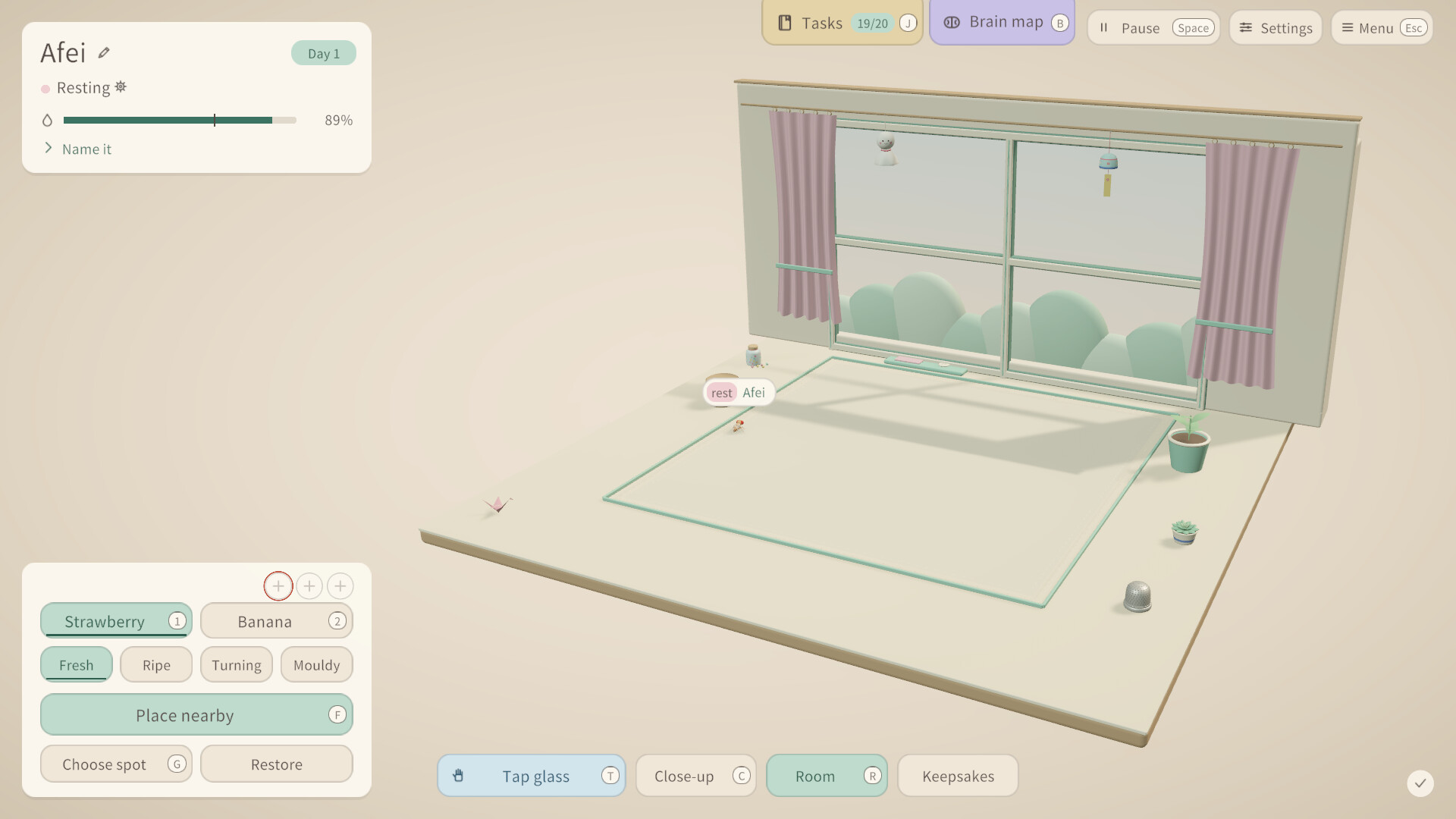


A fruit fly in a glass box on a windowsill. Place fruit, tap the glass and watch it walk, eat and fly, across 20 tasks. Its brain is a simplified model built from the published wiring map of a fly's central nervous system. Program assists are labelled. See the model fire on the brain map.

Sign in to add this item to your wishlist, follow it, or mark it as ignored

Coming Soon To Early Access

The developers of this game intend to release as a work in progress, developing with the feedback of players.

Note: Games in Early Access are not complete and may or may not change further. If you are not excited to play this game in its current state, then you should wait to see if the game progresses further in development. Learn more

What the developers have to say:

Why Early Access?

“AFEI is playable now, but the model and the game are still growing. So far it has been tested on one laptop, so reports from other PCs matter a lot. We are also looking for feedback on what is unclear and which experiments to add next.”

Approximately how long will this game be in Early Access?

“About 6 to 12 months. This is an estimate, not a promise.”

How is the full version planned to differ from the Early Access version?

“We plan to keep improving along these lines. They are directions, not promises, and may change: model time closer to real time; a desktop mode (a small window that stays on top); more tasks and experiments; more detailed behaviour; full controller support; testing on more PCs and graphics cards. Wiring in the compound eyes is a research goal we will explore, but it may not be possible.”

What is the current state of the Early Access version?

“Playable: one fly in a glass box with three scenes (windowsill; veranda and night windowsill unlocked through tasks); up to three fruits (strawberry and banana, four ripeness stages); tapping the glass; a brain map with whole-CNS, brain and smell-path views; 20 tasks with cards and a full clear, then free play; a records page; music and sound; Traditional Chinese, Simplified Chinese, English and Japanese (Simplified Chinese is converted from the Traditional Chinese; Japanese is an AI-assisted translation). Windows only. Tested on one Windows 11 laptop with an NVIDIA RTX 4070 Laptop GPU; other hardware is untested. Model time runs slower than real time. Expect bugs.”

Will the game be priced differently during and after Early Access?

“No. The price will not go up at full release. If you buy during Early Access, you will not pay again for the full version.”

How are you planning on involving the Community in your development process?

“Through the Steam Community Hub discussions and update notes. For bug reports, use Copy diagnostics on the game's About & credits page (it removes your Windows user name). Ideas for new experiments are welcome.”
Read more
This game is not yet available on Steam

Planned Release Date: Nov 10, 2026

This game plans to unlock in approximately 2 weeks

Interested?
Add to your wishlist and get notified when it becomes available.
 

Report bugs and leave feedback for this game on the discussion boards

See all discussions

About This Game

One fruit fly. A brain model you can watch.

AFEI is a quiet observation game. One fruit fly lives in a glass box on a windowsill. You set up small experiments, then watch what the model and the physics body do.

What you do

  • Place fruit. Up to three pieces: strawberry or banana, from fresh to mouldy, close to the fly or far away. Fruit ripens in real time.
  • Tap the glass. Code sends a synthetic looming signal to the fly's looming-detector neurons; the model's take-off neurons decide whether it takes off; the jump and flight are assisted.
  • Open the brain map. Show the whole central nervous system, the brain, or the smell path. Fibres are drawn from measured neuron shapes (simplified); the glow is the model's firing at that moment.
  • Look closely. Orbit, zoom and follow the fly, and give it a name.
  • Complete 20 tasks. From "Watch it eat" to "Weaker fruit reached first". Each task gives a card with one sentence on what the model does and what the code does. Finish all 20 for a full clear, then keep watching as long as you like.

The science, plainly

Afei's brain is a leaky integrate-and-fire (LIF) model of all 165,122 neurons and about 25.6 million neuron-to-neuron connections in the Male CNS v1.0 connectome, the published wiring map of one male fruit fly's brain and nerve cord. It runs on your PC in 1 ms steps. The body is the NeuroMechFly physics model, running in MuJoCo. The model receives smell, taste, leg contact and, when you tap, a looming signal. It cannot see (the eyes are not wired in yet) and it does not learn. All neurons share one parameter set, and whether a connection excites or inhibits comes from the dataset's machine-learning predictions of each neuron's transmitter. Much of the behaviour is assisted by code, and the game marks each assist. Among them: half of the walking drive, the flight itself, turning toward fruit, extending the proboscis, grooming, the walk/rest rhythm, wall-following, and a stronger smell input when it is hungry. Model time runs slower than real time: about half to nine-tenths of real time on the tested laptop. This is a computational model with simplifications and engineering assists. It is not a recording of a real brain, and it is not a complete fly.

No way to fail

The fly does not die and tasks never expire. The model pauses while the game is closed; fruit keeps ripening in real time. Rewards (keepsakes and scenes) are for you and never change the model.

AI assistance: code, images, text, music and sound effects were made with the help of AI tools and reviewed by the developer. The Japanese text is an AI-assisted translation, not yet checked by a native speaker. The Simplified Chinese text is converted from the Traditional Chinese by a rule-based converter (OpenCC) with a term list drafted with AI assistance, not yet checked by a mainland reader. Afei's brain is a simulation of a connectome, not generative AI.

Features

  • A simplified brain model built from the published Male CNS connectome, computed on your PC in 1 ms steps
  • A physics body with six legs, gravity and contact (NeuroMechFly in MuJoCo)
  • A cartoon fly; leg shapes from the flybody model
  • Brain map with simplified neuron fibres, the model's current firing, and readouts: smell input left/right, taste, foot contact, neural drive left/right
  • Up to 3 fruits, 2 kinds x 4 ripeness stages; with one fruit out, its tag shows the smell-path neurons' current firing rate
  • 20 tasks (16 easy, 3 harder, 1 very hard), 20 cards and a full clear; keepsakes and two more scenes (a veranda and a night windowsill) as gifts
  • Every engineering assist marked with an icon and a note; model time shown on the brain map
  • Original music and sound effects
  • Traditional Chinese, Simplified Chinese, English and Japanese, switchable in Settings (Simplified Chinese: converted from the Traditional Chinese; Japanese: AI-assisted translation)
  • Autosave; optional background mode in windowed play

Real data, model and engineering assists

  • Real data: neuron shapes and connections from the published Male CNS connectome; transmitter types are the data authors' machine-learning predictions.
  • Model: Afei's brain is a simplified LIF model; its body runs on NeuroMechFly and MuJoCo physics. On-screen numbers are model output, not recordings. It is not a real brain and not a complete fly.
  • Engineering assists: the walking rhythm, steering toward fruit, the grooming and rest schedule, and the take-off and flight assists are program code, and the game labels each one.

Data and tools

Neural wiring and neuron shapes: Male CNS v1.0 connectome (FlyEM at HHMI Janelia, University of Cambridge, MRC Laboratory of Molecular Biology, Google Research), CC BY 4.0. Simplified for this game (signed weights for a LIF model, simplified skeletons and region meshes); the data creators do not endorse this game. Body: NeuroMechFly v2 / FlyGym (Apache 2.0) and the MuJoCo physics engine (DeepMind Technologies Limited, Apache 2.0). Leg shape from flybody (TuragaLab, Apache 2.0). Fonts: Noto Sans TC, SC and JP (SIL Open Font License 1.1). Made with Unity.

AI Generated Content Disclosure

The developers describe how their game uses AI Generated Content like this:

Made with AI assistance and reviewed by the developer:
- Code: written with AI coding assistants.
- Visuals: the room, props and interface are built by code written with AI assistance. The app icon and loading portrait are AI-generated: they were made with ChatGPT image generation (OpenAI) from text prompts, using a render of the in-game fly as the character reference and a fruit-fly photo for body proportions; the developer chose the images and did not edit them beyond cropping and resizing. The Steam app and shortcut icons are made from this app icon. Store capsules are in-game renders with Noto Sans TC Bold lettering; no AI image generator was used.
- The fly's head and body are a textured 3D model generated with Tripo AI (image-to-3D) from an AI-generated concept image (ChatGPT image generation, OpenAI) that the developer chose, then reshaped and cleaned up by scripts written with AI assistance to fit the game's physics; its legs, wings, mouthparts and scarf are the game's own (the scarf's shape follows the concept image; the legs are shaped after the open-source flybody model, Apache 2.0, not AI-generated).
- Music and sound: scores and a small synthesiser program written with AI assistance. No AI audio generator and no samples were used.
- Text: Traditional Chinese and English text in the game and on this store page written with AI assistance. The Japanese text is an AI translation, not yet checked by a native speaker; the game says so. Simplified Chinese is converted from the Traditional Chinese by a rule-based converter (OpenCC) with a term list drafted with AI assistance, reviewed by the developer; not yet checked by a mainland reader.

Nothing is generated by AI while you play. The fly is driven by a simulation of 165,122 model neurons wired from real fruit-fly connectome data, a physics body, and program assists that the game labels. Its wiring is fixed and it does not learn. It is not a chatbot or a generative AI.

System Requirements

    Minimum:
    • Requires a 64-bit processor and operating system
    • OS: Windows 11 64-bit (Windows 10 64-bit not yet tested)
    • Processor: 64-bit CPU with AVX2 (only Intel Core i7-14700HX tested)
    • Memory: 8 GB RAM
    • Graphics: DirectX 11 graphics card (only NVIDIA GeForce RTX 4070 Laptop GPU tested)
    • DirectX: Version 11
    • Storage: 1 GB available space
    • Additional Notes: Tested on one PC only. Other graphics cards, integrated graphics and Steam Deck are untested. Model time runs slower than real time (about 0.5–0.9× on the tested PC) and is slower on slower CPUs. No internet connection is needed to play.
    Recommended:
    • Requires a 64-bit processor and operating system
    • OS: Windows 11 64-bit
    • Processor: Intel Core i7-14700HX
    • Memory: 8 GB RAM
    • Graphics: NVIDIA GeForce RTX 4070 Laptop GPU
    • DirectX: Version 11
    • Storage: 1 GB available space
    • Additional Notes: The processor and graphics card above are the only ones tested so far. The test PC has 64 GB RAM; 8 GB is inferred from the measured use (about 1.5 GB), not tested.
Review Filters