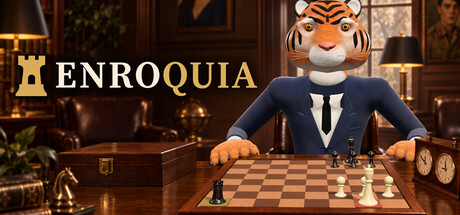

Chess in a 3D club room. James, your coach, tests you, gives you lessons, and comments on your games. The Academy adapts to your level and turns your mistakes into exercises. Twenty opponents move the pieces by hand and press the clock. In 13 languages, no account needed.

Sign in to add this item to your wishlist, follow it, or mark it as ignored

This game is not yet available on Steam

Planned Release Date: Oct 27, 2026

This game plans to unlock in approximately 2 weeks

Interested?
Add to your wishlist and get notified when it becomes available.
 

About This Game

Every game teaches you

ENROQUIA is chess for learning by playing. You sit in a 3D club room, facing an opponent who moves the pieces by hand. When the game ends, you know what happened and what you need to train.

James, your coach

James welcomes you the first time you open the game.
  • Placement exam. Twelve positions of increasing difficulty, each with its own time limit. It tells you where to start in the Academy and which opponent suits you. If you stop halfway, you pick up where you left off. And you can retake it whenever you like.
  • Diplomas. One for each tier of the Academy, in three parts: positions without hints, a time attack, and a 30-move game against the matching opponent. Pass all three and James awards you the bronze, silver, or gold diploma, which you keep in Trophies.
  • Lessons. Before training a concept, you can ask him for a lesson in three steps: look at the position, the move, and why it works. He draws the shape of the idea, like the fan of a double attack or the line of a pin, and in the 3D room he points to the square with his hand.
  • Report and review. When the game ends, he tells you what happened and what to train. In Review, he comments on the moments that decided it, and if you can't see why one of your moves made the game worse, ask him to “Prove it”: he plays the reply against you, and if he can't prove it, he takes the comment back.
  • Throughout ENROQUIA. He shows you around the room in the Guide, in seven steps. He explains the idea behind 34 opening families. And he introduces each round of the competitions.
James talks to you in the language you choose: in his own voice for his regular lines, and in text for anything that depends on your game. If you'd rather play without his voice, or without him, you can turn either off in Settings.

An Academy at your level

  • 17 concepts in three tiers (elementary, intermediate, and advanced), from “Hanging piece” to “Won endgame thrown away”.
  • More than 1,100 training positions, plus the ones from your own games. Your mistakes become exercises with the exact position where you went wrong, and they come back through spaced review.
  • Sets start at the level your placement exam gave you, get harder when you get them right, and easier when you miss. If you prefer, you can make them easier, harder, or random.
  • Position of the day, which gets harder from Monday to Sunday, Tactics time attack, and “Retry what you missed”.
  • Your days in a row practicing, plus the only moves you found and the ones that got away. Nothing gets locked if you skip a day.
  • Solitaire. Capture until only one piece is left: ten levels that teach you how the pieces move, one piece at a time, with hints.
  • Collect the stars. Just one piece and a few stars: land on every one of them in as few moves as you can. Eight levels, and a rating of one to three stars depending on how close you come to the shortest path.

Opponents that tell you how they play

Seven levels, from Apprentice to Full strength. Each card tells you how the opponent plays (“Only sees the next move. Often hangs pieces.”) and how many moves pass between its blunders. Those figures come from measured test games.
The weak opponent is weak because it doesn't see far ahead, and when it's losing, it doesn't fall apart. After six games against one level, if you clearly beat it or it clearly beats you, the game suggests moving up or down.
Each level has its own opponents, and James can sit in at any level. Every opponent remembers you: when you pick one, it tells you where you stand against each other, how your last game ended, and the mistake you repeat most against it. And you can win up to three crowns from each one: the fewer assists you use, the more you get.

A 3D club room

A table, a box of pieces, and an analog clock. At the start, the pieces come out of the box and set themselves up. If you're in a hurry, you can skip it.
Across from you sits one of twenty opponents: Bruno the bear, Bao the panda, Furia the bull, Rajah the tiger, Memo the elephant, Ocho the octopus… They think, pick up the piece by hand, carry it to its square, and press the clock. The button goes down exactly when the hand touches it and the other one pops up, just like on a mechanical clock. And they react to what happens in the game.
Five views, zoom, and full screen, or the flat board if you prefer. Fourteen 3D board finishes and twenty-four flat boards, some for younger players and others you earn by mastering concepts; three tournament piece sets, and lighting that can follow the time on your computer if you like. You can play with your opponent seated at the table or with no one across from you, and draw your arrows and circles in 3D too. And if you like, put an image of your own in the background, behind the whole game.

The living paintings

Two portraits hang on the wall: Queen Celsa and Colonel Carlos. Every now and then they glance at each other, wink, smile, or make some small gesture. They also follow the game. When you win, the Queen smiles and the Colonel winks. After your best move, they both look at the board. The Colonel concentrates when you're in check, and the Queen grows thoughtful if you take your time. Hover over them to find out who they are.
They never move while you're dragging a piece or in “Serious game”, and they can be turned off.
And on the board, if you look closely, a piece now and then comes to life for a moment: the pawn breathes, the knight glances sideways, the king sways. No gesture says anything about the game, and these can be turned off too.

A clock that behaves like a real one

From one-minute games up to 90-minute tournament games with a second time control, with Fischer increment, Bronstein delay, or simple delay. Automatic or manual: in manual mode, you press your own button. Your clock doesn't start running until your first move.

Understanding the game

While you play, after each move a sentence tells you what has changed on the board. It only states what the position proves and never tells you what to play.
When the game ends, the review tells the story of the game in its own way: how the game went, from Winning to Losing, the decisive moments you solved, and, for every move, what it did to the game, from “Holds” to “Sinks the game”. It opens on the move that sank it, with the reply that punishes it shown in red. Moves from the opening book, more than 7,800 positions, are marked “Theory” and aren't judged, and the last one tells you that's where theory ends. You can see how long you thought about each move, and the winning position you had comes back as “Now win it”, so you can play it until you win. From Review, you go straight to training what went wrong.

Chess960

Turn it on in Play: one of the 960 starting positions at random, or the one you pick by number. You castle by moving the king onto its rook, on the flat board and in the 3D room, where the pieces come out of the box already lined up on the back rank. The game can be saved, resumed, reviewed, and exported. It keeps its own record and doesn't count toward your progress.

Competitions and trophies

A Club League played over matchdays, round-robin championships in four divisions, with a career across seasons where the top two move up a division and the bottom two go down, and a Tactics time attack. What you achieve goes into a 3D Trophy room: cups, medals, plaques, your diplomas, and the portraits of the opponents you've beaten. Every item stands for something you've done.

For streamers

ENROQUIA doesn't just let people watch you play: it gives you the tools to stream.
  • Streaming mode: the 3D board always takes up the same rectangle of the window, with your name shown to viewers and large clocks.
  • Below the board, the evaluation bar and the last move's step, with the delay you choose (0 to 30 seconds) so you can talk about the move before it's revealed.
  • Session scoreboard, an 8-second video clip of the last move (in 3D), a vertical video of the whole game for Shorts, Reels, or TikTok, and a break countdown.
  • Commentator whiteboard on the flat board: freehand strokes and highlighted areas that clear themselves on the next move.
  • A transparent page, served only on your own computer, to add as a browser source in OBS: board, clocks, names, evaluation, scoreboard, and the arrows you draw.

In your language

ENROQUIA is available in 13 languages: Spanish, English, Japanese, Korean, German, Polish, Turkish, Greek, Brazilian Portuguese, Italian, French, Russian, and Simplified Chinese. It starts in your system language, and you can change it in Settings.
You choose how moves are written: with figurines (a symbol for each piece) or with letters. Games you export always use English letters, the standard for the PGN format.

Accessibility

Menu and panel text at 115% or 130%, high contrast, a color-blind palette (also in the 3D room), large pieces and coordinates on the flat board, reduced or full motion, and separate volume controls for effects, alerts, and music. You can play by typing your moves on the keyboard, in Solitaire too, and ask what's on the board. To train your board vision, the flat board can go without coordinates, with the pieces semi-transparent or invisible.

Your computer, your games

No account. The game works offline: the only feature that goes online is the optional lookup of the exact result of an endgame with up to seven pieces, and only when you click the button. Your games and progress are saved on your computer, and you can export a backup. Import and export games (PGN) and positions (FEN), or set up your own in the position editor.

AI Generated Content Disclosure

The developers describe how their game uses AI Generated Content like this:

ENROQUIA uses generative AI for pre-made content included in the game; nothing is generated during play and the game does not connect to any AI service. Made with AI: the voice of James, the coach (an original synthetic voice that does not imitate any real person), the music, the club entrance video, the 3D props and textures, the paintings on the club walls, the character designs (the 20 opponents and James), the in-game text and its translations into 12 languages, and the promotional material. The chess engine and its analysis are the game's own, with no AI models, and James's comments on your games are chosen during play based on that analysis.

System Requirements

    Minimum:
    • Requires a 64-bit processor and operating system
    • OS: Windows 11 64-bit
    • Additional Notes: The 3D room requires a graphics card with WebGL 2 support. Without it, you can play on the flat board.
    Recommended:
    • Requires a 64-bit processor and operating system
Review Filters