

What’s left of golf when you take away the swing? Every decision. In the 1930s, as numbered irons arrive, you play golf on paper: a deck of clubs, a pair of dice, and a par to get under. Read the odds, plan for the miss. A turn-based roguelike where the rules come from golf itself.

Sign in to add this item to your wishlist, follow it, or mark it as ignored

This game is not yet available on Steam

Coming soon

Interested?
Add to your wishlist and get notified when it becomes available.
 

About This Game

Before a golf course is built, it is drawn, and before anyone plays it on grass, somebody plays it on paper. That somebody is you. A pair of dice stands in for the golfer, a deck of clubs for the bag, and the goal is the one golf has always had: finish as far under par as you can.

EVERY DECISION, NONE OF THE SWING

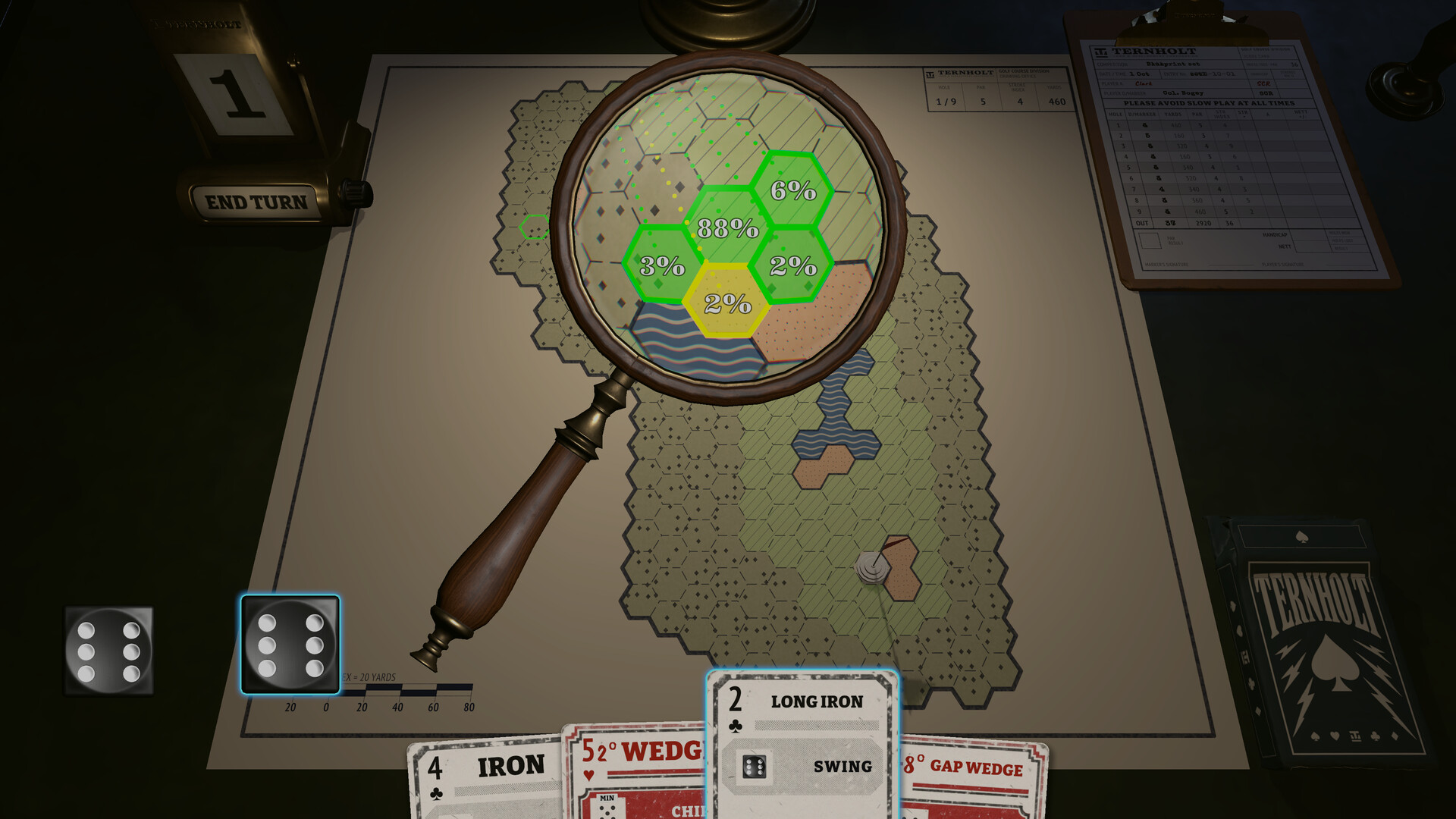
No swing meter, no timing, no test of reflexes. The dice say how far a clean shot goes, and you know it before the shot, which is more than any golfer can say. What to do with the number is between you and your bag: play it safe, or swing for more and pay for it in control, the way you would on grass. The blueprint shows where the ball can finish and the odds of each before you commit. Sand steals distance. Trees block your line. Water punishes optimism.

Golf is a game of misses, and whoever misses best wins. Par is measured, not declared, and nobody set it to make you fail. Getting better here means seeing more, not hitting harder.

A DECK OF CLUBS

It is the 1930s and hickory is on its way out. Steel shafts are legal at last, and steel can be made the same twice: irons come in matched sets, numbered instead of named, the mashie-niblick suddenly a seven. A club for every distance means twenty clubs in the bag, and the fourteen-club limit is on its way. Every season brings a new invention, and some of them get banned. The family tree of golf clubs has never been wider: legends, dead ends, and a few outlaws.

That tree is your deck, one card per club, and a bag holds only so many. Cover every distance and every lie, or carry a specialist and live with the gap. The same hole is a different puzzle with a different bag.

THE GOLDEN AGE, ON PAPER

The golden age gave golf its best holes and one idea behind them: a hole should ask a question, not hand out a punishment. A safe way round, a bold way over, and a bunker guarding the tempting line. The campaign brings twenty-seven of those holes to paper, drawn after the real ones. And the idea itself is built into the game: new holes are built on the same principles, so every weekly course and every run asks the same kind of question.

WORKING CONDITIONS

Golf on paper is desk work, and the desk is yours to set. Rain at night with the lamp on, a grey morning, a low sun across the blueprint: the light and the weather change with the days, or you pick the one you like and keep it. The radio plays low. You read the odds through a magnifying glass, mark the strokes in pencil, and count them on the desk calendar. The round ends with two signatures on the scorecard, yours and your marker's. Nothing here is on a clock.

CAMPAIGN, WEEKLY, RUNS

The campaign is three nines of golden-age holes, and your first day at the office teaches the method.

The weekly is a tournament: four rounds of nine, the same holes and the same dice for everyone, scored as a total against par on a leaderboard. A new one begins every Thursday. A friend who has already played it can be your marker. The filing cabinet goes back to 1920, and every week in it can be played.

A run starts with a phone call about the coming club limit, a handful of plain clubs, and a single die. Take it as far as your scores allow. Everything else you build on the way: a second die, a putter, stamps and strips of tape that turn a club into something no catalogue ever listed. The map is a model of the city in a crate that someone left in your office.

No spells, no monsters, no loot. A course on paper, a pair of dice, a bag you chose yourself, and a par to get under. The only magic is golf.

AI Generated Content Disclosure

The developers describe how their game uses AI Generated Content like this:

A few placeholder textures currently in the build (the city seen through the office window and its signs, and the sample sheets in the customization menu) were AI-generated and are scheduled to be replaced with licensed or hand-made art before release.

System Requirements

Windows
macOS
    Minimum:
    • Requires a 64-bit processor and operating system
    • OS: Windows 10 64-bit
    • Processor: 64-bit dual-core, 2.0 GHz or better
    • Memory: 4 GB RAM
    • Graphics: DirectX 11 capable GPU with 1 GB VRAM
    • DirectX: Version 11
    • Storage: 1 GB available space
    Recommended:
    • Requires a 64-bit processor and operating system
    Minimum:
    • OS: macOS 12 Monterey or later
    • Processor: Apple silicon or Intel Core i5
    • Memory: 4 GB RAM
    • Graphics: Metal-capable GPU
    • Storage: 1 GB available space
    Recommended:
    Review Filters