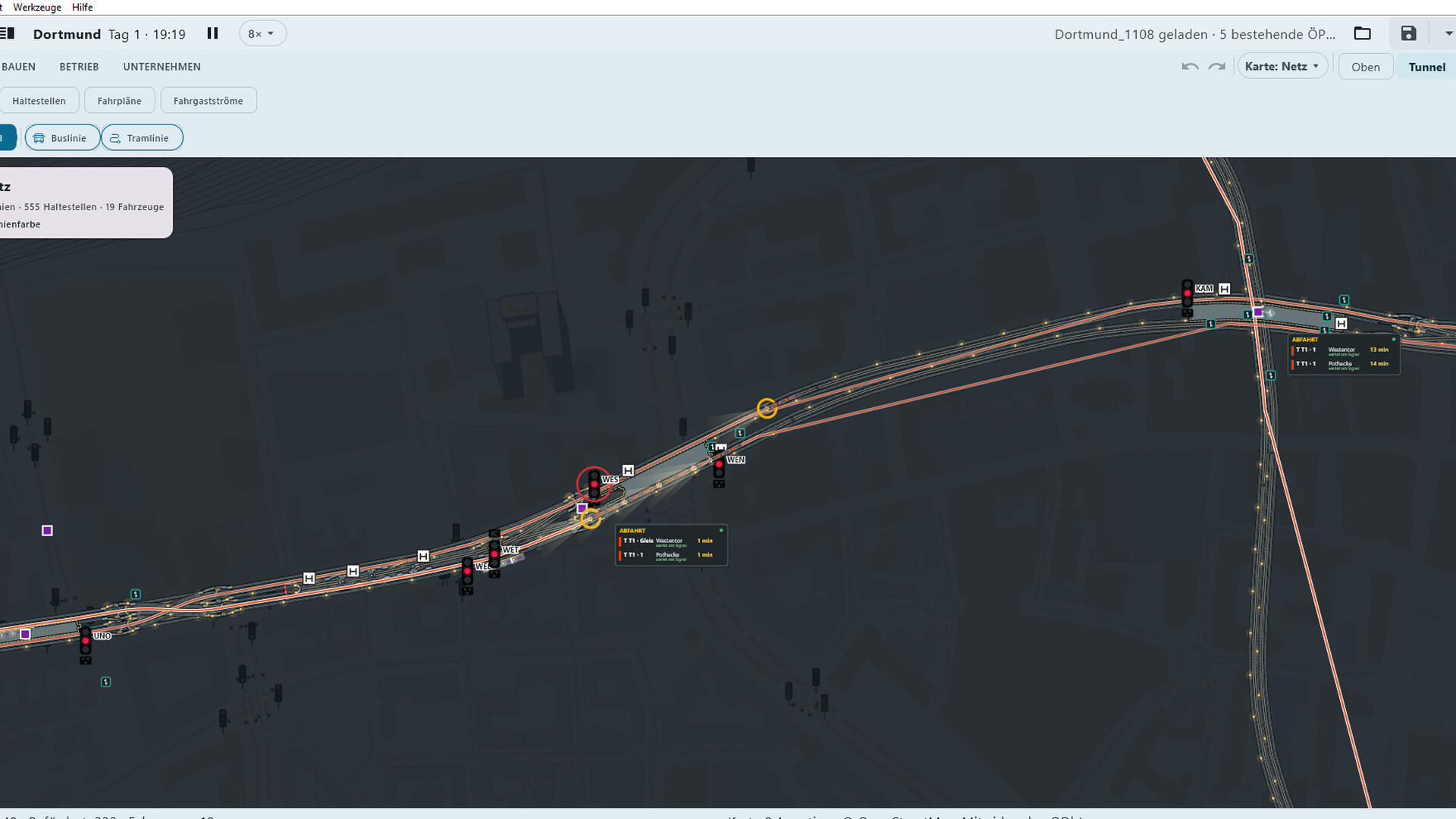

LineManager is a detailed public transport construction and operations simulation built on real-world maps. Plan bus and tram routes, build your own tracks, stops, tunnels and depots, and grow your network from its first section into a complex urban transport system.

Daftar masuk untuk menambah item ini ke senarai hajat anda, ikuti atau tandakannya sebagai diabaikan

Bahasa Bahasa Melayu tidak disokong

Produk ini tidak menyokong bahasa tempatan anda. Sila semak senarai bahasa yang disokong di bawah sebelum membuat pembelian

Permainan ini belum tersedia di Steam lagi

Akan datang

Berminat?
Tambah ke senarai hajat anda dan terima pemberitahuan apabila permainan sudah tersedia.
 

Tentang Permainan Ini

LineManager is a public transport construction and operations simulation built on real-world maps.
You do not simply draw a line on a map and watch what happens. You build the infrastructure, place stops and stations, plan routes and timetables, and make sure your network actually works in day-to-day operation.
You can keep things relatively simple – or dive deep into track geometry, signalling, routes and operational details.

Build your network on real-world maps

The game uses maps based on OpenStreetMap. Dortmund is included as a large playable region, alongside Riga Central and a separate test area for experimenting with track construction.

Roads, buildings, parks, waterways and existing transport infrastructure form the foundation of the map. Existing tram and light-rail tracks can partly be incorporated into your own network, while new routes can be built freely or along existing streets.

Single and double track, street-running sections, reserved track, switches, crossovers, sidings, turning loops and tunnels are all part of the standard toolkit. Curves, track direction and physical connections actually matter.

Buses and trams work differently

Bus routes use the existing road network and have to follow traffic directions, junctions, traffic lights and surrounding traffic.

Trams, on the other hand, operate on their own track network. You decide which tracks are used in which direction, where vehicles can turn around and which platform belongs to which route.

Shuttle services, circular routes, short workings and more complex termini are possible. If a connection does not work, LineManager does not simply ignore the problem – it shows you where the route is broken.

Timetables are more than just a frequency

For each route, you can define operating hours, service frequency and vehicle requirements. Peak extras, short workings and temporary frequency increases can be added as well.

Vehicles follow actual duties, including leaving the depot, operating scheduled trips, taking breaks, switching routes and returning to the depot later in the day.

You can move or cancel individual departures, assign vehicles manually and watch how delays and conflicts affect the rest of the operating day.

Passengers have somewhere to go

Demand is generated by residents, workplaces, education and retail, and changes depending on the time of day and day of the week.

Passengers have their own origin and destination. They wait, board, travel, transfer and can miss connections. Vehicle capacity, service frequency and route design therefore have a direct effect on how well your network performs.

Alongside current passenger numbers, you can also monitor forecasts, waiting times, loads and the accessibility of different areas.

Go deeper if you want to

LineManager can automate many operational tasks, but players who want more control can take over the signalling and protection of the network themselves.

The game includes block sections, routes, switch locking, opposing-movement protection, overlaps, flank protection and protection systems for single-track sections. Routes can be set automatically or manually.

Balises and different signal types are also part of the system. In the signalling panel, you can monitor occupied sections and understand why a vehicle is currently being held.

This level of detail is optional. You decide how much of it you want to handle yourself.

Depots, vehicles and workshops

Trams need suitable storage and turning facilities. Depots can contain several tracks, and their usable length genuinely determines how many vehicles can be stored there.

Both single-ended and bidirectional trams are supported, as well as multiple-unit formations. Vehicle length, platform length, capacity, speed and driving behaviour are taken into account.

Workshop tracks and maintenance capacity form the basis for a vehicle-management system that will continue to expand during development.

Traffic does not only exist on your tracks

Cars and trucks move through the city as well. Buses and street-running trams can be delayed by road traffic, while segregated track remains unaffected by congestion.

Traffic lights have their own phases and can be grouped together. Tram and bus signals can also be integrated into the control system.

External rail services, walking and cycling connections, and larger events can influence demand and overall traffic patterns.

Run a transport company

In the end, the network also has to make financial sense.

Fare revenue, subsidies, vehicle costs and staff costs all contribute to the operating result. LineManager also includes a simplified tax and finance system, along with staff, recruitment, qualifications, sickness and other operational factors.

An optional AI operator can develop its own routes, vehicles and strategies, acting either as a competitor or as a cooperative partner.

A simulation to experiment with and grow into

LineManager is designed as a sandbox. You can build a small, manageable network or take on a complex city with tunnels, depots, timetables and your own signalling systems.

Many systems can be automated or opened only when needed. Players who simply want to build and observe should be able to enjoy the game just as much as those who want to know why that signal still refuses to clear.

LineManager is currently in active development. Some areas – including the vehicle market, staff and duty planning, maintenance, construction costs, audio and mod support – are still being expanded. The interface, visuals and individual game systems may also change significantly during development.

Keperluan Sistem

    Minimum:
    • OS: Windows 10 64-bit
    • Pemproses: Intel Core i5-6500 / AMD Ryzen 3 1200 or equivalent
    • Memori: 8 GB RAM
    • Grafik: NVIDIA GeForce GTX 750 Ti / AMD Radeon RX 460 or equivalent
    • Storan: 2 GB ruang tersedia
    Dicadangkan:
    • OS: Windows 10/11 64-bit
    • Pemproses: Intel Core i5-10400 / AMD Ryzen 5 3600 or equivalent
    • Memori: 16 GB RAM
    • Grafik: NVIDIA GeForce GTX 1650 / AMD Radeon RX 570 or equivalent
    • DirectX: Versi 11
    • Storan: 2 GB ruang tersedia
Penapis Ulasan