
Build and operate public transport in a living traffic simulation. Plan tram and bus networks, schedules and depots while cars, traffic lights, passengers and infrastructure interact around you. Keep it simple – or dive deep into signalling and operations.

Connectez-vous pour ajouter cet article à votre liste de souhaits, le suivre ou l'ignorer

Français non disponible

Ce produit n'est pas disponible dans votre langue. Veuillez consulter la liste des langues disponibles ci-dessous avant de l'acheter.

Ce jeu n'est pas encore disponible sur Steam

Prochainement

Ce produit vous intéresse ? Ajoutez-le à votre liste de
souhaits et recevez une notification lors de sa sortie.
 

À propos de ce jeu

LineManager is a public transport building and operations simulation set in a living traffic world.

You do not simply draw a line on a map and watch vehicles follow it. You build infrastructure, create stops and depots, plan routes and timetables, and then have to make sure the network actually works during daily operation.

Trams, buses, cars and other road users share the same city. Traffic lights, road signs, congestion, stops and operational decisions affect each other.

You can keep LineManager relatively simple — or dive deep into track geometry, signalling, routes, vehicle duties and day-to-day operations.

A city where traffic is more than scenery

Road traffic in LineManager is part of the simulation.

Cars react to traffic lights, road signs, trams and emergency vehicles. Street-running trams and buses can be delayed by other traffic, while segregated infrastructure provides different operational advantages.

Vehicles can travel to operational destinations such as fuel stations or depots. Road signs can affect actual route planning, while traffic lights and public-transport signals influence how vehicles move through the city.

Delays and conflicts therefore do not have to exist only as abstract random events. They can emerge directly from what is happening on the street.

Build and operate transport on real-world map data

LineManager uses real geographic data as the foundation for its regions.

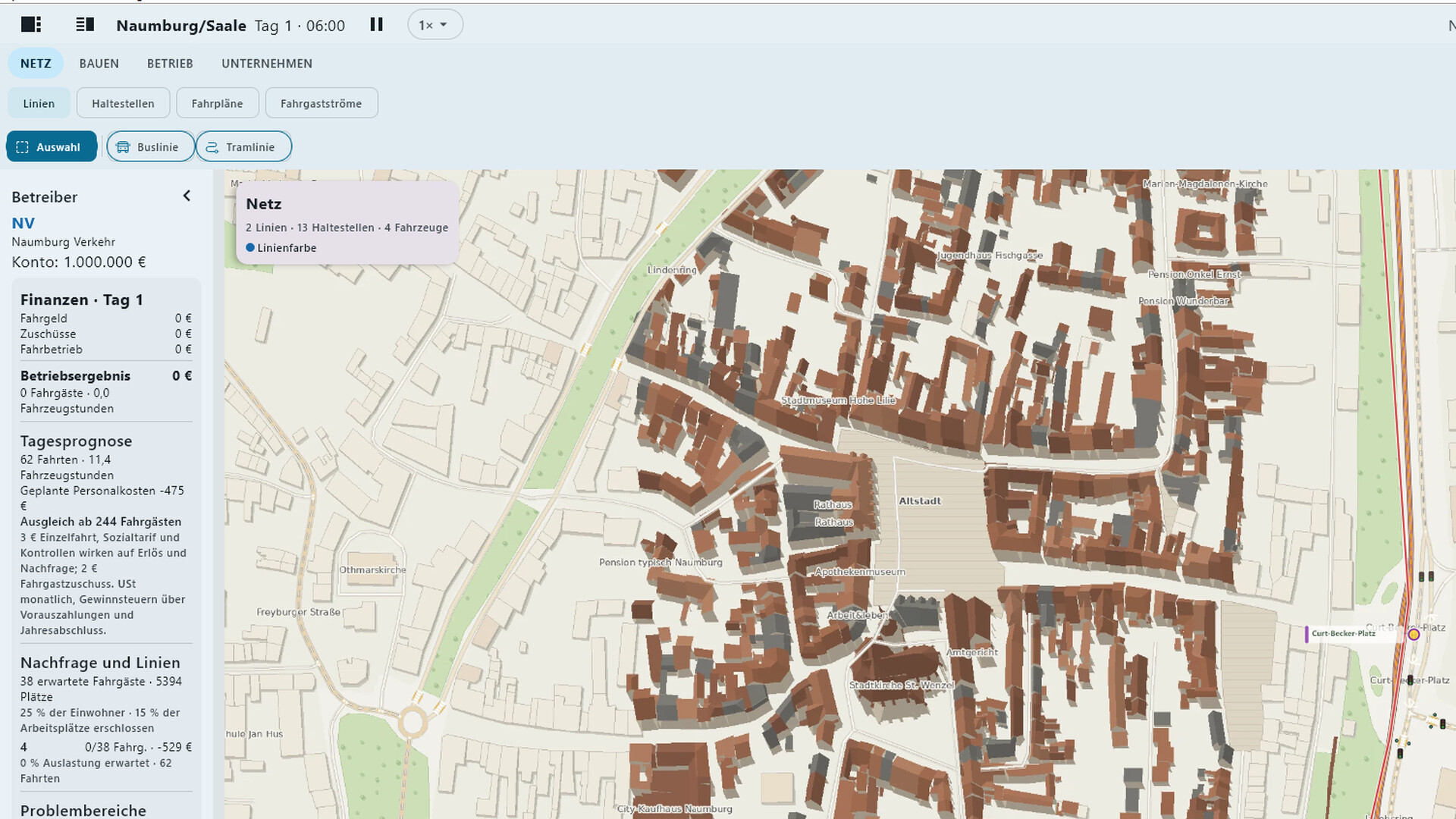
Naumburg (Saale) is currently the main development and demo region. Its compact network combines street-running tramways, segregated track, a depot, a main railway station and historically grown infrastructure within a relatively small area.

Roads, buildings, parks, water and existing transport infrastructure form the basis of the game world. Existing tracks can be incorporated into your network, while new routes can be built and extended.

Single track, double track, street running, reserved track, switches, crossovers, stub tracks, loops and tunnels are all part of the infrastructure toolkit.

Curves, directions of travel and actual track connectivity matter.

Buses and trams are different systems

Buses use the road network and have to deal with one-way streets, junctions, traffic lights and other vehicles.

Trams use their own track network, but may also operate directly within road traffic. You decide which tracks are used in which direction, where vehicles can turn around and which platforms belong to a route.

Shuttle services, circular routes, short workings and more complex terminal arrangements are possible.

If a connection does not work, LineManager is designed to show you why a vehicle cannot continue rather than simply ignoring the problem.

Timetables are more than a frequency setting

Routes have operating hours, service frequencies and vehicle requirements.

Vehicles run through actual duties with depot departures, revenue trips, breaks, possible route changes and eventual return to the depot.

You can follow individual trips, assign vehicles manually and see how delays influence the rest of the operating day.

Peak extras, short workings and time-dependent service patterns allow the network to change throughout the day.

Passengers have somewhere to go

Passengers are more than a number attached to a stop.

They have an origin and a destination. They wait for services, board vehicles, travel, transfer and may miss connections.

Frequency, vehicle capacity, route structure and delays therefore directly affect how well the network performs.

Stops and stations can show their current operational state, including waiting passengers, departures and transfers.

Depots are real places

Vehicles do not simply appear on a route.

Buses and trams can leave their depots, wait there and return later. Parking positions and tracks have physical locations and limited capacity.

For tram depots, usable track length and available movements determine which vehicles can be stored and moved through the facility.

Workshop and maintenance systems will continue to expand during development.

Go deeper if you want to

Many operational tasks can be automated.

Players who want more control can work directly with the signalling and protection of the network.

LineManager includes concepts such as block sections, routes, switch locking, opposing-movement protection, overlaps, flank protection and protected single-track sections.

Routes can be set automatically or manually. In the interlocking view, you can follow occupied sections and investigate why a vehicle is waiting or why a movement cannot be authorised.

This depth is optional. You decide how much of it you want to manage yourself.

Shape the world around the network

LineManager is also developing into a detailed world-building tool.

Road surfaces, lane markings, traffic signs, direction signs and city objects can increasingly be edited and placed directly inside the game.

Trees, benches, streetlights, stops, traffic signals, buildings and other objects can be used to turn an abstract map into a recognisable place.

Some of these editing tools are still under active development. Over time, players who enjoy detailed modelling and customisation are intended to receive considerably more freedom.

Build, observe and operate

You can manage a small, understandable network or work with more complex urban transport involving depots, timetables, road traffic and signalling systems.

LineManager is designed to support different ways of playing.

Someone who mainly wants to build and watch the network should be able to do that — just as someone else may want to know why the tram is waiting behind a car or why the signal refuses to clear.

Active development

LineManager is currently in active development.

Graphics, user interface, vehicle models and parts of the game world are still being revised.

Systems including maintenance, staff and duty planning, construction costs, audio, mod support and further simulation details will continue to expand.

Current screenshots and features represent a work in progress and may change significantly before release.

Configuration requise

    Minimale :
    • Système d'exploitation : Windows 10 64-bit
    • Processeur : Intel Core i5-6500 / AMD Ryzen 3 1200 or equivalent
    • Mémoire vive : 8 GB de mémoire
    • Graphiques : NVIDIA GeForce GTX 750 Ti / AMD Radeon RX 460 or equivalent
    • Espace disque : 2 GB d'espace disque disponible
    Recommandée :
    • Système d'exploitation : Windows 10/11 64-bit
    • Processeur : Intel Core i5-10400 / AMD Ryzen 5 3600 or equivalent
    • Mémoire vive : 16 GB de mémoire
    • Graphiques : NVIDIA GeForce GTX 1650 / AMD Radeon RX 570 or equivalent
    • DirectX : Version 11
    • Espace disque : 2 GB d'espace disque disponible
Filtres d'évaluations