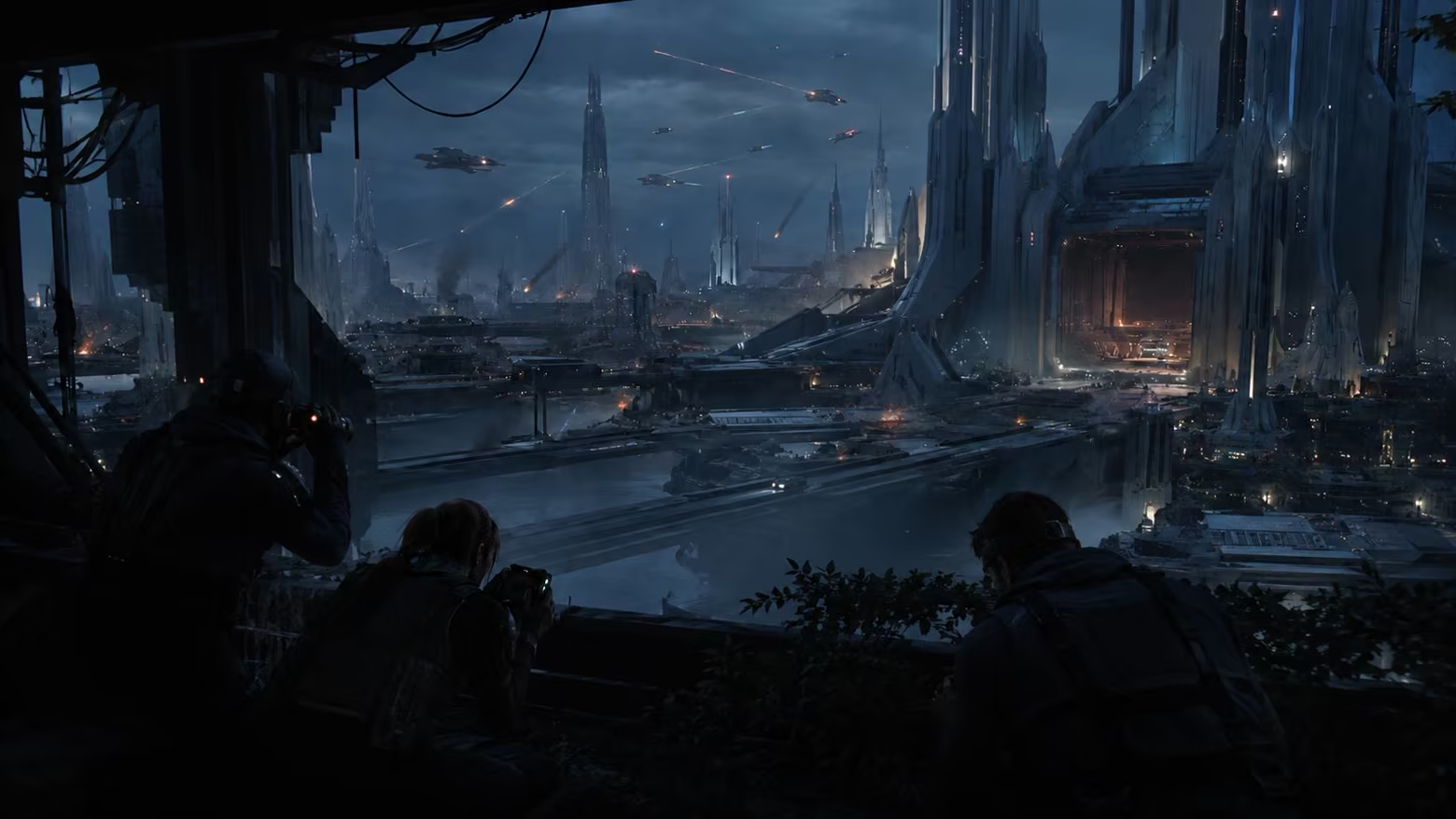

EXODUS: LIGHTS & SHADOWS is a story-driven science fiction action game featuring first- and third-person gameplay, exploration, tactical combat on foot, in vehicles and in space, and missions that let you choose your route, equipment and approach.

Sign in to add this item to your wishlist, follow it, or mark it as ignored

This game is not yet available on Steam

Planned Release Date: To be announced

Interested?
Add to your wishlist and get notified when it becomes available.
 

Kickstarter Campaign Information

EXODUS: LIGHTS & SHADOWS is currently in preparation. Visit our Kickstarter pre-launch page and follow the project to receive a notification when the main campaign begins.

About This Game

EXODUS: LIGHTS & SHADOWS is a story-driven sci-fi action game set in a vast universe shaped by conflict, mystery, alien worlds, and advanced technologies whose true significance unfolds as the story progresses.

You play from either a first-person or third-person perspective, freely adapting your approach to the situation. You fight with firearms and in close combat, make use of special weapons, equipment, vehicles, and advanced technologies, and in some missions also operate combat machines and airborne units.

Not every mission leads you along a single path. You can choose your route, decide how to approach the enemy, and select the equipment you take with you. At times, a direct assault may be the better option; in other situations, a sniper position, stealth, the environment, or an alternative route may give you the advantage. What you discover along the way can make later objectives easier to accomplish — while overlooking important equipment or information may mean finding a different way forward.

Combat in EXODUS demands more than accurate shooting. Before you react, it can often pay to read the situation, assess the threat, identify enemy positions, consider the available routes, and take stock of your own equipment. The right decision made before the first shot can matter more than reflexes alone.

A frontal assault will not always be the most effective answer. In some situations, it may be better to flank the enemy, make use of cover, reposition, work with your team, take advantage of a sniper position, use stealth, or rely on equipment suited to the situation. EXODUS is designed to reward reconnaissance, planning, and deliberate action, not just how quickly you can pull the trigger.

You explore abandoned cities, bases, technological complexes, ship interiors, underground installations, and alien environments. Along the way, you encounter different forms of life, robots, mechs, and enemies that call for different tactical approaches. Some parts of the story are fast-paced and spectacular, while others are much darker — built around tension, caution, and uncovering what happened before.

During the campaign, you make use of a range of vehicles — from futuristic ground machines to units capable of operating in the air and in space. Encounters involving them expand the scale of the gameplay, while heavy weaponry can cause serious damage to the surrounding environment.

As you progress, you gain access to additional types of weapons, sights, equipment, and devices. Before a mission, you choose your gear to suit your role and the situation, and the right selection can influence how you approach and complete the objective.

Moving through the world is not limited to following a set path. Depending on the location, you can climb, vault over obstacles, take different routes, and make use of your movement options and equipment to reach areas that suit the situation.

EXODUS: LIGHTS & SHADOWS combines action, exploration, storytelling, and freedom of approach. The campaign takes you through successive events within a larger story, but the way you reach your objectives, fight, and solve problems will not always be the same.

Golden Scarab Studio™ is formed by a small, highly experienced team of artists and creators with backgrounds in the game, film, VFX, CGI, and cinematics industries. The team brings together many years of experience, broad artistic and technical expertise, a passion for creation, and a shared ambition to build expansive, highly refined worlds and productions with a distinctive identity. The team members’ credits include work on well-known game titles such as The Witcher 3: Wild Hunt, Assassin’s Creed, Dying Light 2: Stay Human, Company of Heroes 3, Risen 3: Titan Lords, Nitro Nation, and Skyforge.

Their experience also includes major film and television productions, including Jurassic World: Fallen Kingdom and Lost in Space, as well as many years of work in VFX, CGI, post-production, supervising, and cinematics. The team combines experience in game development, 3D graphics, design, animation, visual effects, and cinematic visual storytelling. This range of expertise allows the project to be approached as a coherent whole — from its world, characters, and technology to gameplay, narrative, atmosphere, cinematics, and final visual presentation.

The history of Golden Scarab Studio™ grows directly out of the Golden Scarab (Złoty Skarabeusz) team that created EXODUS: THE LAST WAR for the Amiga. It was there that the foundations of the EXODUS Universe were established, together with the creative approach that is now being developed on a much larger scale.

EXODUS: LIGHTS & SHADOWS is our own production and part of the EXODUS Universe, whose origins go back to EXODUS: THE LAST WAR. After a break, the team returned to this world and began developing its new chapter. The project combines the team’s own creative vision with the experience its members have gained through numerous demanding productions. It is this combination of our history, experience, expertise, and full creative control that forms the foundation of EXODUS: LIGHTS & SHADOWS.

EXODUS: LIGHTS & SHADOWS continues the story and universe first introduced in EXODUS: THE LAST WAR, released for Amiga computers in 2000. At the heart of the EXODUS Universe is Mariusz Samson — its creator and author, founder of Złoty Skarabeusz (Golden Scarab), and the originator of both EXODUS: THE LAST WAR and EXODUS: LIGHTS & SHADOWS. For the original game, he developed the concept and game design, was responsible for the art direction, and single-handedly created all the graphics and animations.

For EXODUS: THE LAST WAR, Mariusz Samson also created the opening cinematic, based on a story he conceived that became the starting point for the further development of the EXODUS Universe. He subsequently developed this story together with Tomasz Witt — they worked on the original game's short story and narrative, expanding the initial concept into a broader story and the foundations of the EXODUS Universe being developed today in EXODUS: LIGHTS & SHADOWS.

EXODUS: THE LAST WAR received very high ratings — in a historical ranking based on Lemon Amiga data, it achieved an average score of 9.5/10, and 26 years later it still maintains a rating close to 8/10. EXODUS: LIGHTS & SHADOWS is not a remake, but the next chapter of the same story, expanding the world established by the original game many years earlier.

This time, you can take on the roles of different characters from the EXODUS Universe and experience its world directly through FPP/TPP gameplay. Epic battles, advanced technologies, alien worlds, and mysteries become part of events you experience firsthand — exploring vast locations, taking part in combat, and uncovering new layers of the story through the perspectives of its characters.

The main story campaign is being designed around cooperative gameplay. Missions will be built around several characters working together, allowing multiple players to progress through the campaign and experience the same story as a team. However, the game will not require players to connect with others — the entire campaign will be playable solo, with AI-controlled characters taking on the roles of the remaining squad members.

We also plan to develop extensive interactions with squad members. Players will be able to give them orders, exchange information, and respond together to changing situations on the battlefield. Our goal is to make cooperation with the squad a meaningful part of gameplay, rather than having AI companions simply follow the player automatically.

The project also includes plans for competitive PvP multiplayer and cross-platform play between players on different platforms.

The story you’ll discover here is only one part of the EXODUS Universe. The main story will continue, and over time, other stories may also emerge — set between its most important events and revealing other places, characters, encounters, discoveries, and conflicts within this universe.

Imagine a humanity that has long since moved beyond the borders of a single planetary system. People travel to other stars, establish colonies and research outposts, discover new worlds, and know they are not alone. They have encountered other intelligent civilizations. Some became their enemies; with others, they established contacts that eventually grew into cooperation and alliances. Space remains vast, but it is no longer entirely unknown.

And it is here, in the Antares system, while surveying one of its planets, that humans come across an abandoned settlement belonging to an unknown civilization. It is neither vast nor monumental. It looks more like an old colony or a remote outpost whose inhabitants left relatively recently. Buildings remain, along with devices of unclear purpose and something far more valuable — crystals containing recorded information.

Among the people trying to understand this discovery is Commander Sam Perkins. It is alongside him that you begin to uncover the history of the civilization to which the abandoned settlement belonged. Not through official contact or a face-to-face encounter, but through a record hidden in the crystals they found. Sam reads a translation of someone else’s memories — the story of a being who lived an unimaginably long time ago and witnessed the end of their own world.

The crystals’ contents are incomplete, the translation is imperfect, and many names and concepts remain unclear. But as more fragments emerge, the story of the entire civilization begins to take shape.

Its people discover that their planet has no future. A catastrophe is approaching, and nothing can stop it. Technology, armies, and politics won’t help. They can only decide what they can still save. So the entire civilization prepares for the greatest journey in its history. Ships, transports, and warships gather in orbit, ready to carry the inhabitants, their knowledge, equipment, and everything else that can still be salvaged from generations of achievement. You already know that when they leave, nothing may remain of the world they knew.

But escape alone won’t be enough. Their technology depends on ixomite — an extraordinarily important resource without which the journey onward and the survival of their entire civilization may prove impossible.

They know where to find it, but someone has got there before them. In the Samir system, on the planet Exodus, another powerful civilization is already established. But it is not alone. The planet is also home to its native inhabitants, caught between forces far more powerful than themselves.

And this is where a story about escaping annihilation begins to turn into something far more complicated: a struggle for survival, resources, and the chance to keep existing. Decisions emerge whose consequences may last for generations. And the more you learn, the harder it becomes to answer a simple question: who is the aggressor, who is the victim, and who is simply trying to save their own world?

But you discover this story only in fragments — just like Sam, who reads the recovered report and tries to separate fact from gaps, mistranslations, and uncertain interpretations.

You don’t know how many parts of the record have been lost, or whether the story really ends where the recovered memories break off. When Sam sets the report aside, you return with him to the present — to the people in the Antares system and the abandoned settlement where it all began. And one simple question remains: if the people who lived here survived those events in the distant past, where are they now?

From this point on, the EXODUS Universe begins to open up before you on a much larger scale. The abandoned settlement turns out to be just one clue. The more people learn about its former inhabitants and the Antares system, the clearer it becomes that they have discovered only a small part of something far greater.

One of the places that carries this story forward is Antares IV — a vast moon of the gas giant Abyssus, with an atmosphere, forests, water, and its own ecosystem.

From a distance, it may look almost peaceful. But here, people discover something entirely different from the small outpost they found earlier.

This time, they come across a vast city built by the same civilization.

Vast, monumental, and preserved in a way that raises more questions than it answers. It doesn’t look like a place razed by war. Its plazas, buildings, and entire sections of infrastructure seem more like something that has been silenced, as if this vast urban organism simply stopped functioning. But you soon begin to realize that not everything has truly gone dark.

Some devices still respond. Energy still flows through certain systems. Beneath the surface lie structures that could not be seen from the outside. The deeper people try to understand what they have found, the harder it becomes to treat Antares IV as an ordinary archaeological site.

Sometimes something activates just as someone approaches. Sometimes a signal appears that shouldn’t be there. Sometimes a remnant of an ancient civilization behaves not like a dead machine, but like a system that has been waiting for something all this time.

But before people can truly understand the city, they discover they’re not the only ones interested in Antares IV. They make contact with another alien civilization — one that knows the history of this place, knows far more than humans about its legacy, and makes it very clear that further exploration will have consequences.

You don’t yet know who these newcomers are, exactly what they want, or why they believe they have the right to decide what happens to this legacy. You only know they didn’t come here by chance, and that the situation has just become far more dangerous.

Then you discover something else. The city’s former inhabitants left behind not only safeguards, but also a test — a way to assess those who might one day reach this place and try to uncover its deeper secrets. The humans decide to take it. They must prove they haven’t come for weapons, power, or technology they simply want to seize.

They pass the test, and the system doesn’t reject them. It lets them proceed — only one step further, but far enough to make it clear that the creators of this place left open the possibility of contact with those they consider trustworthy.

But that doesn’t end the problem. The threat that appeared earlier begins to escalate. The humans don’t retreat or try to exploit the situation for themselves.

They side with those they find on Antares IV, helping them survive the threat and protect what remains of their world. Passing the test and the humans’ actions in the face of real danger are what change the relationship between the two sides.

For the humans, this is no longer just the trace of an ancient civilization, recorded in crystals and left behind in abandoned structures. They now stand before living beings with memories, fears, and a future of their own. And the others have a reason to trust the humans and let them come closer.

The events on Antares IV pave the way for a true alliance.

Over time, the two sides begin to build something that once seemed unlikely. Shared goals and outposts emerge, along with exchanges of knowledge and technologies born from combining two very different ways of thinking.

The alliance grows directly out of what happened on Antares IV — the tests they passed, the shared threat, and the decisions both sides made at the time. The years that follow give them a chance to develop and strengthen their relationship, and make it part of everyday life.

That doesn’t mean they become a single civilization. Humans remain human, and their allies retain their own history, experiences, and boundaries they aren’t always willing to let the other side cross. Disagreements arise, along with differences in how they approach technology, security, and responsibility for the decisions they make. Even so, they learn to live and work alongside one another.

One of the most important symbols of this new era is Teron, on Antares IV. The ancient city begins to thrive again, but in an entirely new way. Its old structures are restored to use, while human districts, hangars, laboratories, homes, and new infrastructure rise alongside them. The two civilizations don’t pretend to be the same. They learn to live together and make the most of what each does best.

Almost fifteen years pass. This period comes to be known as the Idyll. Not because every problem has disappeared, but because after the events that brought the two civilizations together, they have time to build something lasting. Teron grows, shared infrastructure expands, new defense systems and technologies emerge, and cooperation becomes more than a response to a threat — it becomes part of everyday life.

For a while, you may even believe the worst is behind them. But peace in the EXODUS Universe doesn’t mean every problem has disappeared. Old conflicts still leave their mark. The humans have allies, but beyond the regions they know lie forces about which they know little — or nothing at all.

And nearly fifteen years later, a new threat emerges — far greater than the one they faced at the beginning. This time, it’s no longer just the safety of an expedition, a city, or a single outpost at stake. The future of a reborn civilization, the strength of its alliance with humanity, and everything both sides have built over fifteen years are at stake. If they lose, the consequences could reach far beyond Antares IV — and affect both sides of the alliance.

What began during the first events on Antares IV now faces a real test. Shared technologies, defense systems, fleets, mutual trust, and fifteen years of living side by side are no longer just symbols of progress. They become the barrier between them and a threat that could erase everything they have managed to rebuild.

You don’t yet know how powerful the coming threat will be, how far its consequences will reach, or how much both civilizations will have to sacrifice to stop it. But you do know that after fifteen years of living together, they are no longer side by side by chance — they share cities, technologies, soldiers, ships, friends, and a future they will have to defend together.

And this is the moment you step into EXODUS: LIGHTS & SHADOWS.

The story of this universe began long before the events of the game, but this is where your own part in it begins.

You step into the role of one of its heroes, and from this moment on, you’re no longer just watching events unfold.

What happens next will depend on you, too — on the decisions you make, the people you meet, and how you face a threat that could determine the future of both civilizations.

AI Generated Content Disclosure

The developers describe how their game uses AI Generated Content like this:

Generative artificial intelligence is not used in the game itself. Generative AI tools were used solely as an aid in creating selected graphics included in the game's description on the Steam store page. Apart from that, AI is not used in the game and does not generate any content during gameplay.

System Requirements

    Minimum:
    • OS: TBD
    • Processor: TBD
    • Memory: TBD MB RAM
    • Graphics: TBD
    • Additional Notes: System requirements are currently being determined and will be updated closer to release.
    Recommended:
    • OS: TBD
    • Processor: TBD
    • Memory: TBD MB RAM
    • Graphics: TBD
    • Additional Notes: System requirements are currently being determined and will be updated closer to release.