

Your deck is alive and it breeds. A creature card hits for its whole strain's population, so your power sits in the cards you never draw. The demo is one complete run — five layers, a boss, and the specimen sheet you get for finishing. 25 to 40 minutes, free.

Sign in to add this item to your wishlist, follow it, or mark it as ignored

Free Demo

Play BROODHOUSE Demo

Check out the full game


About This Demo

Your power is in the cards you can't draw.

Every creature card belongs to a strain. Play one and it doesn't hit for the number printed on it — it hits for the entire population of that strain, everywhere in your deck at once. Draw pile, discard, hand, all of it counts. You never need to find the right card. You only need it to exist.

The demo is one full run, start to finish.

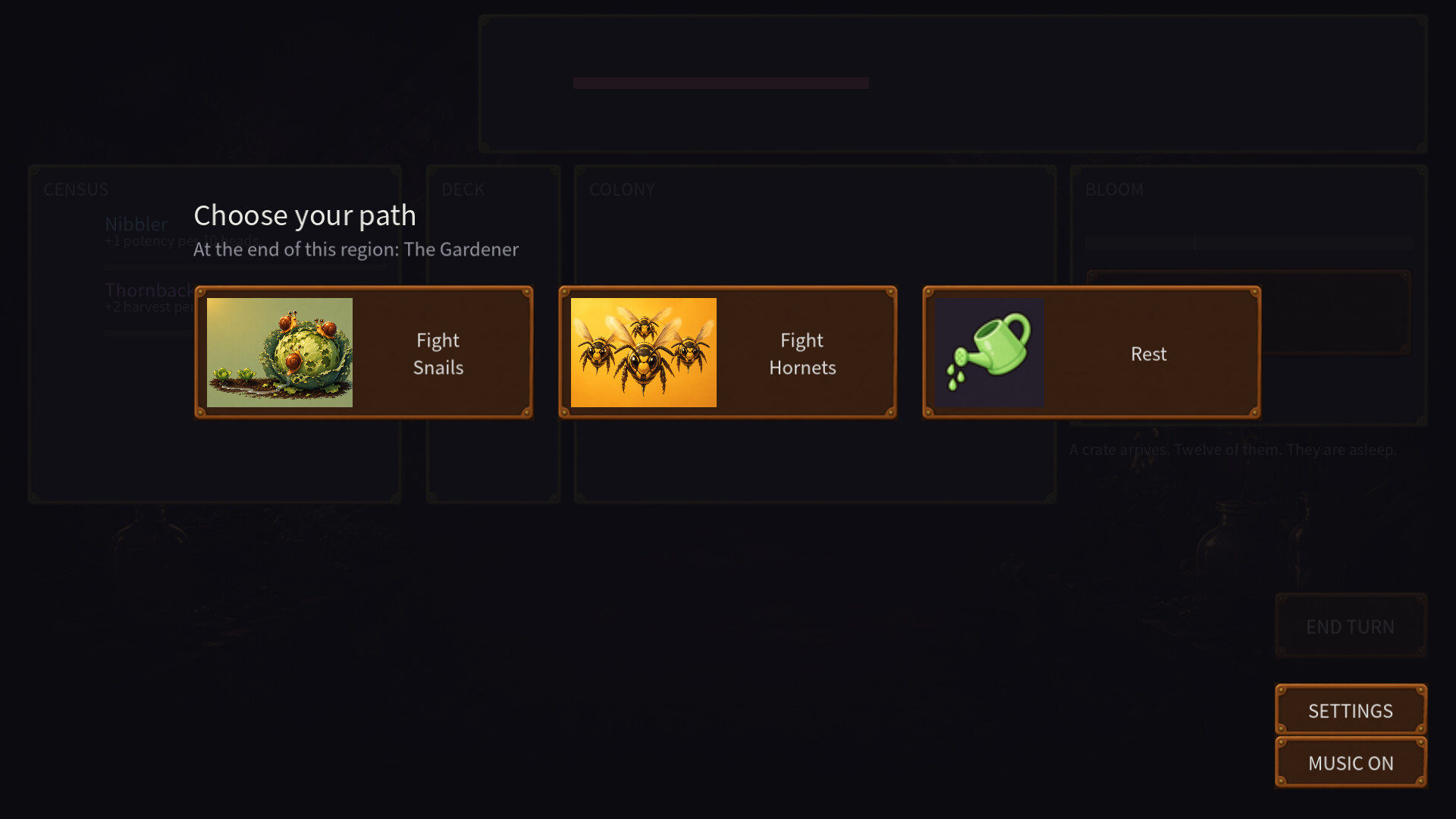
Nothing stops halfway. You sign a Contract — one restriction and one compensation that rewrite the run's physics before you pick a single strain — then cross all five layers and fight The Gardener, and you get the same Herbarium sheet at the end that the full game gives you. What the demo holds back is width, not depth: five of the ten strains, three of the six Contracts, one of the three bosses. Carrying capacity, Feral, BLOOM, the heritable mutations, the enemy tells and the post-battle nodes are all here in full. A run takes 25 to 40 minutes.

Every card asks the same question, every turn.

HARVEST it for damage now, or SOW it to breed more of its strain and hit harder for the rest of the run. There is no energy bar. Your hand refills to five and every card in it is yours to spend — the cost of sowing is simply the damage you chose not to deal. Greed has an axis: go deep on one strain for a multiplier that collapses all at once, or go wide for something steady that never spikes.

Carrying capacity is the ceiling. Going over it is how you get ammunition.

Every strain has its own cap. Cross it and breeding stalls, the end of each turn spits Feral cards into your deck, and if two strains are over at once the larger one eats the smaller. Feral cards are dead weight you cannot play. They are also the only fuel for BLOOM.

BLOOM is a bomb you build out of your own mistakes.

Six Feral cards arm it, and a permanent gauge shows exactly what detonating deals and what it costs you — so it is never a random punishment. Hold at eighteen and it goes off on its own. Every turn you wait makes the bomb bigger, the recoil worse and your hand deader. Set it off and every strain collapses back to its cap; you rebuild from half a colony.

The enemies watch what you are breeding, and they leave you a tell.

Every attack is telegraphed two turns ahead with a condition written underneath it. Meet the condition before you end your turn and the blow lands light. The check reads your colony at the moment you stop — so the forecast is never only "how much is this going to hurt," it is "what am I allowed to do this turn."

The run ends on a sheet worth posting.

Win or die, you get a Herbarium specimen page: the strains you raised, the mutations that drifted into them, your peak population, your Blooms, the Contract you signed. Five strains in the demo, three visible growth stages each, and all six heritable mutations — the colony you finish with is not one anybody else has had.

In this demo

  • One complete run, 25–40 minutes — all five layers, and the boss announced on the very first screen: The Gardener
  • Five of the ten strains, three growth stages each; all six heritable mutations that drift as your colony breeds
  • Three of the six Contracts that change the run's physics; the full post-battle node pool, five on offer every time
  • All five verbs — HARVEST, SOW, BURN, PRUNE, DETONATE. You never do multiplication; every card previews its own result on hover
  • The full Herbarium sheet at the end of every run, win or lose

AI Generated Content Disclosure

The developers describe how their game uses AI Generated Content like this:

This game leverages the power of AI.

System Requirements

    Minimum:
    • OS: Windows 10 64-bit
    • Processor: Intel Core i3 (dual-core 2.0 GHz) or equivalent AMD
    • Graphics: Integrated graphics with Vulkan 1.0 or OpenGL 3.3 support
    • Sound Card: Any Windows-compatible sound card
Review Filters