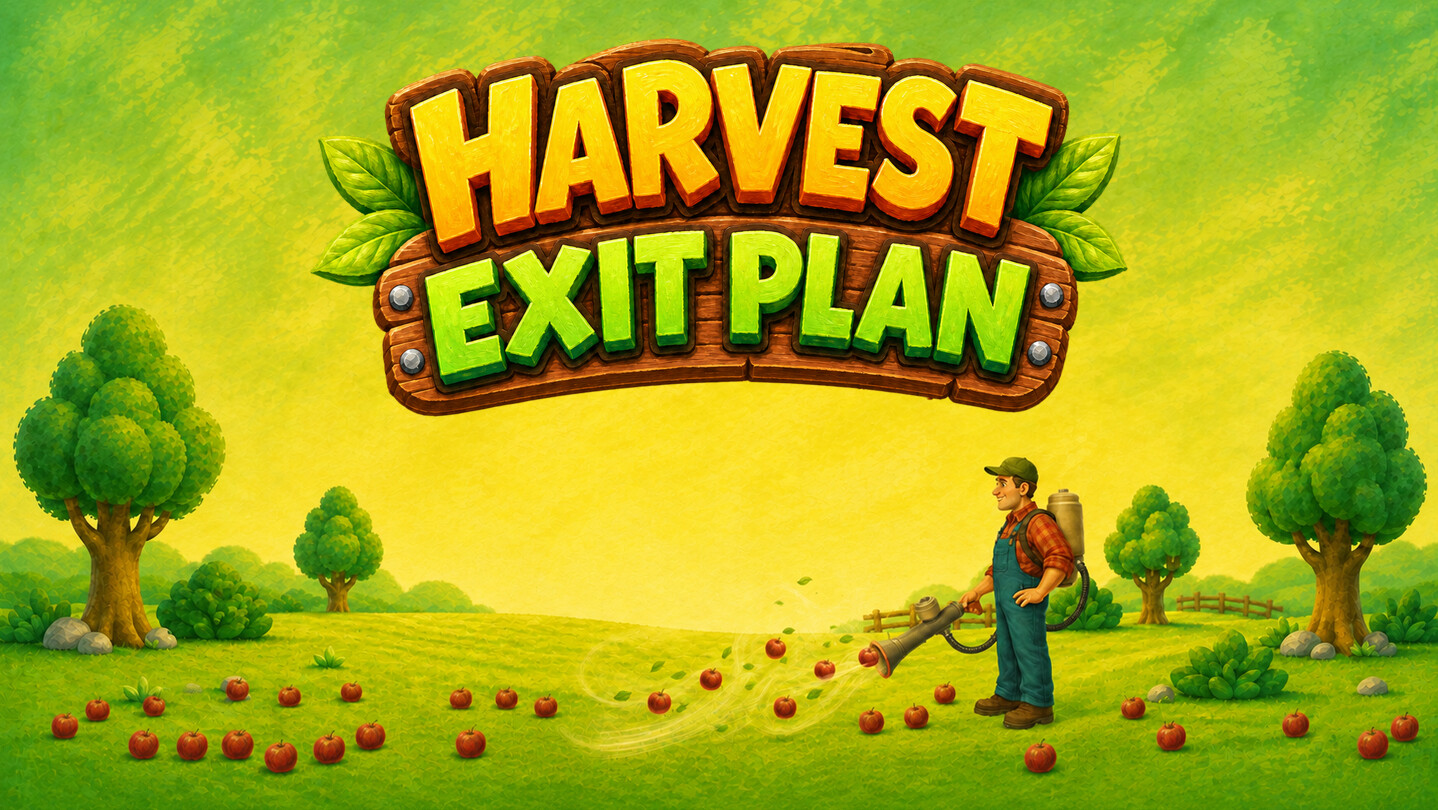


Your grandparents gave you the orchard you spent every childhood summer resenting. The plan: collect every fruit, sell the place, never pick up an apple again. Upgrade your tools, clear six gardens, then run it all again next season, faster, with cards that change the run.

Sign in to add this item to your wishlist, follow it, or mark it as ignored

Coming Soon To Early Access

The developers of this game intend to release as a work in progress, developing with the feedback of players.

Note: Games in Early Access are not complete and may or may not change further. If you are not excited to play this game in its current state, then you should wait to see if the game progresses further in development. Learn more

What the developers have to say:

Why Early Access?

“Harvest Exit Plan needs players to decide what it becomes, not to confirm that it works.

The season deck is the clearest place to see why. Twenty cards exist today, and every one of them is a number: collect faster, carry more, pay less. That is the smallest version of the idea, and it is where I stopped on purpose. What a card should be allowed to do is still open - one that changes where the fruit lies, one that asks something of you in exchange for what it gives, one that makes a season play differently rather than faster. I have more directions than I have confidence, and choosing between them by playing my own game again is exactly how a game gets narrower instead of better.

The orchard grows too. The intention for Early Access is two more gardens, two more kinds of fruit and a fourth tool - and what any of them actually are is not decided. Where the next garden sits and what makes it different from the six that are there, what the two new fruits are worth picking up for, what a fourth tool does that hands, grabber and vacuum do not: those are the questions, and I would rather answer them with a few hundred people than alone in front of a spreadsheet. That is the deal. You are not testing my plan; you are helping write it.

Underneath all of it, the numbers. Garden sizes, fruit values, tool prices and upgrade curves all sit in one place, and I measure full runs regularly - always on my own machine, always with my own habits. A few hundred people will find the flat stretch in season four and the shortcut I have stopped being able to see.

And there is the part I cannot write down here. The requests that keep coming back are usually the ones worth building, and I do not know yet what they will be.”

Approximately how long will this game be in Early Access?

“Around six months.

That is what I expect the planned work to take: growing the deck and widening what a card can do, and then building the gardens, the fruits and the tool that Early Access decides on. Content that is designed with players takes as long as the deciding does, so this is an estimate rather than a promise. If what comes back is worth more rounds than I planned for, I would rather revise this number here, in public, than quietly let a date pass.”

How is the full version planned to differ from the Early Access version?

“The aim is a bigger orchard, a much wider deck, and a run that more than one person has argued about.

Content. The intention is two more gardens, two more kinds of fruit and a fourth tool by 1.0. What they are is deliberately not decided yet - that is the part I want to work out with the people playing, and naming them here would only lock in the answer I would have given on my own.

Season cards. Twenty ship with Early Access, and all twenty change a number. The intention is a noticeably larger deck and, more importantly, a wider idea of what a card can do - cards that change how a season plays rather than how fast it goes. Which of those get built depends on what players reach for and ask for, so I would rather not print a list I wrote before anyone had played.

Balance. Garden sizes, fruit values, tool prices and upgrade costs are set against measurements from my own runs today. The aim is to settle them against how a few hundred people actually play, and to do the same for the cards against each other, so that none is an obvious first pick and none is dead weight.

Beyond that, I expect the full version to contain things that are not in this answer. That is the point of building it this way: what Early Access turns up gets built, and a plan written today would mostly be in the way.”

What is the current state of the Early Access version?

“A full run is playable from the first apple to the last, and the game around that run is young.

What is in: six gardens, played in order, and six kinds of fruit. Three tools - hands, grabber, vacuum - each with upgrades bought from what you sell. A robot per garden that keeps collecting while you are somewhere else. Twelve rare finds, two per fruit, and a collection album that fills as you turn them up. Mastery goals for every garden, and a records screen that shows how a run was played rather than only what came out of it. Steam achievements and leaderboards. Ten languages, each fully voiced and subtitled, with a colour-blind mode, free key rebinding and scalable text. A first run takes a little over two hours.

What is open on purpose: the season deck. Twenty cards, dealt out between seasons, and every one of them is a modifier - a percentage or a multiplier. There is no card yet that changes what a season *is*. That is the largest open design question in the game, and it is open because I want it answered with players rather than by me.

What is not built yet: the gardens, the fruits and the tool that come during Early Access. Six gardens exist; the seventh and eighth do not, and neither do the two new fruits or the fourth tool. What they turn out to be gets decided in Early Access.

And the numbers are measured rather than guessed - but measured against one player. Mine.

So: expect the orchard to grow, expect the deck you are playing with to look different in a few months, expect the balance to move under you when it does, and expect the kind of bug a single developer does not find alone.”

Will the game be priced differently during and after Early Access?

“The price is likely to go up modestly when the game leaves Early Access.

Everyone who buys during Early Access gets everything that comes later at no extra cost, at the lower price. That seems the right way round: there should be more orchard and a wider deck by 1.0 than there is today, and the people who help decide what goes into them ought not to pay more than the people who show up afterwards.

Any increase would be a small one. This is a short, quiet game, and it is priced to stay that way.”

How are you planning on involving the Community in your development process?

“Through Discord, mainly, and the Steam forums.

There is a Discord invite in the pause menu and in the credits, one click from wherever you happen to be - a bug report that has to wait until you go looking for a website is a bug report that never gets written.

The decisions I do not want to make alone are the ones that get made there. Every card idea gets its own thread, and the ones under consideration get picked apart before they are built - and, when the time comes, the same treatment for the two gardens, the two new fruits and the fourth tool: what they should be, what they should be worth, and what would make them worth walking to. None of that is a vote, but none of it is my taste alone either. When an idea keeps coming back, it gets built and tried, and the change notes say whose idea it was.

I also read the records screen and the leaderboards. They say something a forum post cannot: how a run was actually played, rather than how it is remembered afterwards. The balance work runs on both together.

One more thing I would genuinely like help with: the game ships in ten languages, and I did not grow up speaking nine of them. If something reads oddly in yours, tell me. That is the kind of fix that takes a minute and would otherwise never be found.

I cannot promise every suggestion ends up in the game. I can promise it gets read, and that when something changes because someone asked, the change notes say so.”
Read more

Download Harvest Exit Plan Demo

This game is not yet available on Steam

Planned Release Date: Oct 30, 2026

This game plans to unlock in approximately 2 months

Interested?
Add to your wishlist and get notified when it becomes available.
 
See all discussions

Report bugs and leave feedback for this game on the discussion boards

About This Game

A perfect plan

Nico spent every childhood summer at his grandparents' place doing the same thing: picking up fruit. Apples, pears, plums, whatever had just fallen. He hated it. He never said so — Trudi and Klaus were so delighted to have the help that he told them it was the best part of his year, and he was, apparently, very convincing.

Years later they are too old to keep the orchard. So they give it to him, certain it is the loveliest thing they have ever done.

He thanks them. He does not mention that they have just signed over several hectares of childhood trauma. Instead he makes a plan.

Collect all the fruit, sell every last piece, sell the orchard, and never pick up an apple again.

A perfect plan. It holds for about twenty minutes.

Because somewhere between the first full basket, the first money earned, and the genuinely satisfying sight of a patch of grass with absolutely nothing left on it, something goes wrong. Nico is enjoying himself.

The orchard does not stay empty

This is where the exit plan really falls apart.

Clearing all six gardens is not the end of the game. It is the end of season one. The next one begins straight away and it begins faster — and before it does, you are dealt cards that change how it plays. A basket that holds more. A grabber that reaches further. Robots that work harder. A workshop that undercuts itself. A Frenzy that burns hotter. Twenty cards so far, and slots enough to build a season around them.

The scale moves with you. Bare hands take a piece or two at a time; by the end of a run the vacuum is lifting them by the dozen, and the gardens have grown to match. What was an afternoon of tidying becomes something you are frankly too good at.

Nico's plan was to do this once.

Two ways to clear an orchard

Both are correct.

Switch your head off. Walk, hold the button, watch a lawn empty. Nothing here has a timer, a fail state or an enemy; nothing punishes you for standing still and looking at the trees. Buy whichever upgrade looks nice. Let a robot pick away at one garden while you wander into another. You can play this badly for two hours and still finish, and it was built for exactly that.

Or take it apart. Collect without pausing and a streak builds: the pace lifts in stages, the sound climbs with it, and at the top it tips over into Frenzy. Clear a quarter cleanly and it pays a bonus for the rest of the run. Which tool suits which density, when to sell, which upgrade before which — none of that is obvious, and all of it is measured. The records screen keeps your best pick rate, your longest flow, how long you held Frenzy, how far you walked and which tool did what share of the work. The leaderboards are waiting for the moment you think you have it solved.

In the game

  • Six gardens, each with its own fruit and its own robot that keeps collecting while you are elsewhere.

  • Three tools and a workbench full of upgrades, priced so that every purchase is a decision.

  • Twelve rare finds, two per fruit, hiding among the ordinary ones, and an album that fills up as you turn them up.

  • Mastery goals for every garden, for players who want the orchard cleared properly rather than merely cleared.

  • Steam achievements and leaderboards.

  • Ten languages, each one fully voiced and subtitled, with a colour-blind mode, free key rebinding and scalable text.

And then?

"Funny," Nico says, somewhere in the sixth garden. "I thought I'd be happier to be done."

He could sell the place now. That was always the plan.

He is not going to sell the place. You both know it.

AI Generated Content Disclosure

The developers describe how their game uses AI Generated Content like this:

Generative AI was used for parts of the game's 3D assets, voice and narration, ambient audio, translations, and store artwork.

All generated content was reviewed and edited by hand. No AI is used at runtime.

System Requirements

    Minimum:
    • Requires a 64-bit processor and operating system
    • OS: Windows 10 64-bit
    • Processor: Dual-core 2.0 GHz (Intel Core i3-6100 / AMD FX-6300)
    • Memory: 4 GB RAM
    • Graphics: Vulkan 1.0 compatible GPU with 1 GB VRAM (Intel HD Graphics 520 / NVIDIA GeForce GTX 750 / AMD Radeon R7 260)
    • Storage: 500 MB available space
    • Sound Card: Windows-compatible sound card
    • Additional Notes: Requires a GPU with Vulkan 1.0 support and up-to-date drivers.
    Recommended:
    • Requires a 64-bit processor and operating system
    • OS: Windows 11 64-bit
    • Processor: Quad-core 3.0 GHz (Intel Core i5-8400 / AMD Ryzen 5 2600)
    • Memory: 8 GB RAM
    • Graphics: NVIDIA GeForce GTX 1060 / AMD Radeon RX 580 (4 GB VRAM)
    • Storage: 500 MB available space
    • Sound Card: Windows-compatible sound card
    • Additional Notes: Requires a GPU with Vulkan 1.0 support and up-to-date drivers.
Review Filters