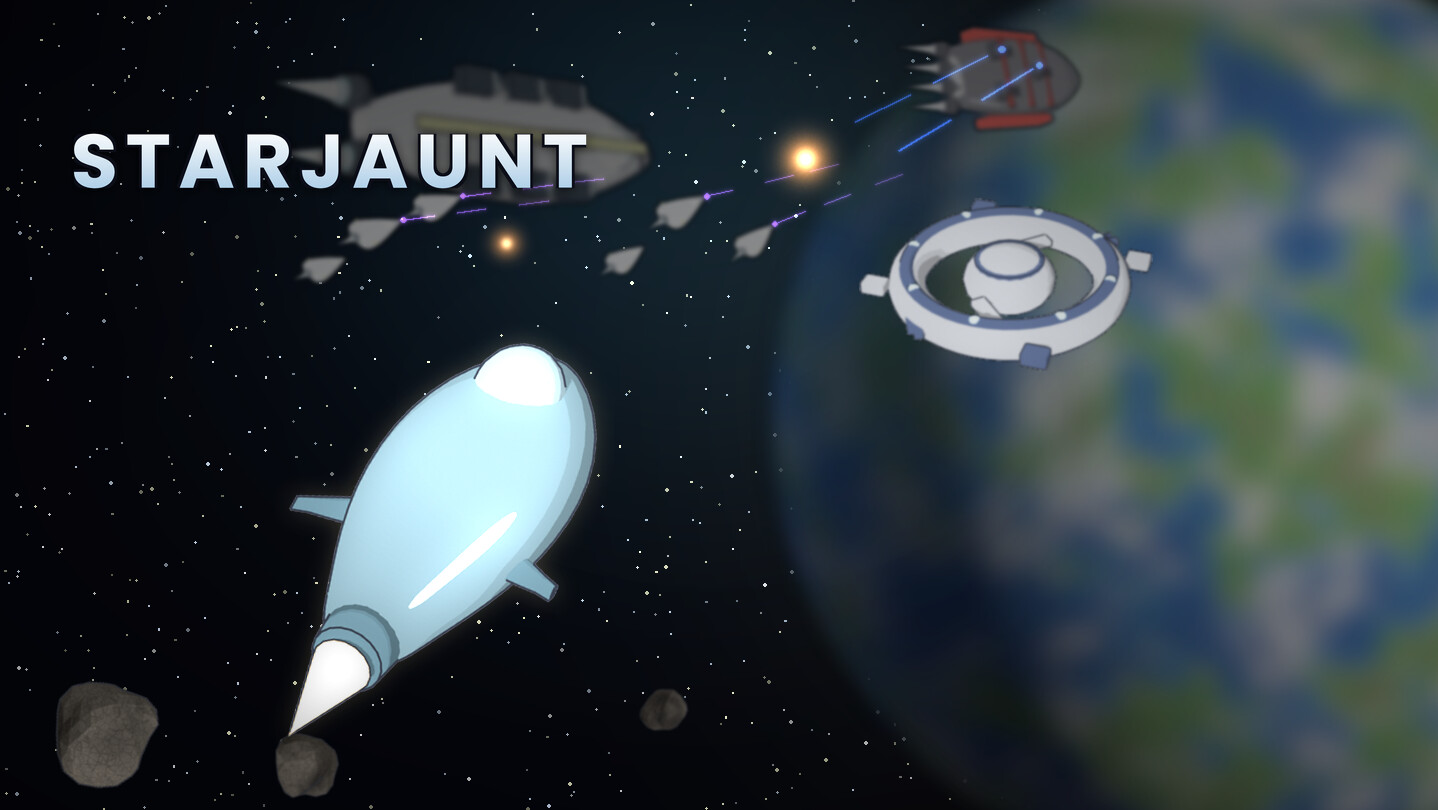

Start with a shuttle and a full tank. A galaxy of forty-four systems, nine factions, and a war that redraws the map while you fly it. Trade, smuggle, mine, spy, hunt bounties, or command a fleet — and past the last charted jump, something older than every flag out here is starting to wake up.

Sign in to add this item to your wishlist, follow it, or mark it as ignored

This game is not yet available on Steam

Planned Release Date: Oct 14, 2026

This game plans to unlock in approximately 4 weeks

Interested?
Add to your wishlist and get notified when it becomes available.
 

About This Game

You start with a shuttle.


Not a warship. Not a legend. A shuttle, a modest hold, and enough fuel to reach somewhere that isn't here.

What happens after that is genuinely up to you. Starjaunt is an open galaxy of forty-four star systems, nine factions with their own grudges and their own ships, and a war that keeps moving whether or not you're involved in it. You can spend the whole game hauling grain and never fire a shot. You can spend it taking systems by force. Most people do something in between and find out what that makes them.

[hr][/hr]

Pick a life, or don't


  • Merchant. Buy low, sell high, watch prices move as the war strangles supply lines. Trade up from a shuttle to a freighter to a hold that pays for itself.
  • Miner. Work the asteroid belts, sell ore to refineries, stay out of everyone's politics.
  • Bounty hunter. Hunt people who don't want to be found, across a six-part arc that gets more complicated the closer you get.
  • Spy. Thirteen missions of intelligence work — planted evidence, two-stage extractions, freighter interdictions, and bribes that show up in your ledger as negative pay. Nobody stays clean.
  • Combat pilot. Fly for a flag. Take contracts, take systems, take losses.
  • Fleet commander. You don't need a carrier to stop flying alone. Make friends who fly your wing for nothing, hire guns at the bar who fly it for a fee, or earn enough trust from a faction's command that they stop handing you contracts and start handing you berths.

Nine factions, and none of them are simply right


  • The Federation — order and duty, expressed as slow ships with too much armor and a tariff schedule for everything.
  • The Rebel Alliance — speed as armor, freedom as a grievance, captured tech held together with conviction.
  • The Free Frontier — farmers, ice-miners and free-port harbormasters who want to be left alone and are squeezed by everyone. They fight defensively and they remember who helped.
  • The Helios Combine — a megacorp that owns the mines, the patents and the foundries, sells arms to both sides, and does not want the war to end. Drone swarms, because people are expensive.
  • The Artifact Order — monastic zealots who hold the Precursor ruins sacred and will ram your hull to prove it.
  • The Federation Bastion — the hardliner splinter that thinks the Federation went soft. Siege doctrine, scorched earth, no negotiated peace, ever.
  • Pirates, the Merchant Guild, and the Independent worlds that keep their heads down while everyone else fights.

Each faction's mission arc unlocks its own hulls, one ship at a time, behind its own missions — fifty-four ships and forty-three weapon and outfit systems across the roster. Fly Federation long enough and you'll be trusted with a carrier. Fly for the Order and you'll be trusted with something stranger.

The war moves without you


Systems aren't decorations with a flag painted on. Control is a live number, and player missions push it. Take enough of a frontier system for the Rebels and it turns green on the star map — and then the markets restock from Rebel suppliers, Rebel patrols replace Federation ones, prices shift, standings follow, and the contracts on offer change with them. Contested systems spawn both sides at once and let them fight it out in front of you.

Nothing about that is scripted. It falls out of one number per system, and it means the galaxy you're flying through in hour forty is not the one you started in.

Nobody out here flies on rails


The pilots you fight weren't handed a patrol route and a state machine. They were trained — a neural network taught to fly by reinforcement learning, in simulation systems built for the purpose, until pirates learned to hunt traders and patrols learned to protect them.

What comes out the other side is pilots with personalities. Some are reckless and some won't commit. Some break off a fight they're losing and some absolutely will not. They misjudge, they overextend, and now and then they do something you wouldn't have thought of. You end up reading them the way you'd read a person, because in the only sense that matters at knife-fight range, that's what the training produced.

Land, and step out


Docking isn't a menu. Set down and you walk the world on foot — desert outposts under prefab domes, forested colonies with lakes and lumber, company towns, garrisons, free ports. Find the fuel depot. Argue with the mechanic. Sell your haul at the warehouse and learn at the bar what's worth carrying next.

You don't have to fly alone


There are three ways to stop, and they cost you different things.

Make friends. Twelve companions can be earned across the storylines — a cashiered Federation ace who flies angry, a homesteader who doesn't forget a kindness, a smuggler paying off a debt in escort hours. They fly their own ships, talk to you in combat, walk beside you when you land, and each has their own mission arc.

Hire guns. Every bar has a wingman desk. Pay the fee and a veteran, a rookie or a mercenary flies your wing until they die or you let them go. When a hire dies you're out the money. When a friend dies you're out a friend — and there's a ledger for the ones who don't come back.

Earn a fleet. Fly long enough for a faction and its command stops offering you contracts and starts offering you berths. Federation carrier certification, signed off by an officer who's watched you work. A converted capital hull the Alliance names you the first captain of. A deck on a Free Fleet carrier, handed over by a pirate king who decides you've earned it. Nobody sells you a fleet. You're given one, by people who had to be convinced.

And past the last charted jump


Something built the ruins at Tau Ceti and seeded the exotic matter at the fringe. It is gone, but not entirely.

Out beyond Sanctum, through a jump that isn't stable, the Rift holds something dormant that answers when the relics are disturbed. It doesn't trade. It doesn't bargain. It doesn't hate you. It responds — and when it starts responding, the Federation's quarrel with the Rebels stops looking like the important story.

How that ends is the one choice the game really asks you for. Seal it. Wake it. Or take it apart and use it.

[hr][/hr]

At a glance

  • 44 star systems across seven distinct regions — core worlds, contested borderlands, frontier reaches, company space, fortress systems, a monastic road, and a deep nobody comes back from
  • 134 missions, including six full faction campaigns that converge on the same battles from opposite sides
  • 54 ships and 43 weapons and outfits, most gated behind the factions that build them
  • A live faction war that redraws the map, the markets and the traffic
  • Enemy and civilian pilots flown by a reinforcement-learning policy rather than a script
  • On-foot exploration of every world you land on — deserts, ice fields, gardens, company towns, free ports
  • 12 companions to earn, mercenaries to hire, and fleets handed to you by factions that learned to trust you — companions who die stay dead
  • Three endings
  • Windows, macOS and Linux

Keyboard only at launch.

System Requirements

Windows
macOS
SteamOS + Linux
    Minimum:
    • OS: Windows 10 64-bit
    • Processor: Dual-core 2.0 GHz
    • Memory: 4096 MB RAM
    • Graphics: GPU with Vulkan 1.1 or DirectX 12 support
    Minimum:
    • OS: macOS 12 Monterey or later
    • Processor: Apple Silicon or Intel Core i5
    • Memory: 4096 MB RAM
    • Graphics: Metal-capable GPU
    Minimum:
    • OS: Ubuntu 22.04 or newer
    • Processor: Dual-core 2.0 GHz
    • Memory: 4096 MB RAM
    • Graphics: Vulkan-capable GPU, Mesa 22 or newer
Review Filters