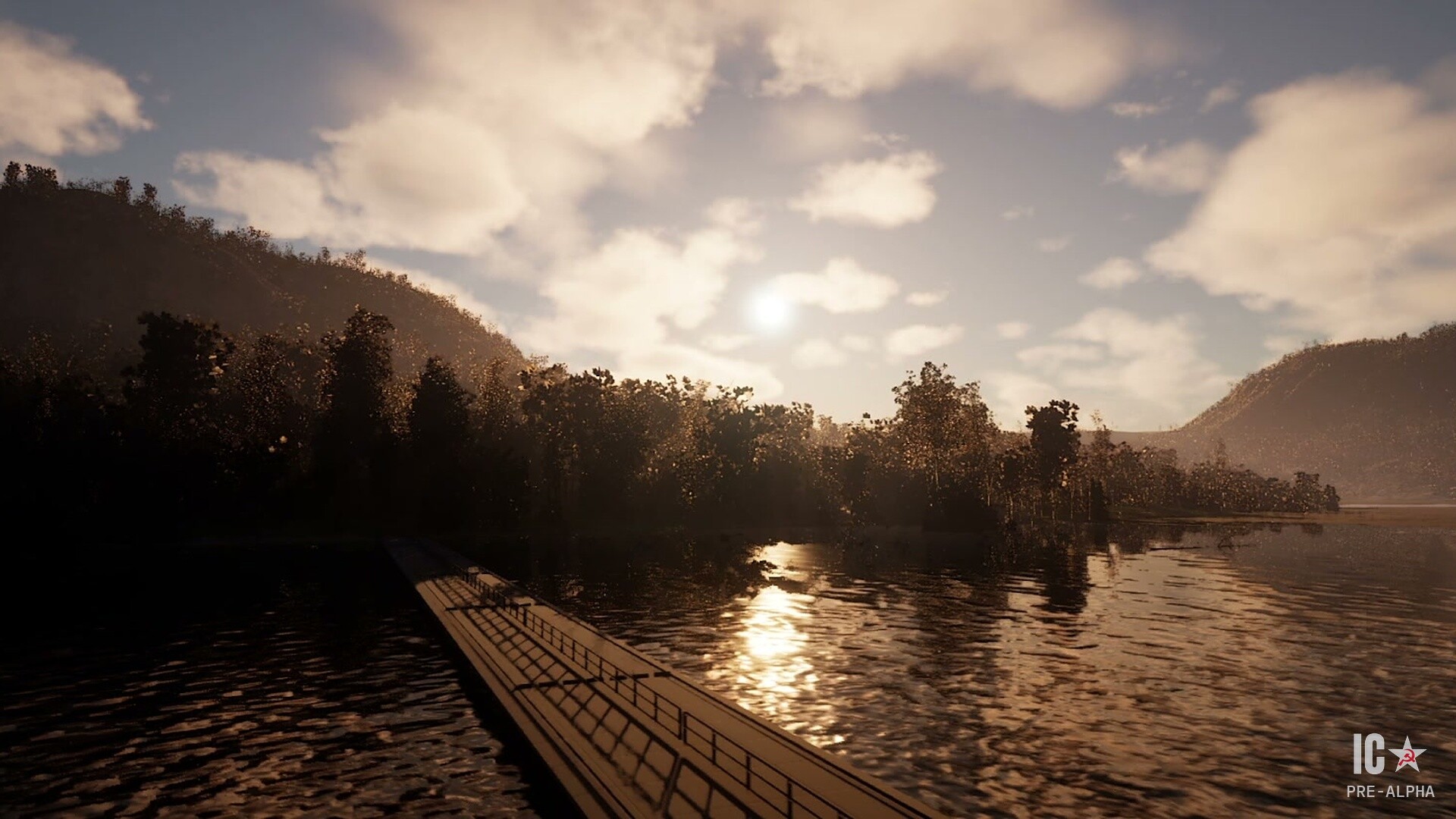


A 200-player war for one American valley. The Cold War ended the other way, and in 1999 the former USA is at war with itself. One persistent front across a real 20 x 24 km Tennessee river valley: dig trenches, haul supplies, hold the line. Free to play. Never pay to win.

Sign in to add this item to your wishlist, follow it, or mark it as ignored

This game is not yet available on Steam

Planned Release Date: To be announced

Interested?
Add to your wishlist and get notified when it becomes available.
 

About This Game

A 200 PLAYER WAR FOR ONE AMERICAN VALLEY

The Cold War ended the other way.

The United States did not lose a battle. It lost a bet. The men who owned its energy and its

appetite decided the future belonged to the other system, and by the time anyone noticed, the

country had been signed over from the inside. What stands now is a captured America: the

Soviet backed USSA, its federal stencil on every hood, against the Homegrowns, an internationally

supported resistance with no factory of its own and no intention of stopping.

Main Street has a propaganda billboard on it. The diner is still open. The war is two years old

and it is not going anywhere.

Internal Conflict is a large scale military simulation for 200 players on one persistent front.

It is a shooter first, a sandbox game second, and it means both of those completely.

WHAT YOU ACTUALLY DO

You spawn at a barracks that belongs to you, draw a weapon that a player physically delivered

there, get moved to a contested position by a driver who chose that job on purpose, and fight over

a strip of ground with a hundred other people on your side. Then you hold it, or you lose it, and

the line on the map moves for everyone in the war, including the people who log in after you leave.

Every system below exists to serve that one sentence.

ONE WAR, NOT A MATCH

There is no queue, no lobby, no countdown, no round timer. You join a war already in progress and

it keeps running after you log off. The front you left is the front you come back to.

A war can still be won. Push the other side three full levels of advance out of the region and that

war ends. It is deliberately built to resist snowballing, so the honest shape of a war is a

grinding stalemate that heaves back and forth for days, punctuated by pushes that cost something.

THE FRONT, AND HOW IT MOVES

The live battlespace is a band of ground twenty kilometers wide that slides north and south across

the valley as the fighting moves. Seven zones are contested inside it at any one time.

  • Three points per zone.[/b] Hold two of the three and the zone begins ticking over to you.

  • Thethird starts to flip once it goes uncontested. More bodies standing on a point takes it faster.

  • Five of seven shifts the war.

  • Hold five zones and the entire front steps one square in your favor, headquarters and all.

  • built on it. An advance hands you a raw position and the job of digging in all over again.

The commander of each faction designates which positions in a sector become that faction's zones,

so the map is a live planning surface rather than a scoreboard.

LOGISTICS WINS WARS

There are no tickets. Nothing is conjured.

Spawns, weapons, ammunition and equipment are physically delivered from headquarters and supply

nodes before anyone can spawn or draw gear at a position. Every category carries its own count, and

spawning burns from it. Starving a base is not a metaphor here. It is the actual way you choke a

faction out of a sector.

That makes the supply run a frontline job. Cutting a road matters as much as winning the firefight

on it. The truck driver wins wars too, and the game keeps the receipts.

COMMAND AND SQUADS

A full chain runs from Commander to Platoon Leader to Squad Leader to squad, named to each

faction's own doctrine. Squads carry the fight. Leadership is a job with actual authority over

where the faction's effort goes, not a cosmetic badge.

[h2]DIG IN[/h2]

Grab a hatchet. Drop trees. Build fortifications and dig trenches where you need them, not where

the map says you may. Experience earned from deliveries into a base buys builds and upgrades at

that base, so a position's shape is a record of the work players poured into it. Two weeks into a

war, the signature of a front is entirely what the players put there.

HOME IS A PLACE

Headquarters is a barracks with your bunk, your footlocker and your armory, per player, per squad

and per platoon. Spawning forward at a contested position is deliberately the opposite: fast,

functional, characterless. One is somewhere to come back to. The other is a foothold.

DEATH, RESCUE AND CAPTURE

Dying costs you something without ending your evening. Gear and cosmetic items degrade and drop,

and an item that dies twice is gone from the world permanently, so the good stuff genuinely

circulates and genuinely runs out.

Anyone can revive anyone, including enemies. You can restrain and capture a player instead of

killing them, which turns a losing firefight into a negotiation, a prisoner, and a story nobody

scripted.

PROGRESSION THAT NEVER BUYS A KILL

Your character persists and improves across every war you fight in: lockpicking, hotwiring,

crafting speed, stamina, and other quality of life skills that make you a more useful person on

the field.

Nothing you unlock, earn, grind or buy will ever give you a combat advantage. That is a design law

we wrote down before we wrote the game, not a launch window promise.

LOOT THE COLLAPSE

Late eighties American arsenals meet Soviet bloc steel. Your faction's patron decides your standard

kit, your uniforms, your vehicles and the look of every town it holds.

Then there is everything the country left lying around. Homes, hideouts and back rooms across the

valley hold rare and strange weapons from a place that stopped moving in 1989. Some are practical.

Some are legends. All of them can be taken off your body by whoever kills you.

THE JOURNALIST

A neutral third faction plays the war unarmed.

Journalists spawn at either faction's base, at neutral press locations and in towns, and they earn

from what they actually get on camera: a kill in frame, a capture in frame, a revive, an interview,

a surrender, a flag changing hands. That money can fund a squad to go take an objective so there is

something worth filming. Protection without invincibility, and a completely different game living

inside the same war.

ONE REAL VALLEY, 194 SQUARE MILES OF IT

A twenty by twenty four kilometer slice of the Tennessee River valley west of Chattanooga, built to

scale from real elevation data. Five million trees. Hundreds of miles of real roads. Appalachian

ridges, river flats, towns you fight through building by building, and one enormous bridge everyone

will learn to fear.

It is one map because it is one war. You will know this valley the way you know a neighborhood.

HOW LONG IS A SESSION

As long as you want it to be. Twenty minutes is a supply run that keeps a sector breathing. Two

hours is holding a zone through three assaults. A war runs for days across thousands of player

sessions, and it does not need you present to continue. Drop in, matter, log off, come back and

find the map changed.

FREE TO PLAY. PLAY FOR FREEDOM.

The entire game is free. Both factions, the journalist, every role, every weapon, every vehicle,

the whole valley and every system described on this page are included at no cost and stay that way.

Purchases are cosmetic only and never touch combat. No premium ammunition, no paid progression, no

paid access to a faction or a piece of ground, no fine print.

Come hold the line.

AI Generated Content Disclosure

The developers describe how their game uses AI Generated Content like this:

Generative AI tools are used as part of Internal Conflict’s technical development and production workflow, including AI-assisted tools integrated directly into our game engine and development pipeline.

These tools help our small independent team accomplish work that would otherwise be beyond the scope of the project. AI does not determine the game’s creative vision, art direction, worldbuilding, themes, game design, or underlying creative theory; those decisions are made by the development team.

We also track the environmental impact associated with our AI usage and contribute toward recovery efforts intended to offset at least twice the estimated impact of that usage.

Mature Content Description

The developers describe the content like this:

Internal Conflict contains frequent depictions of combat violence in a fictional alternate-history American civil war. Players use firearms, explosives, vehicles, and other military equipment against opposing forces, with depictions of injury and death during combat.

The game also includes mature themes related to war, political conflict, civil unrest, military occupation, and societal division. These themes are presented within a fictional setting and may be sensitive for some players.

The game does not contain sexual content or depictions of sexual assault.

System Requirements

    Minimum:
    • OS: Windows 11
    • Processor: i
    • Network: Broadband Internet connection
    • Storage: 50 GB available space
Review Filters