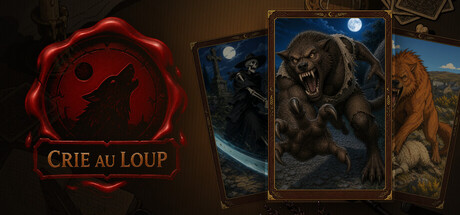



Play your creatures face down across three haunted places, reveal at the same time, and cry wolf to double the stakes. Over 100 folklore legends, from the Dahu to the Ankou, each drawn from a real belief. One match: five minutes. Free, with no random packs and no cards for sale.

Sign in to add this item to your wishlist, follow it, or mark it as ignored

English language not supported

This product does not have support for your local language. Please review the supported language list below before purchasing

This game is not yet available on Steam

Coming soon

Interested?
Add to your wishlist and get notified when it becomes available.
 

About This Game

The vigil is open

Two players, three haunted places, six turns. You play your creatures face down, they all turn over at once, and whoever holds two places out of three takes the pot.

A match lasts five minutes. Learning the game takes three.

Cry wolf

Every match is played for candles. Sure of your hand? Press the seal: the stakes double, you have just cried wolf. Your opponent calls, or folds and leaves you the pot.

The name comes from the fable. The shepherd boy who cried wolf was lying. So can you.

Over a hundred creatures, not one invented

The Dahu, the Ankou, the Tarasque, the Beast of Gévaudan, Melusine, the korrigans, the White Lady, the Wendigo, Baba Yaga, the Yeti, the Kelpie, the Mothman. Every card comes from an attested legend, with its dates, its sources and its home ground. The full bestiary, with the real story behind each creature, is free to read on the official site.

The legend writes the rule

The Dahu has shorter legs on one side, so it can only be played on the leftmost place. The White Lady always comes back: destroy her and she returns to your hand. The Ankou reaps the weakest card on each side. The Werewolf changes face when night falls, every other turn.

The eighteen places have laws of their own: Brocéliande shelters the fae, the Sabbath Clearing is night at any hour, and Gévaudan devours the smallest card every turn.

Free, with nothing hidden in the small print

  • No random packs, no cards for sale, no power you can buy.

  • The collection opens up by playing: renown rises every match, won or lost.

  • What may be sold one day is how the cards look. Nothing that changes a match.

One table for everyone

The game runs in the browser, on phones and on Steam, all on a single match server. Your opponent may well be on a sofa using one thumb: you will never know, and it changes nothing. A challenge link is all it takes to sit a friend down across from you.

What is in the box

  • Ranked online matches, private rooms, challenge links, instant rematch.

  • A solo mode against an AI that actually plays the game: it cannot see your hand, and it plans ahead.

  • A tutorial that is a real match, not a stack of pop-ups.

  • Twelve-card deck builder, several named decks, cost curve on screen.

  • Daily quests, a season track, a candle leaderboard, replays of your matches.

  • The full bestiary at any time, with the legend behind every card.

How it is made

One developer and a lot of late nights. The illustrations are generated with AI on an art direction held by hand, card by card; the writing, the rules and the folklore research are human work, with every source opened and checked one by one. This is stated here because it is true, and because the site's devlog tells the rest without dressing it up.

```

AI Generated Content Disclosure

The developers describe how their game uses AI Generated Content like this:

Crie au loup is made with AI, from the first prototype to the illustrations. That is not a manufacturing detail: it is as much the project as the game itself.

My role is not a craftsman's: I painted no card, and I did not write the code line by line. I designed the system, I direct it, I arbitrate and I verify. Deciding what makes it into the game, what gets redone, what gets cut: that is production work, and it is mine.

What is generated: the creature and location artwork, the interface, a large share of the code and the writing. What is measured rather than assumed: card balance, computed over thousands of simulated matches before every update. What is verified: the historical sources behind every legend, published one by one on the official site, where you can open them and prove me wrong.

What is never generated is your match. No image, no text and no game decision comes out of a model while you play: the engine is deterministic, and the solo opponent is a classic program applying the rules.

Crie au loup is one of the projects I run around generative AI, and the only one you can play. The making-of is documented without varnish in the devlog on the official site.

System Requirements

    Minimum:
    • OS: Windows 10 64 bits
    • Processor: double cœur 2 GHz
    • Memory: 4 GB RAM
    • Graphics: carte compatible Direct3D 11 ou OpenGL 3.3
    • Network: Broadband Internet connection
    • Storage: 600 MB available space
    • Additional Notes: connexion internet permanente requise, le jeu se joue exclusivement en ligne.
    Recommended:
    • OS: Windows 10 64 bits
    • Processor: quatre cœurs 2,5 GHz
    • Memory: 8 GB RAM
    • Graphics: carte compatible Direct3D 11 ou OpenGL 3.3
    • Network: Broadband Internet connection
    • Storage: 600 MB available space
    • Additional Notes: écran 1280x800 minimum. Une fenêtre de 1280x860 correspond à la mise en page testée.
Review Filters