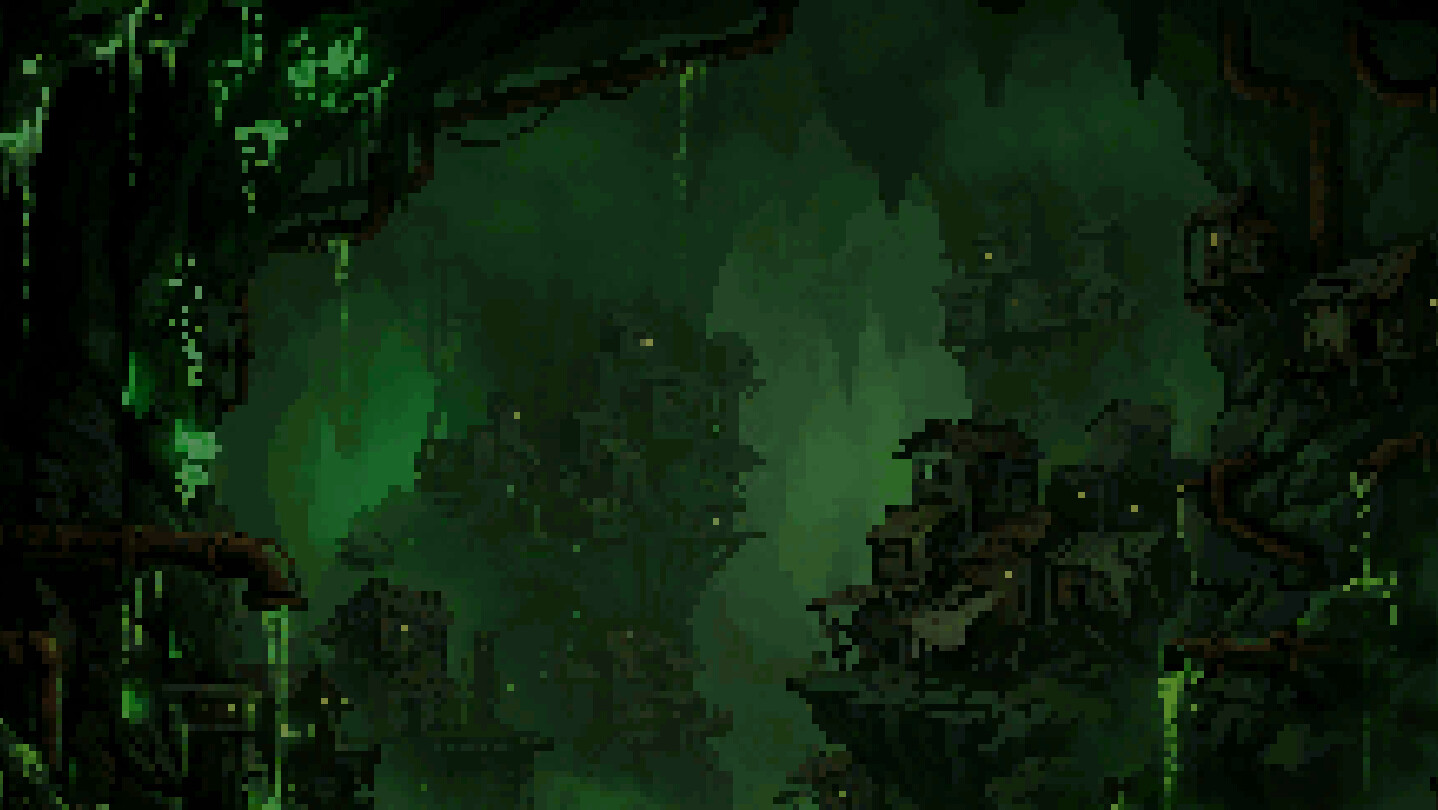


A 2D survival sandbox where the world broke a long time ago and just kept running. You can type freely to anyone, and they remember what you did. Mine, build, wire logic circuits, appease five silent gods, and assemble a ship plate by plate. No ending, no win screen. Pace yourself.

Sign in to add this item to your wishlist, follow it, or mark it as ignored

This game is not yet available on Steam

Coming soon

Interested?
Add to your wishlist and get notified when it becomes available.
 

About This Game

The world broke a long time ago and kept going anyway. You start with a pick. It goes from there.

You can talk to anyone

Type whatever you want; NPCs answer in character based on their trade, their mood, and your past actions. Under the hood, a language model is grounded by roughly 100,000 hand-written lines of dialogue so the world stays cohesive rather than drifting into generic AI mush.

Rob a shop in Khaldurim and the guards at the lower gate will already know by the time you sprint there. Khaldurim is an insular dwarven stronghold—show up as an elf and the gatekeepers will search your pack, mark up prices, and speak to you like you're five.

The world doesn't forget

There is no ending and no victory screen. Get a family exiled from the city and they will pack up, settle elsewhere, and hold a grudge indefinitely. The world state tracks your footprint for as long as you play, which can be a very long time.

The simulation doesn't wait for you

  • Living economy: Settlements produce goods, run into shortages, and dispatch caravans hauling actual coin. Merchants adjust rates based on local supply and personal spite.

  • Organic expansion: When a settlement outgrows its tavern, the locals build a second story.

  • Real logic circuits: Wire automated machinery or assemble a working computer. Whether that’s a sensible use of your weekend is entirely between you and God.

  • Unforgiving mining: Subterranean struts groan and sift dust before a ceiling caves in. Pay attention.

  • Five silent gods: They don't answer in prose, but they keep tallies and respond to offerings on their own terms.

  • Farming & livestock: Enclosed animal pens and functional field laborers, tied directly to local food stocks.

  • No save-scum enchanting: An enchantment either binds cleanly or warps the item permanently. It stays that way.

  • Persistent devastation: Meteors, tremors, and severe weather leave real terrain scars that never despawn.

  • Harmonics: A local tavern card game where the townsfolk will routinely take your hard-earned coin.

  • Modular shipbuilding: Welded and fitted together one plate at a time.

Difficulty is about information, not damage sponges

  • Casual: Clear UI callouts and extensive tooltips explain systems as they happen.

  • Intermediate: Expects you to figure out mechanical interactions through experimentation.

  • Complex: Logs only what you have personally witnessed, closes the tutorials, and stops holding your hand.

Modding

Items, blocks, crafting recipes, structures, and encyclopedia entries are structured data files. Add your own content without needing to dig into core source files.

The Demo vs. The Full Game

The demo gives you the Dwarven mountain city of Khaldurim and its immediate surroundings. The full game is the rest of the continent, which is much larger.

AI Generated Content Disclosure

The developers describe how their game uses AI Generated Content like this:

The demo's NPCs use a local LLM that runs with the game for chat responses, in addition to prewritten lines. NPCs respond based on their personality, past player interactions, job, location, etc.

Some art assets and sounds are initially generated with AI tools.

Mature Content Description

The developers describe the content like this:

Epoch Forge is a grim, low-fantasy game.

Violence. Melee combat with blades and tools, injury, and death.
Wounds and bodies are described in text and shown in small-scale
pixel art. Violence is not graphic, and there is no gore system.

Abduction and captivity. The player character can be seized by a
criminal crew and wakes chained in a cell beneath the city, held
for an indefinite time. A fellow prisoner has been chained there
for eleven weeks. Harm is threatened and implied rather than
depicted; the player is not shown being physically abused.

Poverty, hunger and exploitation. Much of the game takes place in
a slum district. Debt bondage, forced labour, hunger and people
trapped by circumstance are recurring themes, and the story does
not resolve them cleanly.

Alcohol. Taverns serve drink and some characters are drunk.

Generated dialogue. Conversations are written as you play by a
language model running on your own computer, so exact wording
differs between playthroughs. Output is filtered against a list of
prohibited terms, including profanity and slurs, but it is
generated text and cannot be guaranteed word-for-word in advance.

System Requirements

    Minimum:
    • Requires a 64-bit processor and operating system
    • OS: Windows 10 64-bit
    • Processor: Quad-core, 8 threads (Intel i5-8400 / Ryzen 5 2600 or better)
    • Memory: 8 GB RAM
    • Graphics: DirectX 12 or Vulkan 1.2 capable GPU, 2 GB VRAM (GTX 1050 Ti / RX 560 or better)
    • DirectX: Version 12
    • Storage: 8 GB available space
    • Additional Notes: Dialogue is run through a local AI model; without a supported GPU, conversations cause a temporary frame-rate drop while the CPU generates a reply
    Recommended:
    • Requires a 64-bit processor and operating system
    • OS: Windows 10/11 64-bit
    • Processor: 6-core / 12-thread (Intel i5-11400 / Ryzen 5 5600 or better)
    • Memory: 16 GB RAM
    • Graphics: DirectX 12 or Vulkan 1.2 capable GPU, 4 GB+ VRAM (GTX 1660 / RX 6600 or better)
    • DirectX: Version 12
    • Storage: 10 GB available space
    • Additional Notes: A dedicated GPU offloads AI generation and keeps frame rate stable during conversations
Review Filters