

Stranded in the asteroid belt with a broken ship and one working drill. Repair the ship part by part, mine your way back to the stars and grow a lifeboat into an empire. Offline counts exactly like online — no timers, no microtransactions, buy once.

Sign in to add this item to your wishlist, follow it, or mark it as ignored

Coming Soon To Early Access

The developers of this game intend to release as a work in progress, developing with the feedback of players.

Note: Games in Early Access are not complete and may or may not change further. If you are not excited to play this game in its current state, then you should wait to see if the game progresses further in development. Learn more

What the developers have to say:

Why Early Access?

“Belt Zero was built solo. All six systems are playable, from your first repair on the wreck into the endgame — but that is the foundation, not the finished house.

I am going into Early Access for two reasons.

First, balance. I have verified progression through simulated playthroughs, but a simulation only measures whether something is reachable, not whether it feels good. That gap is one I cannot close on my own.

Second, direction. Belt Zero is meant to grow considerably: a more alive game world, a real planet view, more space exploration and more freedom in how you build. Which of those comes first, and what it looks like in detail, is not something I want to decide alone at my desk.

I have worked on this game for over a year and I am ready to keep working until 1.0: regular updates, open communication, answers in the forum.”

Approximately how long will this game be in Early Access?

“The plan is 9 to 12 months.

There is a reason for the range: the end of Early Access depends on four things that can take different amounts of time.

1. The new features. More alive sectors, the planet view and expanded exploration are real development work, not cosmetics — the longest item.
2. Voice-over. 61 texts in two languages are commissioned work; music and sound effects are already done.
3. Balance. It is done when the progression curve stays stable across several updates and no more walls are reported — that needs at least two or three rounds of feedback with weeks of play time in between.
4. Steam Deck Verified. That review process sits with Valve, not with me.

I will not leave Early Access by calendar, but when those four points are settled. If it takes longer, I will say so in the forum and explain why.”

How is the full version planned to differ from the Early Access version?

“All six game systems are already fully playable. What arrives with 1.0 are new features and the layers on top — and both are noticeably absent in Early Access.

More game — this is the foundation. Belt Zero is designed as an idle game that grows over months. Planned:

- A noticeably more alive game world. Sectors should feel like inhabited places rather than backdrops: more visible activity between stations, buoys and colonies, and events that change a sector over time.
- A real planet view. Today your colonies are numbers in a menu and lights seen from orbit. The plan is a closer look at the world itself — surface, settlements, expansion.
- More space exploration. Additional destinations, discoveries and reasons to head back out and revisit a place a second time.
- More sandbox. More freedom to build your empire your own way instead of following a set order.
- More content in the existing systems: further live events and anomaly types across the seven sectors, additional faction contracts and blueprints. These systems are data-driven — new entries are content work, not rebuilds.

Audio. The soundtrack is already in place: over two hours of music, six dedicated tracks per sector, plus the title theme and the intro. The sound effects are there too — 28 of them, for the drill, tractor beam, hyperspace jump, selling, achievements and alarms. What 1.0 adds is voice-over: the 61 log and radio texts recorded in both German and English — the system for it is built in, the recordings are missing. Plus further effects for the new features.

Achievements. The game contains 303 achievements, all wired up in game. Valve allows new titles 100 of them on the store page to begin with; the remaining 203 will follow once that limit is lifted.

Steam Deck. The goal is "Steam Deck Verified". The interface already scales to 1280×800 and controller navigation is built in, but it has not yet been tested on real hardware.

Balance and pacing. 55 data files hold values I have verified by simulation but never experienced with players: mining speed, the cost curves of 16 upgrade lines across ten tiers each, trade buoy prices, the thresholds of 303 achievements and the pace of the colony economy. I will retune those numbers from your feedback — above all the first thirty minutes, the point at which the first FTL jump becomes reachable, and how far the late game carries.

What will not come: no multiplayer, no microtransactions, no ads. Belt Zero is and remains a single purchase.”

What is the current state of the Early Access version?

“The game is fully playable end to end — from your first repair on the wreck into the endgame. Specifically included:

Content: 7 sectors with their own skies and deposits · 32 ores · 16 upgrade lines with 10 tiers each · 20 station modules · 66 building types for the colony economy · 5 peoples with standing, treaties and envoys · 9 warship classes · 52 expedition targets · 12 relics in 3 sets · 39 story sections with a double ending · 303 achievements.

Systems: mining with drill depth and thermals · trade with living market prices · station building with a power grid and logistics · colonies with their own economy · diplomacy with five peoples · optional combat that can be switched off entirely in the options · prestige and New Game+ · photo mode · multiple save slots · Steam Cloud · fully localised in German and English.

Audio: over two hours of music with six dedicated tracks per sector, plus 28 sound effects.

What is still missing today: there is no voice-over — log entries and radio messages are read, not spoken. Of the 303 achievements, 100 are visible on Steam to begin with (Valve's limit for new titles). Controller input is built in but not yet verified on Steam Deck. There is no closer planet view yet, and the sectors are not as alive as they are meant to become. And the balance is exactly what I want to sharpen with you.”

Will the game be priced differently during and after Early Access?

“Yes, the price will rise moderately at the 1.0 release.

Buying during Early Access means paying once and getting everything that follows at no extra cost: every balance patch, the new features, the voice-over, all 303 achievements and every additional piece of content up to 1.0 and beyond. There are no microtransactions, no season passes and no ads — and that will not change after 1.0 either.

The lower entry price is the trade-off for buying a game that is still growing, and for helping me polish it.”

How are you planning on involving the Community in your development process?

“Everything runs through the Steam Community forums — that is where you can reach me, and where everything stays publicly readable.

What you get from me:
- An update with a changelog every two to four weeks.
- A progress report once a month: what happened since the last one, what I am working on, and what comes next.
- An open roadmap in the forum, updated with every report.

Where you have direct influence:
- The order of the new features. A more alive world, the planet view, more exploration, more sandbox — which comes first is something I decide with you.
- Balance polls. Concrete questions with numbers, for instance whether the first FTL jump arrives too early or too late. The answers feed straight into the values.
- The first thirty minutes. The stretch I need the most feedback on. Telling me where you got stuck helps more than anything else.
- Bug reports in a dedicated sub-forum. Reproducible bugs take priority over everything.

I answer personally — there is no team behind this.”
Read more
This game is not yet available on Steam

Planned Release Date: Nov 2, 2026

This game plans to unlock in approximately 2 months

Interested?
Add to your wishlist and get notified when it becomes available.
 
See all discussions

Report bugs and leave feedback for this game on the discussion boards

About This Game

You are stranded. Your jump went wrong, your ship is a wreck, and the only thing still connecting you to the rest of the galaxy is a drill that somehow still runs.

Belt Zero is a space idle game that carries you from a crippled one-man miner to an empire of stations, colonies and trade fleets.

It keeps running while you are away. Exactly as it would have run with you.

Almost everything is broken at the start. The cargo airlock is jammed — you cannot sell a thing. The engine is dead — you cannot even reach the next ore. Workbench, drone bay, navigation core, onboard computer: all of it dark.

Every part is repaired with ore you mine yourself. And every part that comes back online opens up a piece of the game: first selling, then travel, then drones, then modules. You unlock your own game step by step, out of what you pull from the rock.

No click counter, no progress bar that eventually fills up. The drill works continuously and knocks chunks off the asteroid that drift freely in space. Only what you collect counts.

  • Tractor beam — hold a key, pull chunks in. Free, always available.

  • Collector drones — five tiers, gathering chunks automatically. Offline too.

  • Quality tiers — every chunk is rolled: Common through Flawless.

  • Drill depth D1–D10 — the deeper you go, the more valuable the ore and the hungrier the drill. Past D4 the belt turns dangerous.

  • Thermals — Normal, Boost, Overdrive. More yield, more heat. Overheat and output drops until the cooler catches up.

And the asteroid itself is never the same twice: ten types, from the golden motherlode through the gas pocket to the decaying chunk that puts you on a timer. Some open a brief window where a click at the right second pays off.

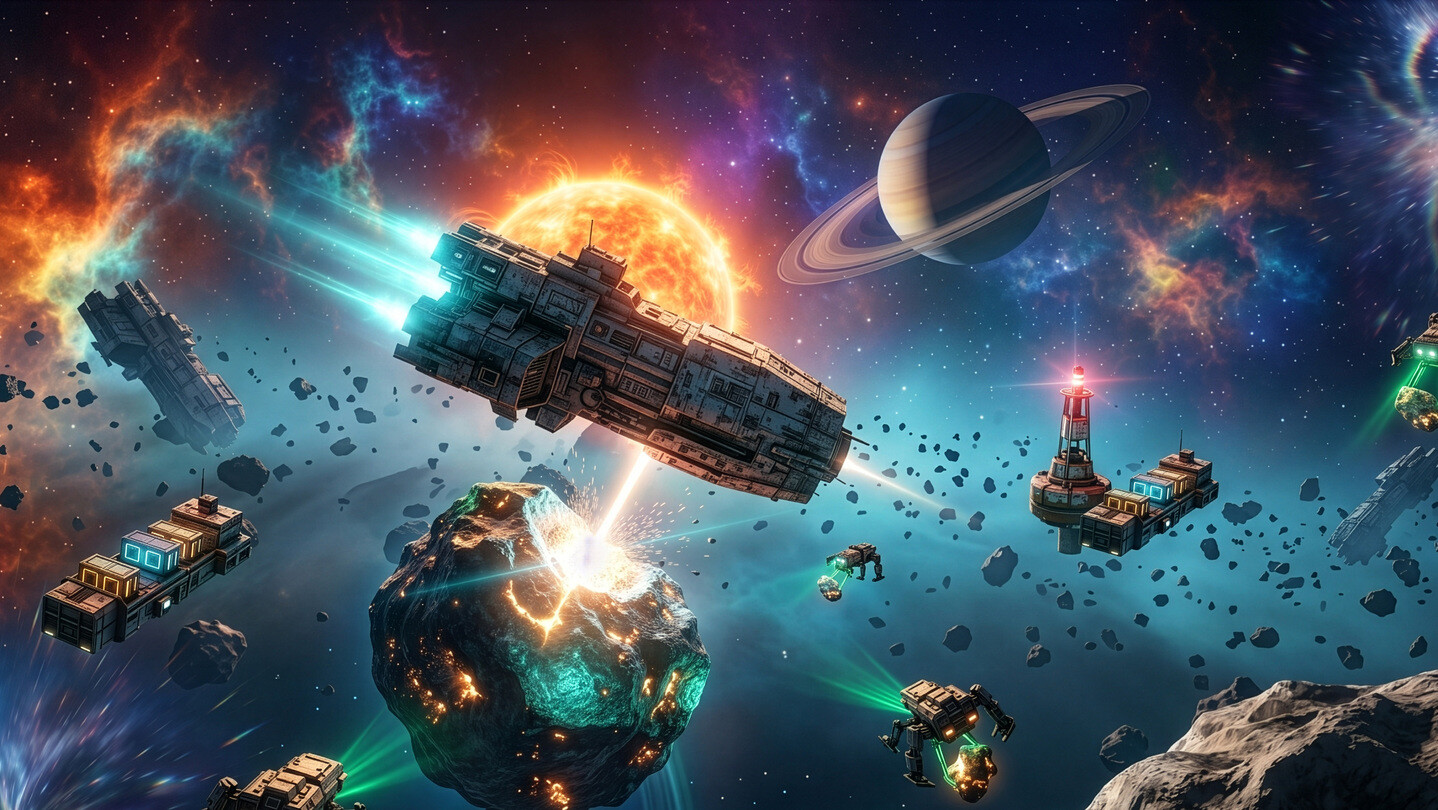
17 upgrade lines, ten tiers each — and none of them is just a number. What you build, you see on the hull: the crippled pod becomes a miner, the miner becomes a mining cruiser with four drill heads, cargo containers and three times the size.

On top of that, a power grid of your own: emergency reactor, fission core, solar sail, plasma burner, fusion core. You split the output across drilling, systems, cooling and charging — and decide whether to burn fuel or run on starlight.

Better drones, scan probes and generators are not handed to you: you research them in the lab, with operating hours as the price of entry. Those who have drilled a lot get to take the next step.

The Alpha Belt is only the beginning. Every other sector has its own star, its own colour and its own ores: a white dwarf over ice worlds, a red giant over lava planets, a pulsar in the ion veil — and in the Core Splinter sector a black hole with a glowing accretion disc.

You do not unlock sectors by level, you find them with a scan probe: build it, launch it, wait. Then you map every ore individually with a deep scan. And each sector carries a signature — in the Cryo Field no chunk is ever lost, Basalt yields giant rocks, at the Core Splinter your drill depth grows faster.

Changing sectors is a journey: engines charge, stars smear, a tunnel tears open — and you come out under a different sky.

Every sector holds a trade buoy. It does not pay the same everywhere, and it does not pay the same at all times: prices move in layered waves — a slow sector cycle, a fast ore rhythm.

Those waves keep rolling like tides while you are away. You can read them (and with the market scanner even forecast them), store ore in the cargo depot at the low and sell at the high. Dump too much at once and you push your own price down.

  • Delivery contracts — 38 jobs with loot you get nowhere else: blueprints, materials, jump fragments.

  • Trade routes — freighters sell in distant sectors for you, offline included. Far markets pay more, but cost cargo to pirates.

  • Escorts and insurance — against exactly that risk.

  • Wandering markets — rare special buoys that briefly pay absurd prices.

Raw ore is the beginning, not the goal. The transmutator turns it into refined materials over time — in three-stage chains where each stage devours the one before it. Materials become components, components become assemblies.

And all of it gets used: high ship tiers demand refined goods, station modules demand components, the great structures demand assemblies. Mine only, and you stall — refine only, and you run out of things to refine.

Nothing in the hangar appears at the click of a button: drones, probes and freighters need a workbench, materials and time. You see what is being built, and you can cancel it.

A derelict structure drifts in every sector. You can go and look at it — your ship visibly flies over, and in front of you stands a wreck many times your size. And you can salvage it.

The wreck becomes a factory: reactors, refineries, assembly works, storage, market docks, research labs, shipyards. Every module eats power, and when power runs short the grid throttles by priority instead of simply stopping. A logistics network moves goods between your stations; one designated hub pulls surplus to where it is needed.

From here you launch research expeditions to 52 destinations: you send a drone or a whole ship, it travels, and what comes back is decided by a roll. And once your works are big enough, you begin a megaproject in six build phases — the largest structure in the game, swallowing everything your factories can produce.

A habitat on your station brings the first settlers. From there you settle the planets of the sector — agrarian, mining, industrial, tech, each type with its own output and its own needs.

And then it gets big. Every colony carries a full economy: 66 building types across six systems (power, housing, agriculture, production, services, infrastructure), 17 goods in production chains, a power grid, labour, logistics. You build one at a time, by tens or by hundreds, and research tiers per building type.

An outpost of a few hundred settlers becomes a world of millions. At night you can see their lights from orbit.

The buoys are not ownerless. Behind them stand five peoples with their own territories, their own tastes, and a web of relations in which the Cryo Conclave and the Magma Forge cannot stand each other.

Trade with one and your standing there rises — and falls with their rivals. Standing buys better prices, then contracts, then treaties (trade pact, neutrality, alliance), then exclusive blueprints and a token shop with its own currency.

You can send envoys who quietly build standing on site, send gifts, and mediate in conflicts — or take a side. Broker peace between two hostile peoples and you open alliances with both, and may take their settlers into your own colonies. That is a goal for many hours of play.

Wealth draws attention. The fuller your warehouses, the sooner pirates show up — as an announced raid with a warning window you can intercept. A defence grid and a garrison keep them out.

If you want, you go on the offensive: nine warship classes with ten tiers and installable modules, raids on pirate targets, sieges of pirate nests — with the odds shown before you commit and a real risk of losing ships. Go far enough and you declare war on a people, take their outposts and negotiate peace later.

And if you would rather not, you do not have to. One switch in the options sets the game to peaceful: no threat, no raids. Everything else stays playable.

The belt holds more than ore. Your scanner uncovers anomalies — 18 kinds in five categories, from salvage fields through signals to phenomena. You send a probe, it works over time, and at the end you make a choice that can go more than one way.

Deep down lie precursor relics: twelve finds in three sets, each with a permanent bonus. The deeper you drill, the more likely you are to find them — the complete third set rewards players who really go down.

On top of that, salvaged AI cores you assign across twenty posts where they grow with you, ore mastery with specialisation paths per ore, and 303 achievements — from your first repair to goals you will work at for weeks.

Sooner or later your FTL core is whole again, and you jump onward. The jump resets your upgrades — but everything you carry in meta upgrades, achievements, relics, AI cores and knowledge stays. The next run starts faster, reaches further and opens ores that were out of reach before.

Five meta lines grow across every run. Past the tenth drill depth waits the abyss with finds of its own. And cards you slot before jumping reshape the next run: more yield against more consumption, more value against more risk.

And for anyone who has wrung all of that dry, there is a New Game+ — with a species that was not selectable before.

Offline counts exactly like online. Not roughly — exactly. Same maths, same results, verified by a dedicated test run that computes both paths against each other. You are never punished for closing the game.

  • No FOMO — nothing expires while you are away. Pending decisions really do wait for you.

  • No dead ends — starter ore is always minable, maintenance always affordable. You can never soft-lock yourself.

  • A welcome-back report showing what your empire did in your absence — from the ore hauled in to the colony that gained a level.

  • A logbook with history graphs across your entire play time.

  • Full English and German, every text and every menu.

  • Buy once. No ads, no microtransactions, no energy bars.

And if you do stick around, the game pays you for it: active moments like overcharge, resonance hits and the tractor beam give you more than idling ever could.

Belt Zero: The Long Drift — mine your way back to the stars.

AI Generated Content Disclosure

The developers describe how their game uses AI Generated Content like this:

Some of the content shipping with this game was created using generative AI:

• Images: the title/loading screen, the store graphics (capsules) and the five faction portraits were generated with an image AI. • Audio: the title music, intro music, sector music tracks and the sound effects were created with AI tools. • Text: the store description was drafted with AI assistance.

All of this content was selected, reviewed and integrated by hand. Not AI-generated: the 3D world, the ships, stations and effects — those are built procedurally and in Blender. The source code was developed with AI assistance; we mention this for completeness, even though development tools are exempt from disclosure.

System Requirements

    Minimum:
    • OS: Windows 10 (64-Bit)
    • Processor: Dual-Core, 2,5 GHz
    • Memory: 4 GB RAM
    • Graphics: GPU 2 GB (GeForce GTX 1050, Radeon RX 560, Intel Iris Xe)
    • Storage: 1 GB available space
    Recommended:
    • OS: Windows 11 (64-Bit)
    • Processor: Quad-Core, 3,0 GHz
    • Memory: 8 GB RAM
    • Graphics: GeForce GTX 1660 / Radeon RX 5600 oder besser
    • Storage: 1 GB available space
There are no reviews for this product

You can write your own review for this product to share your experience with the community. Use the area above the purchase buttons on this page to write your review.

Review Filters