

A cosmic survival roguelite. You are a dying star, and the rock field around you never stops closing in. Survive relentless waves, draft upgrades between levels, and save your cooldowns for when the gaps disappear. Every boss you defeat returns as a regular enemy for the rest of the run.

Sign in to add this item to your wishlist, follow it, or mark it as ignored

Early Access Game

Get instant access and start playing; get involved with this game as it develops.

Note: Games in Early Access are not complete and may or may not change further. If you are not excited to play this game in its current state, then you should wait to see if the game progresses further in development. Learn more

What the developers have to say:

Why Early Access?

“White Dwarf is built around the way its different systems interact. The fun is not just in finding a strong upgrade or beating a particular boss. It is in seeing what happens when the choices we make during a run start working together. There are far too many possible combinations for us to test all of them ourselves. We can play for hundreds of hours and still only discover the builds we already expected to work.

The core game loop is finished and stable. What we need now is a much wider range of players and playstyles. We want to see the build we thought was a bad idea turn out to be incredibly strong, the wave everyone keeps dying on for a reason we never noticed, or the ability that nobody seems to pick. Those are the kinds of things that tell us whether the game is actually balanced, and they are difficult to see when you are the people making the game.

Early Access lets us develop the rest of the game around how people actually play it instead of relying only on our own assumptions. We would rather make those adjustments together with the people playing White Dwarf than spend a year polishing a finished version and only then discover that some of our assumptions were wrong.”

Approximately how long will this game be in Early Access?

“We currently expect Early Access to last somewhere between six months and a year, depending on how the content and balance work develops.

That timeframe is an estimate, not a deadline. The whole point of Early Access is being able to respond to what players actually experience, and some problems only become obvious once enough people are playing. If the game needs more time to get the balance right, we would rather take that time than leave Early Access on schedule with a game that is not ready.”

How is the full version planned to differ from the Early Access version?

“We want to keep expanding the game in the direction it is already going rather than adding unrelated systems just to make the game bigger.

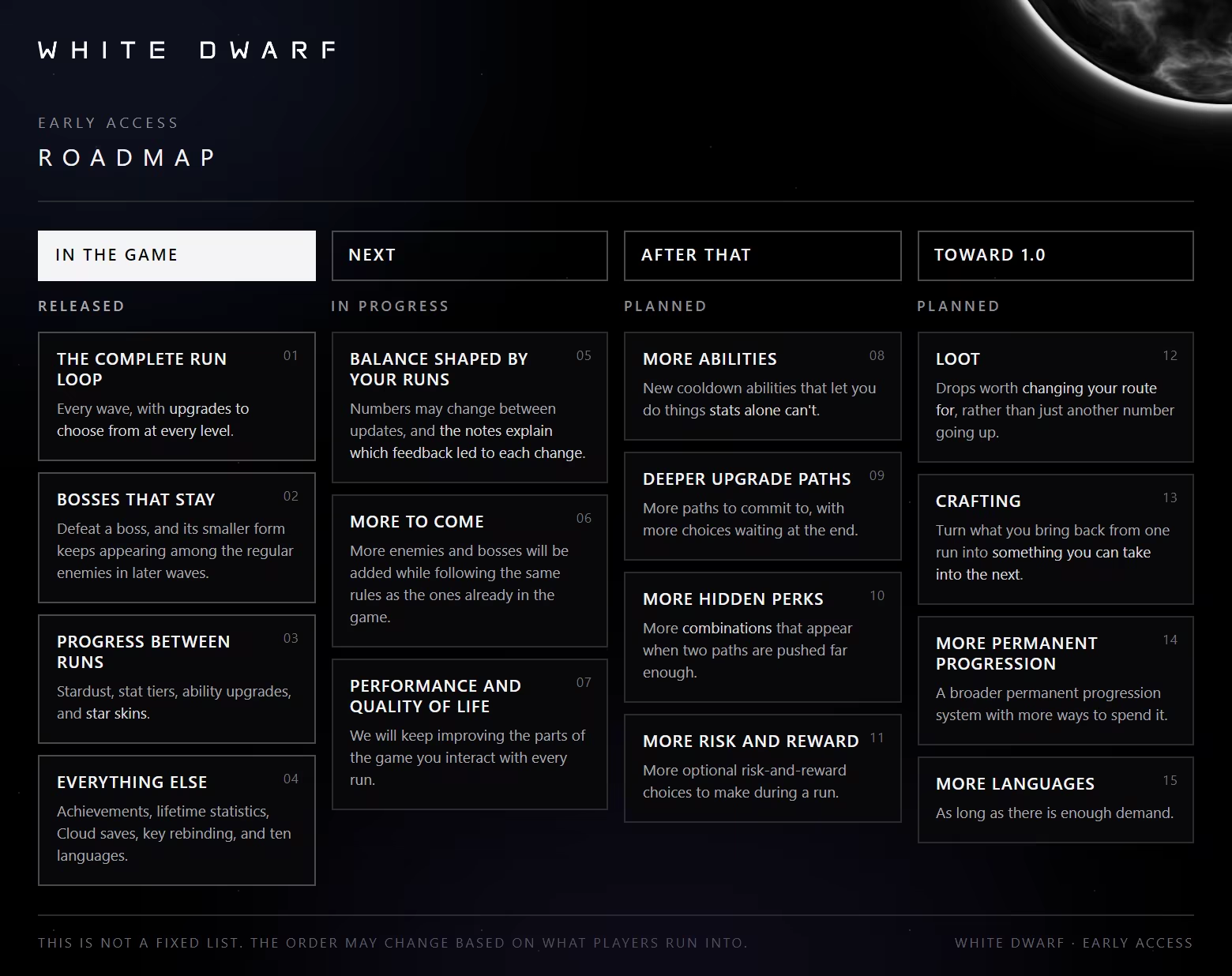
We plan to add more enemy types and bosses, while keeping the same rule that the current ones follow: when you defeat something, it does not simply disappear. It becomes part of the run and can show up again as you continue playing. We also plan to add more active abilities, deeper upgrade paths, and more perks, including hidden ones that can emerge when two different builds come together. We would also like to add more optional choices where taking on extra risk can lead to a greater reward, expand the progression that carries between runs, and give players more ways to spend that progression.

Alongside new content, we plan to keep working on balance based on player feedback, as well as performance, accessibility and quality-of-life improvements. We may also add more languages if there is enough demand.

None of this is a fixed list, and the order can change based on what we learn from players. Nothing here is a promise of a specific feature on a specific date.”

What is the current state of the Early Access version?

“The game is playable from start to finish. It is not a demo or a small slice of the full game. Everything described on the store page is already in the build: the complete run from the first wave to the run that eventually kills you, upgrade choices throughout the run, perks that emerge from the builds you commit to, bosses that can return as regular enemies after you defeat them, and progression that carries between runs.

The current build also includes achievements with lifetime stat tracking, Steam Cloud so your progress can follow you between machines, keyboard and mouse as well as controller support with full rebinding, ten languages, and a settings menu with graphics, display and accessibility options, including a flash-reduction mode.

For us, Early Access is mainly about expanding the game and tuning the balance, not about making the basic mechanics work. The mechanics currently in the game have been tested and are working. Balance is the part that is still evolving, so numbers may change between updates as we receive feedback, and new content will continue to be added. We intend for saves to carry forward across updates.”

Will the game be priced differently during and after Early Access?

“We plan to raise the price gradually as significant content updates are released, and the full version is intended to cost more than it does now. Buying the game during Early Access is intended to be the cheapest way to get it, and everything added during Early Access is included. There is nothing extra to buy on top of it.

There is one currency in the game. You earn it by playing, and it cannot be bought with real money. There are no timers, daily systems or season passes. We do not plan to change that during Early Access or after the full release.”

How are you planning on involving the Community in your development process?

“The Steam Community Hub is our main channel, and we want it to be part of the development process rather than just a place where we post announcements. Bug reports, balance complaints, "this build is broken", "this wave is a wall", "I never once pressed this button" are all useful to us. We read them, and we want the balance changes between updates to be based on what players are actually experiencing.

We plan to include patch notes with every update explaining what changed and why. That way, players can see what feedback led to a particular change. When we have a real choice about what to work on next, we want to ask the community first and let their responses influence the decision.

The most useful thing you can tell us is not just whether you liked or disliked something, but what happened during the run. What build were you using? Which wave were you on? What killed you? A run we can actually picture is much more useful to us than a rating on its own, and it gives us a much better chance of understanding what needs to change.”
Read more

Buy White Dwarf

INTRODUCTORY OFFER! Offer ends August 27

-10%
$1.99
$1.79
 
See all discussions

Report bugs and leave feedback for this game on the discussion boards

Roadmap

About This Game

You are a white dwarf: a burnt-out stellar remnant, small, dense, and mostly harmless. The rock field around you does not care. It closes in from every direction, and it gets worse with every minute you stay alive.

White Dwarf is a top-down survival shooter about holding onto a piece of empty space for as long as you can. Your weapon fires automatically at the nearest target, so the only things you control are where you stand and when you spend your cooldowns. Everything else comes down to the choices you make along the way.

The field fills in around you

The first wave is just a handful of slow rocks. Thirty seconds later, faster ones arrive. A minute in, things start shooting back. Then come enemies that shrug off damage until their armor is stripped away, and others that split into smaller problems when they die.

New enemy types arrive on their own timers, and they never replace what came before. They stack. The wide-open arena you started in gradually turns into a maze of narrow gaps you have to keep finding.

Bosses do not leave

Every few waves, the field makes room for something much larger, and each boss demands a different answer from you. Some sit behind a shield and absorb everything you throw at them. Some stay at a distance and bombard you from across the arena. Some overwhelm you with reinforcements faster than you can clear them. Others split into smaller versions of themselves the more damage they take. Figuring out which problem is in front of you is most of the fight.

Here's the twist: defeating a boss does not remove it from the run. Instead, a smaller version joins the regular enemy pool for every wave that follows. Whatever you kill, you keep fighting—in greater numbers, in ordinary waves, for the rest of the run. By surviving, you build the roster you'll face later.

Build it on the way up

Every level gives you three upgrades to choose from. Some simply increase your stats: damage, fire rate, health, movement speed, or pickup range. Others give you an entirely new button to press—an active ability on a cooldown that does things raw numbers never could. Clear the space around you. Blink through a wall of rocks. Turn your own kills into the next explosion.

Take the same upgrade five times, and it evolves into a perk: a permanent, named bonus layered on top of everything those five upgrades already gave you. Committing to a single path pays off far more than spreading yourself thin—and deciding which way to go is the choice you face at every level-up while the field keeps closing in.

Some perks never appear on the upgrade screen at all. Push two specific upgrade paths far enough in the same run, and they fuse into something neither could do alone: movement that leaves destruction behind, shots that change on impact, or abilities that reduce each other's cooldowns. Discovering those combinations is one of the biggest reasons to experiment with new builds.

Save your cooldowns

Your abilities are the buttons you save for when everything goes wrong. They turn the moment you're completely boxed in with nowhere left to move into a clean floor and a few precious seconds of breathing room—but only if you didn't waste them thirty seconds earlier on a threat that was never going to reach you.

Increase their area, shorten their cooldowns, and eventually transform how they work entirely, until the same button becomes a completely different decision than it was on your very first run.

Runs end. Progress does not.

Every run rewards you with Stardust based on how far you made it, and Stardust buys upgrades that persist.

Unlock permanent stat upgrades that improve the numbers you start every run with. Upgrade your abilities so they behave differently—not just better. Spend resources before a run to earn another chance after the wave that killed you, or reroll a level-up when none of the options fit your build.

Pick a better star

You begin as a white dwarf because that's all that's left after a star burns out. Stardust lets you become something brighter: swollen giants, roiling supergiants, and stranger remnants that spin fast enough to carve beams through their own halos.

Each star uses its own custom shader instead of a simple color swap, so every one feels like a truly different celestial object. Matching trails are included as well.

One currency, earned by playing and spent on making the next run stronger. No timers. No daily chores. Nothing to buy with real money. You play. You die. You grow a little stronger. Then you do it again.

AI Generated Content Disclosure

The developers describe how their game uses AI Generated Content like this:

All marketing and content translations, except for English and Turkish, are AI-generated.

System Requirements

    Minimum:
    • OS: Windows 10 / Windows 11 (64-bit)
    • Processor: Intel Core i3-6100 / AMD FX-6300 or better
    • Memory: 4 GB RAM
    • Graphics: DirectX 11 compatible GPU with WebGL 2.0 support (Intel HD 520 integrated or better)
    • DirectX: Version 11
    • Storage: 1 GB available space
    • Sound Card: DirectX compatible sound card
    Recommended:
    • OS: Windows 10 / Windows 11 (64-bit)
    • Processor: Intel Core i5-8400 / AMD Ryzen 5 2600 or better
    • Memory: 8 GB RAM
    • Graphics: Dedicated DirectX 11 GPU
    • DirectX: Version 11
    • Storage: 1 GB available space
    • Sound Card: DirectX compatible sound card
Review Filters