

When your pilgrim dies, that pilgrim is done. Kill monsters, absorb their runes, and build up legendary companions with gear, runes and awakenings over dozens of hours. A side-view permadeath action RPG — not a game of short repeatable runs. One death costs you, and one careless moment kills.

Sign in to add this item to your wishlist, follow it, or mark it as ignored

Buy Brimir: Pilgrimage to the Heart


About This Game

A primordial giant died, and became the world.


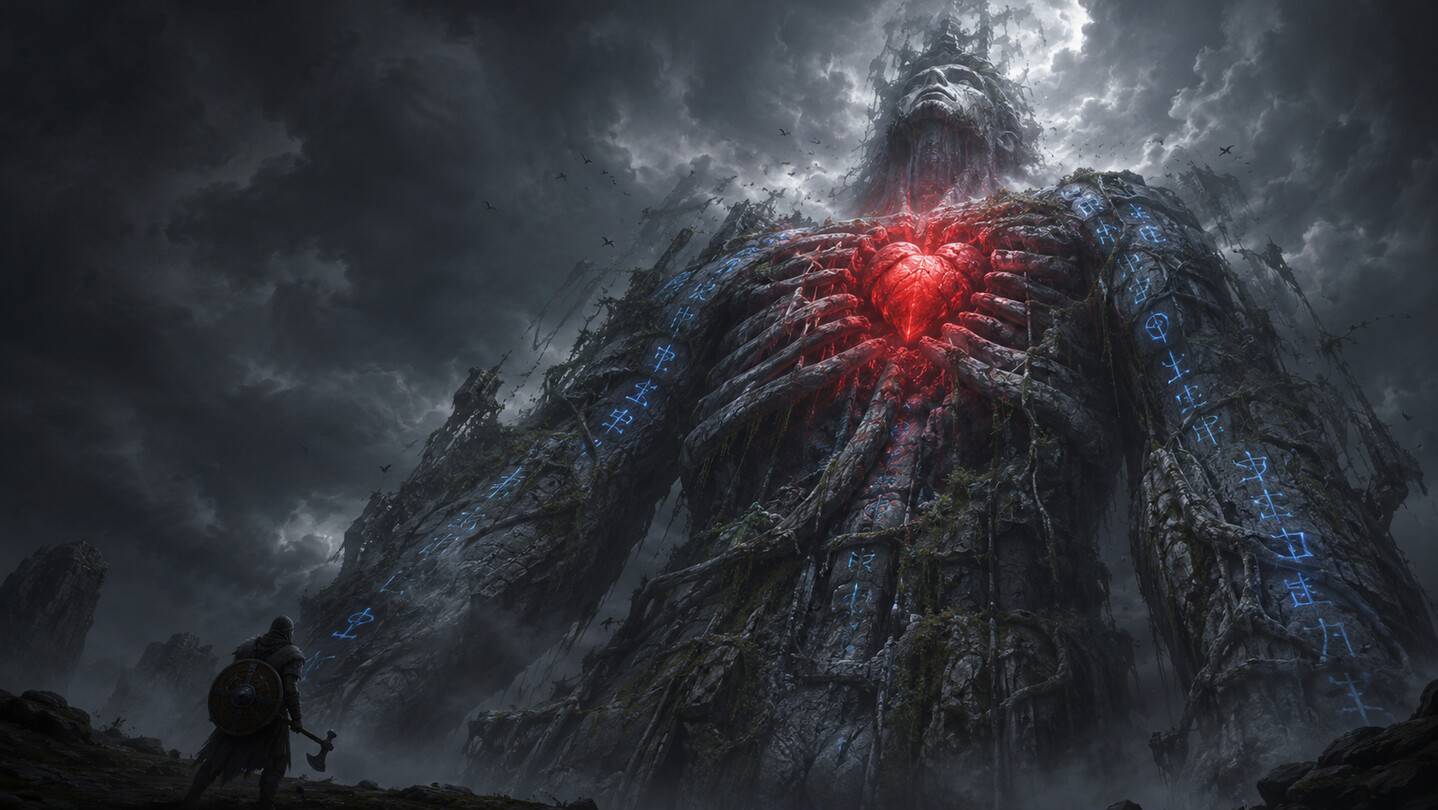
The giant Brimir died on his feet, pierced through the sky. Ages turned his colossal corpse into terrain — skin became land, the space between ribs became canyons, pooled fluids became seas. And high above, in a chest lost to the clouds, the heart still beats.
You are a pilgrim with an axe. From the giant's feet you climb his body toward a heart no one has ever reached.

A side-view permadeath action RPG: kill a monster, absorb the rune it carries, and use that power to take on something stronger.

■ First, what kind of game this is

This is not a roguelike you clear in twenty-minute runs and rebuild from scratch each time. It uses procedural labyrinths and permanent death, but the frame underneath is an RPG where one build grows over dozens of hours.
Runes, gear and companions are not disposable per-run pickups. You come back to town, rework them, and spend dozens of hours making one pilgrim into something. Death is not cheap here — which is exactly why a single death weighs something.
If you are looking for something to dip into in short bursts, this is not it. If you like sinking in and raising something over time, it is.

■ The thrill of scraping through alive

When a monster finds you, there is almost no way home. The recall gear is single-use. A companion's dimension door takes ten seconds to cast and breaks if you are hit even once. Running is not an option so much as a luxury.
Every encounter becomes the same question: how do I survive this one?

■ Breaking the wall that once broke you

That monster that killed you again and again — beat it, and its rune is yours. Take down Isvar of the Bitter Cold, the wall of the first floor, and Blood of the Snowfields is yours. Take down Karnik of the Red Night, and so is Lifesteal. Nearly every monster you can kill is a rune: 414 of them.
Meeting that same monster later and flattening it in one pass — that is the payoff this game is built around.

■ You lose most of it — and climb back faster

When your pilgrim dies, that pilgrim is done. And most of it stays behind — the levels, the marks, the gold you saved, the runes and gear you carved into that body. All you carry into the next life is a handful of runes and relics, and you have to choose them yourself in the moment you die. The deeper the death, the more you get to take.
This is not a loss you shrug off. That is exactly why a single death weighs something.

But the second pilgrimage is far faster than the first.
The companions who walked with you do not disappear. You never have to go find them and win them over again — come back to town and they are simply at your side.
The pilgrim's trail you accumulate with every death is permanent: it raises how many runes you may carry into the next life, and preserves the standing you earned with the Mage Tower and the Temple. Your bestiary and rune research are never wiped either — you start already knowing which monster drops which rune, and what that rune's hidden numbers are.
Stretches that took you days the first time, you walk through the second time because you know them. The pilgrimage is not one person's story but a line of them.

■ Few keys, endless decisions

The controls are simple: move, attack, block, and four skills. This is not a game about fast hands.
It is a game about hard choices. You get exactly as many rune slots as your level, so the question is never what to equip — it is what to give up. How to combine your companions' runes, what order to fire skills in, who to bring along. You will die a lot while working that out.
Even once you know the game, one careless moment still kills you.

■ The legends who climb with you

Legendary companions join you one at a time along the pilgrimage. You do not pilot them — you build them. Gear, runes, bonds, awakenings: every companion is another build. Up to five climb with you.

■ Climbing a giant's corpse

You start at the feet and climb seven floors — each a different part of the body, a different ecology, a different death. In the 25 rifts torn open across him, wardens wait.
And with every heartbeat the giant's blood surges through him like a rising tide. Linger too long and you are swept out. The heart you are chasing is what pushes you back.

■ Made by one person — and to be straight with you

This is a solo project, so I would rather say this up front.
It is not an easy game to get into. You will die a lot early on, the systems do not all land at once, and it is not built for short sessions.
But once it takes hold, I think it is hard to put down. The players who stay longest are the ones who keep swapping runes and rebuilding their party.
If that kind of thrill is what you are after, this is for you — and the free demo is there if you want to check first.
I keep fixing and adding after launch, based on what players tell me.

AI Generated Content Disclosure

The developers describe how their game uses AI Generated Content like this:

Some 2D art assets in Brimir: Pilgrimage to the Heart (such as background illustrations and key art) were created with the help of AI image-generation tools, then reviewed and edited by the development team. Purchased asset packs and tilesets, as well as all game code,
systems, and design, are not AI-generated. We have taken care to ensure the generated content does not infringe on existing intellectual property.

System Requirements

    Minimum:
    • OS: Windows 10
    • Processor: Dual-core 2.0 GHz+
    • Memory: 4096 MB RAM
    • Graphics: OpenGL 3.3 / Vulkan
    • Storage: 500 MB available space
Review Filters