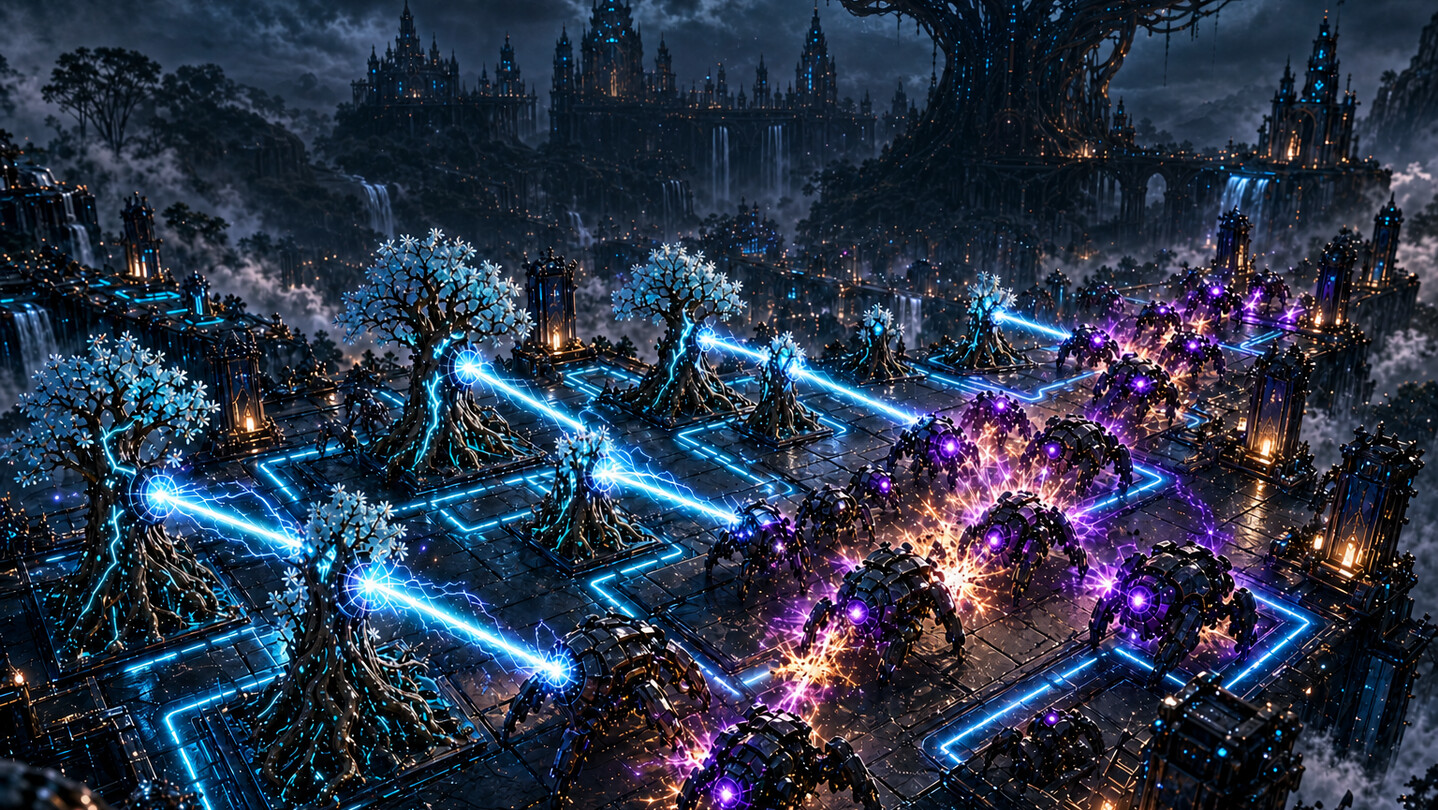

Voltwood is a competitive mazing tower defense with procedurally generated maps. You can't beat waves — hit par or pay. The better you do the higher your score. Compete on daily and weekly maps and a roguelike weekly gauntlet, check the boards to see who built the best maze or chill in casual mode.

Sign in to add this item to your wishlist, follow it, or mark it as ignored

Coming Soon To Early Access

The developers of this game intend to release as a work in progress, developing with the feedback of players.

Note: Games in Early Access are not complete and may or may not change further. If you are not excited to play this game in its current state, then you should wait to see if the game progresses further in development. Learn more

What the developers have to say:

Why Early Access?

“VOLTWOOD is deep, complete-feeling and extensively tested — but a competitive tower defense lives or dies on how it FEELS in thousands of real hands across thousands of maps, and that is the one thing testing alone cannot answer. Early Access lets us tune the difficulty curve, par calibration, onboarding, and readability against real players and real maps before we commit to 1.0. The game already ships with a built-in feedback line — Early Access is how we use it. If you like sinking your teeth into a systems-rich defense game and want a hand in shaping its balance and pacing, this is the time to jump in.”

Approximately how long will this game be in Early Access?

“We expect six months to a year. The point of Early Access for us is to get the balance right according to the people actually playing the game, and to close any gaps they identify. We consider Voltwood near content-complete today: our 1.0 gate is balance and polish validated by real players across a wide range of maps, not a feature count.”

How is the full version planned to differ from the Early Access version?

“The full version is planned to be the finished, fully polished version of the game you are playing today — not a substantially different one. The core is all here: procedurally generated shareable maps, the par-based Torrent, the weekly roguelike Gauntlet and a casual mode, procedurally built enemies and the fused tower modules built to answer them, the Core and its modules, heroes, live leaderboards, and full localization in twelve languages. The road to 1.0 is polish and refinement within these systems, not new systems:
  • Difficulty and par calibration tuned from real Early Access play data across many maps
  • Onboarding and readability refined from first-time-player feedback
  • We are happy to add new content if the community wants it, for example new enemy types, tower modules, heroes and hero abilities shaped by player feedback. The systems are data-driven and built to grow if needed.
  • Presentation pass: visual evolution, late-game clarity, VFX polish
  • Quality-of-life and accessibility improvements the community asks for
We do not plan to gate existing content behind 1.0, and any price change at launch will be announced ahead of time.”

What is the current state of the Early Access version?

“Fully playable start to finish: every enemy trait and every tower module implemented, all modes live (Torrent, the weekly Gauntlet, casual), daily and weekly maps, the Core and all of its modules, heroes, per-map, personal and per-mode leaderboards, a first-run tutorial, a Field Manual, Steam achievements and Cloud saves, full controller support, and complete localization in twelve languages. The systems are stable and covered by an automated architecture test suite. What we're actively refining is the FEEL — difficulty tuning across the full range of maps, the clarity of the opening experience, and the visual polish a premium tower defense earns.

One expectation to set up front: balance patches change how a wave plays out, so they retire runs recorded on earlier builds. A saved replay from an older build can no longer be watched, and a shared Solution from one can no longer be verified. A larger update that changes how waves are built can also stop saves from earlier builds from loading, as our most recent one did. Your scores, your achievements and your leaderboard places are not affected, and a score still waiting to upload when you update is posted as usual. Expect this to keep happening while we are still tuning — it is the cost of the balance work Early Access is for.”

Will the game be priced differently during and after Early Access?

“The price may rise modestly at 1.0 as polish and content accrue. Any change will be announced in advance.”

How are you planning on involving the Community in your development process?

“We encourage the community to tell us about their experience by reporting bugs, suggesting changes and helping to shape the vision for how Voltwood can become the best it can be. Player feedback will be critical to delivering the 1.0 release of Voltwood.

Where we will talk to you, and what each channel is for
  • Dev updates — on this page and inside the game. Every build ships with written patch notes: posted to the Steam news feed, readable in-game under Patch Notes, and archived on our website. When a change came from a player report, the notes say so.
  • Talking to us — the Steam Community Hub. The discussion boards are the main room: strategy, balance argument and questions. This is the channel we check first.
  • Bugs and feature requests — the in-game feedback button. One click from anywhere in the game, and it attaches the map ID, wave and build version automatically, so we can reproduce exactly what you saw instead of guessing at it. The boards work fine for these too — the button is just the fastest route, not a rule.

How often
Every build we release ships with written notes — in the game, on the Steam news feed, and on our website. That is not just an intention: our build process will not produce a release that has no patch notes attached to it.

So you hear from us every time we ship a patch or a game update, and again whenever we reach a significant development milestone. When a change came from a player report, the notes say so.

What you can shape
The feedback we most need is about how the game balances:
  • Balance and par. Every battlefield is procedurally generated from a shareable map ID and scored against a par target, so "this map is unfair" is a report we can act on precisely: send us the map ID and we can regenerate the exact battlefield you played and retune against it. All balance in Voltwood lives in data catalogs rather than in code, so a well-argued report can move numbers in the next patch instead of the next milestone.
  • Modules against enemy types. Whether a weapon module actually answers the thing it is meant to answer, and which enemy compositions leave you with no good tool.
Beyond that, everything is open: enemy types and composition, module types, champions, heroes and villains, the Gauntlet, leaderboards and scoring, map IDs, replays, onboarding and readability — and ideas for where the game should go next, including expansions. We would rather hear an idea than not.

We will not implement every suggestion, and we would rather say so than pretend otherwise. What we will do is consider each one properly, and tell you what we decided.

How we will run it
  • Every report gets a disposition. We keep a triage log of every bug and idea that reaches us, and each one is either fixed or answered with the reason it was not. Nothing is silently dropped.
”
Read more
This game is not yet available on Steam

Coming soon

Interested?
Add to your wishlist and get notified when it becomes available.
 

Report bugs and leave feedback for this game on the discussion boards

See all discussions

About This Game

The map is never the same twice.

Every VOLTWOOD map is procedurally generated. The checkpoints, the blockers, the ground zones, the enemies and the prices are a unique combination every time you play. To replay or share a map, use its map ID.

You compete to maximize kills, not just kill the wave.

VOLTWOOD is a maze-building tower defense built to be competitive. Kill as many enemies as you can during each wave; harder difficulties multiply your score. A good maze kills more; the best maze earns a spot on that map's leaderboard.

Read your waves.

Every wave is generated to create distinctive combinations of enemy stats and abilities, so no two maps are likely to have the same waves. You can see every wave in advance, including each enemy's stats and abilities in detail. Adapt your maze and module strategy to get the most out of every wave.

Survive each wave by meeting or exceeding par.

In the competitive modes, every wave has a par: the number of kills you need. Beating par grants your Core additional shielding. Missing par costs your Core shielding or health. Plan accordingly.

Pick the right tower modules for the job.

You can add modules to your towers and then fuse them with a second module to create special combinations. Find the right mix of modules and fusions to solve the waves for each map.

Every map sets its own prices.

Procedural generation creates endless challenges. Most costs in the game are unique to each map, and they shape the best way to solve it. Focus on the buildings, upgrades, modules and global investments that deliver the most value.

More ways to kill.

In addition to your maze and towers, you always have your map's Core, which has 6 slots for modules unique to the Core: the Hero Barracks, where you recruit and deploy powerful heroes, the propaganda array, hypersonic missiles, drone swarms, stasis fields, the overclock grid and more. Each gives you specific tools to address challenges in unique ways.

Dial up the challenge.

Difficulty settings raise the challenge, and your score, in competitive Torrent play. In Casual, custom run options make the game easier or harder, so you can set up the kind of game you enjoy most.

Show off in the weekly Gauntlet.

After practicing in Torrent, show off on the daily and weekly maps, or in the weekly Gauntlet: a new run of maps every week, the same for every player. Earn coins along the way to spend in the Gauntlet store, and play for a high score on the Gauntlet leaderboard.

Features

  • Procedurally generated, shareable maps: endless variety, and a map repeats only when you choose to replay it
  • Maze tower defense: enemies reroute live as you build
  • The wave-par mechanic: every kill above par counts
  • Procedurally built enemies with rolled traits, and fused tower modules to counter them
  • Per-map prices, with every module, Core module, hero and upgrade open from the first wave
  • Core modules: hypersonic missiles, drone swarms, a hero barracks and more
  • Autonomous heroes, each with their own abilities
  • Modes: Torrent (the ranked par competition), a weekly roguelike Gauntlet, and Casual
  • Daily and weekly official maps with live leaderboards, plus per-map and personal bests
  • Difficulty settings that weight your score: take on more risk for a bigger multiplier
  • Separate leaderboards for Gauntlet, Torrent and Casual
  • Replays: share your best run as a Solution other players can watch

AI Generated Content Disclosure

The developers describe how their game uses AI Generated Content like this:

Voltwood was developed with AI assistance. Pre-generated AI content that ships in the game and on the store page includes: 3D unit, structure, and environment models generated with Meshy from our own concept art; 2D art generated with OpenAI image models (in ChatGPT and through Comfy Cloud) from the developer's direction, including store capsule art, the logo, the app icon and key art, menu artwork, and achievement icons; music generated with Mureka; cinematic and trailer video generated with Google Veo through Comfy Cloud; sound effects and character voice lines generated with ElevenLabs; game code, UI icons, and interface and store-page translations authored with Anthropic Claude. All AI output was reviewed, curated, and integrated by the developer, and all of it is owned by the developer under the respective services' paid-tier terms.

System Requirements

    Minimum:
    • OS: Windows 10 64Bit
    • Processor: Dual core 2.4 Ghz
    • Memory: 4 GB RAM
    • Graphics: GPU with Vulkan 1.0 or DirectX 12 support (GTX 660 / Intel Iris Xe)
    • Storage: 700 MB available space
    • Additional Notes: 1080p display recommended
    Recommended:
    • OS: Windows 10/11 64-bit
    • Processor: Quad-core
    • Memory: 8 GB RAM
    • Graphics: GeForce GTX 1060 / Radeon RX 570
    • Storage: 700 MB available space