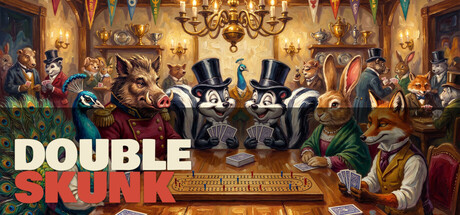

A cribbage roguelite deckbuilder. Build a hand, score a show, win a leg, repeat. Climb the Long Tally from regional clubs to nationals. Stack powerups, spend consumables, mark your cards, and out-peg every opponent. Campaign, online multiplayer, and vs AI.

Sign in to add this item to your wishlist, follow it, or mark it as ignored

Coming Soon To Early Access

The developers of this game intend to release as a work in progress, developing with the feedback of players.

Note: Games in Early Access are not complete and may or may not change further. If you are not excited to play this game in its current state, then you should wait to see if the game progresses further in development. Learn more

What the developers have to say:

Why Early Access?

“Double Skunk is a cribbage roguelite built by one developer on the side. The core systems are stable: the scoring engine, the pegging round, the run loop, and three game modes you can play right now. What still needs to settle is the kind of tuning you can only get from a real player population. Run-to-run balance, opponent behavior at higher difficulties, and the long arc of the campaign all need more hands on the game than one person can put on it alone. Early Access is the honest way to ship that: get the game in front of cribbage and deckbuilder players, let their runs shape what 1.0 becomes, and ship the work incrementally instead of in one big bang.”

Approximately how long will this game be in Early Access?

“Approximately six to nine months. The plan is to use Early Access for several rounds of content additions and balance tuning based on player feedback before declaring 1.0. We'll publish a roadmap when the Early Access build launches and update it as work lands.”

How is the full version planned to differ from the Early Access version?

“The Early Access build ships with the full core gameplay loop, three game modes, and a campaign that plays end to end. We plan to use the full version to deepen the content around that loop: more opponent variety per zone, more story beats between milestones, balance tuning at the highest difficulties, and polish passes across art, audio, and UI. Specific powerups, consumables, and peg unlocks may be added or revised based on what the Early Access community finds broken, undertuned, or boring.”

What is the current state of the Early Access version?

“Early Access launches with the full cribbage scoring and pegging engine, three game modes (Campaign, vs AI, Online Multiplayer), a roster of forty powerups, a growing set of consumables, run-tier and campaign-tier card marks, and a campaign of tournament tours from regional clubs through a national championship. Three opponent personalities are available across three difficulty tiers. The systems that determine whether the game is fun (scoring, pegging, the run loop, the build economy) are all in. What's still rough at launch is the polish layer: more visual variety between zones, the story beats between milestone rings, balance at higher difficulties, and the long tail of edge cases that only surface when many people are playing many different builds.”

Will the game be priced differently during and after Early Access?

“We plan to raise the price modestly when Double Skunk exits Early Access. The Early Access price reflects the in-progress state of the build and the value of joining the community early. The full version's price will reflect the additional content, polish, and tuning that Early Access feedback produces. Players who buy during Early Access get the full version at 1.0 without paying the difference.”

How are you planning on involving the Community in your development process?

“The Steam Community Hub will be the primary channel for announcements, patch notes, roadmap updates, and bug-report threads. I'll read every post and respond where my time as a solo developer allows. Patch notes for every Early Access update will explain not just what changed but why, so the reasoning behind balance tweaks and content choices is visible. Major design decisions that affect the run loop (such as adding or rebalancing core powerups or changing the structure of the campaign) will be aired in advance for discussion before they ship. The roadmap will live as a pinned post on the Community Hub and update as work lands so the trajectory of the build is always visible.”
Read more
This game is not yet available on Steam

Planned Release Date: Q3 2026

Interested?
Add to your wishlist and get notified when it becomes available.
 
See all discussions

Report bugs and leave feedback for this game on the discussion boards

About This Game

A cribbage roguelite deckbuilder. One peg, one board, one tournament tour at a time.


You're a traveling cribbage player working your way up the Long Tally, a tour that starts at regional clubs and ends at the national championship. Every match is a real cribbage match. Deal six. Drop two to the crib. Peg the round. Count the four cards in your hand against the cut.

Between matches, you build the player who shows up to the next one. Between tours, you build the player who walks back into the next tour.

Three ways to play


  • Campaign: the full Long Tally tour, with persistent unlocks, peg selection, and the campaign-layer build that carries between runs.
  • vs AI: one-off matches against AI opponents at three skill tiers and three personalities. No campaign, no progression. Just cribbage.
  • Online Multiplayer: head-to-head cribbage against another human, outside the campaign. Matchmaking and direct lobbies.

The run and the campaign


A run is one tournament tour from a regional club through nationals, with different opponents in every zone. Within a run, you build a temporary loadout: powerups that change how your hands score, consumables you spend between matches, crayons that mark specific cards for the duration of a single tour. When the run ends, the build resets.

The campaign sits above the runs. Across many tours, you earn permanent markers on specific cards, unlock different pegs to play as, and climb a tree of milestones that persists win or lose. The run's build is loud. The campaign's build is patient.

How the count builds


Cribbage already stacks small scores into bigger ones. The four cards you keep plus the cut combine into fifteens, pairs, runs, and flushes. A run of three with two fifteens is eight points. A run of four in a flushed hand can clear twenty before any modifiers fire.

The roguelite layer takes the count past where a kitchen-table game would stop. A powerup that triggers on every fifteen pushes a fifteens-heavy hand into the thirties and forties. A crayon on your favorite card doubles whatever it touches. Two or three good builds in a run and the counts grow into territory regular cribbage doesn't reach.

Powerups, consumables, and marks


Three systems shape your build.

  • Powerups: modifiers that fire on specific scoring events. Some trigger on fifteens. Some trigger on pairs. Some trigger on the run-ending Go. Stack them and the synergies stack with them.
  • Consumables: one-use items you spend during a match for a specific effect. One use, one decision.
  • Marks: enhancements applied to specific cards. Crayons last for one tour. Markers carry across the entire campaign. A doubled Five. A penalized Jack. A card that scores twice when it shows up.

Cribbage, if you've never played


Cribbage is a 350-year-old card game played to 121 points. Two players take six cards, drop two each into a side pile called the crib, then take turns laying cards down to a running count that resets at 31. The pegging round is a tactical poke and parry. Then both players reveal their four-card hands and count the score against a randomly cut fifth card: every fifteen, every pair, every run, every flush, every nob.

We kept all the rules. The roguelite layer is the wrapper, not the replacement. If you have played cribbage at a kitchen table, the math is the same from minute one.

What's in the box


  • Three game modes: Campaign, vs AI, and Online Multiplayer.
  • A campaign of tournament tours from regional clubs through the national championship.
  • Different opponents in every zone, each with their own personality and skill tier.
  • Multiple pegs to play as, each with their own play personality.
  • A growing roster of powerups, consumables, crayons, and campaign markers.

Early Access


Double Skunk is launching in Early Access while the campaign content and balance fill in. The core systems are stable: the scoring engine, the pegging round, the powerups, the marks, the campaign layer, all three game modes. The content is still growing: more opponents per zone, more rings on the campaign tree, more tuning passes against real player runs.

We're aiming for a content update every six to eight weeks during Early Access, and a 1.0 release once the full ring of opponents is in and the tuning has had time to settle against the EA cohort's runs.

If that sounds like a game you want to help shape, wishlist now and the page will notify you the day the demo lands.

AI Generated Content Disclosure

The developers describe how their game uses AI Generated Content like this:

Static art assets (store-page capsules, in-game card art, in-game icons) and audio placeholders are generated via Replicate (Google Nano Banana Pro for image, Lyria-2 / AudioGen for audio) using human-authored prompts. Outputs are reviewed by the developer before shipping. No live AI generation occurs during gameplay; all assets are baked at build time.

I would like to pay for human assets, but I am moving fast. In the same way that AI turned 12 months of dev time into 2, it also affected how I skinned the MVP. This is best for communicating intention, and I can polish it with human art if there is traction.

System Requirements

Windows
macOS
    Minimum:
    • OS: Windows 10 64-bit
    • Processor: Dual-core 2.0 GHz
    • Memory: 4096 MB RAM
    • Graphics: OpenGL 3.3 / Vulkan compatible (integrated graphics OK)
    • Storage: 1024 MB available space
    Recommended:
    • OS: Windows 10 64-bit or Windows 11
    • Processor: Quad-core 2.5 GHz
    • Memory: 8192 MB RAM
    • Graphics: OpenGL 3.3 / Vulkan compatible, dedicated GPU recommended
    • Storage: 2048 MB available space
    Minimum:
    • OS: macOS 12 Monterey or later
    • Processor: Apple Silicon (M1 or later) or Intel x86_64 dual-core 2.0 GHz
    • Memory: 4096 MB RAM
    • Graphics: Metal-compatible GPU
    • Storage: 1024 MB available space
    Recommended:
    • OS: macOS 13 Ventura or later
    • Processor: Apple Silicon (M2 or later) or Intel quad-core 2.5 GHz
    • Memory: 8192 MB RAM
    • Graphics: Metal-compatible GPU
    • Network: Broadband Internet connection
    • Storage: 2048 MB available space
* Starting February 15, 2024, the Steam Client will no longer support 32-bit games or macOS 10.14 or lower.
There are no reviews for this product

You can write your own review for this product to share your experience with the community. Use the area above the purchase buttons on this page to write your review.

Review Filters