
Classification yards, waybills and live dispatch — on a 1:4-scale Earth. Build a multi-modal freight empire across rail, sea and air through twelve eras of transport history, in a persistent world shared by up to 255 companies.

Daftar masuk untuk menambah item ini ke senarai hajat anda, ikuti atau tandakannya sebagai diabaikan

Akan Datang ke Akses Awal

Pembangun permainan ini berhasrat untuk melancarkannya sebagai projek yang sedang berlangsung, dengan perkembangan dipengaruhi oleh maklum balas pemain.

Nota: Permainan dalam Akses Awal belum lengkap dan mungkin akan mengalami perubahan. Jika anda tidak berminat untuk bermain permainan ini dalam versi semasa, anda seharusnya menunggu untuk melihat jika permainan ini akan terus dibangunkan. Ketahui lebih lanjut

Kata-kata daripada pembangun:

Kenapa Akses Awal?

“Age of Transport - Blue Marble is a persistent multiplayer game, and the multiplayer half of it is unfinished by design — because the decisions it still needs are not ours to make alone.

The single-player simulation is playable end to end today. What comes next is the part that only exists once people are in it: how dedicated servers are hosted and administered, what tools the people running large worlds actually need, how communities grant standing to their members, what a world of 255 companies demands that a world of five does not, and how twelve eras of balance hold up when players spend fifty hours in each of them rather than the hours we can spend ourselves.

The charter system is the clearest case. Charters are the objectives that give a player direction in an otherwise entirely open world — undertakings, trials, surveys, routes and developments, with the largest of them gating the eras. Early Access ships with a basic set, and the stack it grows into will be built substantially from what players suggest. The thing that tells you what to do in this game is a thing our players help write.

We have opinions about all of that. We do not have answers, and we would rather build the answers with the people who will live in these worlds than guess and ship. Early Access is where that conversation can happen while the game is still shaped by it.”

Berapa lama permainan ini dijangka akan berada dalam Akses Awal?

“We're planning around nine to twelve months. That estimate assumes the networked infrastructure — dedicated servers in particular — lands roughly on schedule. If real-world testing tells us it needs longer, we'll take longer and say so, rather than shipping 1.0 on a date we picked before we had the data.”

Apakah perbezaan yang dirancang antara versi penuh dan versi Akses Awal?

“The multiplayer and community layer will be built out rather than merely hardened. Dedicated server hosting will be released with the administration tools operators ask for during Early Access — we have a first guess at what those are and expect to be wrong about some of it. The lobby, standings and watchdog will have grown features we haven't thought of yet.

The charter system will have grown from the basic set at launch into a much larger body of objectives, a substantial part of it built from what players suggest and ask for.

Balance across the twelve eras will have been reworked against real play: charter difficulty, era pacing, city-service thresholds and the economics of each period, tuned by how people actually play rather than how we imagined they would.

The vehicle catalogue will be substantially larger than the 2,500+ at Early Access launch, and prioritised by player requests.

And the systems that ship at launch will have had a year of real use behind them — including the ones we will have changed because players showed us a better idea.”

Bagaimanakah keadaan semasa versi Akses Awal?

“Playable end to end, single-player and multiplayer. All twelve eras, the economy and production chains, industry and power, city growth and control, the research tree, the 2,500+ vehicle catalogue, Train Spotter mode and world visitors are in and working.

Multiplayer is where the development is. The global lobby, global standings, server availability watchdog and dedicated server hosting are built and working, but they are young: they have been exercised by our own testing rather than by real communities, and both the feature set and the administration tools will change substantially based on what server operators tell us they need. Expect refactoring and optimisation as real load arrives.

The charter system ships with a basic set of objectives. It is deliberately a starting point rather than a finished body of content, and growing it is one of the main things Early Access is for.

Balance is the other open area. Era pacing, charter difficulty and city-service thresholds are tuned against our own playthroughs. Twelve eras at twenty to fifty hours each is more play than a small team can generate, and these numbers will move as players reach places we haven't.

One commitment that will not change: we do not wipe worlds. The world you start with is the world you keep.”

Adakah harga permainan ini berbeza semasa dan selepas Akses Awal?

“Yes. The price will increase going from Early Access to version 1.0. Buying early costs less and always will — there is no edition, season pass, DLC or in-game purchase to buy on top of it, now or ever. One purchase covers the game, everything added during Early Access, and everything added after it.”

Bagaimana anda merancang untuk melibatkan Komuniti dalam proses pembangunan anda?

“**Player feedback is the primary input, not a suggestion box.** Early Access exists so that the people living in these worlds decide what gets built next, and the work is organised around four things they genuinely shape.

**Dedicated servers and the tools around them.** The people running large worlds for months are the ones who will find what is missing, so their feedback is prioritised. Administration tools, how communities grant standing to their members, how worlds are listed and discovered — none of it is settled, and it should be settled by the operators it affects rather than by us guessing at what they need.

**The charter system.** Charters are the objectives that give a player direction and purpose in an open world, and Early Access ships with a basic set. Growing that stack is a conversation we intend to have in public, because every player has a route they want built or a record they want attempted, and the good ones will not all come from us.

**Balance.** Era pacing, charter difficulty and city-service thresholds are our best guess, tuned against our own playthroughs. Twelve eras at twenty to fifty hours each is far more play than we can generate ourselves. Players will reach places we have not, and the numbers that are wrong are the ones they will tell us about.

**The vehicle catalogue.** The production queue is public — you can see what is being built now and what is queued behind it. What moves up that queue is decided by what players ask for. We are working towards an in-game voting system so that requesting and voting happen where players already are, rather than on a forum they have to remember to visit.

**How we communicate.** The Steam forums and our community channels, read and answered by the developer rather than by a community manager. Regular builds with changelogs that say what changed and who asked for it. And regular posts about what is going well and what is proving harder than expected — including the things we got wrong.”
Baca lagi
Bahasa Bahasa Melayu tidak disokong

Produk ini tidak menyokong bahasa tempatan anda. Sila semak senarai bahasa yang disokong di bawah sebelum membuat pembelian

Permainan ini belum tersedia di Steam lagi

Tarikh Keluaran Dirancang: 2027

Berminat?
Tambah ke senarai hajat anda dan terima pemberitahuan apabila permainan sudah tersedia.
 

Laporkan pepijat dan tinggalkan maklum balas untuk permainan ini di papan perbincangan

Lihat semua perbincangan

Tentang Permainan Ini

Age of Transport™ - Blue Marble began as a love letter to railroad history. That part never changed.

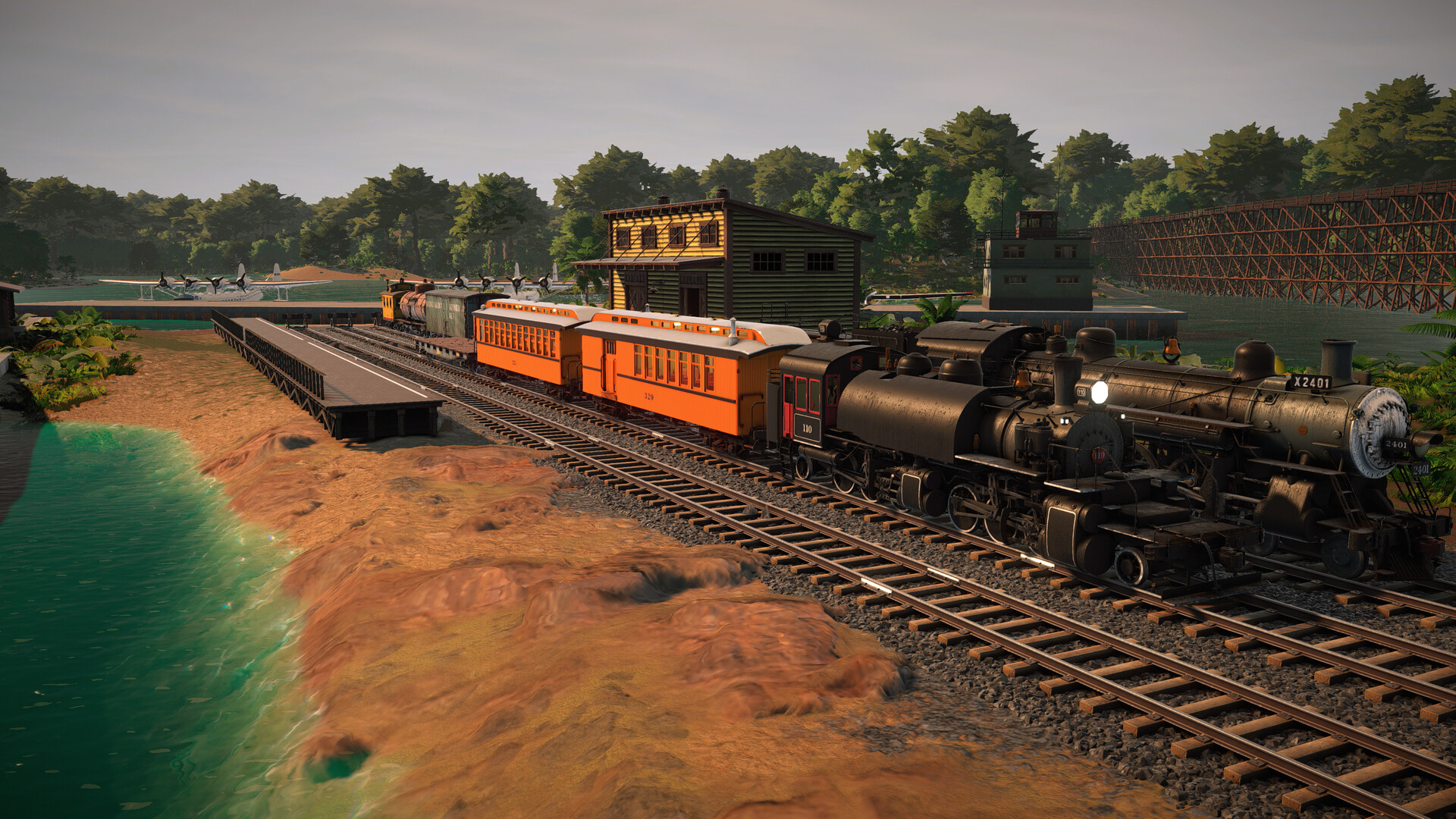
Trains are dispatched, not assigned to routes. Consists arrive on the receiving tracks, go over the hump, and are sorted through the bowl into new trains. Track is rail, sleepers, fastenings and ballast, and your line is only as good as the worst of the four. Branch lines are built like branch lines, not like mains. Every locomotive in this game was built by someone, somewhere, for a reason — and it still has the reason in it.

What we wanted was for all of that to *matter*.

In every tycoon game ever made, the railroad is how you earn money, which means the operation itself is decoration. Replace the yard with a number and nothing changes but the animation. So we took the money out. Now the railroad isn't how you earn — it's how a world works. A badly planned junction doesn't cost you cash. It means the city on the other side of it doesn't get what it needs.

The map is the actual Earth at 1:4, with more than 70,000 real cities full of people who need things that are somewhere else. You build the mines and the factories, the power stations and the schools — and then you build the thing that connects them, because nothing moves unless you move it.

You get one world of your own, and one company. It's a game meant to be played once, and to still have somewhere to go on your five hundredth hour.

THE SHORT VERSION

  • The whole Earth, at 1:4 scale. 35 million km², more than 70,000 real cities, real mountain passes and rivers. All installed with the game — no streaming, no network required.

  • There is no money. Cost is work. You don't buy a locomotive, you build it — from ore you hauled, in a shop that's busy until Thursday.

  • Real railroading. Trains are dispatched, not assigned to routes. Yards hump and sort. Track is rail, sleepers, fastenings and ballast, and your line is only as good as the worst of the four.

  • Charters give a planet a purpose. Undertakings, trials, surveys, routes and developments — you choose what kind of game you're playing this month, and the largest of them are the gates between eras.

  • You build the industry as well. Mines, factories, production chains nine steps deep, and the power stations and grid that keep them running. The chains go deep — but this is not a game about units per minute, it is a game about whether Chicago gets fed.

  • Your network feeds itself. Your railway hauls coal, and your railway burns coal. Steam wants water towers, electrics want catenary, ships want bunkers, aircraft want fuel on the apron.

  • Cities are people, not points. They need food, then comfort, then medicine. You zone them and build their schools — and an educated city is the only place your high-tech factories can go.

  • More than 2,500 rail vehicles, before the ships and the aircraft. The tech tree unlocks capabilities rather than catalogue entries: research the gas turbine and you get every turbine locomotive, not one.

  • Every mode has real physical limits. Nothing but a ship crosses an ocean. Only a seaplane reaches a place with no runway. Until the late 1930s, no aircraft can fly over a mountain range at all.

  • Nothing is ever waiting for your attention. A yard rebuild in Chicago, an ore corridor in Western Australia, a river service you have been meaning to fix since last week — all of it running at once, all of it yours to move between. You move between projects, not through time.

  • Get down to track level whenever you like. Set the spotter panel to what you actually love — steam or diesel, yards, harbours, arrivals, panoramas — and the camera goes and finds it. A coal drag lifting a grade in the Rockies. A night departure under station lights. Your world becomes an aquarium.

  • Twelve eras, the 1830s to today. You inherit every decision you ever made. The route that was a triumph in 1880 is the bottleneck of 1950.

  • One world of your own, and only one. Persistent, cloud-synced, never wiped, no restarts — and playable entirely alone for as long as you want.

  • Or share the planet with hundreds of people. Up to 255 companies in one running world, 500 or more concurrent players on a good dedicated server, and it all keeps running whether you are logged in or not. Persistent multiplayer at this scale is new to the genre.

  • The other players are your customers. The airline needs concrete for its runways and fuel somebody else refined. The railways need aluminium that crossed an ocean. Past a certain point nobody is self-sufficient, and that is the design working.

  • Open your world, and let it have an audience. Visitors spectate, found their own company on your map, or join yours as associates. Spectators lock to your camera and see exactly what you see, in real time — and the watchdog tells them the moment you log in, even from a world of their own.

  • No DLC. No microtransactions. Not ever. Every world is a shared world, so everyone in it runs exactly the same game.

THE WORLD

At a scale of 1:4, planet Earth offers 35 million km² (13.5 million mi²) of familiar and exotic environments alike. Real mountain passes, coastlines and rivers, and more than 70,000 real cities. All part of your basic game installation — no streaming and no network required. Build the Trans-Siberian. Rebuild the Alpine freight corridors. Take on a single country and do it properly, or span a network across every continent.

And the world is real in the way that matters most: things are where they actually are.

Chilean saltpetre is the only route to dynamite until nitrogen fixation arrives in the 1910s, which means South America holds a genuine monopoly on the ability to blast a tunnel through a mountain. Break that monopoly and mountain ranges stop being walls — but until you do, somebody else owns the mountains.

Aluminium needs cryolite, and cryolite means Greenland, which is what makes an Arctic route worth an appalling cost to build. Rare earths mean Asia. Tantalum means Central Africa. Put those together and a computer turns out to depend on three continents at once — you cannot build one from a single landmass, and that isn't a balancing rule. It's just where the ore is.

===== WHAT YOU OPERATE =====

THE RAILROAD

Trains are not assigned to routes. They're dispatched.

You lay down multi-track corridors following a real hierarchy — main lines, secondary lines, branch lines, industrial spurs and yard leads, down to logging lines laid to last a season and no longer. Each class carries its own standards: curve geometry, loading gauge, ruling grade, line speed and the materials available in that era.

The dispatcher plans routes using that hierarchy, so expresses and locals are assigned timeslots on the right tracks. Priorities age, conflicts resolve, meets and passes happen where the infrastructure allows them, and a badly planned junction will teach you exactly why real railroads obsess over junctions. Even a switchback — a zig-zag climbing a mountain in stages — is something the dispatcher will work out for you.

And the track itself is built, not chosen from a menu. Four slots: rail, sleepers, fastenings and ballast. Your line is only as good as its worst one, so the game names the problem — your sleepers are the limit — rather than letting good rail hide a bad foundation. Strap rail on timber baulks does twenty. Head-hardened welded rail on slab track does three hundred and twenty. Getting from one to the other is eleven separate decisions across a century, and the constraint moves every time you solve it.

Build cheap now and upgrade later is a legitimate strategy, not a punished one: half of what you rip up comes back as scrap. Your pioneer iron rails literally become the steel rails that replace them. And the line you laid in 1835 is still there a century and a half later, still doing forty-five, now a rural branch. It never became a liability. It just got old.

THE YARDS

But the real magic happens in the yards.

Consists arrive on the receiving tracks, go over the hump, and are sorted through the bowl into new consists on the departure tracks — ready to be picked up for fresh destinations by locomotives waiting at the engine terminal. Get the yard right and the whole network breathes. Yards are the backbone of any railroad.

The rolling stock you build is assigned to yards and given roles: switcher, road switcher, pusher, express, passenger, mixed, local freight or road hauler. From there the yardmaster takes over, using the stock you've provided to build dynamic consists that behave like the real thing.

THE SHIPS

Nothing in this world moves at scale without ships, and nothing else crosses an ocean. Not one locomotive you will ever build, not one aircraft until very late. If a continent has what you need, something has to float it home.

Steam river boats arrive in 1860, and they stay cheap forever — on the corridors a river happens to serve, nothing beats push-tow economics per tonne-kilometre. The Mississippi and the waterways feeding it run thousands of miles into country you have no other way to reach. For a generation, they are your highway.

Coastal ships arrive in 1880 and open both American seaboards, the Gulf and the Caribbean — twenty years before anything can face open ocean.

Ocean vessels arrive in 1900, and from that moment the whole planet is in play. Every scarce thing on the far side of a sea becomes reachable, and every long haul you have ever wanted to run becomes possible.

And ships have their own propulsion story, which is not the one the railways tell. Compound and then triple-expansion engines wring more and more work out of every ton of coal — and at sea that efficiency is the capability, because a ship that burns less carries more and goes further between fuelling stops. Every improvement to the engine lengthens the route you can actually run.

Then the steam turbine arrives and changes the scale of the thing entirely: the great liners, real speed across open water, power no reciprocating engine could match. Steam rules the sea for half a century after it stops ruling the land — and it is heavy oil, after 1950, that finally ends the age of coal at sea.

Icebreakers and ice-strengthened hulls open the Arctic. Much later, LNG carriers and container ships reshape freight entirely.

THE AIRCRAFT

We recreate civilian aviation history, and we take it as seriously as the railways — with particular love for everything before the jets took over.

Between 1920 and 1945 there were almost no runways anywhere on Earth, so water was the airport. That single fact is the reason the seaplane family is at the centre of our aviation rather than off to one side. A water-capable aircraft needs no infrastructure at all — no concrete, no strip, nothing you have to build first. It reaches a region before you can build anything there, which makes it the aviation equivalent of the riverboat.

Bush floatplanes working remote lakes and river bends. Seaplanes on coastal and lake runs. Amphibians that will use water or a strip and cost more than either specialist, and are worth it while the map is still opening. Flying boats carrying real cargo over water twenty years before runways exist. Survey flying boats revealing coastline and interior water you haven't reached. And the transoceanic clippers crossing the Pacific in stages, briefly the most glamorous objects on Earth.

Flying boats, floatplanes, amphibians, clippers and early airliners make up the largest part of the pre-jet roster — this is the part of aviation history we most wanted to get right.

Around them, the rest of the century: pioneer biplanes and mail planes, the first all-metal airliners, tri-motors, crop dusters that consume fertiliser over farmland and raise the yield beneath them, and racing floatplanes that carry no cargo at all and exist purely to advance engine technology, exactly as the Schneider Trophy machines did. Then the DC-3, pressurised airliners, long-range freighters, turboprops, the first jets, widebodies and supersonic.

And every aircraft has a ceiling. That single fact shapes an air network more than anything else in the century, and almost nobody expects it. Until cabin pressurisation arrives in the late 1930s, your aircraft cannot fly high enough to cross the world's great mountain ranges — so you thread the passes at low level, or you route around them and add hours to every service. The Andes, the Himalayas, the Rockies and the Alps are walls to an airline long after the railways have found ways through them.

Pressurisation is not a comfort feature. It lets you fly *over* terrain instead of *through* it, and it opens more of the map in one step than any engine ever did. The jets, when they come, only make it faster.

When concrete runways finally arrive, the seaplanes don't become museum pieces. They stay the right answer for lakes, rivers, ice-free Arctic coast and island chains — which is what happened in reality, and means an investment you made in the 1920s is still earning in the 2000s.

One more thing about running an airline here: your career is gated by concrete. A runway decides how heavy an aircraft can land on it, and concrete has to be made and hauled. Airlines need railways. That is not a balance decision, it's just true.

WHERE THE MODES MEET

Cargo moves under waybills and manifests, handed between forwarders who decide where a shipment needs to go and carriers who actually haul it.

True multi-modal across standard and narrow gauge railroad, trams, ocean liners and river boats, airplanes and helicopters. Every mode is a first-class citizen — and so are the difficult places where they meet. Ports, terminals and break-of-gauge transloading points aren't obstacles bolted on later, they're the joints your network is built around. One crate can cross your railway, change hands at a port, and finish on somebody else's bush plane.

Passengers are simply cargo with somewhere to be.

===== WHY IT MATTERS =====

YOU BUILD THE INDUSTRY

Some things are already in the ground when you arrive. Farms are being worked, mines are being dug, and all they need is a railroad. Everything after that is yours.

You site the factories. You decide what gets made and where, and you build the chain that feeds it: 199 goods, from iron ore and logs at one end to integrated circuits and orbital launch vehicles at the other, with chains running as deep as nine steps. Iron ore, coke and limestone become pig iron; pig iron becomes wrought iron and cast iron in two different buildings; those become boilers and frames and wheelsets, and those become a locomotive.

That last part is the point. Vehicles are not purchased, they are manufactured. An 1880s 4-4-0 is a boiler, a steam engine, valve gear, three wheelsets, a frame, brass fittings and planks — and every one of those lines traces back to a mine you connected. Track is the same. A hundred years later the locomotive has no engine at all, because it's electric and it needs a grid instead. Read down that column and you can see the whole century.

The chains go deep, and they get deeper every era. But this is not a game about units per minute. It's a game about whether Chicago gets fed.

POWER IT ALL

Industry needs energy, cities need energy, and neither of them makes their own.

You build the power stations and the distribution networks that carry electricity, coal and gas to every factory and every city on your map. A grid is a network with a topology, a capacity and a bottleneck, exactly like a railway — and when it fails, the factories stop and the cities go dark.

Then there is your own fleet, which is the part that closes the circle. Steam wants water towers and coaling stages. Diesels want fuel depots. Electrics want catenary, and catenary wants a power station behind it. Ships want bunkering and aircraft want fuel on the apron. Your railway hauls coal, and your railway burns coal.

This is why real railways looked the way they did. Water tower intervals set station spacing. Mountain grades were electrified first because that's where the economics worked. Diesel won partly because it walked away from an entire water-and-coal infrastructure the railroads were tired of maintaining. Here you meet the same pressures, and you answer them your own way.

THE PEOPLE ARE THE POINT

Here is why any of it moves.

People live in these cities. They want to be comfortable, and to be comfortable they need things — food first, then clothing and furniture, then medicine, then the small luxuries that make a place somewhere you'd want to live. Nobody makes those things where they're needed.

So you'll know when you've failed, and you'll know exactly how. Miss the basics and the population shrinks. Miss the comforts and growth stalls, though nobody starves. Miss the modern goods and the town simply stops becoming what it was going to be.

Cities you control are cities you help shape. You zone them — housing, commercial, industry and public — and among the public buildings are the schools and the universities. Educate a city and you change what it's capable of: advanced and high-tech factories can only be sited where the population can actually run them. The semiconductor plant doesn't go wherever you like. It goes where you spent thirty years building schools.

Cities are won by being first. Build transport infrastructure to a city nobody serves and it comes under your control. Keeping it is the harder part — meet its demand, deliver on time, and it stays yours. Let service fall below the threshold and the city is open again, and the first rival to climb back over that line takes it, and everyone living in it. Cities come in five tiers, and a megacity counts for far more than a market town while being proportionally harder to keep fed.

And a city you've supplied starts supplying you back. Deliver cars, buses and trucks and the city fills its own slots — cars and buses widen how far people will travel to reach your station, trucks widen how far your goods spread from it. Then they wear out, over twelve to eighteen years, and become scrap. A large motorised city is an ore body. Your customers become your suppliers. Meanwhile every car you delivered is drawing petrol and every truck is drawing diesel, so the city you motorised is a bigger customer than it was. That is the loop, and it never closes.

There is no cash to count. Success is measured in something harder to fake: how many people depend on you, and how well you're holding up your end.

CHARTERS

A planet is a lot of freedom. Charters are what you do with it.

Some are yours to take. Undertakings are the enormous ones against a hard deadline — a transcontinental on the route it was really surveyed, the Trans-Siberian, the Orient Express. The United States alone offers close to a dozen transcontinental routes, with more in Canada, Mexico, Guatemala, Costa Rica and Panama. Trials put your network against everyone else's: how fast can a letter get from New Jersey to San Francisco by rail alone, and you are paid by where you place. Surveys are about reaching what nobody has reached yet. Routes are about running a service properly, sometimes with the gauge or the mode prescribed. Developments are about growing a region until it becomes something.

You choose which of those you want, which means you choose what kind of game you are playing this month.

And some arrive whether you want them or not. Telegrams bring you the world as it happens: two million acres opening in Oklahoma at noon, an exposition coming to Chicago, prospectors who need to reach the Sierra Nevada before the season closes. The real ones carry a date, because they really happened.

The largest undertakings are the gates between eras. Connect Omaha and Sacramento and the 1880s open — and with them the coastal ships, which is a fitting reward for a railroad that just reached the Pacific. Put something into orbit and you reach the modern world. What you take on between those is your business, and the stack never runs out.

TIME IS THE ONLY CURRENCY

Cost is work. A locomotive costs what it takes to make it, all the way down to the ore, and you feel that cost as a shop occupied and a queue you're waiting on. You can't build the locomotive because the steelworks runs forty tonnes an hour and the boiler shop is busy until Thursday — and unlike a bank balance, you can walk up the chain and *see* that. The constraint has a location.

Opportunity cost becomes physical too. Steel spent on rails is steel not spent on locomotives, and you watch the pile shrink.

What stays scarce is time. A faster route is worth having at hour ten and at hour five hundred, and no amount of accumulated anything will ever make a badly planned junction quick. A warehouse network spread across the world is worth building for exactly one reason: it gives you your evenings back.

===== WHAT HOLDS IT TOGETHER =====

MORE THAN 2,500 VEHICLES

There is no Steam Workshop, and there can't be — a shared world only works if everyone in it is running exactly the same game. So the catalog is our job, and we've taken it that way.

More than 2,500 vehicles and counting. Over 400 unique base models of locomotive, rolling stock, tram, ship and aircraft, before you count a single livery or modification.

You will not find them in the tech tree, and that is deliberate. The tech tree unlocks capabilities, not catalogue entries. Research the gas turbine and you haven't unlocked one locomotive — you've unlocked every turbine locomotive that anyone ever built with the other parts you already know how to make. The tree stays readable at 130 technologies while the catalogue grows to thousands, because the two are not the same list.

Coverage is deepest in the three traditions with the most distinctive operating practice and the most devoted followings — American, British and German — with fleets and variants from the rest of the world filling in steadily.

If you would have modded it in, we would rather have built it. Tell us what's missing.

RESEARCH IS A LOGISTICS PROBLEM

130 technologies, and none of them is a percentage. Every one changes what you can do. Dynamite doesn't make tunnelling cheaper, it makes hard-rock tunnels possible, and mountain ranges stop being walls. Superheating gets a quarter more work out of the same coal. The automatic stoker removes the fireman as the limit on how large a locomotive can be. Track circuits give you automatic block signalling, and a single-track line carries double the traffic.

Two of them exist mainly to make things beautiful. Streamlining gives you the streamlined classes and the speed records. Stainless trainsets give you the articulated lightweights — the first trains people queued up just to look at.

Research happens in universities you build and have to keep supplied — books at first, then machinery, then computers. An unsupplied university runs slow.

And only a large city or a megacity can host one. You cannot stack your research at home, because the places able to carry it are scattered across the planet and most of them are not yours yet. A university is something you earn by growing a city big enough to deserve it — which means feeding it, for years, until it is. Research capacity ends up distributed because the map distributes it, and reaching a new continent pays you in knowledge as well as ore.

And some things cannot be researched from a library at all. You have to go and get them. Rare earth processing doesn't begin until fifty tonnes of ore have physically arrived at a university. Titanium refining waits on twenty tonnes landed at the door. Exploration comes before technology, not after it.

Which is what makes Antarctica worth reaching. There is nothing to mine there and there never will be — inventing a fantasy ore would insult how carefully real the rest of the planet is. What Antarctica has is research stations, and they consume food, fuel and machinery forever while producing absolutely nothing you can sell. It's the only supply run in the game that will never pay for itself, and it's still obviously the right thing to do.

TWELVE ERAS, AND YOU INHERIT ALL OF THEM

One company, one map, one continuous run from the 1830s to the present day, cloud-synced so it follows you between machines. Not a save slot you reroll when a plan goes wrong.

You don't restart between periods. You inherit. Each era brings new motive power, new modes and new demands, and leaves you living with the decisions your earlier self made — corridors laid down in the steam age still shape what's possible a century later. The route that was a triumph in 1880 becomes the bottleneck of 1950 and the restoration project of 2000.

Each era changes what the network is, not just how fast it goes. In the 1930s your long-haul passengers fly by boat, because the water is there and the runways are not. Ocean liners still matter. Trams still matter. And out past the diesels and the container ports, you put something into the sky that doesn't come back down, which is what opens the modern world and the last of the progression. There is a great deal of planet left after it.

The first five eras each hand you a way of moving you've never had before — standard gauge, then narrow gauge and the rivers, then the coasts, then the oceans, then the air. The map opens as the technology does. Everyone begins inland in America and works outward: down the Mississippi and the waterways feeding it, thousands of miles into country you have no other way to reach, until eventually you come out at the coast. By 1900 there are ships that can make the Atlantic and the Pacific, and from that moment the whole planet is in play.

And nothing is locked, only expensive. There is nothing stopping you grading a railroad down through Central America in 1865 to reach South America twenty years before the coastal ships — except how long it takes, and the fact that almost nobody will.

Moving on is your decision, too. Stay in the age of steam as long as it still has something to teach you.

Played properly, an era is twenty to fifty hours, and the biggest ones closer to a hundred. Twelve of them. Somewhere between three hundred and six hundred and fifty hours before you've seen it all, and that's if you're efficient about it. This is a game you live in.

THE PACE IS THE POINT

A modern high-speed service running flat out and nonstop takes over four hours of real time from New York to San Francisco. Run the same corridor in 1860 — about thirty-five miles an hour, with stops for water and coal — and it's the better part of a day.

Getting an Italian sports car to a New York showroom takes weeks. Rubber harvested in South America, cotton from the American South, leather finished in Ireland, aluminium out of Norway or Brazil, steel from Korea — all of it converging on factories across Europe that produce the chassis, the engines, the transmissions and the tyres, assembled into a car in Italy, and finally delivered by ocean freighter, riverboat and rail, or by air. Nothing makes that happen faster. It happens because you built something capable of doing it.

Run as many projects at once as you can hold in your head — a yard rebuild in Chicago, a new ore corridor in Western Australia, a river service you've been meaning to fix since last week. Nothing is waiting on your attention; everything is already running. You move between projects, not through time.

And if diesels are what you love, you don't have to wait a hundred hours to see one. Join a friend or a server already in 1930 and go and work there.

A LIVING, PERSISTENT WORLD

Up to 255 companies share a single running world — and a company isn't a one-person operation. Every company has an owner and as many associates as they care to bring in. The owner admits members, runs the business, and decides who the company treats as a friend and who as a rival. Allies agree shared connection points and hand traffic to each other across their networks; rivals fight for the same corridors, contracts and resources. Run a crew of six on one sprawling railway, or a company of one that survives by being indispensable to everybody else.

And on a busy world, the other players are your customers. Nothing rail can do will cross an ocean, so shipping is a career nobody can take from you. Only a seaplane reaches a region with no track at all. Rivers beat rail on cost, but only where the river goes. Trucks own the last mile, and a city can't consume what nothing distributes.

So the airline needs avgas somebody else refined and hauled, and concrete for its runways. Shipping needs diesel and hull sections. The railways need aluminium that crossed an ocean and rare earths from Asia. Past a certain point nobody is self-sufficient, and that's the design working rather than failing.

Communities can also run a world locked permanently to a single era, for people who want to work one period properly and never see a diesel. Every era from the 1830s to the modern day stands up as a complete game on its own — full roster, closed economy, real research, real choices. We check that, every build.

Log off and the world carries on without you. The map you come back to is the one everyone else has been shaping.

OPEN YOUR WORLD

Tick a box and your world takes guests — and you decide what kind. Spectators look but never touch: they wander your network, watch it work, and take the tour if you've built one. Players can do more. Let them found their own company on your map, or bring them into an existing company as an associate, working the same railway you do.

Most worlds settle into a rhythm: let people watch, then promote the ones you like. A spectator becomes a player, a player becomes a company owner, and every step is yours to grant. Communities running larger worlds can automate that ladder against whatever membership system they already use, so regulars arrive with the standing they've earned.

If you run a channel or a community, this is a world you can run for it. Open it to your audience and let them walk the network they have watched you build. Grant standing as people earn it, or let whatever membership system you already use grant it for you, so regulars arrive with the status they have. A world like that keeps running between streams, and it is still there next year.

Curate what they see. Define a highlights reel and visitors get a guided tour of your network — the routes, the junctions, the views worth stopping for, in the order you want them seen.

Or skip the tour and let them tag along. Any connected player can lock to your camera, and your exact view is mirrored to their screen in real time — so they see the network the way you see it, while you are working in it. Laying out a new corridor. Rebuilding a yard. Taking the first train over a pass you spent a week grading. It is the guided tour, except live, and you are not narrating a highlights reel — you are just doing the work, and they are watching it happen.

And they will know when you are on. The watchdog tells people when a world they care about comes up — or when you do. Somebody playing their own world on the other side of the planet gets a notification the moment you log in, and can be standing in your yard a few seconds later.

You can follow a visitor too, which is the fastest way to teach a new associate what your railway expects of them.

REAL BEAUTY, REAL WEATHER, REAL NATURE

Stunning vistas, dynamic weather, seasons that come and go, day and night. Like the real Earth, you'll find it all somewhere at any time — beautiful sunsets, starry nights, morning fog, snow gradually covering the world in a cosy white blanket, wild blizzards, thunderstorms, sandstorms, heavy rain and light skies opening up. Just spin the globe. When it's winter in the northern hemisphere, the southern hemisphere is having summer. Decades of real weather data give every part of the planet its own natural rhythm.

Planet Earth is not made up of three or four biomes. The WWF categorises the planet's flora and fauna into 9 realms of 14 biomes each, and Blue Marble features them all. That's what makes the Sahara look and feel genuinely different from a desert in Mexico.

TRAIN SPOTTER MODE

Open the spotter panel and set the sliders to whatever you actually like. American, British, German, Asian. Steam or diesel. Trains, trams, ships, river boats, aircraft. Yards, harbours, stations, airports. Arrivals and departures. Panoramas.

Then leave it alone. Every fifteen to sixty seconds the camera finds something in the world that matches your taste and shows it to you — a coal drag lifting a grade in the Rockies, a container ship easing into a berth at Rotterdam, a night departure under station lights. Snow on the Norwegian line in February and the same line green in July. Your world becomes an aquarium.

It is also, not coincidentally, the best thing to have on screen while the network gets on with its work without you.

WHAT AGE OF TRANSPORT IS NOT

  • No DLC.

  • No microtransactions, and there never will be.

  • No premium currency.

  • No season pass.

  • No paid vehicle packs.

There can't be: every world is a shared world, which means everyone in it has to be running exactly the same game.

WHERE MULTIPLAYER STANDS TODAY

Some honesty about scale. The 255-company cap is a design decision; the number of people in a world is not — it's whatever the hosting machine and its connection can sustain. Early figures, all provisional: a low-spec PC on a poor connection might carry a handful of concurrent players, a high-spec machine on top-tier broadband upwards of a hundred, and a well-resourced dedicated server 500 or more.

These are preliminary, and they'll be revised against real players in real places rather than simulated load between a handful of test machines. Which is most of the reason this game is launching into Early Access.

WHY EARLY ACCESS

The simulation is playable end to end. The multiplayer half is deliberately unfinished, because the decisions it still needs are not ours to make alone.

Nobody has run a world of 255 companies for six months. Nobody has administered a dedicated server full of strangers building on the same planet. We don't know what tools those people will need, how communities will want to grant standing to their members, or which of our balance numbers fall apart at hour four hundred — and we would rather build those answers with the people who will live in these worlds than guess and ship.

So the lobby, the standings, the watchdog and dedicated server hosting get finished in public, shaped by the people running them. The twelve eras get tuned against real play rather than our own. The charter stack ships basic and grows from what players ask for — and charters are what give a planet a purpose, so the people playing have a hand in what playing it is like. The vehicle catalogue keeps growing, prioritised the same way. We are planning around nine to twelve months.

What will not change is underneath all of it: we do not wipe worlds, and there will never be DLC or microtransactions.

YOUR WORLD WILL SURVIVE EARLY ACCESS

You only get one world, so this matters: we do not wipe. The world database stays as it is through Early Access and into release. Features arrive around it, locomotives are added to it, things are adjusted — but the world you start in the first week of Early Access is the world you'll still be running at 1.0 and after.

Start building for real on day one.

*Age of Transport - Blue Marble is still in development. Everything described here reflects the game as it stands today, and the final feature set is subject to change — the commitments are not.

Keperluan Sistem

    Minimum:
    • DirectX: Versi 12
    Dicadangkan:
    • DirectX: Versi 12
    • Rangkaian: Sambungan Internet jalur lebar
Penapis Ulasan