
A first-person action RPG: a wide, strange kingdom to wander, as in Morrowind, and slow, punishing fights, as in Dark Souls, drawn like a late-90s console game. Veyr's King has not been seen in seven years, and its people are forgetting who they are. Find out why.

Sign in to add this item to your wishlist, follow it, or mark it as ignored

Coming Soon To Early Access

The developers of this game intend to release as a work in progress, developing with the feedback of players.

Note: Games in Early Access are not complete and may or may not change further. If you are not excited to play this game in its current state, then you should wait to see if the game progresses further in development. Learn more

What the developers have to say:

Why Early Access?

“Legato is a long game being made by a very small team, and the best way to get it right is to put each act in players' hands as it's finished. The whole story is complete and playable end to end, all five acts and their three endings. Early Access pays for the rest and tells us what to change before it's set in stone: where the dungeons drag, which fights are unfair, which quests leave people lost.”

Approximately how long will this game be in Early Access?

“About two years. Every region is in the game; what is left is balance and pacing tuned on real playthroughs, more people and quests where the world is still thin, and Steam Deck support.”

How is the full version planned to differ from the Early Access version?

“Early Access has the whole story, all five acts, and every region of the kingdom. The full game adds to the world around it where it is still thin: more people and side quests in the open country. Along the way the balance of levels, gear and enemies will be tuned on real playthroughs, and Steam Deck support will be verified.”

What is the current state of the Early Access version?

“The whole story is finished and playable from the opening to its three endings: five acts, eighteen main-quest chapters and the choice at the end, sixty-six side quests, sixteen regions, fifteen dungeons and nine bosses, the Wayrest to rebuild and farm, with combat, magic, leveling, shops and the journal all in place. It is an alpha: expect bugs, rough edges and balance changes between updates. Saves are kept between updates wherever we can manage it.”

Will the game be priced differently during and after Early Access?

“The price will go up as the rest of the world is added. Anyone who buys during Early Access gets every update at no extra cost.”

How are you planning on involving the Community in your development process?

“Through the Steam forums. Bug reports and playthrough notes go straight into the work list, and each update's notes say what changed and why. The things we most want to hear about are where you got stuck, what felt unfair, and which parts you wanted more of.”
Read more

Join the Legato Playtest

The Playtest will be added to your Steam Library.
This game is not yet available on Steam

Planned Release Date: To be announced

Interested?
Add to your wishlist and get notified when it becomes available.
 

Report bugs and leave feedback for this game on the discussion boards

See all discussions

About This Game

Legato is a first-person action RPG somewhere between Morrowind and Dark Souls: a whole kingdom to wander, its people, quests and lore found wherever you go, and fights that are slow, deliberate and unforgiving. It is built and drawn the way the late-90s console games were: a low resolution, chunky geometry, painted textures and the picture put through an old television.

You wake in a cave on the edge of the kingdom of Veyr with a cold fire, a pack and no clear memory of the road that brought you there. Past the hills lies the village of Dren. Its people are forgetting things: names first, then faces, then why they came. The King of Veyr has not been seen in seven years, and the gate of his city is shut to anyone who cannot answer for what they carry.

Everyone has a different story about what happened. Some of them are even partly right.


Fights are slow, deliberate and close. Enemies wind up before they strike, so you have time to block, step aside or parry and answer with a riposte. Some blows cannot be parried; they glow red while they are wound up, and you had better move. Swinging wildly empties your stamina in seconds.

Every weapon suits a different kind of character. Swords, spears, axes, maces, flails, bows and crossbows each favor their own attributes and have a trait of their own. A spear in the hands of a pure Strength build is a stick.


Magic in Veyr is called a rote: words written down long ago that still do something when said. You learn them from inscriptions, from books and from the few people who still remember them. Saying one costs hold, which comes back slowly on its own and all at once when you sleep.

There are five elements: flame, cold, sound, storm and stone. Every kind of enemy is weak to some and shrugs off others, and nobody will tell you which. You find out by hitting them, and the game writes down what you learn. Staves and rods carry their own attacks, so a Magic build can fight on its focus alone and keep the rotes for when they count.


Your journal keeps what people told you, in their own words, with the names and landmarks they gave. Quest markers are optional: with them on, jewels on the compass and marks on the map point the way for the quest you are following; turn them off when you start a new game and you find your way from the journal alone. Puzzle help is optional too: a press of Show the Way at a puzzle points to the next right thing to use, and if you choose, a puzzle you've worked at a while can be skipped, the world changing just as if you'd solved it.

The dungeons are the heart of the game. Each is several floors of rooms, stairs, shafts and water, with puzzles built into the place itself: sluices that raise and lower a flooded garth, a hall of cages on points, scales that weigh you as well as what you put on them, a signal line of glasses to turn, a frame of wheels to set. Every dungeon is bigger than the last, and every boss has its own way of fighting that you will have to learn.

Between them lie villages whose people go about their own rounds through the day, a marsh of fen houses and reed-cutters, a gallows wood, a manor behind a wall, and the capital's outskirts, where the pilgrims who were refused at the gate have made a camp. Off the main road the country keeps going: a high moor of barrows, a northern forest, an abbey in the highlands, farmland gone to seed, lowlands under floodwater and the cliffs of the western coast, with hamlets, wash-places, way-houses and camps along the roads between. Storms come in over the hills.

At the head of Dren's north road lies the Wayrest, an old pilgrims' rest gone to ruin, and the one place in the game you make for yourself. Lay out plots, walls and a house on its footings piece by piece, sow and gather six crops, and bring its scattered stock home: the hens, a goat, a cow and the bees, and the people who have been minding them, each by a quest of their own. What you grow becomes meals, drinks and draughts that help for a while. As the place fills it grows lighter and greener, the one bright place in a dark country. Nothing there is ever lost and nothing needs doing; it waits for you.


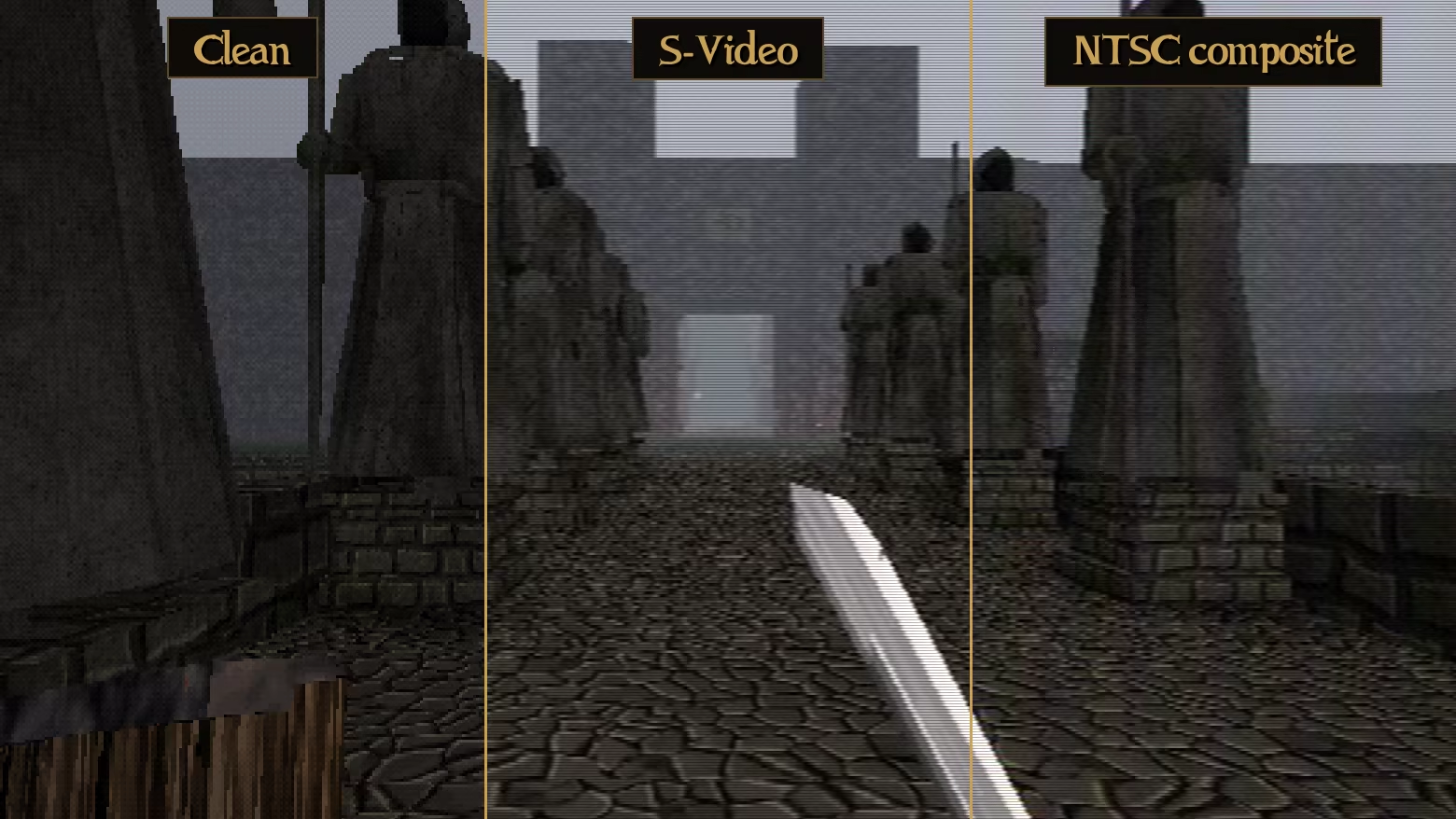
The game renders at 640x360 and presents it the way a CRT would. Scanlines can be turned on or off; the video signal can be clean, S-Video, or NTSC composite, which smears color the way a television did; brightness and contrast are yours to set. Play with an Xbox or PlayStation controller or with keyboard and mouse, and rebind the controls. The on-screen prompts follow whichever you touched last.


What's in the game now. The whole story, all five acts, playable from the opening to its three endings:
  • eighteen main-quest chapters, the choice at the end and its three endings, and sixty-six side quests, several with more than one ending
  • sixteen regions: the Ironroot Hills, Dren Valley, Greyfen Marsh, Gallow Wood, Hunter's Manor, the Veyr Outskirts, the Ashen Fields, the city of Veyr itself, its districts nearly empty, the Pale Road, the Pale Mountains, the High Moor, the Northern Forest, the Abbey Highlands, the Eastern Farmlands, the Flooded Lowlands and the Western Cliffs, with caves, barrows, towers, a mill and a tomb off the roads, and settlements and travelers along the roads between
  • fifteen dungeons: the Old Watchtower, the Abandoned Mine, the Mother's house, the Gallow Court, the Drowned Cloister, the Old Aqueduct, the Cathedral of Continuance, the Public Archive, the municipal furnace house, the Ossuary of Saint Oriel, the royal ascent, the Pale Road, the Pale Keep, the Kingdom Beneath and the Four Burdens under the throne
  • nine bosses, each with its own way of fighting to learn
  • the Wayrest, an old pilgrims' rest to rebuild and farm: a house and grounds built piece by piece, six crops, hens, a goat, a cow and bees, six settlers each brought home by their own quest, and meals, drinks and potions made from what you grow (not in the demo)
  • weapons, pieces of armor, shields and foci across nine tiers, shops in each region and a smith who improves what you bring him
  • rotes of five elements, caster rings, and the weaknesses of every enemy kind, learned by striking
  • save stones, difficulty settings, a quest compass and puzzle help chosen at New Game, and full controller support
What's still to come. Every region is open now. What's left is the work of making it good: balance, enemy numbers and the pace of the dungeons and quests are a first pass and will change with your feedback, and the quieter corners of the map will get more people and more to find. The finished game is planned at around thirty hours for a first playthrough.

AI Generated Content Disclosure

The developers describe how their game uses AI Generated Content like this:

GenAI was used to assist in code as well as construction of assets/content used within the game.

System Requirements

Windows
macOS
SteamOS + Linux
    Minimum:
    • Requires a 64-bit processor and operating system
    • OS: Windows 10
    • Processor: Any
    • Memory: 2 GB RAM
    • Graphics: Any
    • DirectX: Version 10
    • Storage: 100 MB available space
    Recommended:
    • Requires a 64-bit processor and operating system
    Minimum:
    • Requires an Apple processor
    • OS: 15.1
    • Processor: Apple M1
    • Memory: 1 GB RAM
    • Graphics: N/A
    • Storage: 100 MB available space
    Recommended:
    • Requires an Apple processor
    • OS: 15.1.1
    • Processor: Apple M1
    Minimum:
    • Memory: 1 GB RAM
    • Storage: 100 MB available space
    • Sound Card: N/A
    Recommended: