
Become a real orchestra conductor in VR. Shape tempo, dynamics and cues with your own two hands, build a career from student to Maestro, manage the money behind every concert, and create your own pieces with the free Level Editor.

Sign in to add this item to your wishlist, follow it, or mark it as ignored

Early Access Game

Get instant access and start playing; get involved with this game as it develops.

Note: Games in Early Access are not complete and may or may not change further. If you are not excited to play this game in its current state, then you should wait to see if the game progresses further in development. Learn more

Leaving Early Access: Q4 2026

What the developers have to say:

Why Early Access?

Maestro VR has been in development for several years with a single goal: to make conducting a symphony orchestra feel real in virtual reality. Early Access has been essential to get there. Player feedback led us to rebuild the conducting and gesture system from the ground up, and it shaped the career, economy and progression systems that now sit at the heart of the game.

We are continuing in Early Access because the last two pillars of the experience are still being built, and we want to build them with our players rather than reveal them at the end. Conductors, musicians and rhythm-game players each ask for very different things from this game, and that ongoing conversation is what turns a good simulator into one that works for everyone.

Approximately how long will this game be in Early Access?

“We plan to leave Early Access during the fourth quarter of 2026.

Everything that remains is already defined and in production, so the roadmap is short and specific rather than open-ended. As always, we would rather take the extra weeks needed to release something polished than hit a date with an unfinished feature.

How is the full version planned to differ from the Early Access version?

“The Early Access version is already a complete experience: the conducting system, the three game modes, the career, the talent tree, the economy, the masterclass and the free Maestro Level Editor are all in your hands today.

For the full version we plan to add:

  • More concert halls. New venues with their own acoustics, capacities, audiences and economics — meaning new decisions about where to premiere each piece and how much to risk on it.

  • Concert Mode. A new way to play that lets you group several pieces into one single, longer performance — a real concert programme conducted end to end, with everything that implies: stamina, pacing, and one shot at getting it right.

We also plan to keep polishing the game with community feedback: performance improvements, refinements to the gesture system and animations, and adjustments based on what players report.

Please note these are our current intentions rather than guarantees, and the scope may evolve as we build them.

What is the current state of the Early Access version?

Maestro VR is fully playable today and includes:

Conducting

  • Two-handed conducting with real conducting patterns for 2, 3, 4, 5, 6 and 7-beat metres.

  • Tempo, cues, dynamics, crescendos, accents, fermatas and final cut-offs, all performed with your own hands.

  • Automatic height calibration, seated or standing, plus a full left-handed mode.

Game modes

  • Rehearsal, Performance and Pro Performance.

  • Stage screen on or off, which completely changes how each mode plays.

  • Rehearsal section muting to work on one part of the orchestra at a time.

The orchestra and the halls

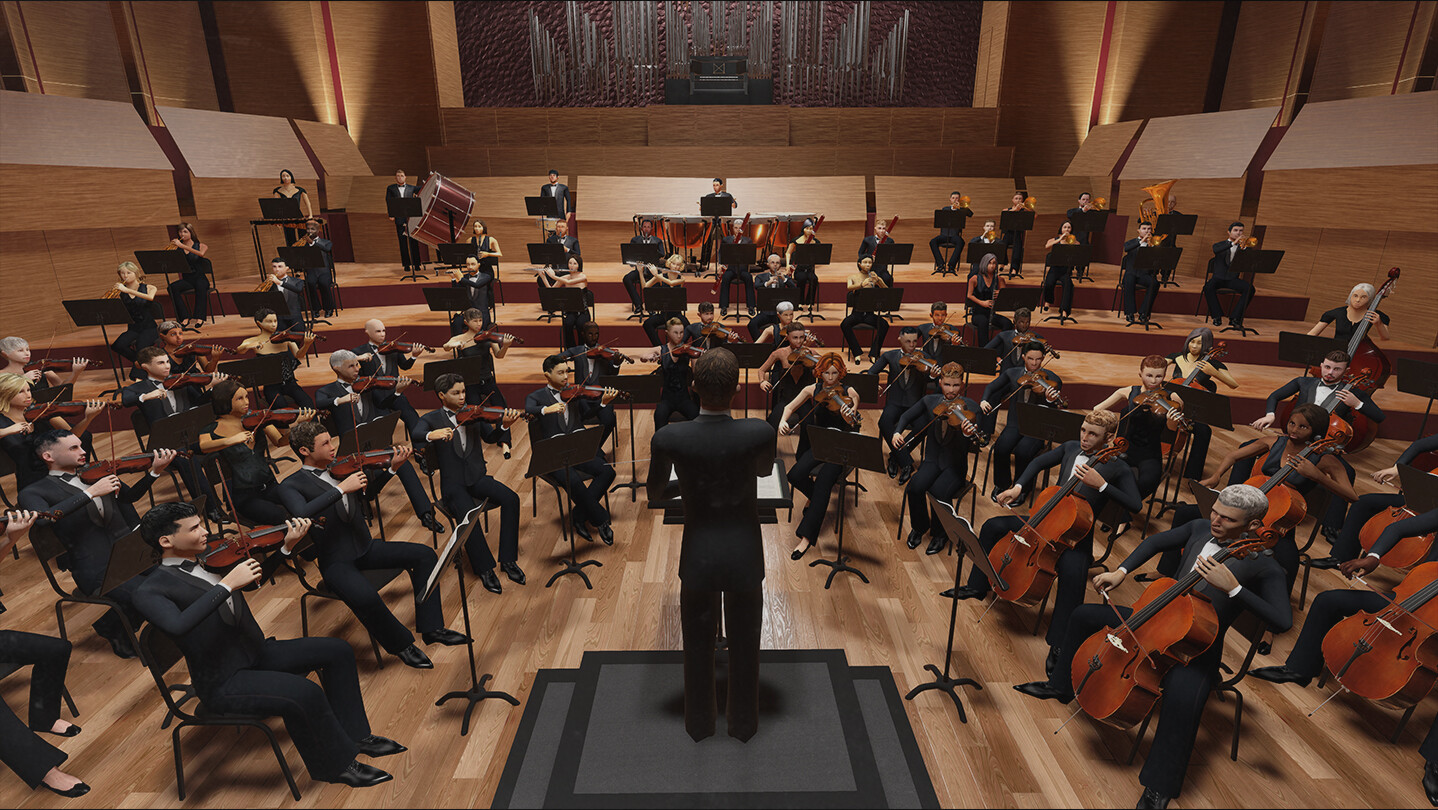
  • 38 instruments and voices, with up to nearly 100 musicians on stage at once.

  • Instrument-accurate animation, musicians who look at you and react to your mistakes.

  • 6 venues with their own acoustics, capacity and economics.

  • A reactive audience: layered applause, standing ovations and booing.

Career, economy and collection

  • Experience points, honorary ranks and a 0-5 star reputation.

  • A talent tree with almost 50 talents across three branches, including active techniques.

  • Full concert economy: self-financing or patron, advertising campaigns, hall rental, musicians' wages, taxes, box office and critics' reviews.

  • Dozens of batons across five rarities, each with its own ability, plus stands, a store and an inventory.

  • A full Maestro CV tracking everything you have done.

Learning

  • An 8-lesson masterclass with voiced classes, written exams, practical work and a diploma wall.

Creation

  • Maestro Level Editor, a separate free desktop application with multitrack audio, MIDI import, musician animation and one-click Steam Workshop publishing.

Also included

  • Steam achievements, 15 languages, extensive comfort and accessibility options, quality settings for both SteamVR and Meta Quest 3, and OBS streaming support.

Will the game be priced differently during and after Early Access?

“We do not plan to change the price during the remainder of Early Access. When the full version launches with the additional concert halls and Concert Mode, the price may be adjusted to reflect the added content.

How are you planning on involving the Community in your development process?

“The community is the backbone of Maestro VR. The conducting system, the interface and much of the progression exist in their current form because players told us what wasn't working — and we rebuilt them.

We read the Steam forums, social media and our inbox, and we act on what we find there. With the Maestro Level Editor and Steam Workshop support, players are now shaping the game's content directly: every piece published expands the repertoire for everyone.

As we work towards the full version, we especially want to hear from you about the new concert halls and about Concert Mode. Tell us which venues you want to conduct in, and how you would like a full concert programme to be built. Ideas, suggestions and bug reports are all genuinely welcome.
Read more

Buy Maestro BUNDLE (?)

Includes 2 items: Maestro VR, Musicmenia

-25%
$29.98
VR Only

Buy Maestro VR

 
See all discussions

Report bugs and leave feedback for this game on the discussion boards

About This Game

YOU ARE THE CONDUCTOR


Maestro VR reads both of your hands independently, exactly like a real conductor uses them: the right hand keeps the pulse, the left hand shapes the music. Beat the tempo, bring in a soloist, swell a crescendo, freeze the entire orchestra on a fermata with a closed fist. Every gesture means something musically — nothing here is decorative.

As rigorous as you want it. As accessible as you need it.

THREE WAYS TO PLAY


  • Rehearsal — No audience, no money, no pressure. Mute entire sections (strings, woodwinds, brass, percussion, choir) to work on just one part, and turn on the metronome. You must rehearse a piece before you premiere it, exactly like real life.

  • Performance — The real thing: a paying audience, ticket revenue, critics and your reputation on the line. If the orchestra loses confidence in you, the concert falls apart.

  • Pro Performance — For conductors who already own the baton. Far more density, none of the visual aids.

And one switch that changes everything: screen on or screen off. With the stage screen on, a large display guides you. With it off in Performance, the cues float in 3D space around you — the purest rhythm-game feel. With it off in Pro, there is nothing at all. Just you, the orchestra, and your memory.

A LIVING ORCHESTRA


  • 38 instruments and voices — full strings, woodwinds, brass, percussion and choir.

  • Up to nearly 100 musicians on stage at once, each playing their own part.

  • They really play: bows rise and fall, fingers slide along the fingerboard, vibrato, pizzicato, col legno, tremolos, mallets alternating hands and striking harder or softer with the music.

  • They look at you. Their eyes move between the score, your baton and the audience.

  • They react to your mistakes. A badly cued musician loses focus, stops playing and takes time to recover his confidence. You will hear it.

  • The final bow: after a great concert, point at the concertmaster with your hand and raise the entire orchestra to take the ovation. It only happens if you do it.

SIX HALLS, SIX DIFFERENT CHALLENGES


Every venue has its own acoustics, reverberation, capacity and economics — from an intimate chamber room to a great symphonic auditorium. When a piece fits more than one hall, you choose where to premiere it, and with it you choose your rent, your risk and your reward.

The audience is real: as many people are physically seated as you managed to attract. Layered applause that grows with the crowd, a standing ovation that spreads like a wave from the front rows to the back of the house — and booing, if the concert collapses.

BUILD A CAREER


You start as an aspirant with a cheap baton and no money. Everything else you earn.

  • Experience points for every gesture you land, with streaks, multipliers and bonuses.

  • Honorary ranks that track your career: Aspirant, Assistant, Associate, Principal, Maestro, Resident, Emeritus.

  • A 0-to-5 star reputation that rises and falls with your concerts and your reviews. And beware — the more famous you get, the more your musicians charge you.

  • Four musical notes per piece: complete the rehearsal, the performance, the Pro performance, and finally Virtuoso — a flawless interpretation without a single mistake. Each note can be upgraded from Cyan to Green to Gold.

The Talent Tree


Almost 50 talents across three specialisations, five tiers deep, with mutually exclusive paths and a mastery talent at the end of each branch:

  • CONDUCTING — rhythmic precision, timing windows, fermata control, consistency multipliers and stamina.

  • LEADERSHIP — easier cues, section trust, shields that absorb a mistake, higher income and better reviews.

  • EXPRESSION — dynamics, accents, expressive range, graceful recovery and standing ovations.

Passive talents, active techniques you equip in two slots and fire mid-concert with the controller buttons, trade-offs that give you more power in exchange for more demand, and mastery talents that change how you conduct entirely. Respec freely and try a different build for every piece.

CONDUCTING IS ALSO A BUSINESS


Before a single note is played you must decide how you are paying for this concert.

  • Self-financed — you pay every cost up front. If it goes well, the profit is entirely yours. If it doesn't, that money is gone.

  • Patron — you pay nothing, but he takes half the earnings. Fail him and his cut climbs to 60%, 70%, up to 75%, until you deliver a success again. With a patron you cannot run an advertising campaign.

  • Advertising campaigns in four tiers. More investment, more people in the hall — but publicity is not an exact science. Some nights it overperforms, some nights it doesn't, and the report tells you exactly what it achieved.

Afterwards you get a full financial report, written in plain language: attendance rate and real headcount, hall rental, musicians' wages, advertising cost, gross revenue, bracketed taxes (highly profitable concerts pay a success surcharge), the patron's share, and your net profit. There is an efficiency bonus if you conducted a piece with fewer musicians than the hall usually requires — and a break-even point below which you lose money no matter how well you conducted. Filling the seats is part of the job.

Then the critics publish. Several reviewers write about your concert and your reputation moves accordingly, broken down star by star.

COLLECT, BUY AND EQUIP


  • Dozens of batons in five rarities — Common, Uncommon, Rare, Epic and Legendary.

  • Every baton has its own ability, either passive or an active technique with its own cooldown.

  • Many are tied to a musical era — Renaissance, Baroque, Classical, Romantic, 20th and 21st century. When you pick a piece, the game equips and unequips the matching ones automatically, so choosing your baton is part of preparing the concert. The finest ones work in any era.

  • Buy several copies of the same baton to keep it ready on different stands, or sell the ones you regret.

  • Baton stands are bought one at a time, each with its own design and rarity. Your table and your display cabinet have a physical limit, so collecting means choosing.

  • Pick your conductor avatar and adjust their attire.

A REAL CONDUCTING COURSE


Maestro VR includes a full masterclass built into your career — not a two-screen tutorial.

  • 8 lessons (seven classes plus a final exam) taught by a professor in a virtual classroom.

  • Voiced lessons with lip sync, available in several languages.

  • Written exams answered with the controller buttons, with an explanation after every answer — whether you got it right or wrong.

  • Practical work: almost every lesson includes a real piece you must conduct to pass.

  • An academic average recorded permanently in your file.

  • A diploma wall in your studio: every major achievement physically hangs on the wall, with your name and the exact date you earned it.

YOUR MAESTRO CV


A profile panel laid out like a professional résumé: your rank and reputation, experience and money earned, concerts offered, completed and abandoned, your best accuracy ever, your repertoire and medals, talents unlocked, masterclass grade, and your baton collection broken down by rarity.

CREATE YOUR OWN PIECES — MAESTRO LEVEL EDITOR


Maestro Level Editor is a separate, free desktop application — no headset needed, mouse and keyboard, on your PC. It is the very same tool the official levels were built with, and it turns any piece of music into a playable Maestro VR level.

  • Build the orchestra: choose the hall, then set the line-up instrument by instrument — how many violins, how many horns, whether there's a choir, harp or organ. The editor warns you automatically if you exceed the physical positions that hall has.

  • Multitrack audio: one independent audio track per instrument, with a visible waveform for each. Every instrument plays from its real position on stage with that hall's reverberation — you don't have to configure any of it.

  • Write the gesture score: tempo and tempo changes, time signatures and changes of metre, cues, dynamics, crescendos, accents, fermatas and the final bar — placed by bar and beat, or freely at the exact second.

  • One-click pattern filling: the editor lays down the correct conducting pattern for the whole piece, adapting to every change of metre, right-handed or left-handed.

  • Import your MIDI and the editor reads it for you, placing tempos, tempo changes and time signatures automatically.

  • Animate the musicians: link a MIDI track to an instrument and its players will perform note by note — bows, fingers, vibrato, articulations and intensity all taken from the score itself.

  • Copy and paste by bar ranges, full undo and redo, live preview of the musicians as you edit, built-in user manual and error checking before you save.

Steam Workshop

Community pieces are handled through the free Maestro Level Editor, which has its own Steam Workshop. Install it, then browse and subscribe from inside it — everything you download appears automatically in your list of pieces in Maestro VR.

You only need the editor once, to get the pieces. After that you conduct them in VR like any other work.

COMFORT AND ACCESSIBILITY


Maestro VR is built so anyone can conduct, regardless of height, dominant hand or play space.

  • Full left-handed mode — everything mirrors properly, it's not a patch.

  • Automatic height calibration that works equally well seated or standing, and re-adjusts itself if you change posture mid-piece.

  • Latency offset in milliseconds, and gesture sensitivity with a live meter showing exactly how much force each hand is applying.

  • Interactive calibration tool with a practice piece — change a value and feel the difference instantly.

  • Configurable controller vibration, off, perfect-only or always.

  • Safety net: wander too far from the podium and you're returned to your spot. Head protection so you can't push your face into the stand or the scenery.

  • Instant pause whenever you need to reorient.

  • Interactive interface map: hover over any part of the screen and the game explains what it does.

PERFORMANCE


Quality presets and full manual control: image sharpness, edge smoothing, four levels of shadows, and separate detail settings for the orchestra and the audience. Distant characters are automatically simplified without you noticing, keeping the framerate stable with a hundred musicians and hundreds of spectators on screen. Optimised specifically for SteamVR and Meta Quest 3.

FOR STREAMERS


Direct output to OBS through a dedicated Steam launch option, with a fully adjustable head-mounted camera: field of view, tilt, height and forward offset, anti-motion-sickness stabilisation so your viewers don't get sick, horizon levelling, and output up to 1080p at 60fps. Mixed reality support with LIV is planned.

LANGUAGES


English · Spanish · Latin American Spanish · French · German · Italian · Brazilian Portuguese · Polish · Russian · Turkish · Arabic · Simplified Chinese · Traditional Chinese · Japanese · Korean

System Requirements

    Minimum:
    • OS: Windows 10
    • Processor: Intel Core i5-9600K / AMD Ryzen 5 3600 or equivalent
    • Memory: 8 GB RAM
    • Graphics: NVIDIA GeForce GTX 1660 Super / AMD Radeon RX 5600 XT or equivalent
    • DirectX: Version 11
    • Storage: 5 GB available space
    • Sound Card: DirectX compatible
    • VR Support: OpenXR and SteamVR compatible. Supports Oculus Rift S, HTC Vive, Valve Index, Meta Quest 2, 3, 3s(via Link), Pimax, and other OpenXR
    • Additional Notes: A compatible VR headset is required.
    Recommended:
    • OS: Windows 10
    • Processor: Intel Core i7-12700K / AMD Ryzen 7 5800X or equivalent
    • Memory: 16 GB RAM
    • Graphics: NVIDIA GeForce RTX 3080 / AMD Radeon RX 6800 XT or equivalent
    • DirectX: Version 11
    • Storage: 10 GB available space
    • Sound Card: DirectX compatible
    • VR Support: OpenXR and SteamVR compatible. Supports Oculus Rift S, HTC Vive, Valve Index, Meta Quest 2, 3, 3s(via Link), Pimax, and other OpenXR
    • Additional Notes: A high-end VR headset is recommended for an optimal experience.
Review Filters