

You leave the city for an overgrown block and an old sawmill. Read each log before the blade goes in: chalk where you think the knots and the rot are, and how deep. Then saw it, and the wood shows how well you read it. Sell the boards and build your homestead from your own timber.

Sign in to add this item to your wishlist, follow it, or mark it as ignored

Coming Soon To Early Access

The developers of this game intend to release as a work in progress, developing with the feedback of players.

Note: Games in Early Access are not complete and may or may not change further. If you are not excited to play this game in its current state, then you should wait to see if the game progresses further in development. Learn more

What the developers have to say:

Why Early Access?

“Far Acre's first update, Green Lumber, is playable from start to finish: buy logs, read them, saw them, grade and dry the boards, fill orders, then build a cabin from your own timber and move in. The rest of the homestead comes in later updates.

I'm developing Far Acre in phases, and I want to do it alongside a community that can influence its direction. I'm serious about feedback and advice.

Far Acre is an unusual game, and I know of few like it. It's for a particular player: someone who likes slow games that favour realism and building something of your own. Getting that right takes a lot of experimenting and changing course. I'll give each update the time it needs, and I'm dedicated to doing it properly, as quickly as that allows, with player feedback worked in along the way.”

Approximately how long will this game be in Early Access?

“About a year. Five more updates follow Green Lumber, about two months apart. If an update slips, its Sawdust Notes post will say so and give the new date.”

How is the full version planned to differ from the Early Access version?

“The first Early Access version is about the basics: the homestead's clearing, how it looks and feels, and how it all begins. You turn logs into rough lumber and sell it. The money buys tools and more, and you start your homestead by building your first cabin.

After that the game opens up. Building becomes open-ended: you're free to design any structure you want, as long as it could really be built with timber-framing techniques. Furnish it with things you buy, or make them yourself from your own wood. Keep a small garden that feeds you and plant an orchard. Raise a workshop. Choose and fell your own trees in the forest.

A lot of influences come together in Far Acre. It's part farming sim and part life-sim base building, with a touch of survival.

The plan today is five more free updates: Standing Timber, Kitchen Garden, Dried In, Barn Raising and Home Place, which is V1. That is its current shape, and it may change with players' influence and feedback.”

What is the current state of the Early Access version?

“Far Acre in Early Access has:
  • reading logs: a viewer that turns the log, chalk for your calls, and a card that scores them once the log is sawn
  • a seller's yard where you buy your logs
  • portable bandsaw mills from five makers, with blade wear, sharpening and the odd nail in a log
  • eight wood species, with every log generated, so each one saws differently
  • boards graded like real hardwood lumber
  • drying on stickers in a shed, or faster in a solar kiln
  • orders from furniture makers on a noticeboard
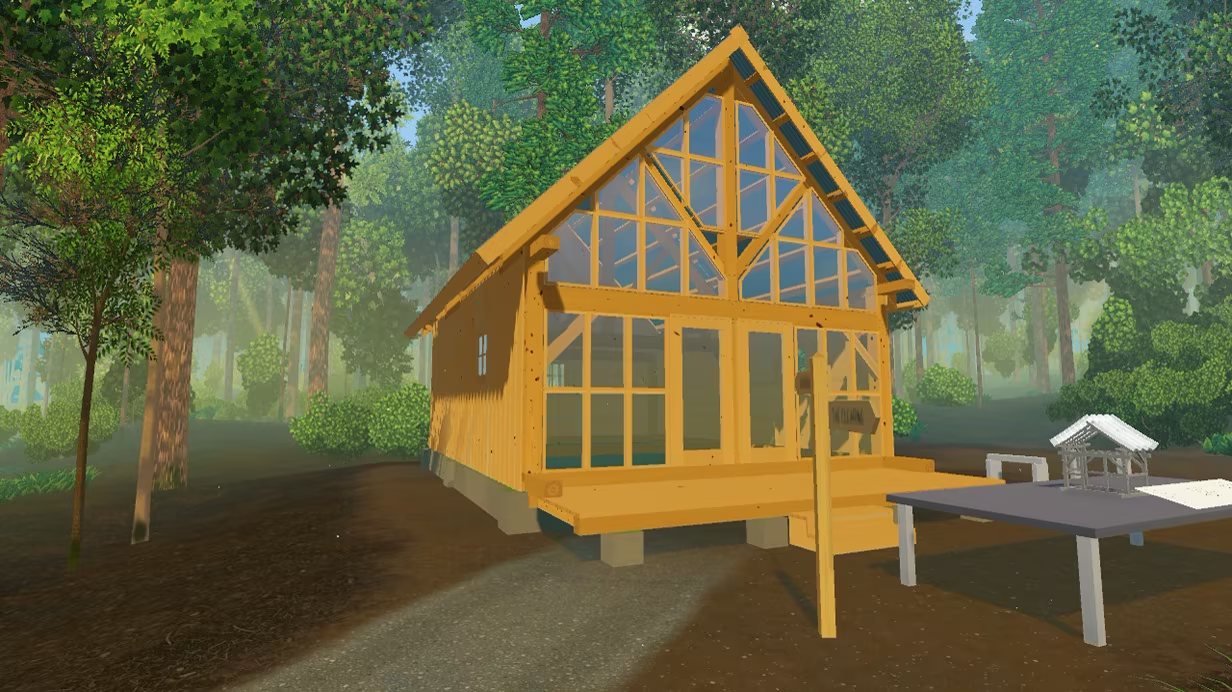
  • the Glass Gable, a timber cabin you frame, close in, furnish and move into
  • the seasons, from spring blossom to winter, with weather that changes how your stacks dry
  • two in-game manuals: The Sawyer's Manual and The Timber Framer's Joinery Handbook
  • gamepad and Steam Deck support
  • sizes in imperial or metric
Still to come: your own trees (for now you buy logs from the seller), farming and the other buildings. It's single-player, on Windows. It's in English for now, and translations into other languages will follow. Expect some bugs.”

Will the game be priced differently during and after Early Access?

“Yes. The price will go up a little at V1, and I'll announce it well before. Every update up to V1 is included in the price you pay now. There is no paid DLC.”

How are you planning on involving the Community in your development process?

“Each update and patch gets a Sawdust Notes post here on Steam: what changed and what's next. Send feedback from the game's pause menu. Report bugs and ask for features in the Steam forums or on the Far Acre Discord server. I read all of it and use it to decide what to fix first. If you saw or frame timber for real and spot a mistake in the game or the manuals, please post it; I'll correct it.”
Read more
This game is not yet available on Steam

Planned Release Date: Q1 2027

Interested?
Add to your wishlist and get notified when it becomes available.
 

Report bugs and leave feedback for this game on the discussion boards

See all discussions

About This Game

You sold everything and left the city. The money went into an overgrown piece of land at the edge of the country and a second-hand portable bandsaw mill. There's a tarp on poles over a cot and a camp stove, and the dealer down the road has already dropped a deck of logs by the mill.

Each of those logs has knots somewhere inside it, and some have rot. The bark gives part of it away.

Far Acre is a homesteading game about reading logs and sawing them well. Everything you build comes from logs you saw yourself. The plan is the whole homestead, raised from your own timber over free Early Access updates: the lumber business, the cabin and the barn, the workshop and a small farm, all off the grid.

The first update, Green Lumber, starts with a log you have to read and boards people will pay for. It ends on the night you move into a cabin built from your own timber, and the tarp comes down.

Every log is grown from the pith out


The wood here comes from the log, and each log is grown by an algorithm that mimics how real wood grows. Rings, heartwood, rays, knots, heart rot and the odd fence nail the tree grew around: each log carries its own. Saw it at any height and the fresh face shows what's there. Eight species so far, from white oak and black walnut to white pine and red cedar.

Read it before you saw it


Look closely at any log and it turns in front of you. Bring an end round and the rings read flat on. A bump in the bark is a branch the tree grew over, and a dark seam can run to the heart.

Then take the chalk and make your call. Ring the spot and say what you think is under it: a knot, a seal, a seam, rot, steel or figure. Say how deep it runs and how sure you are. The chalk writes your call beside the ring, and it stays on the log until the blade goes in.

The saw is the only reveal. When the log is sawn up, a card goes through every sign it carried and tells you which ones you called right, which you found under the wrong name and which you missed. Ring one stub out of eight and the card says one called right, seven missed.

Saw it like a sawyer


Roll the log onto the bunks, clamp it, shim the small end and set the blade. Push the head too fast and the cut wanders. Too slow and you're burning daylight. Turn the log a quarter at a time to square up a cant (the squared-off heart of the log). Bark dulls the blade fastest, so your blade hates bark even more than you do. Hit a nail and you file the struck teeth at the bench; a band that's dull all along goes out to the sharpening service.

Graded on what's really there


Every board comes off with a grade card: species, size, board feet (a foot square, an inch thick), and what it lost points for. Two knots and a strip of sapwood and that cherry drops to No. 2A Common. Open the next log on a better face. Sizes read in inches and board feet, or switch to millimeters and cubic meters in the settings.

Drying on stickers, or in a solar kiln


White oak comes off the mill at about 72% moisture. Stack it on stickers (thin spacer sticks) in the shed and 1-inch boards are air-dry in about twelve days. In a hurry? Build a solar kiln from your plainest boards and take it down to 8% for the furniture makers who want kiln-dried.

Orders on the noticeboard


Furniture makers pin up what they want, down to species, grade, size and how dry. Fill the order and the money buys the next log. Slabs and offcuts go on the firewood pile and sell for two dollars apiece.

A cabin from your own timber


The first building is the Glass Gable, a timber cabin 20 feet by 26 (about 6 metres by 8) with a glazed gable end. Every timber and board in it comes off your mill, bay by bay. Close it in with your own shakes and siding. Then furnish it and move in. We're building this part of the game now, and it is in at Early Access launch.

The manual on the bench

The Sawyer's Manual is a field guide to running a small bandsaw mill, written from how portable mills are really run: reading a log, opening the first face, sawing for grade, quartersawing for figure, drying slowly and evenly. The game follows the book. Do what it says and you get what it promises. Rush the drying and your oak checks.

At Early Access launch: reading logs, the seller's yard, the mill, grading, drying, the solar kiln, orders, the seasons from spring blossom to winter, the Glass Gable cabin and the Sawyer's Manual.

Coming in Early Access: the road to V1

This is the first step. The rest of the homestead comes update by update, all from your own timber.

  • The Standing Timber update: fell your own trees on the ridge and skid the logs down to your deck. The furniture makers start ordering from you by name.
  • The Kitchen Garden update: dig the garden and plant the orchard, with a hen house between them.
  • The Dried In update: move the yard down to the terrace under a mill shed you frame yourself. Raise the workshop, and add on to the cabin.
  • The Barn Raising update: an aisled barn with its tractor, and livestock in the pasture. Water comes down from the spring, and power from panels on the workshop roof.
  • The Home Place update: the bees, the workshop fitted out for furniture, and a white-oak porch. That's V1, and the game leaves Early Access.

You run one mill, and you upgrade it as the money comes in. The plan is for the game to end on an evening on a porch made of white oak you sawed yourself.

AI Generated Content Disclosure

The developers describe how their game uses AI Generated Content like this:

I use AI to some degree in most of our workflows, where it speeds things up at an acceptable quality and doesn't get in the way of crafting the game.

System Requirements

    Minimum:
    • Requires a 64-bit processor and operating system
    • OS: Windows 10 64-bit
    • Processor: Intel Core i5-7500 or i3-8100, AMD Ryzen 5 1600 (4 cores)
    • Memory: 8 GB RAM
    • Graphics: NVIDIA GeForce GTX 1060 or AMD Radeon RX 580, with Vulkan support
    • Storage: 1 GB available space
    • Additional Notes: Runs the Low preset at 1920 × 1080. Needs a dedicated graphics card for now.
    Recommended:
    • Requires a 64-bit processor and operating system
    • OS: Windows 10 or 11, 64-bit
    • Processor: Intel Core i5-8400 or AMD Ryzen 5 2600 (6 cores) or newer
    • Memory: 8 GB RAM
    • Graphics: NVIDIA GeForce RTX 2060 or AMD Radeon RX 6600 XT
    • Storage: 1 GB available space
    • Additional Notes: Runs the High preset at 1920 × 1080 at 60 fps.