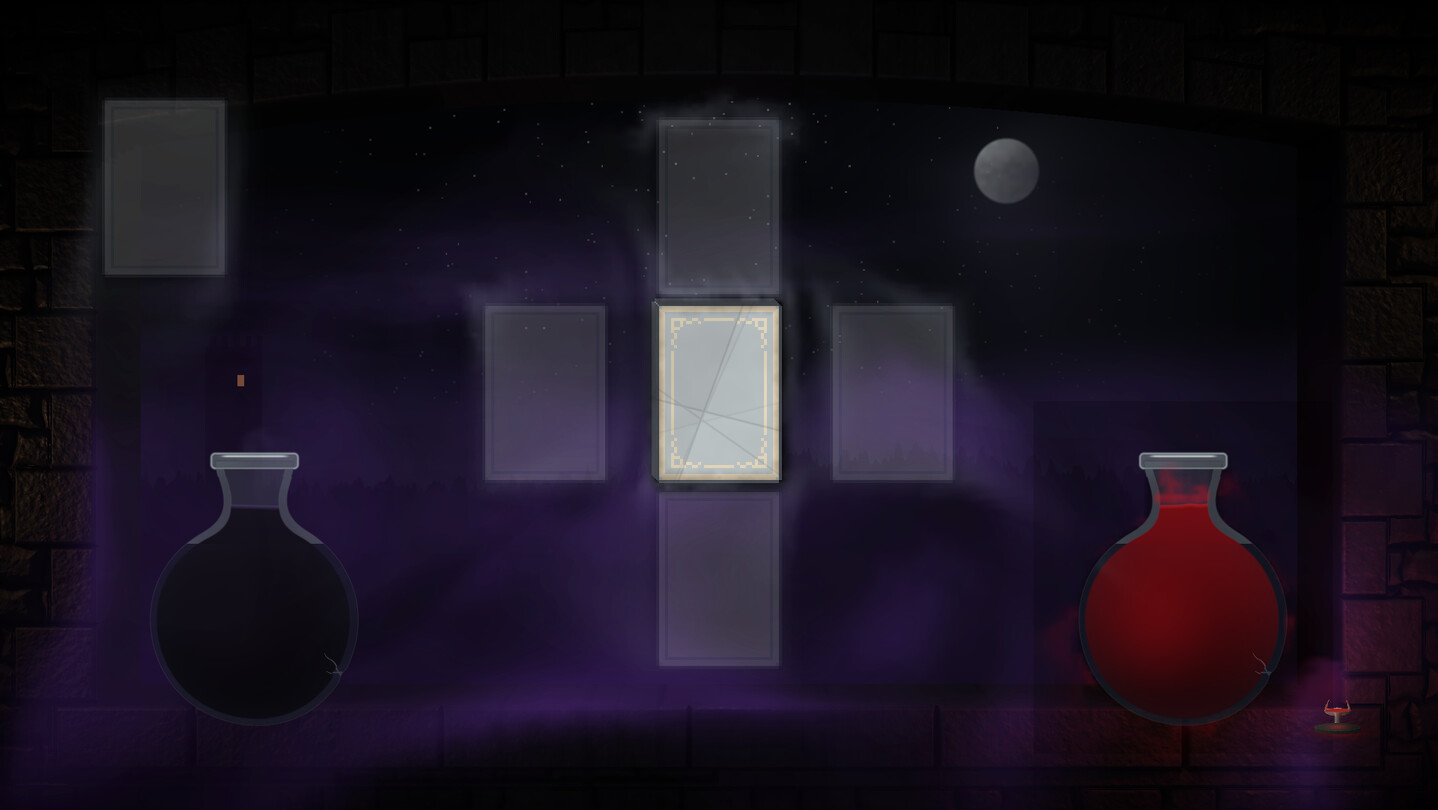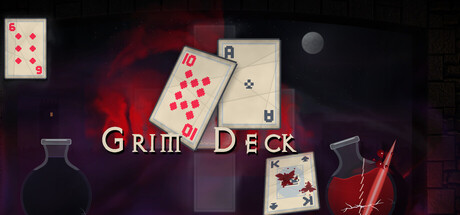

A solo card game with one deck. Clubs and spades are monsters. Diamonds are weapons. Hearts are potions. Each round deals 4 cards: play 3, keep 1. Get through the deck alive. Every deck can be won.

Sign in to add this item to your wishlist, follow it, or mark it as ignored

This game is not yet available on Steam

Planned Release Date: November 2026

Interested?
Add to your wishlist and get notified when it becomes available.
 

About This Game

It's a Grim Solitaire

It's a grim solitaire. One deck, 44 cards, 20 life.

Clubs and spades are monsters. They hit for their rank: J 11, Q 12, K 13, A 14.

Diamonds are weapons. A weapon takes its rank off every hit, but only fights monsters weaker than its last kill.

Hearts are potions. They heal their rank, up to 20. Only the first one each round heals.

Each round deals 4 cards. Play 3. The 4th stays for the next round.

Flee a round to send all 4 under the deck. Not twice in a row, and not once you've played a card.

Clear the deck to win. Hit 0 and you lose.

Every deck is dealt to be winnable.

Couch and Online Co-op

Two players, two decks, two crosses of 4 cards. The crosses share 2 cards.

A shared card goes to whoever plays it first. What you leave there, your partner can reach.

Leave them the potion. Take the monster their weapon can't. Flee your cross and the shared cards go with it.

Each player has their own life, weapon and potion. If one falls, you both lose.

Clear both decks to win.

Play local, or online with a Steam friend.

A Small Game

Grim Deck is small: one deck, one table, one set of rules.

Runs are short. You will die a lot.

Deal again.

Features

  • Every deck winnable, or any shuffle

  • Local and online co-op

  • Step-by-step tutorial

  • Undo, stats and streaks

  • Keyboard, mouse or controller. PlayStation, Xbox, Switch and Steam Deck prompts

  • 12 languages

Based on Scoundrel by Zach Gage and Kurt Bieg. Cards and sounds: Kenney. Icons: .

AI Generated Content Disclosure

The developers describe how their game uses AI Generated Content like this:

Artificial intelligence was used to help write the code for the game.
Years ago, I started working on Fade Basic (https://fadebasic.com), which is a language inspired by my love for Dark Basic Pro (sadly now defunct). I am a MonoGame (https://monogame.net/) supporter, and I wrote a 2D engine with MonoGame, and built bindings for Fade Basic.

Then, I used AI to write the Fade Basic code itself, using the engine bindings I wrote. I like building the game this way, because MonoGame is open source, and since I made Fade Basic open source, I own the game engine layer entirely. I know that the engine provides pretty intense constraints on how games can be made, so it is harder for the AI to do things in silly ways.

Also, AI was used for translating the game from English into non-English languages.

System Requirements

Windows
macOS
    Minimum:
    • OS: Windows 10 64-bit
    • Processor: Dual-core 2.0 GHz
    • Memory: 4 GB RAM
    • Graphics: Vulkan 1.1 GPU: Intel UHD 620, GeForce GT 730, Radeon R7
    • Storage: 300 MB available space
    Recommended:
    • OS: Windows 10/11 64-bit
    • Processor: Quad-core 2.5 GHz
    • Memory: 8 GB RAM
    • Graphics: GeForce GTX 1050 / Radeon RX 560 / Intel Iris Xe
    • Storage: 300 MB available space
    Minimum:
    • Requires an Apple processor
    • OS: macOS 12 Monterey
    • Processor: Apple Silicon (M1 or later) only
    • Memory: 8 GB RAM
    • Graphics: Built-in Apple GPU (Metal via MoltenVK)
    • Storage: 300 MB available space
    Recommended:
    • Requires an Apple processor
    • OS: macOS 12 Monterey
    • Processor: Apple Silicon (M1 or later) only
    • Memory: 8 GB RAM
    • Graphics: Built-in Apple GPU (Metal via MoltenVK)
    • Storage: 300 MB available space