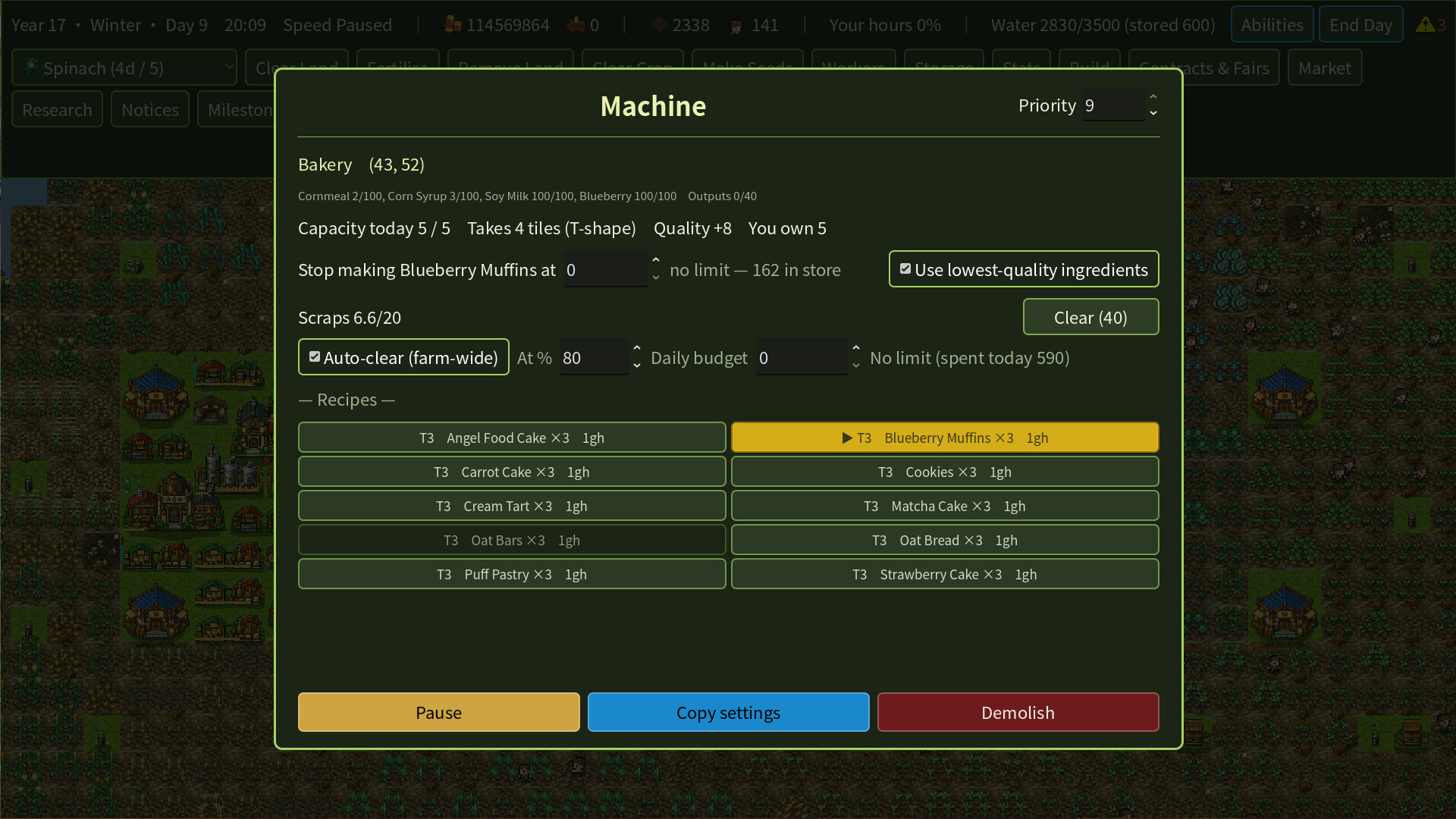


Start with a hoe and four tiles of dirt. End with an agricultural empire. Farm, breed, and chain 179 recipes across four tiers — with no rot, no bankruptcy, and nothing that can ever die. Quality only goes up. The only enemy is your own floor plan.

Sign in to add this item to your wishlist, follow it, or mark it as ignored

This game is not yet available on Steam

Coming soon

Interested?
Add to your wishlist and get notified when it becomes available.
 

About This Game

[h1]A hoe and four tiles of dirt[/h1]

For the first hour you'll click every single thing yourself: till, sow,

water, harvest. Eighty hours later you'll be standing over a farm you

can't see the edge of, watching dozens of workers haul crates between

fields, workshops and warehouses — and the thing on your mind will be

why the flour on that one line keeps piling up with nobody to carry it.

Agrarian Empire takes the first hour of Stardew Valley and bolts it onto

the last three hundred hours of Factorio.

Nothing here can die

This is a production-chain game with no failure state.

  • Crops don't wither, livestock don't starve, and you cannot go bankrupt

  • No rot, no spoilage, no expiry — a stack left sitting is just a stack left sitting

  • Quality only ever goes up. Cheese left sitting is just cheese left sitting

  • Every nudge is a bonus, never a penalty: 5★ goods sell for triple, rather than 1★ goods being rejected

There's exactly one source of frustration: your setup isn't efficient enough yet.

Which is the problem you came here to solve.

Your logistics are people, not conveyor belts

You don't lay belts here. You hire.

Every worker is a character walking around your map with goods on their

back. You plan what goes where; they actually walk it. Which means:

  • Distance is a real cost — twenty tiles from field to workshop is twenty tiles, every trip

  • Re-planning your layout is always cheaper than hiring another body

  • Short-staffed? Goods pile up at the source. Nothing is lost — there's just nobody to carry it

Each worker has five skill lines (speed, planting, operating, livestock,

cooking) rated 0–10. You pick one of three applicants, and now and then a

prodigy walks in. Found someone you like working with?

Give them a name — a named worker becomes a favourite, and a

favourite can't be dismissed. Not even by a slip of the mouse.

Research pushes your worker cap from 5 all the way to 75.

But the better you get, the harder you'll work to need fewer of them.

Footprints are a puzzle

Buildings aren't uniform squares. Machines occupy 2, 3 or 4 tiles, and

footprints come in ten shapes — including L, J and T pieces with

concave corners.

And they don't rotate.

So "where do I put this mill" becomes a genuine question. An L's notch

takes another building's corner, and the two lock together to save a whole

tile. Place it badly and every route across your farm gets three tiles

longer — three tiles your workers walk dozens of times a day.

One quality rule, from the soil to the dinner plate

Crops, livestock, processed goods, aged goods, your restaurant —

all of it runs on the same 1★–5★ scale. Learn it once.

[code]input quality = 0.7 × weighted average + 0.3 × worst ingredient

output quality = input + machine bonus × (1 − input/100)[/code]

That "0.3 × worst ingredient" is the spine of the whole game:

one bad input drags the whole batch down.

A single 5★ truffle will not rescue four 1★ ingredients.

So you start caring about soil. And your soil's nitrogen comes from the

manure of the pigs you keep. And those pigs eat feed you grew yourself.

And the quality of that feed comes from the soil.

The loop closes on itself — and you will spend hours making it close

just a little tighter.

Also: bees don't eat feed. They feed by pollinating, so where you put

the hive directly sets the quality of the orchard next to it.

Four tiers, 179 recipes

  • T1 — 51 recipes. Mills, juicers, oil presses, dehydrators. Crops into ingredients

  • T2 — 61 recipes. Creameries, noodle works, smokehouses, fermenters. Ingredients into food

  • T3 — 55 recipes. Bakeries, aging cellars, frozen-meal plants, fine kitchens. Food into products

  • T4 — 12 recipes. The restaurant and the heirloom leatherworks. Products into signatures

Higher tiers get fussy about star ratings, and T3 recipes routinely eat the

output of two or three separate lines. By then your farm stops being a pile

of machines and becomes a network feeding itself.

There's still research after you finish the tree

32 tech nodes, 997 research points. Finish it and infinite research

opens up: five permanent upgrades you can keep buying forever.

And when a run has given you everything it has — pass it on.

Convert the run into legacy points and start fresh.

8 upgrade lines, 1,355 points to max: better seed, better bloodlines,

richer soil, a bigger map.

But land, buildings and unlocked features are never inherited.

That's deliberate. Handing you a factory would destroy the one thing the

game is about: growing out of four tiles of dirt. A legacy gives you a

better run-up, not a shortcut past growing up.

At a glance

  • 25 crops, including perennial trees whose yield and quality improve with age

  • 6 livestock species and 6 housing types, with breedable bloodlines managed per building

  • 33 machines, 179 recipes, four tiers

  • 32 tech nodes, 997 research points, and infinite research after that

  • 8 legacy upgrade lines, 1,355 legacy points

  • Real time at 1x / 2x / 3x, pausable whenever you like

  • Single-player, no fail states, roughly 40–80 hours per run

  • Full English and Traditional Chinese interface

AI Generated Content Disclosure

The developers describe how their game uses AI Generated Content like this:

I use AI to generate game codes and images, nothing more.

System Requirements

Windows
macOS
    Minimum:
    • OS: Windows 10 64-bit
    • Processor: Intel i5 or equivalent
    • Memory: 4 GB RAM
    • Storage: 1 GB available space
    Minimum:
    • OS: 10.7+ Lion (64 bit)
    • Processor: 2.0 GHz Dual Core Processor (Apple Silicon or Intel x64)
    • Memory: 4 GB RAM
    • Storage: 1 GB available space
* Starting February 15, 2024, the Steam Client will no longer support 32-bit games or macOS 10.14 or lower.
Review Filters