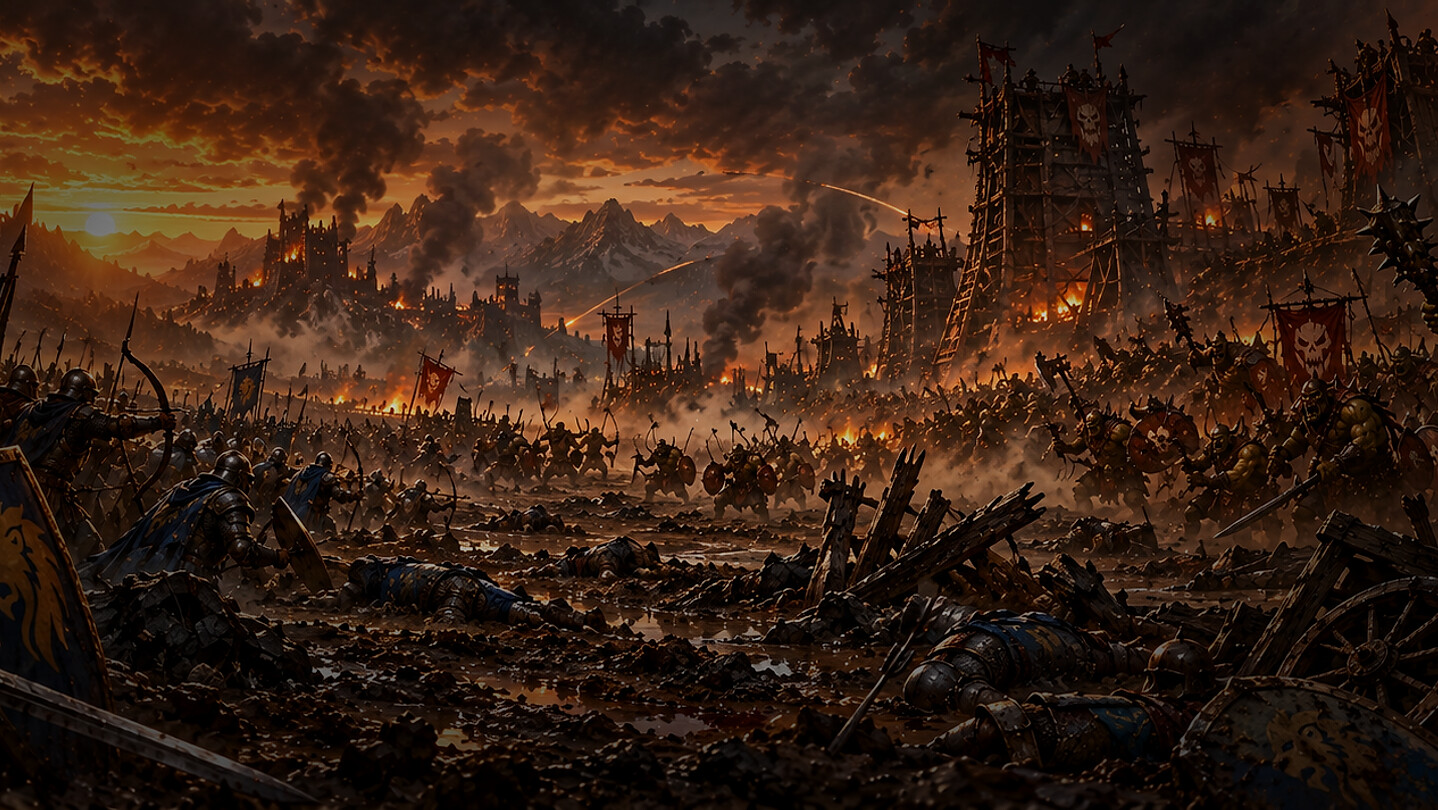

A turn-based hex wargame where the deck decides who fights. Draw a Battle card, call up knights or archers or a war machine, and make a plan survive the order it is dealt. Two rulesets: a clean card game, or the full tabletop with nerve, toughness and charges.

Sign in to add this item to your wishlist, follow it, or mark it as ignored

This game is not yet available on Steam

Coming soon

Interested?
Add to your wishlist and get notified when it becomes available.
 

About This Game

The deck decides who fights

Most tactics games let you move whoever you like. Warmasters draws a Battle card each turn, and it names who is allowed to act. Your knights. Your archers. The war machine that has spent three turns crawling toward their line and is finally in range, if the deck says so.

So a plan here is not a sequence you execute. It is something that has to survive the order it is dealt. The cavalry charge you were saving comes up a turn too early, or a turn too late, and the difference is the battle.

Two rulesets in one game

Basic is the card game underneath. One Combat Value, one hex a turn, skulls against shields. You can teach it to somebody in five minutes and still lose to them.

Advanced is what a tabletop player turns up for. Units activate one at a time instead of by card. Every model has its own movement, melee, missile, toughness and nerve. Dice are rolled on a matchup, not a single number. Charges gain weight, shield walls hold a line until something breaks them, and high ground is worth what it is worth.

And nerve is the one that changes how you play. Armies break here. A regiment that has taken enough gives ground on its own, and a line that folds at the wrong moment loses you a fight you were winning on kills. Most of your losses will not be men dying. They will be men leaving.

Pick either at the start of any battle. Both campaigns play both ways.

Ground that fights back

Every board is hand built, and the terrain is not decoration. Rivers need a ford or a bridge, and a drawbridge needs somebody standing on the lever. Woods break up a charge. Towers give a man reach and take away his shield wall. Hills come in tiers, and an archer on the third one can see over the second.

Weather and time of day sit on top of it. The same field in clear dawn and in a blizzard is not the same field, and a mission tells you which one you are getting before you pick your army.

What you take onto it

Infantry that holds, cavalry that breaks a flank, archers that make a crossing expensive. War machines that reload slowly and flatten what they hit, with scatter and misfires and a crew that can be cut down where it stands.

Casters roll for their spells against a casting value, and a failed roll can turn on the man who cast it. Magic here is a risk you take when the line is going, not a button you press every turn.

Two campaigns

The Iron Betrayal. Thirteen missions. The raids have stopped behaving like raids. Something out in the marches has given the horde a mind, and the realm is slower to believe it than it should be. Siege, long retreat, and one last reckoning.

North of the Kill. Six missions, the same war from the other end of it. You keep one warband the whole way, paid for out of a war chest that never quite stretches. Veterans carry what they learned into the next fight. Your dead do not come back.

And when the campaigns are done

  • Skirmish on any map at any points value, with an army you build yourself
  • Hot seat for two commanders on one screen, nothing hidden from either
  • A full army book with every profile, and what each unit is actually for
  • A narrated tutorial that teaches the game by playing a real battle, not by showing you slides

Made by someone who plays these

Warmasters is a wargame first. It keeps the things a tabletop game gets right, the dice you can read, the morale that decides more than the maths, the terrain that matters. It leaves out the ones a screen does better: no table to clear, no rulebook to look things up in, and nothing to paint before you can play.

AI Generated Content Disclosure

The developers describe how their game uses AI Generated Content like this:

Generative AI tools were used during development to assist with the creation and iteration of some 2D visual assets, including character and unit artwork, backgrounds, and promotional images. These outputs were selected, edited, composited, and integrated by the developer.

The game does not generate content during play, and no player input or personal data is sent to generative AI services.

System Requirements

Windows
macOS
    Minimum:
    • Requires a 64-bit processor and operating system
    • OS: Windows 10 64-bit
    • Processor: any 64-bit dual core
    • Memory: 4 GB RAM
    • Graphics: any GPU with hardware acceleration
    • Storage: 512 MB available space
    Recommended:
    • Requires a 64-bit processor and operating system
    • Memory: 8 GB RAM
    • Storage: 1 GB available space
    Minimum:
    • OS: macOS 11 Big Sur
    • Processor: Apple Silicon (M1 or later) or Intel Core i5 — universal binary, runs natively on both
    • Memory: 4 GB RAM
    • Graphics: any GPU with hardware acceleration
    • Storage: 512 MB available space
    Recommended:
    • Processor: Apple Silicon (M1 or later) or Intel Core i5
    • Memory: 8 GB RAM
    • Graphics: any GPU with hardware acceleration
    • Storage: 1 GB available space
Review Filters