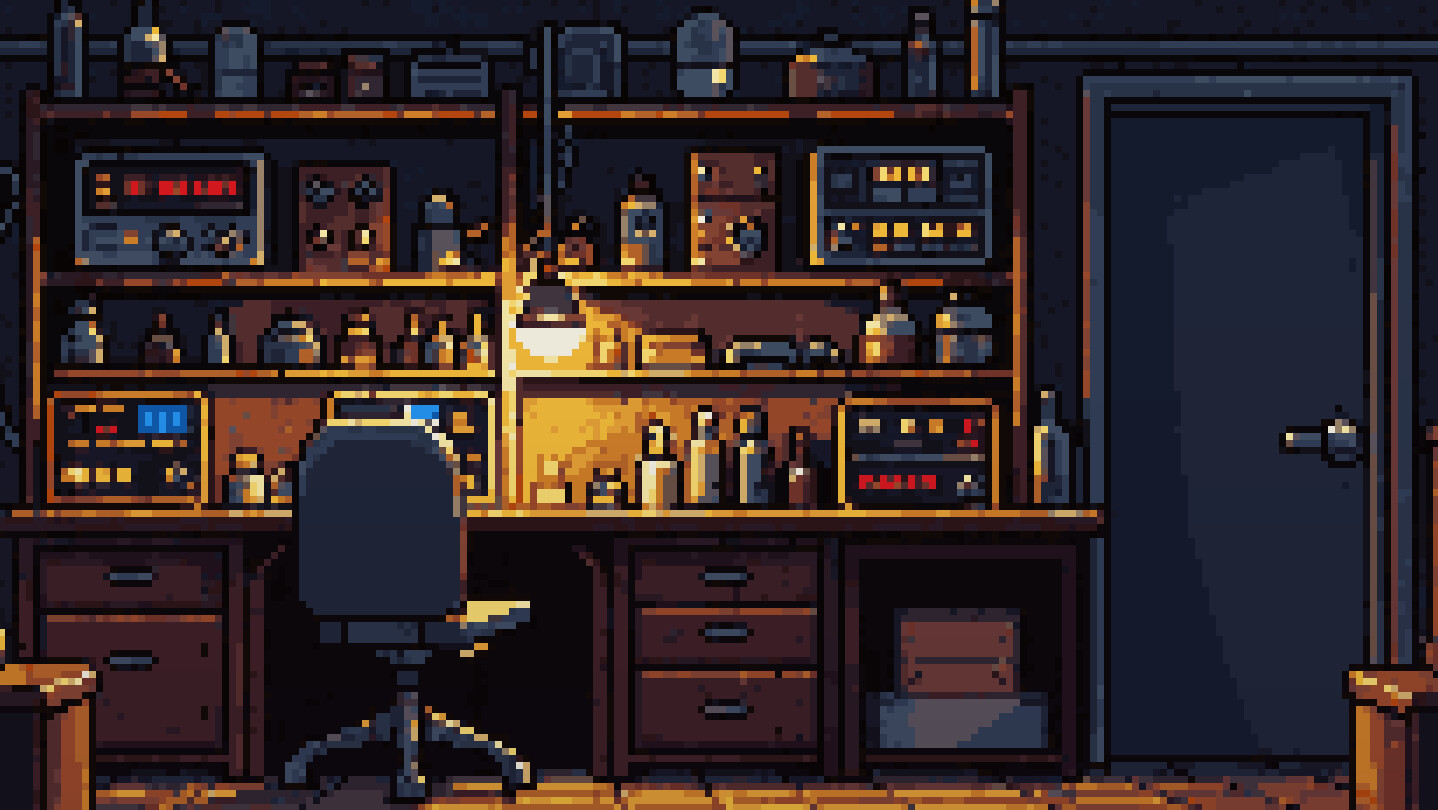


A 1970s electronics repair shop, genuinely simulated. Nothing is scripted — every fault is a real component misbehaving, and the only way to find it is to switch the machine on, let it warm through, and measure. Halve the chain, then halve what is left. Fix it, hand it back, hope it stays fixed.

Sign in to add this item to your wishlist, follow it, or mark it as ignored

This game is not yet available on Steam

Planned Release Date: Nov 1, 2026

This game plans to unlock in approximately 12 days

Interested?
Add to your wishlist and get notified when it becomes available.
 

About This Game

Nothing on the bench is scripted

A machine that comes in is a real circuit, built out of real components, with
something genuinely wrong with one of them. There is no hidden answer and no
list of steps. There is a resistor that has drifted, a capacitor that has gone
leaky, a solder joint that lets go once the board is warm — and the reading
your meter gives you is what that circuit would actually do.

Twenty-six machines, from a desk lamp to a home organ. Twenty-seven kinds of
component. Five hundred and fifteen different things that can be wrong, and
every one of them can be found and fixed.

Halve the chain, then halve what is left

Every machine is a chain of blocks with a test point between each pair. Full
signal at one point and nothing at the next means the fault is in the block
between them. Probe in the middle rather than at the end, and every
measurement halves what is left to search. That is the whole method, and the
game never does it for you.

Most faults are shy

A dry joint is perfect cold and lets go at eighty per cent warmth. A worn
control only crackles while somebody is turning the knob. A cracked track
needs a knock. Half the faults in this trade do not exist until you switch the
machine on and leave it running — so you watch it, listen to it, and put the
thermal camera on it.

The machine on the bench shows you what it is doing. It stutters, it goes
feeble, it smokes. What you hear is mixed live from the same readings the
notes are written from, so it is evidence rather than decoration.

Find the fault before you buy the part

Anyone can replace a circuit board one component at a time, and everyone who
does it goes broke doing it. Parts come out of a drawer that starts nearly
empty. A day is seven hours and every action spends some of them. Wages come
out of the till in the morning whether the day earned them or not.

Reputation is slow to earn and quick to lose: two points for a clean repair,
nine off for one that comes back. So test it warm, test it cold, knock it, and
only then hand it over.

The other half of the trade

Buy them broken, mend them, sell them on. There is a salvage yard full of
house clearances described the way the seller sees them, which is to say
badly. There is a shopfront, a licence that says how much you may list, and an
advertising agency that will sell you search ranking by the week. What sells
is ranking and reputation multiplied together, which means the bench is still
the thing that matters.

And a shop to run

Kit that changes what can be known rather than what can be bought: a better
scope resolves one per cent instead of five, a logging meter reads every test
point in one pass, a bench supply takes "is it the mains?" off the table
either way. Three people you can put on the books, each of whom has to earn
their wages. A specialism that builds up in whatever you spend your days on,
and brings you more of it.

The details

  • Everything drawn, animated and scored for the game
  • English, German, Turkish, French, Italian and Spanish
  • No microtransactions, no online requirement, no launcher
  • Runs on a potato — it is a dozen small animations over a still picture

AI Generated Content Disclosure

The developers describe how their game uses AI Generated Content like this:

Pre-generated content only. The game makes no network calls and generates
nothing at runtime.

ART. All 2D art is pixel art produced with PixelLab, an AI image generation
service, from prompts written by the developer and kept in the repository
(tools/pixellab.py). This covers device sprites, component and interface
icons, shop and manufacturer marks, effects, textures, the menu backdrop,
achievement icons and the store capsules. Every image was reviewed and
selected by the developer, many were regenerated against a written art
direction until they matched it, and several are further transformed in
code — trimmed and squared, recoloured for dark backgrounds, made seamless
for tiling, or desaturated to produce the locked variant of an achievement
icon.

TEXT AND LOCALISATION. The interface text, the tutorial, the help book and
the in-game prose were written with AI assistance, and the translations into
German, Turkish, French, Italian and Spanish were AI-produced from the
English. All of it was reviewed by the developer. The store description and
its five translations were produced the same way.

System Requirements

Windows
SteamOS + Linux
    Minimum:
    • OS: Windows 10 64-bit
    • Processor: any x86-64 processor
    • Memory: 2 GB RAM
    • Graphics: anything with OpenGL 3.3 / Vulkan 1.0
    • Storage: 400 MB available space
    Minimum:
    • OS: any current 64-bit distribution
    • Processor: any x86-64 processor
    • Memory: 2 GB RAM
    • Graphics: anything with OpenGL 3.3 / Vulkan 1.0
    • Storage: 400 MB available space
Review Filters