

Pebble to Star is an idle growth game. Swallow the bodies that drift past and raise a grey pebble into a planet, a star, even a black hole and a galaxy, immersed in an ever-changing universe.

Sign in to add this item to your wishlist, follow it, or mark it as ignored

This game is not yet available on Steam

Coming soon

Interested?
Add to your wishlist and get notified when it becomes available.
 

About This Game

Pebble to Star is an idle growth game.

Pull in the bodies that drift past and raise a grey pebble into the world you want: a planet, a star, a black hole, a galaxy.

You start as a grey rock in a 1-bit sky. Nothing is timed. What you eat decides what you become.

Left-click to pull, right-click to push

Left-click a comet or a meteor and it falls in, leaving a crater. Hold the left button and sweep to take whatever the cursor passes. Right-click what you don't want and it is flung away. Anything flashing red is on a collision course: take it, or push it off. The heavier you grow, the more your gravity pulls in by itself, and it keeps eating while you are away.

Become the world you want

Open the growth route and pick a destination: an ocean world, an iron planet, a blue giant, a magnetar. A checklist in the corner shows what is still missing. Ice makes oceans and metal makes iron worlds; the mass you ignite at decides what kind of star you become, and how heavy it is when it dies decides what it leaves behind.

From 1-bit to 24-bit

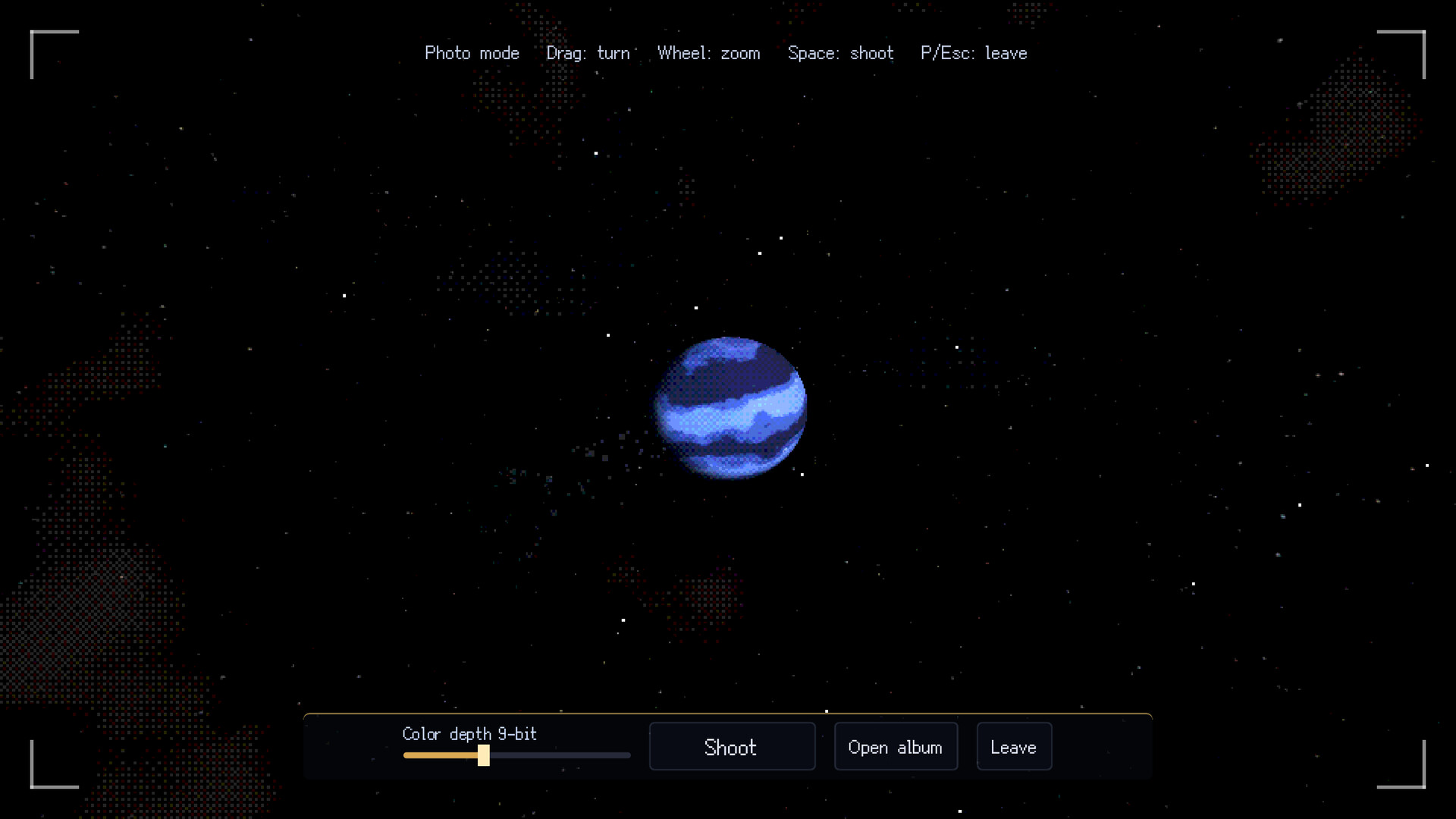
The screen starts in 1-bit black and white. As heat, water and life build up and you grow from layer to layer, it gains color depth bit by bit, until oceans, clouds, rings and nebulae show in full color.

Events ask you to choose

A neighboring planet swings past: move inward, move outward, or hold your orbit. The Sun falls toward you: merge, or push it away. A planetary embryo the size of Mars is aimed at you: a grazing hit makes a moon, and melts the whole surface. Every layer brings choices like these, all the way up to colliding galaxies.

A civilization, from first light to last

Keep a living world stable and a civilization appears: you can see its lights. Then it reaches outward: telescopes, satellites, a space station, starships. But one big impact throws it back into a dark age, or ends it and leaves only ruins.

In the game:

  • - Grow from a pebble all the way to a galaxy, with a new look and new events at every stage

  • - Dozens of destinations: worlds, stars, stellar remnants and galaxies, each with its own conditions

  • - A star map with dozens of upgrades across several branches, bought with the elements you eat

  • - Several kinds of life, and more than one way for a civilization to leave its planet

  • - Modeled on current astrophysical theory and observations: stars die the way real stars do, almost every event is based on a real object, and the black hole is ray-traced through curved spacetime

  • - A codex of 100+ worlds and phenomena, and an in-game camera for the moments you want to keep

  • - If you like collecting: fill the codex and the periodic table

  • - Complete the periodic table and you can refuse the bounce: watch the universe age all the way to heat death

  • - Big Bounce: collapse the universe and start again with a periodic table that keeps your progress

  • - Let it grow on its own: switch on idle and it keeps eating while you are away; growing up waits for you. Sometimes letting go is a choice too

How far can your pebble grow?

AI Generated Content Disclosure

The developers describe how their game uses AI Generated Content like this:

This game is a solo project; the developer made it with the help of AI tools:

- The game's content and text were conceived by the developer and written up with AI assistance (drafting and polishing); the other languages were translated with AI assistance. Every line was reviewed and edited by hand.
- All visuals and sound are rendered and synthesized by code at runtime.
- That code (the shaders and the audio synthesis) was written by the developer with the help of AI coding tools; no AI image-generation or audio-generation models were used.
- The store capsule artwork was commissioned from a human artist.

The game does not use AI to generate any content at runtime.

System Requirements

    Minimum:
    • OS: Windows 10 64-bit
    • Processor: Dual-core 2.0 GHz
    • Memory: 4 GB RAM
    • Graphics: Vulkan 1.1 compatible GPU (Intel UHD 620 / GeForce GTX 750 / Radeon R7 260 or better)
    • Storage: 1 GB available space
    • Sound Card: Any
    • Additional Notes: Requires a GPU and driver with Vulkan support. 1920×1080 or higher recommended.
    Recommended:
    • OS: Windows 10 / 11 64-bit
    • Processor: Quad-core 3.0 GHz
    • Memory: 8 GB RAM
    • Graphics: GeForce GTX 1050 / Radeon RX 560 or better
    • Storage: 2 GB available space
    • Sound Card: Any
Review Filters