

You sold everything you owned and bought a house on a tidal coast, sight unseen, to fish. Here every fish is a boss fight: read the tell, answer right, give line, hold steady, and it tires. Answer wrong and your line snaps. You get better because you learned the fish, not because your stats went up.

Zaloguj się, aby dodać tę pozycję do listy życzeń, zacząć ją obserwować lub oznaczyć jako ignorowaną

Polski język nie jest obsługiwany

Ten produkt nie obsługuje twojego lokalnego języka. Przed zakupem zapoznaj się z listą obsługiwanych języków, która znajduje się poniżej.

Ta gra nie jest jeszcze dostępna na Steam

Wkrótce dostępne

Interesuje cię ten produkt?
Dodaj go do swojej listy życzeń i otrzymaj powiadomienie, gdy stanie się dostępny.
 

O tej grze

A desk in a city that is all windows and no sky. An hour that keeps getting later. One photograph that nothing in this game ever explains.

Then a list. Everything you own, itemised, going one line a second, and a card for a house in Kettle Bight you have not been to see.

The game opens on that, wordless, in grey. Then it cuts to the water, and you arrive with a borrowed rod and no idea what you are doing.

A hook-up is not a progress bar. It is an encounter.

The fish telegraphs what it is about to do: a run, a dive, a jump, a head-shake, or that awful dead-weight stillness. You answer.

Give line when it runs.

Bow when it jumps, or the tight line snaps in mid-air.

Hold steady through a head-shake. Slack throws the hook.

Pump a sulker off the bottom.

Side pressure to turn its head off the oyster racks.

Right answer, and its stamina drains. Wrong answer, and your line does.

The first time a Silver King comes out of the water you will probably lose it. The correct response is the one every instinct says not to do. The second time you will know.

Every species' first catch unlocks its journal entry: its tells, its habits, what it does when it is tired and lying about it. Nothing is hidden behind a level. The tell is in the animation from the very first encounter, at every stat level. The journal just gives it a name.

You do not grind. You learn fish.

The coast opens one shore at a time, and the town says so in its own materials. A way you cannot take yet is boarded: a trestle dragged across the road, a drum, an iron sheet wired to a scaffold pole. Not an invisible wall with a line of text over it.

Eleven main quests, and every one is a specific person asking you for a specific thing in their own words. One key opens a log that shows the whole line in order, which shore each step belongs to, and how far through it you are.

Gone Fishin' is the other mode, and it is not a difficulty setting. Everything unlocked, every shore open, every rod and reel already in the bag, no quests and no gates. Walk to the surf at dawn on your first morning if you want to.

What it does not remove is the fish. The tide still runs, the conditions still decide what is there, the surf still comes in sets, and a Silver King still has to be fought rather than collected. The gear was never the difficulty. Its own save, so a game you were given can never write over one you earned.

A real clock, a real tide table, and weather that means something.

  • Tidal current drives everything, not tide height. Incoming pushes fish onto the flats. Outgoing stacks them at the creek mouths. Slack water is dead, except for the few things that only show up when it is.

  • The estuary's pool changes with the tide, and the water visibly rises and falls across the mudflats, drowning and exposing the oyster racks as the day turns.

  • A falling barometer means six hours of hard feeding before the weather arrives. Bottom-dwellers do not care. They have no swim bladder to notice with.

  • Dawn, dusk, rain, fog, wind, moon phase. An incoming tide at first light in soft rain is a genuinely different day's fishing than slack water at noon under a hard sun.

Nothing here is a straight upgrade.

Braid is the strongest line in the game, has no stretch at all, and will therefore transmit every mistake you make straight to the hook. It cuts on structure. It is visible in clear water, and a wary fish will simply decline. Monofilament forgives you and loses you time. Fluorocarbon disappears underwater and costs a fortune.

Tie your own leaders. A rig is only as strong as its worst knot, and that is implemented rather than flavour text. You can fish a badly tied clinch. You will find out when it matters.

A working fishing town on the wrong side of a good decade. Not dying dramatically, just doing that quieter thing where the school closed, nobody mentions it, and the bait shop still opens at five.

  • Ovid wants to see one particular fish again. He last saw one in 1984. It is not extinct. It is upstream, in cold rain, after the pressure drops.

  • Bett runs the tackle shop and has strong opinions about braided line, which she will explain at length while selling you some.

  • Merle has logged every boat that left this harbour since 1971, including the two that did not come back. He will not discuss it. You can read the book.

  • Grieve is at the end of the dock at four in the morning, every morning, and has never caught anything. He seems fine about it.

And the house is yours: a front room with a hearth, a yard with a thorn hedge round it, and a pond with the harbour's two commonest fish in it. Deliberately the worst water in the game, and a minute from your own door. It is on no signpost and nothing sends you there. Every achievement you earn quietly puts one small object on that shelf, and the game never once mentions it.

  • 24 species, each with a distinct set of tells. No palette-swap filler.

  • Five shores opened in order: dock, freshwater stream, tidal estuary, open bay, open surf. Plus a house and a pond that are on no signpost at all.

  • A live clock, a semidiurnal tide table, weather and barometric pressure.

  • Rods, reels, lines, leaders and lures as trade-offs, plus real leader crafting and knot-tying.

  • A bestiary written by a visiting ichthyologist three years into a two-month survey.

  • Eleven main quests and eight errands, all hand-written, none generated.

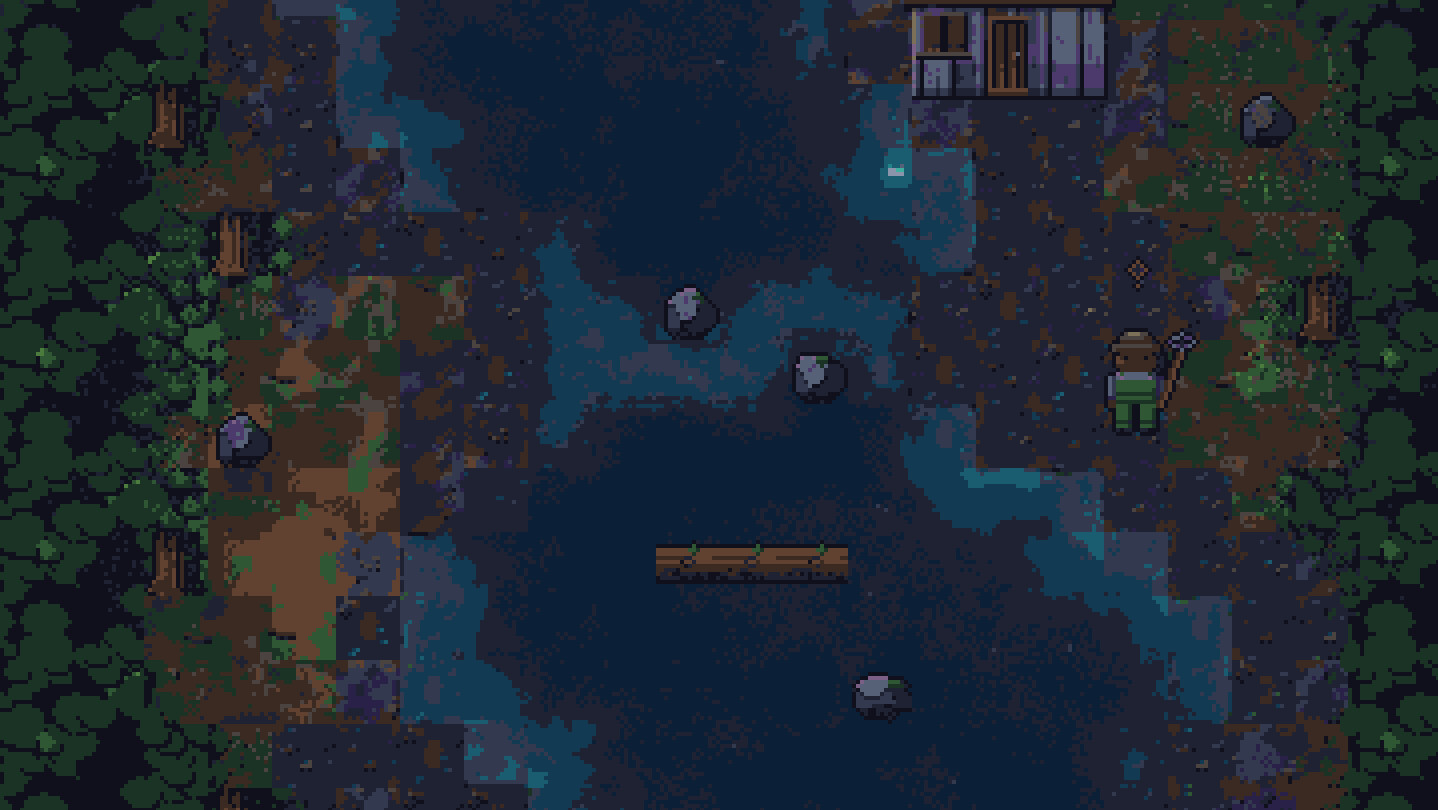
  • Chunky readable pixel art in a single 47-colour palette, with water that refracts what is under it.

  • A wordless prologue, and a town that keeps its own time whether or not you are in it.

  • Gone Fishin', a second mode with everything unlocked and no quests, on its own save.

  • Full controller support and full keyboard-and-mouse support, both first-class.

  • A Patience slider that scales every timing window, up to "wait for input". Nothing in the design breaks at any setting.

No grinding. If you are stuck on a fish, the answer is never "come back at a higher level". It is that you have not worked out what it is telling you yet. It has been telling you the whole time.

Wymagania systemowe

Windows
SteamOS + Linux
    Konfiguracja minimalna:
    • System operacyjny: Windows 10 64-bit
    • Procesor: Any x64 CPU, 2015 or later
    • Pamięć: 4 GB RAM
    • Karta graficzna: Integrated with WebGL 2.0 - Intel HD 520 or better
    • DirectX: Wersja 11
    • Miejsce na dysku: 500 MB dostępnej przestrzeni
    • Dodatkowe uwagi: x86-64 only — no ARM build
    Konfiguracja zalecana:
    • System operacyjny: Windows 11 64-bit
    • Procesor: Any modern x64 CPU
    • Pamięć: 8 GB RAM
    • Karta graficzna: Any discrete GPU, or 2020-or-later integrated
    • DirectX: Wersja 11
    • Miejsce na dysku: 500 MB dostępnej przestrzeni
    • Dodatkowe uwagi: x86-64 only — no ARM build
    Konfiguracja minimalna:
    • System operacyjny: Ubuntu 22.04, or a distribution of equivalent vintage (glibc 2.35+)
    • Procesor: Any x64 CPU, 2015 or later
    • Pamięć: 4 GB RAM
    • Karta graficzna: WebGL 2.0 capable, Mesa 22 or later
    • Miejsce na dysku: 500 MB dostępnej przestrzeni
    • Dodatkowe uwagi: Ships as an AppImage. x86-64 only — electron-builder.json5 targets arch: ['x64'], so there is no ARM build
    Konfiguracja zalecana:
    • System operacyjny: Ubuntu 24.04 or later
    • Procesor: Any modern x64 CPU
    • Pamięć: 8 GB RAM
    • Karta graficzna: Discrete GPU, or 2020-or-later integrated with Mesa 24+
    • Miejsce na dysku: 500 MB dostępnej przestrzeni
    • Dodatkowe uwagi: Ships as an AppImage. x86-64 only — electron-builder.json5 targets arch: ['x64'], so there is no ARM build
Filtry recenzji