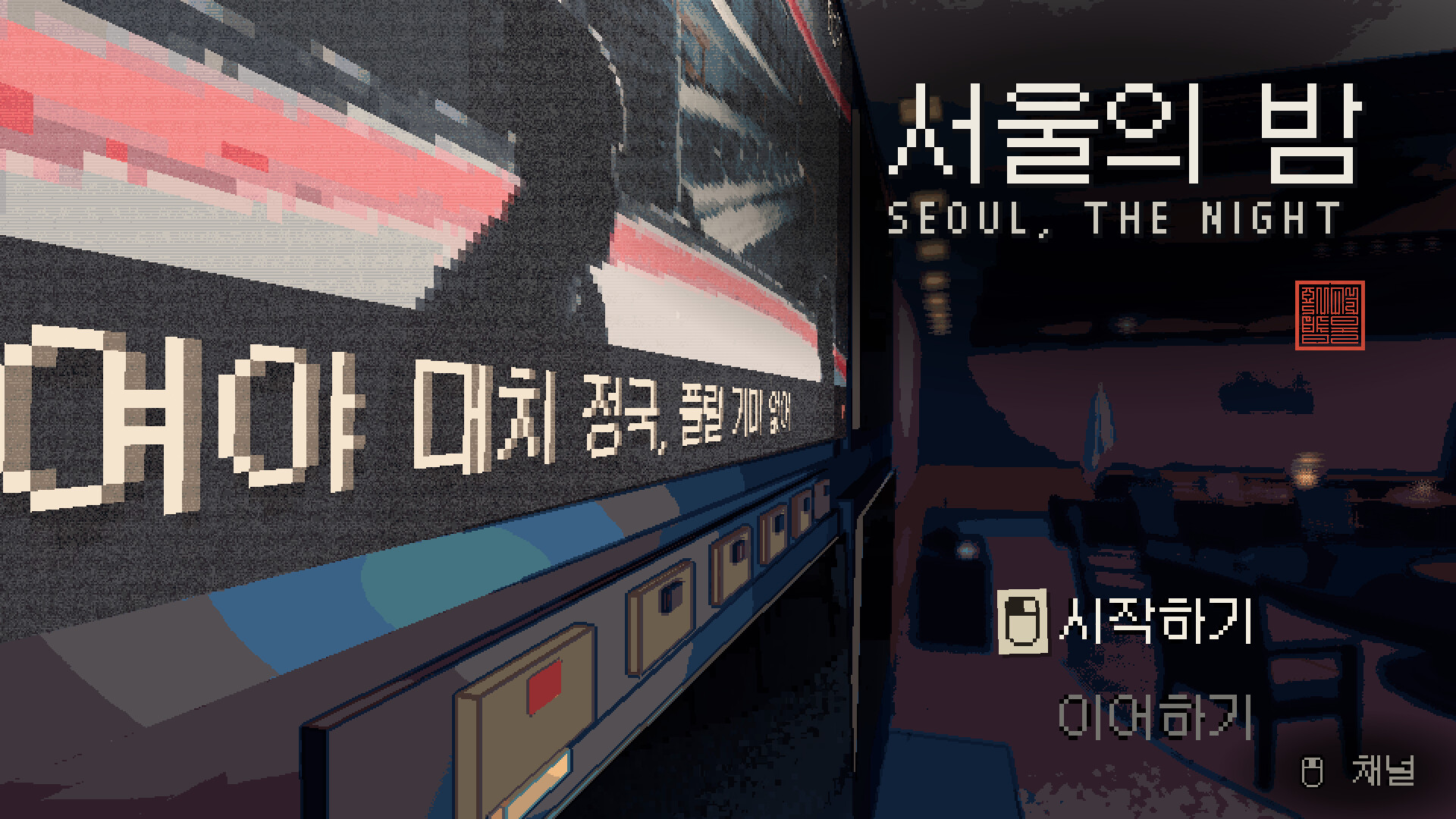


The night martial law was declared, you sit at the desk those orders crossed. Route the orders, draw up the paperwork, make sure nothing is written down. That night, martial law was stopped by a vote in the National Assembly. How often it nearly wasn't, you'll find out when you play.

Sign in to add this item to your wishlist, follow it, or mark it as ignored

This game is not yet available on Steam

Planned Release Date: November 2026

Interested?
Add to your wishlist and get notified when it becomes available.
 

About This Game

On the night of December 3, 2024, the president declares martial law in a televised address. While the address is on the air, a room full of telephones goes to work, and keeps working until seven in the morning.

There are no stars on your shoulders. You route the words of the men who wear them — take the call, draw up the paperwork, decide what goes on paper and what never does. The night has been planned. Your job is to make the plan survive contact with the people who have to carry it out.

EVERYONE KNOWS HOW IT ENDS

Martial law was lifted within six hours, after the National Assembly passed a resolution demanding it. The institutions held, and the night settled into a reassuring story.

This game is about how close that was.

What stopped martial law that night was people — citizens who resisted, and soldiers and police who did their jobs as slowly as they could. A commander who told his men to take their time. Investigators who drove the long way on purpose. Military lawyers who said the order was unlawful. An official who said: put it in writing. Take a few of them out of the room, and the night ends differently.

WHAT YOU DO

  • Orders arrive by radio, by telephone, on paper, over the broadcast. What you can do with one depends on how it came in.
  • Approve, delay, send it back. Some moments call for a single careful sentence that means nothing at all.
  • Leave no record. The catch: bureaucracy does not move without making one.
  • Close the night, and the next day an envelope is waiting on the same desk: what the record wrote after that night.

Each time the night's plan gets past the people who hesitated, the cost is billed to the record — the deeper into the small hours, the thicker the evidence. The last scene is a court ruling, and what you did at this desk that night is read back: how many papers you stamped, how many you held back, the calls you missed, how many times you looked out of the window.

A NOTE ON FORMS

Even the settings are paperwork. Pick a language, then pick a country's paper: the settings folder is reprinted, and printed out, in that state's official forms. The approval folders on the night's desk keep their Korean format. That is where it happened. The same folder holds text size, contrast, subtitles, volume and camera sway.

IT'S ALL IN THE RECORD

Every fork in this game was pulled straight from the public record — hearings, court rulings, constitutional decisions, reporting. Sooner or later you will hit a scene and think: they made this one up. That one is the real record. The names are gone; only the titles remain. The questions this game asks, and the answers it gives back, are the ones that actually crossed the wires that night. Where the records disagree, both versions stand side by side.

The facts in this game follow the public record as of 2026-10-10 (court rulings, decisions, hearing transcripts, reporting). When new rulings or facts come out, a patch brings them in and this date moves with it.

The plan is to add Brazilian Portuguese, Polish and Spanish during Early Access.

AI Generated Content Disclosure

The developers describe how their game uses AI Generated Content like this:

Pre-generated AI content. Some visual assets were produced with AI image tools and then reworked by hand: surface textures used by the procedural city renderer, and a set of pixel-art stills (concept passes from an image model, converted to pixel art with a diffusion tool, then edited). Some of the 3D props on the desk were generated with an AI 3D tool, then reduced and retextured by hand. The music was made with an AI music tool and split into layers for the game. Store artwork was made the same way as the stills. In-game text was drafted with AI assistance and then edited and verified by the developer against the public record — hearings, court rulings, constitutional decisions, reporting. Much of the code was written with an AI coding assistant. The game does not generate any content at runtime.

Mature Content Description

The developers describe the content like this:

This game takes place over one night in a situation room, after martial law is declared. Its subject is political coercion: orders that would put soldiers in the streets and people in custody are discussed over the radio, on the telephone, and on paper. Troop movements appear only on the room's monitors (security-camera feeds, a situation board, the news) and in photographs attached to the paperwork. There are no depictions of violence, blood, injury, nudity, or sexual content. The events and times come from the public record; the coordinator you play, and the choices you make, are the game's. Every person in it is called by title.

System Requirements

Windows
macOS
SteamOS + Linux
    Minimum:
    • OS: Windows 10 64-bit or later
    • Processor: 64-bit dual-core, 2.0 GHz (Intel Core i3-6100 / AMD equivalent)
    • Memory: 4 GB RAM
    • Graphics: Vulkan 1.0 compatible GPU, 1 GB VRAM (Intel HD Graphics 620 / NVIDIA GeForce GTX 650 / AMD Radeon HD 7750)
    • Storage: 500 MB available space
    • Additional Notes: Pixel art drawn at an integer scale to fill your display. Full controller support.
    Minimum:
    • OS: macOS 26 Tahoe (tested). Earlier versions not yet tested.
    • Processor: Apple Silicon (M1 or later). Intel Macs not yet tested.
    • Memory: 8 GB RAM
    • Graphics: Apple M1 GPU or better (Metal)
    • Storage: 1 GB available space
    • Additional Notes: Pixel art drawn at an integer scale to fill your display. Full controller support.
    Minimum:
    • OS: SteamOS 3, or a 64-bit Linux distribution released after 2018 (glibc 2.28 or later)
    • Processor: x86-64 CPU with SSE4.2 support
    • Memory: 4 GB RAM
    • Graphics: Vulkan 1.0 compatible GPU
    • Storage: 1 GB available space
    • Additional Notes: Pixel art drawn at an integer scale to fill your display. Full controller support.
Review Filters