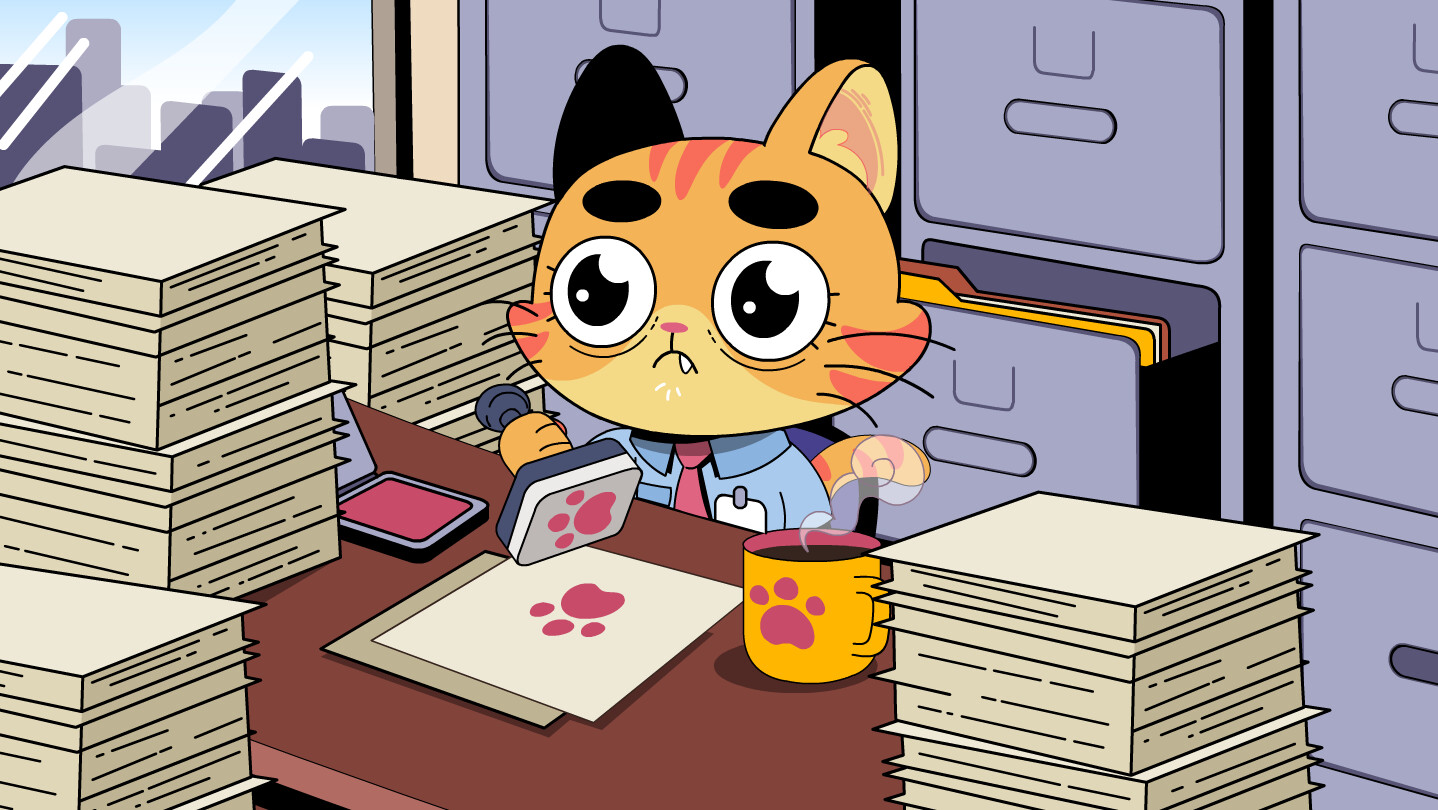

An idle game about a cat stamping an absurd amount of paperwork, in a window that lives on top of everything else you are doing. Collect the package, stamp what is inside, send it out. Do it all by hand until you can afford not to, then go find out who keeps sending the work down.

Sign in to add this item to your wishlist, follow it, or mark it as ignored

Download Pawperwork Demo

This game is not yet available on Steam

Coming soon

Interested?
Add to your wishlist and get notified when it becomes available.
 

About This Game


You are the cog that makes the paperwork turn.

Pawperwork is an idle game that lives on top of your other windows, in a strip of screen you can leave open while you use the computer for anything else. There is a desk, a stack of papers that never stops arriving, and a cat with a stamp. Or a dog, if you would rather have a dog. Pull the package in, stamp what is inside, send it out the other side. Then hire an intern to open what comes in, let the cat stamp on its own, put a dispatcher on the outbound tray, and go find the next bottleneck.

The job never changes. The scale does.


Every tier of the bureaucracy runs the same three steps: collect, stamp, dispatch. What changes is what you are stamping and what stands between the steps.

Produce enough and you get promoted. The tier above is yours now, and everything you built so far keeps running underneath it and feeding it. A promotion only ever adds. Nothing you built ever shuts down.

  • Desk, you stamp a single sheet of paper
  • Office, folders of ten sheets
  • Bureau, pouches of a hundred
  • District, boxes of a thousand
  • Metropolis, containers nobody has counted
  • and five more above that

Ten tiers in all. They stop being about buildings well before they stop being about paperwork, and the last thing you seal is worth a billion sheets of it.

Only the Desk turns paper into credit. Everything above it feeds the tier below through a physical funnel, so the whole tower is one supply chain, and when it backs up there is always a place you can go and look at.

Nine things to fidget with while you wait


Idle games leave your hands empty. Each tier above the Desk hands you something small to do instead, wedged between two steps of the loop. Pick one up when you have a spare moment, put it down when you do not. The line keeps running either way.

They are not busywork. Doing one well marks the unit, and the mark is still on it when it reaches the bottom of the tower, where it turns into credit. Every one of them starts in your hands, and every one of them can be handed off later. The automation trades your attention for throughput and pays for it in accuracy, which you then buy back level by level.

  • Formatting, sweep a matrix to draw the shape being asked for
  • Numbering, divide the digits in your hand across the open orders so each total closes exactly
  • Stencil, tile the silhouette on the bench with the pieces you were sent
  • Calibration, hold a sinking valve inside the requested color band while the line keeps delivering
  • Mixing, close the truck with the two primaries that make the secondary color on the order
  • Dock, pack the cargo from the pile into a truck grid without leaving gaps
  • Board, trace a path of adjacent tiles that adds up to the total being demanded
  • Sequence, always take the lowest card left on the bench and put it on the rail
  • Sorting, send each folder down the conveyor that matches the color it arrived with

Three threads run the length of the tower


Color, shape and number are not decoration. Each one is created on one tier, transformed on another and spent on a third, and it rides down the chain inside the unit itself.

The pump in the District makes a primary color. One tier down, the truck in the Bureau mixes two primaries into a secondary. One more tier down, the Office sorts that exact secondary onto a conveyor. Miss the pump and the box goes down uncolored: further down the truck runs short of primaries, and the Desk gets less color and fewer marks.

Get it right and the unit carries a mark for every mechanic it passed through. The Desk credits all of them at once.

It admits that it is sitting on your desktop


Pawperwork is a desktop app with no window frame that sits on top of your other windows and can have a transparent background. It comes in five shapes:

  • Companion, just the cat, its ink pad and the papers, in a small corner of the screen
  • Desk, the stamp and the two trays around it
  • Line, the whole production line at once
  • Borderless, the same line across the whole monitor, for when you actually sit down to play
  • Native window, the whole monitor with your system's own frame back

Meeting mode multiplies everything you produce for as long as you are on a call. Flip it yourself, or let the game notice that something on your machine is holding the microphone. That detection is off unless you turn it on, it reads only what your operating system already shows on its own privacy screen, and it never leaves your computer, because there is no networking anywhere in the app. The game also counts how many hours you have spent stamping while in a meeting, and does absolutely nothing with the number.

The game saves itself and credits you for the time you were away.

The cat does the stamping


  • A second hand. The cat picks up a second stamp. The two arms alternate, each with its own ink and its own trip to the pad.
  • The Batch Stamp. A giant stamp drops onto Pending and sends a whole batch straight to Dispatch, spending no ink, then needs a while to recharge.
  • The nap. While the game is closed, the cat dozes off and banks the time you were away. Turn the nap on for a tier and it runs hot until the bank is spent.
  • Golden ink. A second ink pad on the Desk, with a reserve of gold that slowly refills on its own. Dip the stamp in it by hand, and every hand stamp comes out golden and is worth more. The automatic stamp never spends the gold.
  • Stampbots. Further up the tower, autonomous units arrive at the bench. They work in parallel with the cat, they never touch the ink pad, and they keep stamping right through the moments the cat spends refilling.
  • The corporate gift. Hats, glasses, neckwear and stamp heads to dress up the cat, or the dog, plus skins for the speech balloon and the windows.

A career, and then another one


  • An Upgrades tree, where every node is unlocked by the one before it, in branches for the helpers, the stamp, the ink, the rubric, the Batch Stamp and more. What you buy in the branches holds across the whole hierarchy, and each tier has purchases of its own.
  • Every promotion comes with a Directive. Choose Crew or Machines for the new tier, and Commitments arrive as the tier produces and gains new systems: trades with a gain and a cost written into the terms. Adopt one and it is final. Shelve it and it goes back to the end of the queue, free of charge.
  • The Process. One single document that not even resigning erases, and nobody carries it but you. Drag it through every tier by hand, get it stamped, tear off the stub, sign it and file that tier's copy, because Dispatch refuses it otherwise. The last stamp pays out a seal pack.
  • Hire real copies. A tier can hire copies of the tier below it. Not a multiplier: each copy is an actual line running its own loop and pouring into the funnel underneath it. A Map tab shows the entire chain, the funnels between tiers, and exactly where it is choked.
  • The golden document shows up every so often and flies across the scene. Click it in time and everything the Desk credits is multiplied for a few seconds.
  • Seal packs are what your credit buys once the upgrades run out: collectible seals in a range of rarities, each one multiplying the whole run.
  • Hand in your resignation. The prestige reset. Almost everything is demolished, the run converts into rank, every stamped sheet is worth more forever, you gain a title, and your résumé gets one more line. It is the only thing in the game that takes anything away from you, and you are the one who chooses it.

The short version


  • Idle and incremental, played in a strip of your screen or in fullscreen
  • Ten tiers of bureaucracy stacked on each other, each one more absurd than the one below it
  • Nine small fidget mechanics to fill the waiting, each with an automation path and an accuracy curve
  • Three attribute threads that cross the whole tower and can be ruined far from where you touched them
  • An Upgrades tree, a prestige reset, and a cat

AI Generated Content Disclosure

The developers describe how their game uses AI Generated Content like this:

This game uses AI-assisted tools during development, limited exclusively to programming assistance, multilingual translation assistance, drafting assistance for written store page copy, and a synthesized voice used for the narration of our promotional videos.

The narration script is written by the development team. Only the voice reading it is synthesized, and it appears in promotional videos only. It is not part of the game, and no AI-generated output is integrated into the game itself. All content is manually reviewed, edited, integrated, proofread, and tested by the development team before use.

AI is not used to create characters, character illustrations, character-related artwork, animations, music, sound effects, narrative, or other core creative content. Our sound effects are public domain field recordings, and the music in our videos is licensed from human authors. The game does not generate content in real time while running, nor does it connect to external AI services to provide generative features to players.

System Requirements

Windows
SteamOS + Linux
    Minimum:
    • OS: Windows 10 (64-bit)
    • Processor: Any 64-bit dual core processor
    • Memory: 4096 MB RAM
    • Graphics: Integrated graphics with OpenGL 3.3 or Direct3D 11 support
    • Storage: 500 MB available space
    • Additional Notes: The game runs in a small always-on-top window over your desktop. No internet connection is required.
    Minimum:
    • OS: 64-bit, Ubuntu 22.04 or newer (or equivalent)
    • Processor: Any 64-bit dual-core processor
    • Memory: 2 GB RAM
    • Graphics: Integrated graphics
    • Storage: 300 MB available space
    • Additional Notes: Tested on Ubuntu 22.04 and Fedora 44