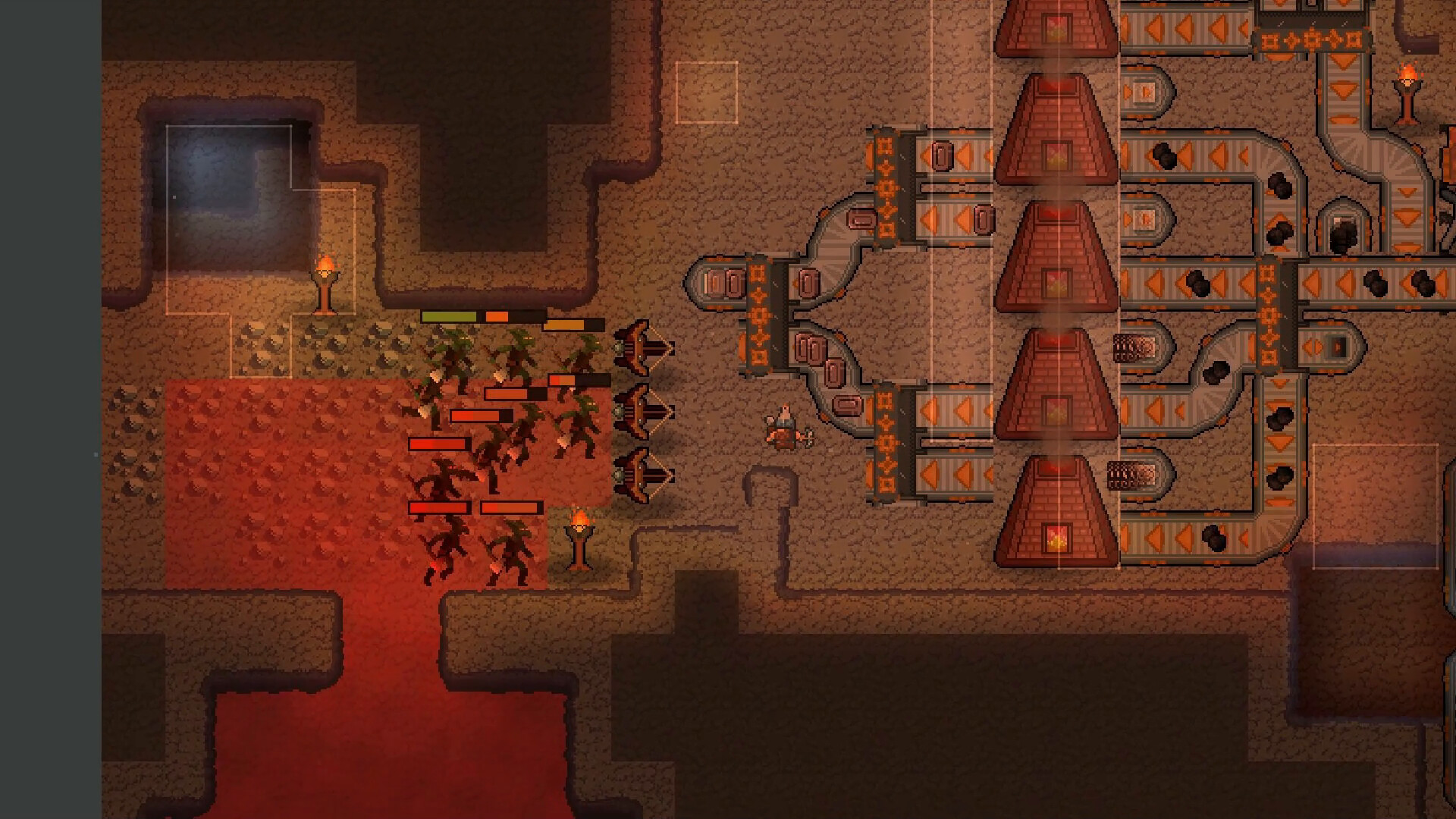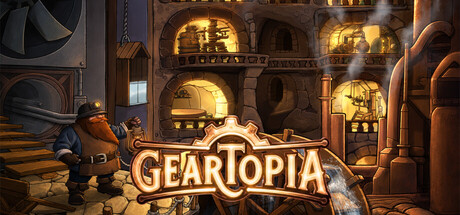


A factory builder with no electricity, but steam, shafts, gears and water wheels. Run production chains from drill to furnace, carry torque half across the map, and build downward when flat ground runs out. Goblins come down the shafts you dug.

Sign in to add this item to your wishlist, follow it, or mark it as ignored

This game is not yet available on Steam

Planned Release Date: Q1 2027

Interested?
Add to your wishlist and get notified when it becomes available.
 

About This Game

You're a dwarf with a pickaxe on the edge of an empty map. You set a water wheel by the water, run a shaft from it to a drill, the drill chews rock, a belt carries ore to the furnace. Electricity was never invented here and never will be: everything runs on water, steam, brass and rivets. The iron is ordered by dwarven fortresses under siege by goblins, and they hold out exactly as long as you keep shipping. Flat ground runs out faster than you'd think, so the factory doesn't spread outward, it goes down, floor by floor. And down those same shafts you dug, the goblins come to you.

There's never enough torque

Everything in your factory turns off the same water. The wheel turns a shaft, the shaft runs half across the map and three floors down, splitting into branches on the way, and at the end of every branch something is working.

There's one pool of power for all of it, and it's never enough. Place a sixth drill and everything stops. Not the sixth drill — the whole line: the furnace, the crusher, the belt, the other five drills. A network has two states, enough and not enough, and there is nothing in between.

There is no battery. You can't bank rotation for later and there's nowhere to buy more power. You can only rebuild: swap the gears, run another branch, find better water, admit that four drills on one shaft was a bad idea. The steampunk here isn't wallpaper — the steam engine isn't a decorative pipe in the background, it's reward after spending half the game chained to a river.

What floor are you on?

You run out of room on the surface somewhere around hour two. There's as much of it as you like further down, but a new floor isn't just new space. Power has to reach it, ore has to get down there, and everything has to come back up. Every level you descend is paid for in construction.

The upside is that you can see all of it. Every floor runs at once, and through the holes you dug yourself you watch furnaces working below, water spreading, and goblins creeping.

Goblins want dwarf flesh

You will not be left to build in peace. Goblins come for dwarf meat, and the bigger your factory the more of them turn up: the size of a wave is measured against your own production. Success gets billed.

The good news is that getting rid of them leaves room for creativity. A ballista is reliable and boring. Far more entertaining is dropping a wave down a four-storey shaft: goblins are not good at landing. Or opening a sluice and drowning the whole company at once with water, though deeper down there's something warmer to be found. Or walking them into a corridor nobody walks out of.

There are no separate "defence levels" here. Your weapons are your factory, your tunnels and your ingenuity and the passages you dug for convenient logistics, you dug for the goblins too.

Water doesn't care whose floor it is

Water here flows on its own. It spreads, pours from floor to floor, and finds every hole you forgot about. Whose shaft it is, yours or the goblins', makes no difference to it.

Hence the best trap in the game. A full tank up top, a sluice above the shaft, the wave walks in, the sluice opens. Nothing further is required of you.

Hence also the best disaster in the game, because water doesn't stop on the floor where you let it out. It carries on down, to the smelter you spent two hours building.

Pumps, pipes and tanks exist for exactly one reason: to make water go where you decided rather than where it would rather go. It doesn't always work.

The fortresses need iron

You aren't the only one under siege. Dwarven fortresses send in orders, and an order here isn't a line reading "20 iron, 200 gold" — it's a particular fortress running out of that iron.

Orders arrive at the aerodock. There's one on the whole map, the board always holds three offers and you can take one, and while you're busy with a bad one the good ones pass by.

A fortress can be lost. Not "reputation −5" — Kaz-Dur, which stops writing.

Gold isn't mined here, only earned. So "how much gold have you got" means exactly one thing: how much you've done for the people holding the line. It goes on research, on new land, and on making life worse for goblins.

The dwarves need iron! And long live dwarven capitalism!

AI Generated Content Disclosure

The developers describe how their game uses AI Generated Content like this:

AI was used to write code and structure ideas.
For art and music it wasn't used.

System Requirements

    Minimum:
    • OS: Windows 10 (64-bit)
    • Processor: Dual-core x86-64, 2.5 GHz — Intel Core i5-7200U / AMD Ryzen 3 3200U
    • Memory: 4096 MB MB RAM
    • Graphics: Vulkan 1.0 capable GPU, 1 GB VRAM — Intel UHD Graphics 620 / AMD Radeon Vega 3 / NVIDIA GeForce GTX 750
    • Storage: 1024 MB available space
    • Sound Card: Any
    Recommended:
    • OS: Windows 10 / 11 (64-bit)
    • Processor: Quad-core x86-64, 3.5 GHz — AMD Ryzen 5 3600 / Intel Core i5-10400
    • Memory: 8192 MB RAM
    • Graphics: Dedicated GPU with 2 GB VRAM — NVIDIA GeForce GTX 1050 Ti / AMD Radeon RX 560
    • Storage: 2048 MB available space
    • Sound Card: Any
    • Additional Notes: Large factories spanning many depth levels are bound by single-core CPU speed rather than by the GPU.
Review Filters