

CADRE: Centralized Administration, Data & Reporting Environment
A turn-based political simulator. You are the Chairman: forty quarters, thirty-four provinces, a deck that keeps your account, and five colleagues who could replace you. Every edict has a stated version and a real one. Every number you see is the number you were given. Thirteen endings.

Sign in to add this item to your wishlist, follow it, or mark it as ignored

This game is not yet available on Steam

Planned Release Date: Oct 1, 2026

This game plans to unlock in approximately 4 weeks

Interested?
Add to your wishlist and get notified when it becomes available.
 

About This Game

The weekly ration is raised from two hundred and twenty grammes to one hundred and ninety grammes. The masses are invited to celebrate the increase.

They celebrated. The queues did not get shorter. They did get quieter.

A turn-based political simulator. You are the Chairman of a fictional state, for a term of ten years — forty quarters. The harvest, the borders, the newspapers, and the past are yours to manage. There is a great deal you can do: move grain, post garrisons, sell land, print money, build railways, investigate colleagues, amend records. The one thing you cannot do is find out what is actually happening.

Every edict comes with two texts

Before you issue it, you read the Stated Purpose. After the quarter settles, the archive records what actually happened. The two never meet, and the distance between them is the game.

"STEEL FROM EVERY HOUSEHOLD"

Stated: A furnace in every yard. A girder out of every pot.

Actual: Output tripled. Quality did not. Three existing bridges have been reclassified as ornamental features.

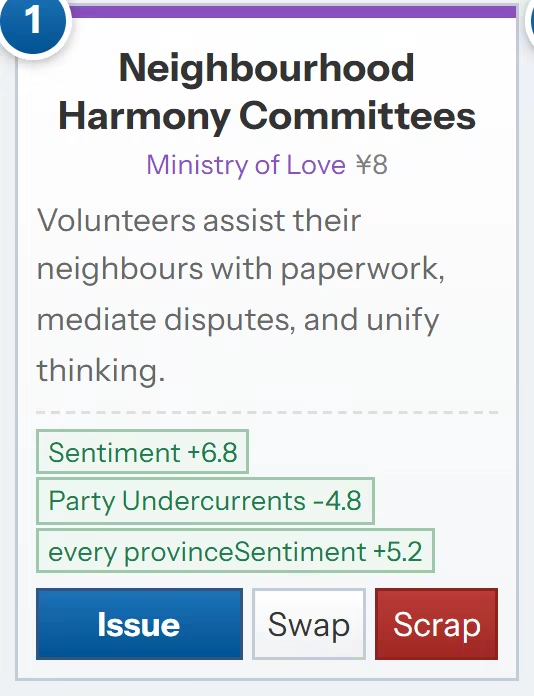
"NEIGHBOURHOOD HARMONY COMMITTEES"

Stated: Volunteers assist their neighbours with paperwork, mediate disputes, and unify thinking.

Actual: Denunciations rose fourfold. About one in five was substantiated. The remainder concerned parking.

You approve the stated version. You cause the actual one. Ten years later, the historians read both.

There is no national figure — only what the provinces report

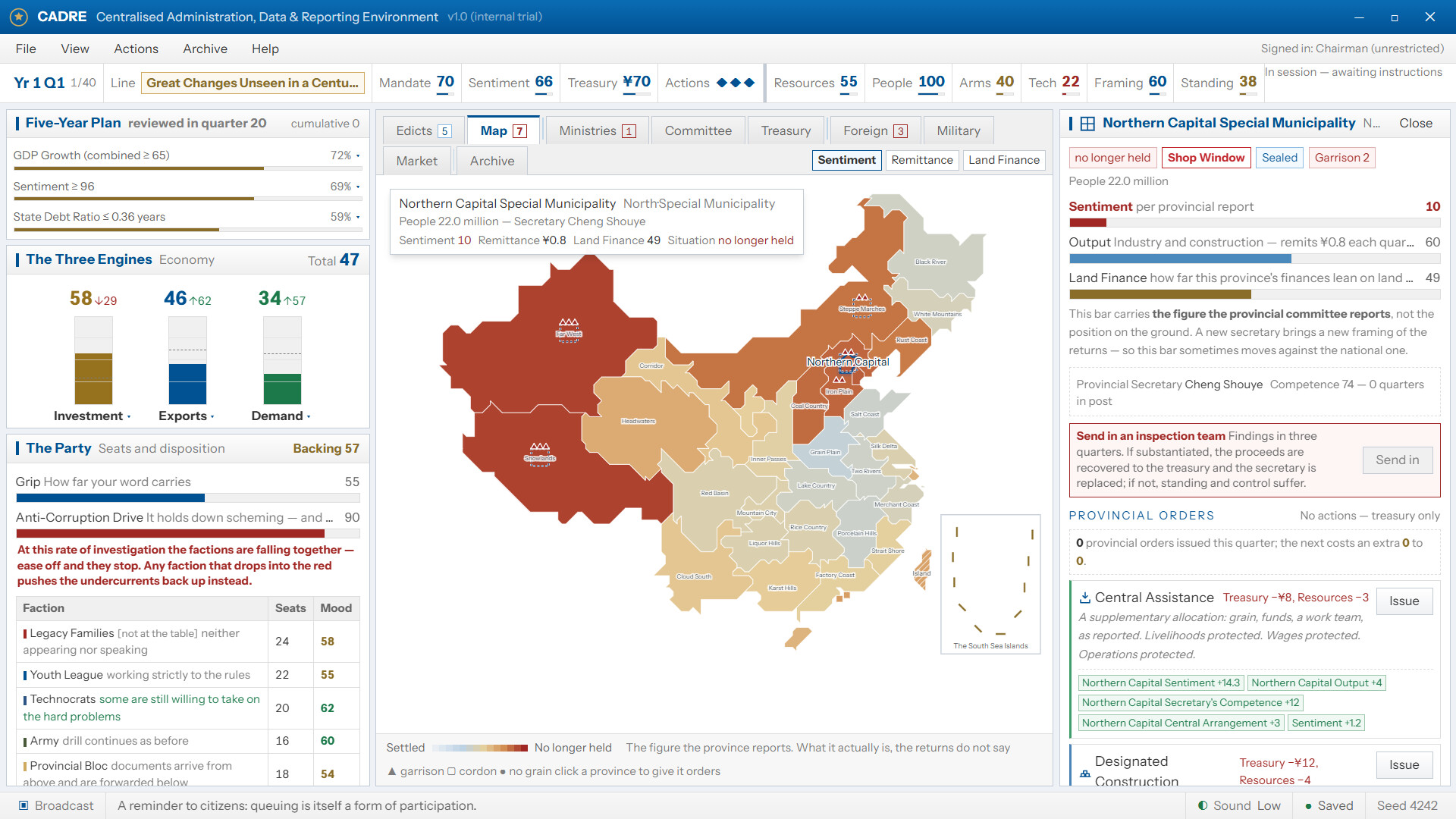
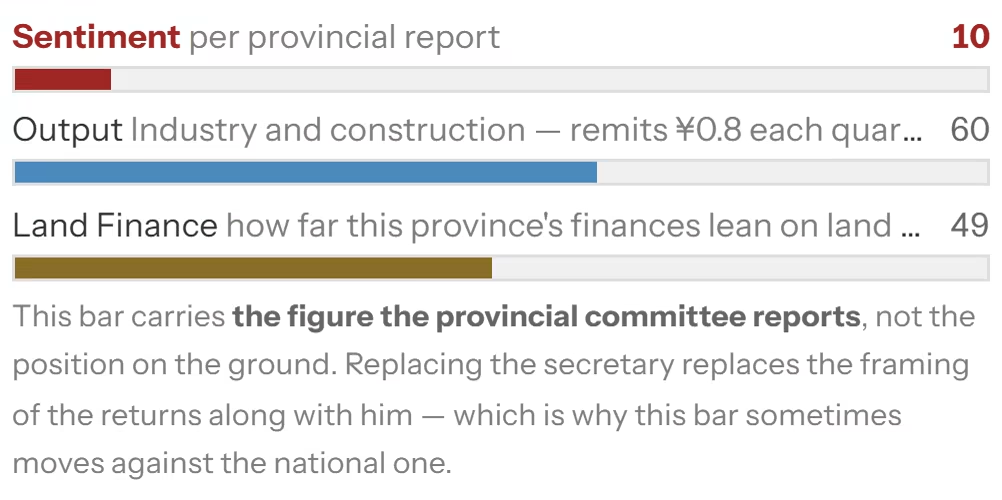
"National sentiment" is not an independent reading. It is thirty-four provinces weighted by population, less one further deduction: how many people live in a province that has genuinely stopped coping. An average of sixty, and an average of sixty with three provinces on fire, are not the same country.

Each province reports unrest at roughly half its true value, and the less loyal the secretary, the better it reads. Investigate harder and the returns get more honest — and investigating costs real money. You are permitted not to know.

Two readings — Party Undercurrents, and Records — carry the Ministry's own word for the number alongside it. Below twenty it is "unanimous"; below forty, "cordial". At the top of the same table it reads "everyone is observing everyone." The bad news is written in the same voice as the good — which is the part that should worry you.

Ministry of Harmonious Outcomes — Governance Terminal v1.0 (internal trial)

This terminal is issued to the Chairman. There is no second account.

Edicts. Proposals from the four ministries are endorsed here. Each carries a Stated Purpose for unified external messaging. After the quarter settles, an Actual Outcome is generated and filed. The latter is not for external use.

National Map. All thirty-four provinces on one screen. Figures are self-reported by the provinces. This terminal does not verify them; verification falls under a different department.

Standing Committee. Loyalty is displayed as an estimate with a confidence percentage. Where an exact figure is required, surveillance is available. The loyalty of the person under surveillance will fall by four points. This is normal.

Archive. A complete record of every decision by every Chairman. Records may be amended. Records of amendments are not retained.

Technical note. This terminal does not connect to any network and uploads nothing. Everything you do here is known only to you and to the archive. The archive reports to you.

Every lever that saves you is tied to something else

Selling land is the fastest money there is: it clears the same quarter, and unrest even falls — people mind other things less while prices are climbing. It also grows the bubble and the local debt together.

Garrisons suppress unrest while grinding down that province's loyalty, and low loyalty raises unrest. Self-reliance survives an embargo and costs enough to starve the Ministry of Love. Propping up the market works immediately, and then that money can never be sold.

A strong army under a Chairman with a weak Mandate is simply another road to four in the morning.

Public anger needs years to kill you. Your colleagues need one morning.

Five factions hold seats, opinions, and demands with deadlines — the military wants an armaments floor, the provinces want land quotas. Miss one and they keep the account.

An investigation always finds something; by design, everyone has something, which is exactly what makes the instrument so useful. Afterwards your grip is higher and your vote count is lower.

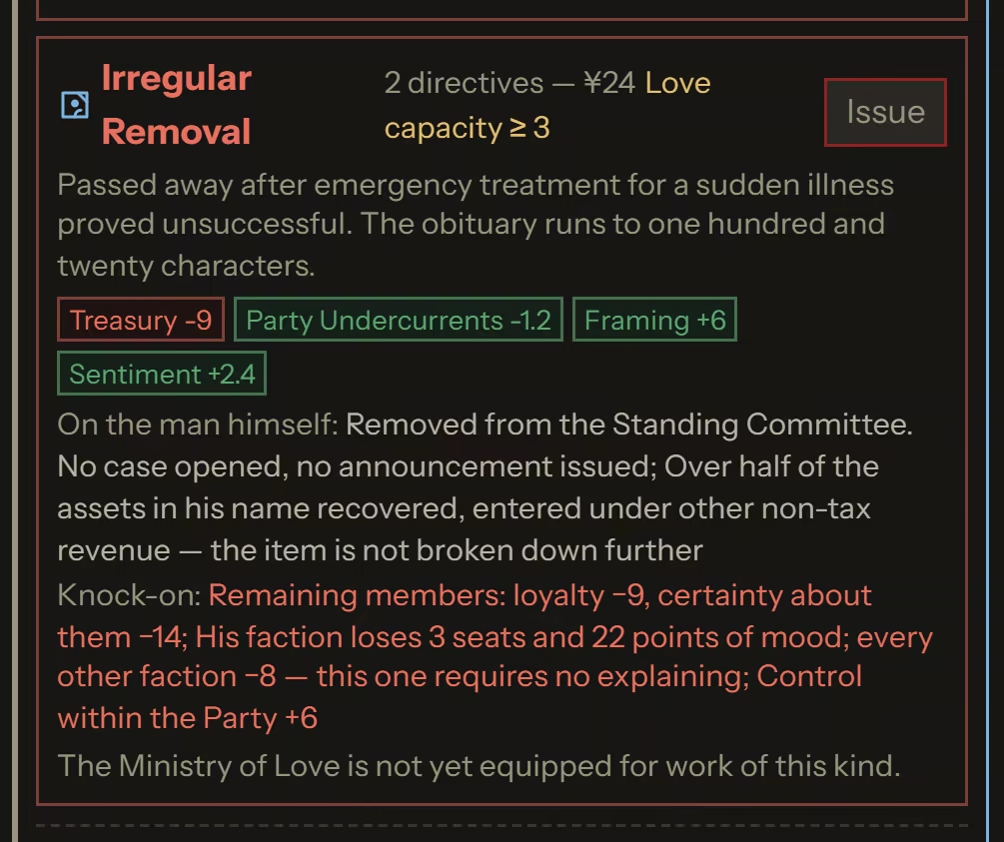
Every personnel action states two things: what it does to the man, and what it does to everyone else. The second line is the one to do the arithmetic on.

And the provinces make trouble without waiting for orders. A burning province puts a formal request on your desk, and a request must be answered on the spot — approve, delay, or refuse, each with its own bill. The session does not adjourn until you answer.

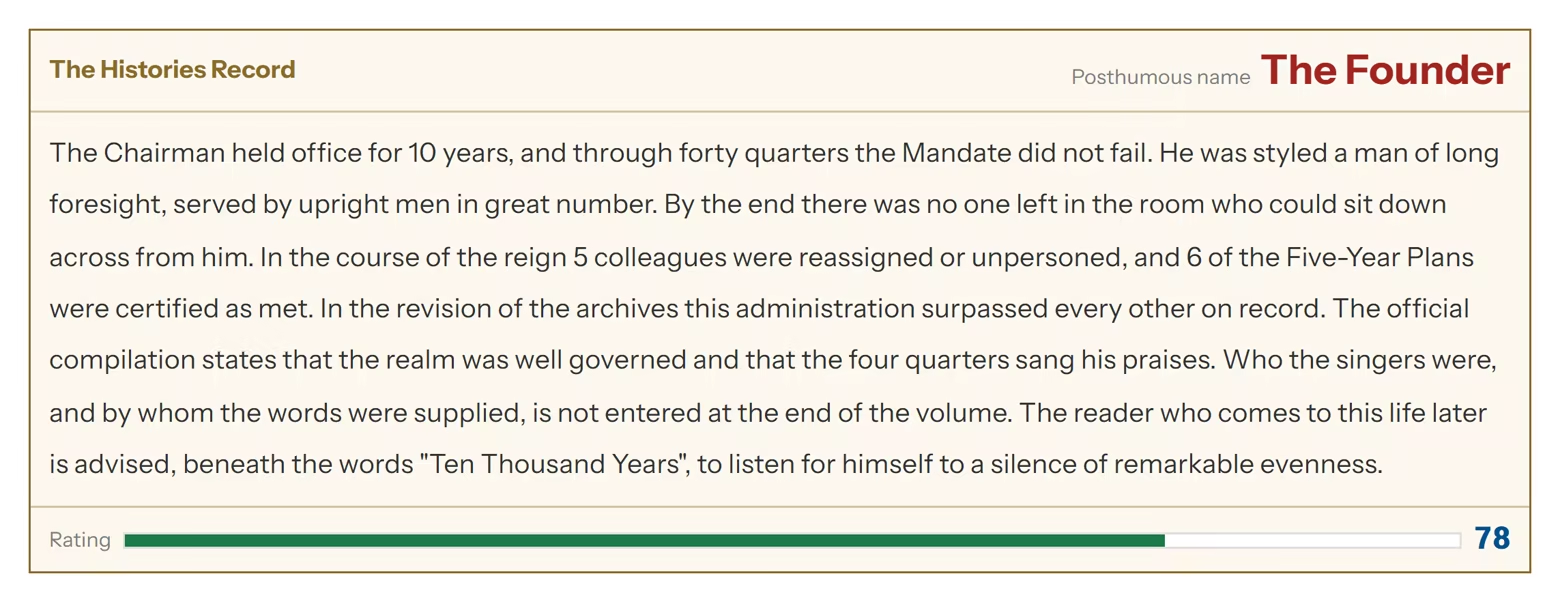
Thirteen endings. One posthumous name.

The Years of Difficulty

The Celebrations Reached the Gate

The Books Balance. The Money Does Not Exist.

The Records Deny One Another

Four of the thirteen. In the codex the ones you have seen are titled; the ones you have not get a single line and no name.

And the horror ending: Chairman for the Foreseeable Forever.

Afterwards the historians close the book and assign you a posthumous name in the classical style. The official wording is always dignified: the more dignified it is, the more carefully it should be read backwards.

"This game will let you win. It permits exactly one way of winning."

Contents

  • 102 edicts, each with its stated and actual text

  • 60 events and 27 set pieces, with attachments you can open

  • 34 provinces, 8 dispositions, 11 kinds of formal request that must be answered before the session adjourns

  • 6 openings: An Orderly Handover, Your Predecessor's Accounts, Lifted In by the Army, The Frontier Is Burning, The Top of the Bubble, Particulars Unavailable

  • 13 Five-Year Plan targets, three per term — each term harder than the last: the better you do, the more you owe yourself

  • Five factions, 15 demands with deadlines; the Politburo does not meet on a calendar — its appearance is itself the signal

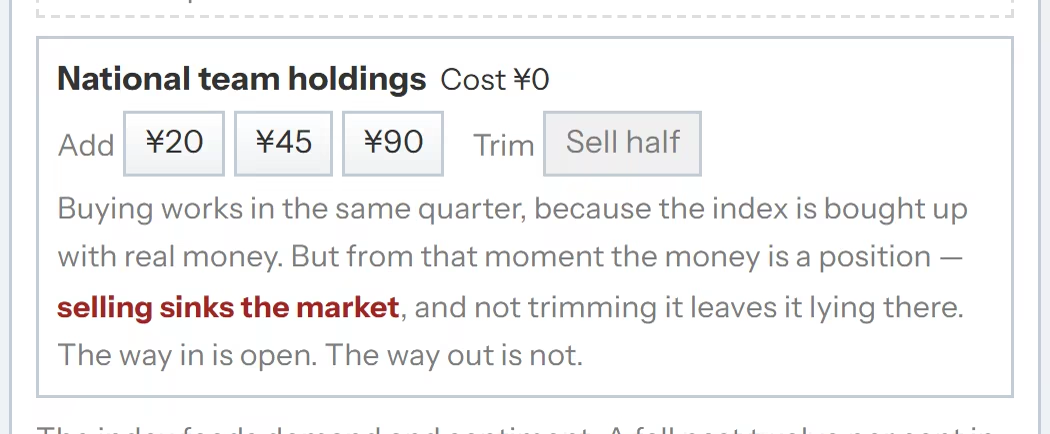
  • Three engines of growth and a stock market: the national team can buy in but never sell out

  • 8 instruments of foreign policy; a declaration of war cannot be withdrawn

  • 13 endings, 13 posthumous names, a codex that carries across runs and never spoils what you haven't seen

  • Fully bilingual — written twice, not machine-translated

  • Night duty mode — the same terminal, in four-in-the-morning colours

  • Deterministic: the same seed replays the same decade, exactly

This work is fiction. Any resemblance to a real country is entirely the point, and satirical.

AI Generated Content Disclosure

The developers describe how their game uses AI Generated Content like this:

CADRE was built with the help of generative AI, and some of its assets were
generated with AI tools.

- Sound. Every sound in the game — the office room tone, the stamps, the pen,
the signature, the coughs down the corridor — was generated with a
text-to-audio tool (ElevenLabs), then trimmed, re-pitched, levelled and
mixed by hand.
- The application icon began as an AI-generated image and was then re-cropped,
recoloured to the game's palette, and re-rendered at every size.
- Code and writing. The game was written in collaboration with an AI coding
assistant (Claude) — this includes engine code and prose: the edicts, the
events, the broadcasts and the archive entries. Every line was read, edited
and approved by a human before it shipped, and the design decisions
throughout are the author's.

There is no AI inside the game itself. CADRE runs fully offline, makes no
network requests of any kind, and generates nothing while you play. Every word
you will read was written and fixed before release, and the same seed always
replays the same decade.

Mature Content Description

The developers describe the content like this:

CADRE is a political satire set in a fictional authoritarian state. It contains
no graphic imagery: everything is presented as official documents, reports and
public broadcasts. The mature content is in what those documents describe.

Recurring subject matter includes:

- Famine, and the falsification of records that conceals it
- Political purges — colleagues can be investigated, reassigned, or removed
without process, and can be erased from the historical record entirely
- Suppression of civilian unrest, including martial law imposed on regions
defined by ethnicity and religion
- War, with casualties reported to the player as quarterly figures
- Corruption, surveillance, espionage and bribery

The game's method is to describe these things in the cheerful, euphemistic
language of an institution that never admits anything is wrong. Some players
may find that tone more uncomfortable than explicit depiction would be.

There is no sexual content or nudity. There is no depiction of self-harm or
suicide. Alcohol is referred to once, in passing. No real country, organisation
or person is named.

System Requirements

    Minimum:
    • Requires a 64-bit processor and operating system
    • OS: Windows 10 (64-bit)
    • Processor: Dual-core 1.8 GHz
    • Memory: 4 GB RAM
    • Graphics: Integrated graphics (Intel HD 4000 or better)
    • DirectX: Version 11
    • Storage: 500 MB available space
    • Additional Notes: 1280x720 or higher required; a non-scrolling desktop layout, best at 1920x1080.
    Recommended:
    • Requires a 64-bit processor and operating system
    • OS: Windows 10 / 11 (64-bit)
    • Processor: Quad-core 2.0 GHz
    • Memory: 8 GB RAM
    • Graphics: Any GPU from the last decade
    • DirectX: Version 11
    • Storage: 500 MB available space
Review Filters