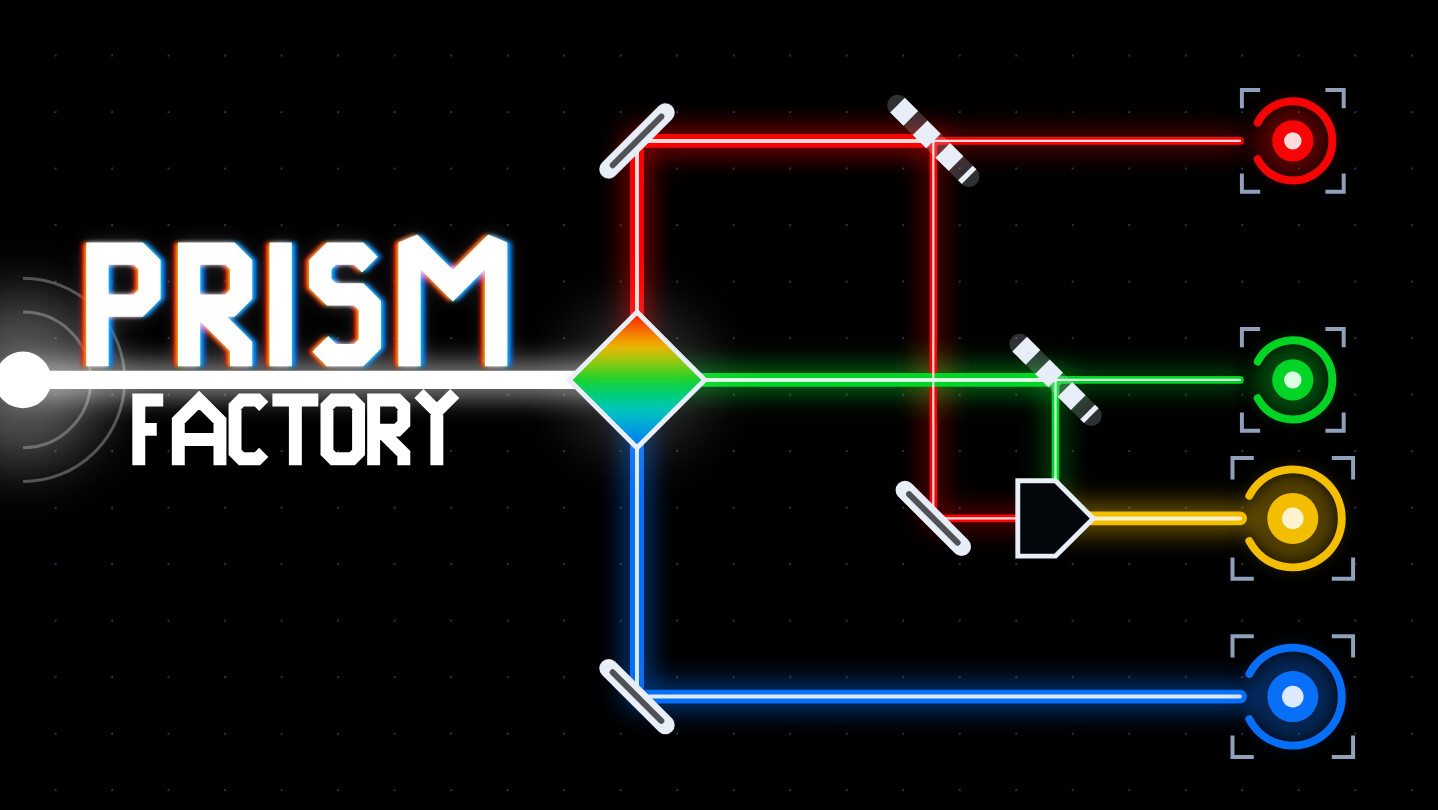


"Yellow light, intensity 5." That is how orders arrive at a factory that works in light. Split white with a prism, take exactly what you need, and route it to the port that asked. Every split leaves you with less. Keep it up and the whole factory fills with light. How far can you get?

Sign in to add this item to your wishlist, follow it, or mark it as ignored

This game is not yet available on Steam

Planned Release Date: Q1 2027

Interested?
Add to your wishlist and get notified when it becomes available.
 

About This Game

A factory that takes white light and delivers it as the colour and brightness each order demands.

Yellow light, intensity 5. That is the shape every order arrives in. All the board gives you is one lamp and a white beam travelling in a straight line. You place optical devices to bend it, split it, and blend it until a port gets exactly the light it asked for.

A filled order never goes away. Every wave brings another order, and every few waves another lamp, and the board fills with light. Dozens of waves later, your factory is one sheet of light running edge to edge. There is no ending. Your score is how far you got.

No device creates light. Every split costs exactly what it gives

If a lamp emits 8, then 8 is what it puts on the board — no more. Split it in two and you hold 4 and 4. Nothing in the toolbox amplifies. Conservation of energy is the resource constraint.

There is no power grid, no money, no parts inventory. Refusing a second resource is the centre of this design. With a single number to track, everything visible on the board is something you can reason with. When you come up short, there is only ever one question to ask: where is light going to waste?

Five minutes to learn. Hours to put down

A mirror turns a beam. A prism splits white into red, green, and blue. A splitter taps a fraction off a beam and lets the rest carry on. A merger adds colours back together. Four devices. That is the entire toolbox.

The board keeps getting harder anyway, because a splitter can only tap a half, a quarter, or an eighth. Three is not a number a device can hand you, and neither is five. To reach the value an order wants, you have to split light and add it back together. Four devices, making numbers that none of them can make. That is the arithmetic of this game.

Orders never go away

Each wave either adds one new order or raises the demand of an existing one. Once you take an order, you supply it forever. Nothing is ever delivered and done — it stays on the board as a line you have to keep feeding. Which makes the board a record of everything you have agreed to.

Every wave runs on a clock. When it expires, the customer whose order is furthest from being met walks out. When enough customers have walked out, the session ends. You can also abandon an order yourself when a board is beyond saving. Both cost you the same.

What grows is the number of lamps

Every few waves, another lamp appears on the board. A single lamp is exactly as bright on the last wave as it was on the first. What you are handed is never stronger light — it is another white beam, somewhere else on the board.

So growing supply never makes the board easier. A new lamp is worth nothing until you run a line out to it and bring it together with what you have already placed. Every time supply grows, you get more work. Not bigger numbers — another reason to redraw the board.

You are not stuck. You just cannot see it

Most boards that look hopeless are boards where the light you need is already there and already being thrown away — a tapped line ending at a wall, a port taking more than it asked for. Find it, rewire, and the whole board loosens by a notch. That moment is the best thing this game does.

Which orders are getting more light than they need, and which beams nobody is using, is shown on the board at all times. Nothing is hidden. Nothing is solved for you either. How to rewire is your job.

Ten boards, and how far you got

Start on any of ten maps, each with its own walls, lamp placements, and colour profile, unlocked in turn by how far you reach. One of them deals you a different board every run. A mode without the wave clock is there too.

Everything on screen except the text is drawn as you watch. There is not a single image asset in the game. Your score is the wave you reached — but the board is the thing you will want to show people.

Key features

  • Light is the only resource — No power, no money, no inventory. Every split costs what it gives

  • Four devices — Mirror, prism, splitter, merger. Five minutes to learn, hours to put down

  • Numbers no device can make — Taps come in halves, quarters, eighths. Split it and add it back

  • Growth means more lamps — Never brighter light. Every time supply grows, so does the work

  • Orders are forever — Take one and you supply it for the rest of the run

  • One device, whole board — Beams run straight. Nudge one device and a distant order changes colour

  • The slack is always there — You are never stuck. You just cannot see it yet

  • Endless sessions — Nothing to clear. Your score is the wave you reached. Ten maps

  • Drawn, not painted — Every pixel on screen is rendered. No image assets at all

  • Language support — English and Japanese

System Requirements

    Minimum:
    • OS: Windows 10 64-bit
    • Processor: Intel Core i3 or equivalent
    • Memory: 4 GB RAM
    • Graphics: Integrated graphics or better
    • DirectX: Version 11
    • Storage: 200 MB available space
    Recommended:
    • OS: Windows 10 / 11 64-bit
    • Processor: Intel Core i5 or equivalent
    • Memory: 8 GB RAM
    • Graphics: Dedicated graphics card or modern integrated graphics
    • DirectX: Version 11
    • Storage: 200 MB available space
Review Filters