

A space sim where you build the industry that produces your rockets, then fly them. Genuinely integrated orbits, aerodynamics solved part by part, procedural planets you can walk. From first mine to first interstellar flight.

Sign in to add this item to your wishlist, follow it, or mark it as ignored

Coming Soon To Early Access

The developers of this game intend to release as a work in progress, developing with the feedback of players.

Note: Games in Early Access are not complete and may or may not change further. If you are not excited to play this game in its current state, then you should wait to see if the game progresses further in development. Learn more

What the developers have to say:

Why Early Access?

“StarWorks has reached a point where its major technical systems can be used together in a playable game, but I do not yet consider the game's design to be settled. Building the systems myself can tell me whether they work technically; it cannot tell me whether they are actually enjoyable to use, whether they create a good progression, or whether the different systems work well together for players.

There are still important questions that I want to answer with the community. Is the current level of aerodynamic realism enjoyable to pilot, or does it make flying unnecessarily difficult? Does the current planetary environment provide the right experience, or should it be substantially redesigned? Are the production and research systems logical and rewarding over a full playthrough? Does the current scale of the universe make sense, or would a different approach work better? There are also gameplay systems, such as crew management and movement between established bases, whose final form is not yet decided.

These are not simply bugs or polish issues. Some of the answers may require substantial changes to existing systems, including simplifying, expanding, or completely redesigning them.

Early Access gives me the opportunity to make those decisions based on real player experience rather than assumptions. I want to see how players actually build, fly, automate, progress, and explore, and use that information to determine what StarWorks should become.”

Approximately how long will this game be in Early Access?

“I currently expect StarWorks to remain in Early Access for approximately six months to a year, but this is an estimate rather than a fixed deadline.

The length of Early Access will depend on what I learn from players and on the scope of the changes that result from that feedback. If testing reveals that a major system needs to be substantially redesigned, I would rather take the time to do that properly than keep to an arbitrary release date.

I will communicate significant changes to the Early Access schedule on the store page rather than quietly extending the development period.”

How is the full version planned to differ from the Early Access version?

“The full version may differ substantially from the Early Access version. While the current build provides the technical foundation and a playable core loop, many of the game's higher-level systems and design decisions are not yet considered final.

A major purpose of Early Access is to determine which parts of StarWorks are genuinely enjoyable and which need to be redesigned. For example, I am not yet certain whether the current approach to planetary rendering provides the experience I want, or whether it may need to be substantially reworked. The same applies to the aerodynamic simulation: the current system aims for a high level of realism, but player feedback and experience may show that it is too complex for enjoyable piloting, in which case the system could be simplified or redesigned rather than simply polished.

The industrial and research systems are also functional but not fully balanced. I need to learn whether the production chains, research progression, resource requirements, and overall progression feel logical, rewarding, and enjoyable over a complete playthrough. These systems may therefore be significantly rebalanced or redesigned during Early Access.

The overall scope of the game is still open as well. I am considering different approaches to the playable universe, including how much of the surrounding star system should be simulated and whether the game should remain focused on a limited region or eventually use more procedural generation. Gameplay systems such as movement between established bases, crew management, and other higher-level mechanics are also still being evaluated.

Because of these uncertainties, the final version is not simply planned as the current game with more content. Some systems may be expanded, simplified, replaced, or redesigned entirely based on player feedback and observation of how people actually play the game.

The goal of Early Access is to discover what StarWorks should become. I have built the underlying technology and enough interconnected systems to make that experimentation possible, but I do not want to assume that my first implementation of every system is necessarily the best game. Community feedback and player behaviour will therefore have a direct influence on the final design, scope, and priorities of the game.”

What is the current state of the Early Access version?

“The current version contains a complete playable gameplay loop and the underlying systems needed to support it. Players can mine resources, establish an industrial base, process materials, design their own parts, manufacture components, assemble a rocket, launch it, reach orbit, perform atmospheric re-entry, and land.

The simulation itself is already substantial. Orbital physics, spacecraft flight, part-by-part aerodynamics, resource processing, manufacturing, custom part design, procedural environments, and other core systems are functional and can be used together in the current build.

However, the fact that these systems are functional does not mean that their final design has been decided. The current version should be considered a working foundation rather than a finished representation of the final game.

The amount of content is currently limited, and progression, research, production chains, resource balance, and the overall pacing of the game still need significant iteration. Some interfaces need improvement, and very large bases and factories require further optimization.

There are also larger design questions that cannot be answered through internal testing alone. I do not yet know whether the current level of aerodynamic realism is the right balance between simulation and accessibility, whether the current planetary experience is satisfying, or whether some higher-level gameplay systems should be kept, changed, or replaced.

Players entering Early Access should therefore expect a functional and technically substantial game, but also a game whose systems and design can change significantly as I learn what actually makes the experience enjoyable.”

Will the game be priced differently during and after Early Access?

“Yes. The Early Access price is intentionally lower than the final price. Joining a niche game that no one knows yet, helping smooth out its rough edges, and taking the time to provide feedback is a real contribution to its development — and it deserves a more favorable price. The price will increase with the release of version 1.0 as the content expands. Players who purchase the game during Early Access will keep the game at no additional cost.”

How are you planning on involving the Community in your development process?

“The Steam forums will be the main channel for discussing the development of StarWorks. I will use them for bug reports and technical issues, but also for much broader discussions about gameplay, balance, usability, and the direction of the game.

I am particularly interested in seeing what players actually do with the systems I have built. Player-created spacecraft, factories, production chains, aerodynamic designs, and unexpected solutions will help me understand whether the tools provide enough freedom and whether the underlying systems encourage interesting gameplay.

I also want feedback on experiences rather than only individual features. If players find the aerodynamic simulation too difficult to use, the progression too slow, a production chain unnecessarily complicated, or the planetary environment unsatisfying, that feedback may lead to changes much larger than a simple balance adjustment. Systems may be simplified, expanded, redesigned, or replaced when there is a good reason to do so.

Development updates and patch notes will document important changes and explain how community feedback influenced them. When possible, I will also explain why a frequently requested change was not adopted.

The Early Access community will therefore not just be testing the implementation of a predetermined final game. Their experiences will help determine which systems deserve more depth, which need to change, and ultimately what the final version of StarWorks should be.”
Read more
This game is not yet available on Steam

Coming soon

Interested?
Add to your wishlist and get notified when it becomes available.
 
See all discussions

Report bugs and leave feedback for this game on the discussion boards

About This Game

StarWorks is a game about building spacecraft and the industry behind them. You start on an empty site on a planet, you mine ore, you refine it, and you use it to manufacture the parts of the rockets you assemble. Then you launch.

Nothing here is scripted: orbits are integrated, aerodynamics are solved on the real shape of your vehicle, and the ground your landing gear touches is the same ground physics sees.

Assemble it, stage it, and find out in flight why it tumbles

The design office gives you a parts palette, symmetry up to eightfold, staging you reorder line by line, a fairing you draw by hand around the payload, and a readout of the centres of mass and pressure. Nothing in there validates a craft for you: the flight decides.

Aerodynamics that know the shape of your craft

Every part is run offline through a solver that samples the incoming airflow direction across a full grid and produces a table of forces and moments. In flight your vehicle has a real centre of pressure, a real angle of attack, real stability — and a badly balanced rocket tumbles, without any rule having decided it should.

Build the chain that gets you to orbit

Mines, furnaces, electrolysers, presses, centrifuges, conveyors, a power grid, warehouses, an assembly hall, a launch pad. A rocket does not appear from a menu: it is produced, out of metal you extracted, by a factory you placed and powered. Distant sites trade freight over routes you open.

Step outside the ship

You walk out on foot, you climb into the cockpit, you fly from the pilot's seat with instruments you read and controls you touch. The terrain is real fractal relief, with grass, dust and cast shadows — not a texture under your boots.

One solar system, then the others

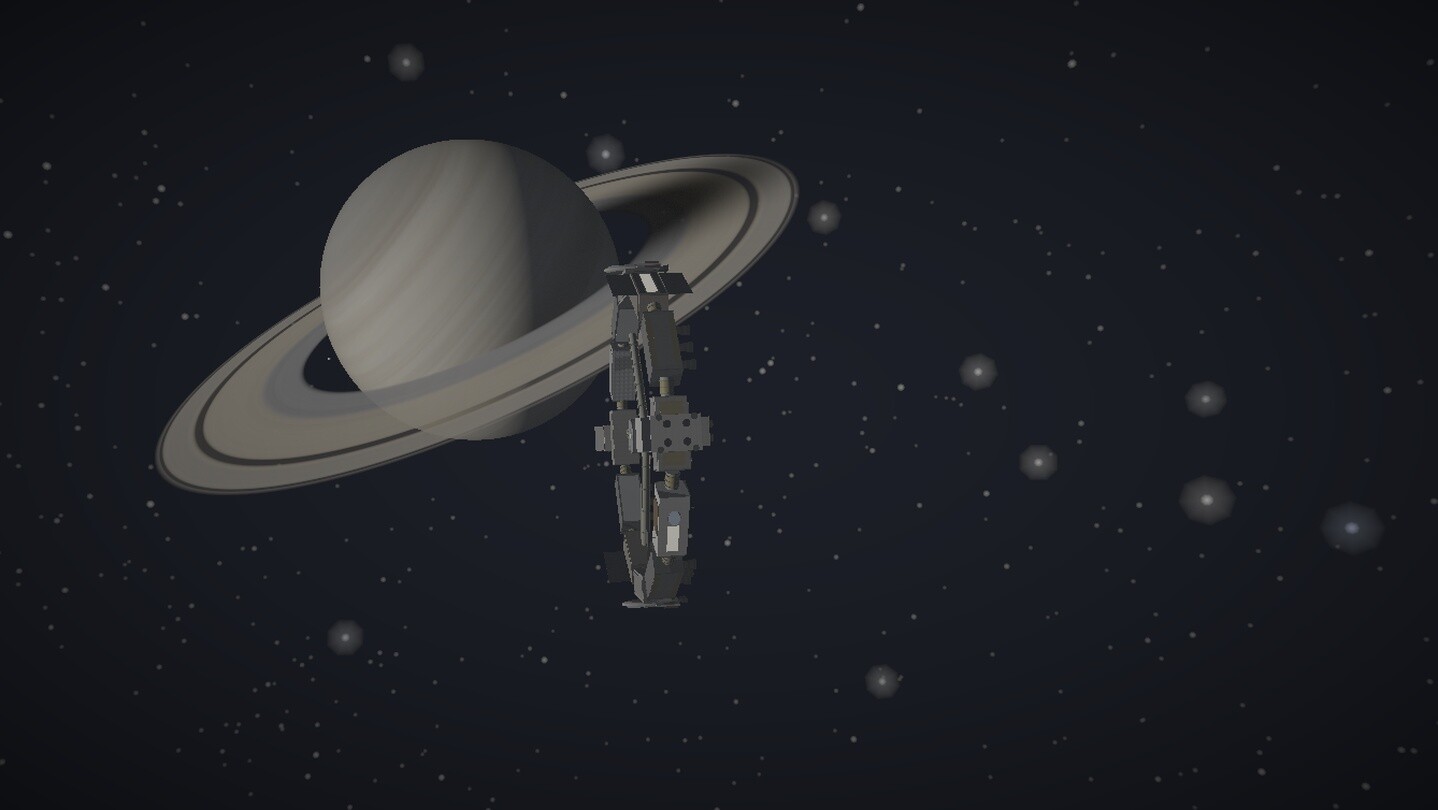
Procedural planets with atmospheres and rings, atmospheric reentry with heating and plasma, manoeuvres planned ahead of time, time warp, docking. The distances are true, all the way out to the neighbouring stars.

Written for this

An in-house engine in C++20 and Vulkan. No generic engine: positional precision, the scale of the distances and the fixed-step simulation are architectural decisions, not settings.

AI Generated Content Disclosure

The developers describe how their game uses AI Generated Content like this:

The game's surface textures — the colour and relief maps applied to parts,
buildings, terrain and visual effects — and its sound effects were created
with generative AI tools during development. They are generated ahead of
time, reviewed and integrated by hand, and ship with the game as ordinary
image and audio files.

Nothing is generated while you play, and the game never connects to an AI
service.

The simulation itself — orbital mechanics, aerodynamics, the production chains — is written by hand.

System Requirements

Windows
SteamOS + Linux
    Minimum:
    • Requires a 64-bit processor and operating system
    • OS: Windows 10 64-bit
    • Processor: Intel Core i5-6300U / AMD FX-6300
    • Memory: 4 GB RAM
    • Graphics: NVIDIA GTX 960 / AMD RX 460 / Intel Iris Xe, 2 Go
    • Storage: 2 GB available space
    • Sound Card: Compatible DirectX
    • Additional Notes: Vulkan 1.3 compatible graphics card required.
    Recommended:
    • Requires a 64-bit processor and operating system
    Minimum:
    • OS: SteamOS 3.0+ / Ubuntu 22.04+
    • Processor: Intel Core i5-6300U / AMD FX-6300
    • Memory: 4 GB RAM
    • Graphics: NVIDIA GTX 960 / AMD RX 460 / Intel Iris Xe, 2 Go
    • Storage: 2 GB available space
    • Sound Card: Compatible DirectX
    • Additional Notes: Vulkan 1.3 compatible graphics card required.
    Recommended:
    Review Filters