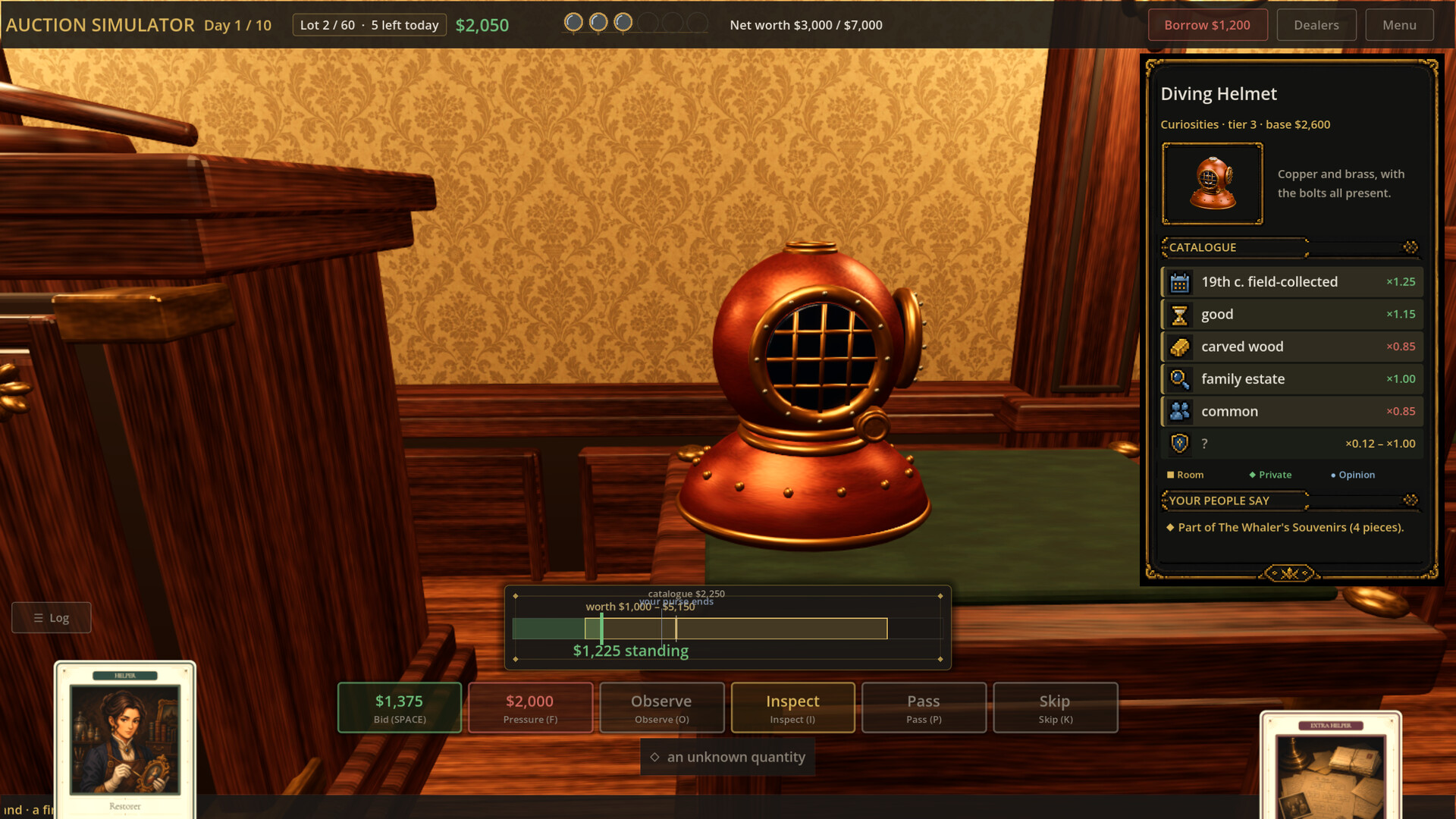


Build an auction career where every bid is a tell. Buy, research and sell valuable objects, read rivals in poker-inspired psychological auctions, build collections, run your own auction house, or become a dealer in the dark market. Every bid is information. Every object could be an opportunity.

Sign in to add this item to your wishlist, follow it, or mark it as ignored

This game is not yet available on Steam

Planned Release Date: September 2026

Interested?
Add to your wishlist and get notified when it becomes available.
 

About This Game

Going once. Going twice. Build an empire.

You start small.

A little cash. Cheap storage. No reputation. No prestigious contacts.

Just enough money to walk into a local auction and take a chance on something everyone else overlooked.

Maybe that dusty painting is exactly what the catalogue says it is.

Maybe it's worth ten times the estimate.

Maybe the collector across the room knows something you don't.

And maybe he's bluffing.

Auction Simulator is a deep auction-house and collecting simulator built around incomplete information, psychological bidding, market speculation and long-term progression.

Buy objects.

Research their history.

Build collections.

Restore forgotten treasures.

Follow market trends.

Read your rivals.

Sell for a profit.

Build relationships with collectors and experts.

Open your own auction house.

Or discover the very different opportunities hiding beneath the legitimate market.

THE AUCTION HOUSE IS YOUR POKER TABLE

Auctions aren't simply about who has the most money.

Every bidder has a different hand.

Except instead of cards, their hand is made from information.

You might know the painting has an unusual signature.

Margaret might know it belongs to a larger collection.

Henry might already have a private buyer.

And the bidder who just doubled the price?

Maybe they know something nobody else does.

Or maybe they're bluffing.

Read bid timing, hesitation, sudden aggression, unusual interest and changes in behaviour. Build a mental model of your opponents and decide when they're revealing genuine information — and when they're trying to manipulate what you believe.

But remember: they're reading you too.

Bid predictably and experienced rivals may learn when you're confident, when you're uncertain and when you're bluffing.

There are no cards.

But everyone at the table has a hand.

EVERY BID TELLS A STORY

Auctions aren't simply about who has the most money.

They're about information.

Your opponents have their own knowledge, budgets, collections, objectives and personalities.

A bidder suddenly jumps from $8,000 to $15,000.

Why?

Did they recognize the artist?

Are they completing a collection?

Do they already have a private buyer?

Are they trying to scare you away?

Or do they simply want you to believe they know something?

Watch how your rivals behave.

Learn their habits.

Identify their interests.

Recognize hesitation.

Pressure their liquidity.

But remember:

they're watching you too.

Become predictable and experienced opponents may learn exactly when you're bluffing.

NOBODY KNOWS THE WHOLE TRUTH

Every object is an information puzzle.

Auction catalogues provide estimates.

Experts provide opinions.

Research reveals history.

Restoration can uncover hidden details.

Provenance documents tell part of the story.

Other bidders reveal clues through their behaviour.

But information isn't always complete.

And it isn't always correct.

You might discover that an ordinary-looking painting has an unusual signature.

Another collector might recognize the subject.

Someone else may know where the painting was exhibited fifty years ago.

A private dealer might claim to know its previous owner.

Everyone sees a different part of the picture.

Decide what you believe.

Then decide how much you're willing to risk on being right.

BUILD A CAREER, NOT JUST A COLLECTION

Every auction is part of a persistent career.

Objects, money, relationships, reputation, knowledge and collections survive from one auction to the next.

Start at small estate sales and local auction rooms.

Build your reputation.

Develop expertise.

Meet collectors.

Gain access to specialist sales and prestigious auction houses.

Eventually, six-figure bids that once seemed impossible may become routine.

But larger opportunities mean larger mistakes.

One brilliant discovery can transform your career.

One terrible acquisition can leave you scrambling for liquidity.

FIND YOUR OWN PATH

There is no single correct way to dominate the auction world.

THE DEALER

Buy undervalued objects.

Research opportunities.

Follow market trends.

Turn inventory quickly.

Build relationships with private buyers.

Buy low. Know more. Sell well.

THE COLLECTOR

Hunt rare objects across years of auctions.

Discover relationships between seemingly unrelated pieces.

Complete legendary collections.

Work with museums and experts.

Decide whether your greatest discoveries belong in your collection...

...or back on the market.

THE AUCTIONEER

Stop merely attending auctions.

Run them.

Win prestigious consignments.

Hire specialists.

Build catalogues.

Set reserves.

Attract the right collectors.

Choose your lot order.

Develop your auction house into an internationally respected institution.

THE BROKER

Sometimes the most valuable thing in the room isn't an object.

It's information.

Discover what collectors want.

Connect buyers with sellers.

Build a private client network.

Know where objects are before they reach the public market.

You don't always need to own something to profit from it.

THE BLACK MARKET DEALER

Some objects never reach respectable auction houses.

Some collectors prefer that they don't.

Build a hidden network of private sellers, brokers, informants, experts and secretive collectors.

Buy uncertain objects.

Broker discreet transactions.

Reconstruct provenance.

Find private buyers.

Build trust.

Control information.

And eventually become the person people contact when an object is too unusual, too uncertain or too sensitive for the ordinary market.

Every path can be combined.

Become a collector-dealer.

An auctioneer-broker.

Or operate one of the world's most respected auction houses while quietly maintaining a completely different network behind the scenes.

BUILD YOUR COLLECTION

Objects don't disappear when an auction ends.

Keep them.

Research them.

Restore them.

Exhibit them.

Use them as collateral.

Wait for the market to change.

Or search for the other pieces that belong beside them.

A seemingly insignificant object acquired early in your career could become the missing link in a collection worth a fortune many hours later.

And other collectors build collections too.

Discover what they're looking for and suddenly an ordinary $5,000 object might be worth $50,000...

to exactly one person.

The question is whether they know that you know.

RESEARCH WHAT YOU OWN

Winning an auction is sometimes only the beginning.

A mysterious painting purchased for $3,200 might initially be listed simply as:

Unknown Dutch Painting

Invest in research.

Clean it.

Investigate its provenance.

Consult a specialist.

Discover an old exhibition record.

Eventually it might become:

Attributed to the Workshop of a Dutch Master

Estimated value:

$18,000–$30,000

Now you have another decision.

Sell immediately?

Continue researching?

Wait for the market?

Find a private collector?

Or put it into your own auction?

Knowledge can be more valuable than the object itself.

SELL YOUR OWN OBJECTS AT AUCTION

Eventually you'll be sitting on the other side of the transaction.

Choose an auction house.

Set your reserve.

Research the object.

Restore it.

Improve its presentation.

Promote it to specialist collectors.

Then watch the auction unfold.

$12,000.

$14,000.

$16,000.

One bidder folds.

Another hesitates.

This time you're not hoping they'll stop.

You're hoping somebody bids again.

BUILD YOUR OWN AUCTION HOUSE

As your career grows, you can stop relying entirely on other auction houses and build your own.

Attract sellers.

Negotiate commissions.

Hire specialists.

Research consignments.

Build themed auctions.

Promote headline lots.

Invite collectors.

Develop your reputation.

And decide exactly what enters your catalogue.

Your auction house isn't a building-placement minigame.

The auction itself is your build.

You might have 40 available consignments but only 15 places in your next prestigious evening sale.

Which objects belong together?

Which collectors will they attract?

Which lot should open the auction?

Where should you place the headline object?

Will similar lots create excitement...

...or drain the same collectors' budgets before your most valuable piece appears?

Build the right catalogue.

Get the right people into the room.

Then let them fight over it.

KNOW YOUR BUYERS

A great object doesn't guarantee a great auction.

You need the right bidders.

If only one serious collector wants your rare watch, you have a problem.

If three wealthy collectors want it...

you have an auction.

Build relationships.

Learn their interests.

Send private invitations.

Develop specialist mailing lists.

Create previews.

And remember which collectors hate losing to each other.

Sometimes your greatest skill as an auctioneer is simply making sure the right two people are sitting in the same room.

FOLLOW THE MARKET

Values change.

Categories rise and fall.

A major exhibition can suddenly increase interest in an artist.

A famous collection entering the market can create oversupply.

A celebrity purchase can ignite demand for a forgotten category.

A scandal can destroy confidence overnight.

Buy today.

Sell next week.

Or hold for six months.

Your inventory isn't just a collection of objects.

It's a portfolio.

RISK YOUR CAPITAL

The best opportunities rarely arrive when you have enough cash.

Borrow against your collection.

Finance major acquisitions.

Offer guarantees to win important consignments.

Invest in restoration.

Expand your operation.

But debt changes the way you play.

Imagine discovering an object that might be worth $900,000.

The seller wants $450,000.

You have $180,000.

You can borrow the rest.

If you're right, it could transform your career.

If you're wrong...

the loan doesn't disappear just because the painting is fake.

COMPETE WITH RIVAL AUCTION HOUSES

You're not building your business alone.

Other auction houses want the same:

Collectors.

Experts.

Sellers.

Important estates.

Headline objects.

Prestige.

Dominate the watch market and a rival may launch a competing specialist sale.

Hire a brilliant expert and another house might try to recruit them.

Bid aggressively for a major estate.

Offer guarantees.

Compete for the objects that can define an entire season.

ENTER THE BLACK MARKET

Eventually you may discover another side of the auction world.

A message arrives.

I hear you acquired Lot 47.

The auction house doesn't know what they sold you.

I do.

IGNORE

RESPOND

The black market isn't simply another shop.

It's a network.

Private collectors.

Brokers.

Informants.

Specialists.

Questionable provenance.

Secret collections.

Objects respectable auction houses won't touch.

And information people don't want appearing in a catalogue.

BECOME THE DEALER

At first, you're just another buyer.

Build trust and the relationship changes.

Private sellers begin contacting you.

Collectors tell you what they're searching for.

Brokers introduce opportunities.

Eventually you don't even need to buy the object yourself.

You know someone who owns it.

You know someone who desperately wants it.

Make the connection.

Negotiate the deal.

Take your fee.

Protect your reputation.

Build your client book.

Progress from an unknown contact to a trusted buyer, connector, underground dealer, network operator...

and eventually:

a market maker.

At that level, you aren't waiting for opportunities.

You're creating them.

INFORMATION IS A COMMODITY

Someone offers you information:

Margaret Sinclair is searching for objects from the Beaumont Estate.

Price:

$1,500

Tomorrow's catalogue contains:

Beaumont Family Portrait

Estimated value:

$4,000–$6,000

That information could be worth a fortune.

Or it could be wrong.

Outdated.

Incomplete.

Or deliberately planted by Margaret herself.

Every source has a history.

Every informant has motives.

And sophisticated rivals can manipulate the same networks you use.

RECONSTRUCT THE PAST

Some underground objects aren't worthless.

They're simply impossible to sell through prestigious channels.

Yet.

Buy an uncertain object.

Investigate its history.

Find previous owners.

Recover missing documentation.

Restore it.

Seek authentication.

Get it exhibited.

Build credible provenance.

Eventually, something acquired privately for $12,000 might become a legitimate six-figure auction lot.

Or months of research might reveal exactly why nobody respectable wanted it.

PROTECT YOUR REPUTATION

Your public and private careers can coexist.

Perhaps you're known publicly as:

★★★★★ Distinguished Auctioneer

while privately you've become:

★★★★★ Underground Dealer

That combination can give you extraordinary access.

It also gives you far more to lose.

One disputed object.

One unreliable contact.

One provenance scandal.

And a business you spent years building can suddenly be under pressure.

How close to the edge are you willing to operate?

EVERY CAREER CREATES DIFFERENT STORIES

One career might make you the world's leading watch dealer.

Another might revolve around completing a legendary art collection.

Another could see you building an international auction house.

Another might turn you into the invisible broker connecting the world's wealthiest collectors.

Or perhaps you operate both sides of the market.

Publicly respected.

Privately indispensable.

The systems overlap.

Objects move between markets.

Collectors become rivals.

Rivals become clients.

Experts become allies.

Information becomes leverage.

And something you bought for almost nothing ten hours ago might eventually become the most important object in your career.

KEY FEATURES

Deep Psychological Auctions
Read behaviour, bid patterns, hesitation, aggression and opponent motivations.

Persistent Career Mode
Your money, objects, relationships, reputation and discoveries survive every auction.

Multiple Career Paths
Develop as a Dealer, Collector, Auctioneer, Broker, Black Market Dealer or hybrid.

Dynamic Object Values
Objects can have different values to different buyers based on collections, information, market conditions and private objectives.

Research & Authentication
Investigate provenance, authenticity, condition and historical significance.

Persistent Collections
Hunt connected objects across many auctions and build increasingly valuable sets.

Sell Your Own Objects
Choose venues, estimates, reserves, preparation and promotion before watching your objects go under the hammer.

Build an Auction House
Acquire consignments, hire experts, construct catalogues, attract bidders and develop an international reputation.

Catalogue Building
Select lots, create themes and determine lot order to maximize attendance and competition.

Dynamic Markets
React to changing demand, events, supply and collector trends.

Financing & Risk
Use loans and portfolio collateral to chase opportunities that would otherwise be beyond your reach.

Persistent Rivals
Collectors and competing auction houses remember, adapt and pursue their own objectives.

Private Buyers & Brokerage
Connect sellers and collectors without necessarily owning the object yourself.

Black Market Career
Build a secret network of dealers, informants, specialists and private collectors.

Information Trading
Buy and sell intelligence while deciding which sources deserve your trust.

Provenance Reconstruction
Transform uncertain objects through research, expertise and historical evidence.

Reputation & Heat
Balance legitimate prestige against the risks of your underground activities.

Systemic Events & Missions
Manipulate auctions, locate missing collection pieces, investigate rivals and exploit changing market opportunities.

High Replayability
Different objects, markets, opponents, collections, auction houses, contacts, factions and career choices create a different economy every time.

FROM A $500 BOX TO AN AUCTION EMPIRE

You walk into your first estate auction with almost nothing.

Twenty hours later, you might be deciding whether to:

Sell a legendary collection.

Borrow $500,000 to chase a masterpiece.

Guarantee an important estate for your auction house.

Manipulate a rival into overspending.

Accept an underground consignment.

Hire a world-renowned expert.

Or risk your reputation on an object that could change everything.

Every great collection starts with one object.

Every auction empire starts with one bid.

Going once.

Going twice...

What happens next is up to you.

AI Generated Content Disclosure

The developers describe how their game uses AI Generated Content like this:

Some of the images in the game are AI generated

System Requirements

    Minimum:
    • OS *: Windows 8 64 Bit
    • Processor: Intel Core i3-6100 / AMD Ryzen 3 1200 or equivalent
    • Memory: 4 GB RAM
    • Graphics: NVIDIA GeForce GTX 750 Ti / AMD Radeon RX 460 / Intel UHD Graphics 630 or equivalent
    • Storage: 600 MB available space
    • Sound Card: DirectX-compatible sound device
    • Additional Notes: 64-bit processor and operating system required. Vulkan-compatible GPU recommended.
    Recommended:
    • OS: Windows 11 64Bit
    • Processor: Intel Core i5-8400 / AMD Ryzen 5 2600 or equivalent
    • Memory: 8 GB RAM
    • Graphics: NVIDIA GeForce GTX 1050 Ti / AMD Radeon RX 570 or equivalent
    • Storage: 600 MB available space
    • Sound Card: DirectX-compatible sound device
    • Additional Notes: 64-bit processor and operating system required. Vulkan-compatible GPU recommended.
* Starting January 1st, 2024, the Steam Client will only support Windows 10 and later versions.
There are no reviews for this product

You can write your own review for this product to share your experience with the community. Use the area above the purchase buttons on this page to write your review.

Review Filters