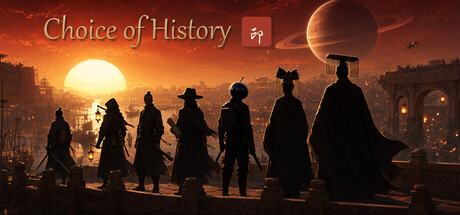


Choice of History is a deep historical sim where you rule as one of 739 real sovereigns across China, Rome, Britain, America, and Russia. Make monthly decisions through 70,000+ events, climb a 1,158-node tech tree, and balance rival factions. Your choices echo through history—no right answer.

Sign in to add this item to your wishlist, follow it, or mark it as ignored

Early Access Game

Get instant access and start playing; get involved with this game as it develops.

Note: Games in Early Access are not complete and may or may not change further. If you are not excited to play this game in its current state, then you should wait to see if the game progresses further in development. Learn more

What the developers have to say:

Why Early Access?

“The game is already fully playable. We just need to add more languages, expand it with large batches of events and emperor updates, and we welcome more feedback.”

Approximately how long will this game be in Early Access?

“Roughly until the first quarter of next year.”

How is the full version planned to differ from the Early Access version?

“The full version may add more playable heads of state, potentially bringing the number of playable rulers to 800+.”

What is the current state of the Early Access version?

“The game has completed its alpha phase and entered comprehensive testing (Beta). It already offers a complete core gameplay loop: 556 real monarchs (across five civilizations — ancient China, Rome, Britain, America, and Russia), more than 16,000 historical events, a 1,158-node technology tree, four-way faction politics, five-dimension historical appraisal, and branching narrative driven by flags and causal gating — plus a narrative memory layer and vernacular mode, with multi-language interface support. You can also bring your own AI API key so a large language model dynamically generates memorials, imperial edicts, and event dialogue for a more immersive experience. Even without AI, offline mode lets you experience all the built-in historical content and core gameplay in full. Our current focus is on adding more languages, rolling out large event/emperor updates, and continuously polishing balance and numbers based on player feedback.”

Will the game be priced differently during and after Early Access?

“No.”

How are you planning on involving the Community in your development process?

“The community has a decisive influence on the game's direction. I will read every single Steam review — positive or negative — one by one. Your suggestions directly shape the priority of our next iterations: which language to add next, which batch of events and playable emperors to release, and which balance adjustments to pursue, always weighing the community's loudest requests first. You're also welcome to reach out through the Steam Community Hub and official discussion boards (and future channels like Discord). In Early Access, player feedback is the most precious asset — I'll keep turning your opinions into version updates, letting Choice of History gradually grow into the game players truly want.”
Read more

Buy 择决千秋


Report bugs and leave feedback for this game on the discussion boards

See all discussions

About This Game

The throne is yours now

The Yellow River has burst its banks; three provinces are under water. The frontier army is three months unpaid, and its commander is still outside your tent waiting for one word. The censor's memorial has just landed on your desk — accusing the one man you trust.

You can only sign one of them today.

The other two will not go away. They will come back next month, as your new problems.

Choice of History is a deep historical simulation built on one thing: the decision. It never tells you which option is right, because the people who sat in that chair did not know either.

739 real rulers · 8 civilizations · 4,100 years · 76,000+ story events

Who will you be

From the Xia dynasty of the 21st century BC to the White House of the 21st century AD.

China, Rome, France, Germany, Britain, America, Russia, the Ottoman Empire — eight courts, one resolution engine, eight different arithmetics: Rome's Senate and Praetorian Guard, Britain's Parliament and gentry, France's parlements, the Ottoman Janissaries, Russia's politburo, America's Federalists.

You can be Kangxi. You can be Caesar. You can be Washington — or a boy emperor who reigned eleven months and got three lines in the history books.

Honestly, the last one is harder.

New: the German chapter. 66 rulers across six periods fill in the middle of Europe — from clan warbands and the age of migrations through the Salian investiture crisis and the Habsburg household, to Prussian-Austrian dualism and reunification.

Four worlds, four ways to live

Not four difficulty levels — four currencies, four different prices to pay.

The Historical World · 739 rulers
Govern. Treasury, popular support, military, court, livelihood, technology — six tightropes at once. Weigh the royal clan, the scholar-officials, the frontier generals and the merchants against each other, and at the end a historian grades your whole life.

The Palace World · 10 consorts
Empress Lü, Lady Gouyi, Zhao Feiyan, Wu Zetian, Consort Yuan, Consort Zheng, Empress Yi'an, Empress Zhaosheng — plus Hurrem Sultan and Kösem Sultan of the Ottoman harem. Four dynasties, one inner court, nearly 1,500 hand-written scenes. You are not measuring a nation, but how far up the wall one woman can climb, and what title she is left with. Favor, palace authority and faction are your main readouts; expenses and health drain you in the dark.

The Sci-Fi World · 10 protagonists · two billion years
From the Homeworld to Changgeng, then to Youyao. The survival of a civilization rests on your judgment alone. No six-stat panel to catch you — only one choice chain that runs to the end, where every line you pick becomes a line in the Human Chronicle.

The Fantasy World · 4 realms, 20 protagonists
Juyong: blood is the cage, and the price is lifespan. The Sea Kings: recognition is sovereignty, and the price is old wounds. Flameshadow: people priced by the job, and the price is exposure. Jiuyou: the blade's name is the self you dare not speak, and the price is your remaining years. Four realms that never touch, each with its own stats, its own way to die, nearly 2,900 scenes.

779 playable characters in total — each with their own attributes, faction board and opening situation.

One month, one move

The game advances month by month. Every step brings a documented event: a flood out of nowhere, a frontier rebellion, a memorial from a scholar-official, a succession quarrel behind the palace walls.

Each event branches. Each branch rewrites faction relations, the treasury and the mood of the realm on the spot.

There is no correct answer — only costs and trade-offs. Cutting taxes buys you goodwill and empties the treasury. Promoting an unaffiliated scholar wins you public praise and angers the hereditary clans. Executing a powerful minister stops the bleeding today and may cost you the loyalty of every frontier general tomorrow.

You are not choosing an option. You are choosing what you are willing to pay.

Three pillars that keep strategy players up at night

1. Tech tree: 1,158 nodes, ten branches
Nine branches, from agriculture and industry to law, ritual and natural philosophy — plus a fantasy branch of cultivation. Research climbs the eras and obeys prerequisites, and what you develop becomes real combat odds, livelihood gains and event mitigation — a disciplined long-term investment that also peels the fog off your hidden stats.

2. Factions and the five-part verdict
Royal clan, scholar-officials, frontier generals, merchants — they rise and fall against each other under your rule (-100 to 100). Your life is finally judged across treasury, popular support, military, court and livelihood. There is no single victory condition. There is only what you leave behind.

3. Flags and causal gating
A decision echoes further than its numbers. An act of mercy early on may block a coup decades later; a broken promise plants the seed of its own revenge. A narrative memory layer lets events call back across a whole reign — what you write is not a run, but a national history belonging to this one ruler.

Something no one else does

Chinese emperors and the rulers of Rome, France, Germany, Britain, America, Russia and the Ottoman Empire, under one comparable rule set — same six stats, same faction logic, same measuring stick.

Almost nobody has attempted that. It is why all 739 rulers were audited against two independent sources: better one ruler short than one ruler invented.

Replay is the design, not the bonus

The same ruler, in different hands, produces opposite histories — a direct consequence of the flag system, not a marketing line.

  • 76,000+ events, unlocked in layers by ruler and era. Every new run is a new context.

  • 114 achievements across six categories: career, statecraft, technology, decisions, collection, biographies.

  • 454 encyclopedia entries on figures, institutions, events and terms — all sourced, so you learn history while you play.

  • A collection room that files each reign into a card album, with rarity tiers and cloud saves.

  • A plain-language mode that turns classical Chinese prose, plot and choices into modern Chinese with one click. Read the original, or read it easy.

Built for long reading sessions

  • Full Steam Deck and controller support: native 1280x800 layout; stick and d-pad reach every screen without touching a keyboard.

  • 16 languages: Simplified and Traditional Chinese, English, Japanese, French, Spanish (Spain and LatAm), German, Portuguese (Brazil and Portugal), Russian, Turkish, Hindi, Bengali, Urdu, Arabic.

  • No timers, no reaction checks: save anytime, adjustable text size and contrast, mouse-only or touch-only.

About Early Access

The game is in Early Access. Every world, every ruler and every scene described above is playable right now — not a roadmap.

Future chapters will be folded into the base game as updates.

About AI: optional, never required

Offline, the full built-in content and every core system are playable end to end.

If you want more immediacy, bring your own free LLM API key (Agnes, Qwen and other flash-tier models work) and paste it into settings. The game uses it to write event prose live, so every court session feels like someone is waiting for you to speak.

The key and quota stay with you; your play data is never uploaded or used for training. Skip the API and no built-in content goes missing.

Your turn

History will not make the move for you. It just sets the throne out, and watches.

Sit down.

AI Generated Content Disclosure

The developers describe how their game uses AI Generated Content like this:

AI assistance was used in the development of this game. Players are strongly advised to play using mainstream free "flash" AI APIs such as Agnes API or Qwen API — simply fill in your API information in the game settings. For the sake of speed, enabling thinking mode is not recommended. This game contains optional generative AI features. In “AI-Enhanced Narrative Mode”, the game calls the third-party LLM API you provide yourself, generating more immersive event text in real time as you play. This mode is entirely optional: even without connecting any API, you can still fully experience all of the built-in, human-written historical content and the core gameplay. The game will not use your gameplay data to train any models. All AI-generated content is controlled by your own API key and quota, and you are responsible for your own usage.

System Requirements

Windows
SteamOS + Linux
    Minimum:
    • Requires a 64-bit processor and operating system
    • OS: Windows 10 / Windows 11
    • Processor: Intel Core 2 Duo E8400
    • Memory: 2 GB RAM
    • Graphics: Intel HD Graphics 4000 support DirectX 11
    • DirectX: Version 11
    • Storage: 4 GB available space
    • Sound Card: Not required
    • VR Support: None
    • Additional Notes: Requires a 64-bit operating system
    Recommended:
    • Requires a 64-bit processor and operating system
    • OS: Windows 11 64-bit
    • Processor: Intel Core i3 / AMD Ryzen 3 or higher
    • Memory: 8 GB RAM
    • Graphics: Intel HD Graphics 4000 or higher (supports DirectX 11)
    • DirectX: Version 11
    • Network: Broadband Internet connection
    • Storage: 8 GB available space
    • Sound Card: Not required
    • VR Support: None
    • Additional Notes: Personal AI API recommended
    Minimum:
    • OS: Ubuntu 20.04 / SteamOS 3 (64-bit)
    • Processor: Any x86_64 dual-core processor
    • Memory: 2 GB RAM
    • Graphics: Intel HD Graphics 4000 or equivalent integrated GPU (supports OpenGL 3.3 / DX11)
    • Storage: 4 GB available space
    • Sound Card: Any
    • VR Support: None
    • Additional Notes: Requires a 64-bit operating system
    Recommended:
    • OS: Ubuntu 22.04 or later / SteamOS 3.5+
    • Processor: Intel Core i3 / AMD Ryzen 3 or higher
    • Memory: 8 GB RAM
    • Graphics: Vulkan 1.0 compatible or higher
    • Network: Broadband Internet connection
    • Storage: 8 GB available space
    • Sound Card: Any
    • VR Support: None
    • Additional Notes: Personal AI API recommended
Review Filters