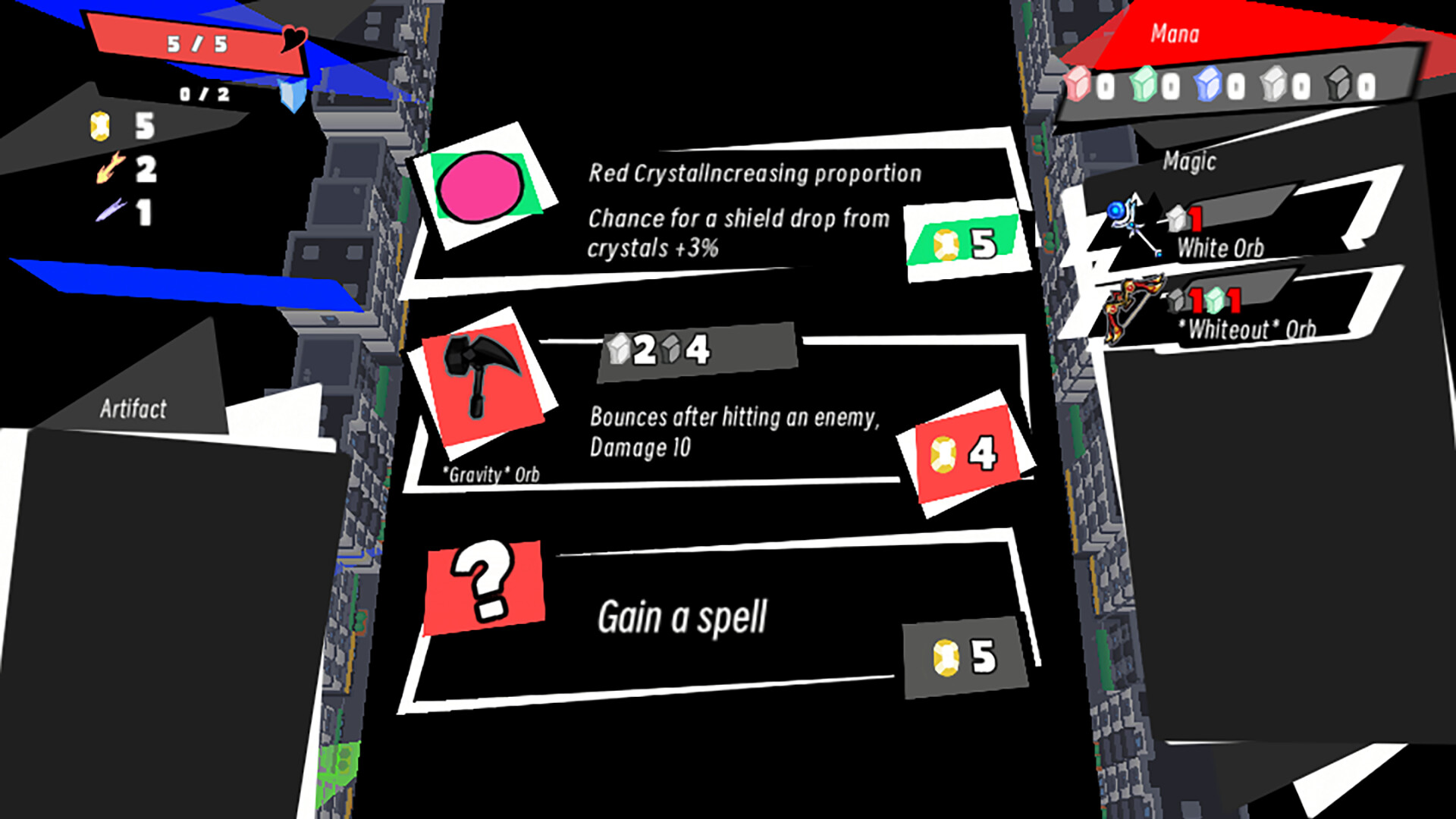

Heaven fell. A Cupid in the Fallen City, bow that fires orbs. Bubble-shooter aiming on a two-zone falling board, built on five-color mana: every shot a choice — crystals for mana, wraiths for damage, summons to stop the hit. Orbs, spells, and artifacts interlock into one five-color mana build.

Sign in to add this item to your wishlist, follow it, or mark it as ignored

This game is not yet available on Steam

Planned Release Date: To be announced

Interested?
Add to your wishlist and get notified when it becomes available.
 

About This Game

Heaven fell. You didn't get out.


King Cupid is a roguelike that fuses bubble-shooter aiming with a two-zone falling board, five-color mana building, and target-priority puzzling.
Heaven came down, and what's left standing is called the Fallen City. The angels pulled out early. A handful of Cupids didn't make it — and neither did the wraiths now filling the streets.
Your job is simple: clear the wraiths, pocket the Heaven Coins, and when it's all over, put on the crown nobody ever got to wear.

Front: four rows. Back: five rows. Each has its own line.

The battlefield is a nine-row staggered grid: five rows at the back, four up front, every row a real cell.
New crystals spawn along the top every turn, and then everything falls — two rows at a time,
because adjacent rows are offset by half a cell and a straight drop can only land two rows down.
The front is only four rows deep, so anything there reaches the line in one or two turns. The back is five rows and buys you one extra turn of buffer.
You're not managing one board. You're managing two clocks, and they don't tick at the same speed.

There's a line across each zone.

Anything that reaches its zone's line has left the grid — and what happens next depends entirely on what it was:
  • Crystals cross — they vanish. You lose a row of mana income. It doesn't hurt, but you get poorer every time.
  • Obstacles cross — they vanish. The lane they sealed off opens up by itself.
  • Summons cross — it lights up. Not a hit. A warning.

The wraiths don't come down. They roam, and they throw things.

Wraiths don't ride the board down. They move across the grid on their own.
What they throw depends on their attack pattern — not every turn. Some charge for a few turns and fire a volley.
Some never throw summons at all and drop obstacles instead, sealing off your lanes.
Some are in more of a hurry: what they throw lights up the instant it lands, no waiting for the line — deal with it this turn or take it next turn.
That means the threat can be read. Learn a wraith's rhythm and you know when to break it and when to leave it alone.
And the lower a wraith drifts, the faster whatever it drops reaches you. Where it stands is how urgent it is.

Three targets. One shot.

Aiming works the way bubble-shooter players expect — there's a guide, you can see the bounce, you can see where it lands.
The real question is what you're aiming at.
  • Shoot a crystal: it breaks in one hit and pays out mana in its color. It also deals no damage at all.
  • Shoot a wraith: it has health and takes several hits. Kill it and that lane stops producing forever. The catch is you often can't reach it.
  • Shoot the summons: it has health too, and it can be destroyed. Break it and the hit never lands.
    The catch is zero damage, zero economy — but you have until the damage resolves.

Firing costs mana, and shooting crystals earns it back.

Crystals are your lifeline. They're also your wall.

This is the one rule that makes the game: crystals are both your mana source and physical cover.
They sit between you and the wraith. You want damage, you have to clear them first — and the shot that clears them pays you in mana, not in blood.
You can also do nothing and let the board carry them off, opening the lane for free. But then you earn nothing from it.
Summons work the same way: sometimes one sits right on your line and you clear it for free value, and sometimes it's on the opposite side of the board from the wraith you need to hit.
That's when you have to pick: does this shot save you, or does it move you forward?
And the wraiths keep moving. The lane you just opened may not have anyone in it next turn.

Selectable Cupids, one five-color mana system.

White, Black, Red, Green, Blue — five selectable characters you pick from, not five decks you draw.
Color isn't a class gate: any Cupid gathers all five colors of mana and casts all five colors of spells. The real system is the five-color mana build — how you scrape together and spend the five color costs is what every run actually turns on.
Each Cupid just brings one default skill and a role, to make one of those color lines run smoother:
  • White Cupid — Combo (refills white mana every turn, steady fuel to keep firing)
  • Black Cupid — Conversion
  • Red Cupid — Area
  • Blue Cupid — Control
  • Green Cupid — Delay
You start with White Cupid only; clear a run with him and the other four come back. Who you bring just changes your opening move — the five-color mana you play is always the same.

Three build lines. Two of them colliding can break a run wide open.

  • Orbs: Explosion, Poison, Ice, Fragile, Parasite, Piercing, Gravity, Repel, Split, Growth, Lifesteal, Soul, Extract, Same Color, Whiteout, Combo… turn a wraith into crystal, then wipe every crystal of that color in one shot.
  • Spells: Lightning, Random Lightning, Front / Back Row Thunderstorm, Homing Lightning, Avalanche, Plague, The Wall of Sighs, crystal recoloring, Strength and Crit buffs. Five colors of mana, and the wrong one is a dead card.
  • Artifacts: A Mini Demon fires for you every turn. Getting hurt makes you stronger. Heaven Coins earn interest. One turns a wraith into crystal so a single clear wipes the board.

Five districts. And five things at the bottom of them.

Three wraiths per district: two small ones, then the big one.
Each of the five big ones fights you with your own tricks turned inside out —
eating the crystals you chain off of, recoloring your board, charging up and scattering summons across the grid, wearing you down by simply outlasting you,
and the last one, who looks exactly like you, locking away one of your five colors every single turn.
Clear the fifth district, and you've earned the right to reach for the crown — assuming you're still breathing.

You will die a lot

But you'll always know exactly why. That shot should have gone into the summons, and you spent it on a crystal.
Or: the lane you opened last turn was already empty.

Key features

  • Bubble-shooter aiming: a full aim guide showing bounce angles and landing spots. You pick the shot — physics doesn't pick it for you.
  • Two-zone falling board: front zone of four rows, back zone of five, each with its own line. Two clocks, two speeds.
  • Three targets, one shot: crystals for mana, wraiths for damage, summons to stop the hit. Every shot is an opportunity cost.
  • A nine-row staggered board: adjacent rows offset by half a cell, everything drops two rows a turn. Odd rows and even rows are two tracks that never meet.
  • Crystals are resource and cover: they pay your mana and block your line. Push damage through, or wait for the board to move them out — and earn nothing.
  • Wraiths with attack patterns: they don't throw every turn. Some charge and volley, some drop obstacles, some light a warning the instant they throw.
  • Shields are an optional buffer: occasionally built, never required.
  • Orbs, spells, and artifacts: three interlocking systems, near-endless build combinations.
  • Five-color mana economy: white / black / red / green / blue settle separately. Color is the gate, not your character.
  • Selectable Cupids, all using the same five-color mana: what differs is each one's default skill and role.
  • Five districts, fifteen fights: two lesser wraiths and one greater wraith each, every greater wraith with its own mechanic.

System Requirements

    Minimum:
    • Requires a 64-bit processor and operating system
    • OS: Requires a 64-bit processor and operating system
    • Processor:
    • Memory: 4 GB RAM
    • Graphics:
    • Storage: 1 GB available space
    Recommended:
    • Requires a 64-bit processor and operating system
    • OS: 需要 64 位处理器和操作系统
    • Processor:
    • Memory: 4 GB RAM
    • Graphics:
    • Storage: 1 GB available space
Review Filters