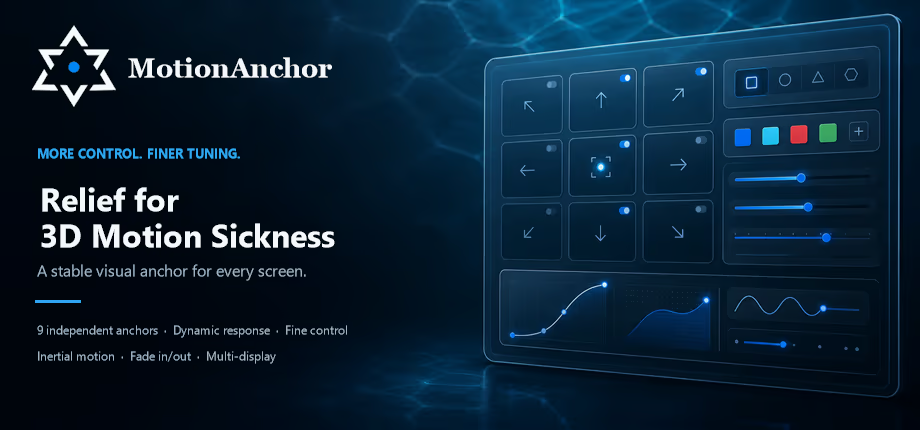

Purely visual overlay relieving 3D motion sickness without touching game processes. 9-zone anchors give your brain a stable reference. 45+ parameters, per-game presets, hotkeys, motion follow, fade, multi-monitor, Steam Cloud. <1% CPU, <10MB, exits on close. Not a drug—a tool to tune comfort.
Release Date:
Coming soon
Developer:
Publisher:
Tags

Sign in to add this item to your wishlist, follow it, or mark it as ignored

This game is not yet available on Steam

Coming soon

Interested?
Add to your wishlist and get notified when it becomes available.
 

About This Software

The most complete and customizable 3D motion sickness relief tool available.

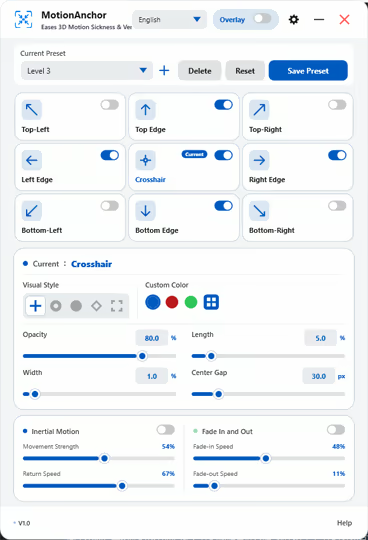
3×3 grid anchors, custom crosshair, inertial motion, dynamic fade in/out, preset switching, and global hotkeys. Every element can be fine-tuned until you find the mode that feels right.

Playing 3D games without feeling sick shouldn’t be a talent.

It’s just a sensory conflict: your eyes say “I’m moving,” your body says “No, you’re not,” and your brain gets caught in the middle, finally protesting with nausea. We can’t change your physiology, but we can trick your brain.

MotionAnchor doesn’t treat a disease, doesn’t inject anything, and doesn’t modify your game. It simply places a layer of visual anchors on screen—visible but unobtrusive—like the horizon on a rocking boat, giving your brain a stable reference point. Everything else—rhythm, intensity, on/off—stays in your hands.

Motion sickness shouldn’t be where your enjoyment ends. It shouldn’t be part of the game at all.

Pure Visual Overlay Technology: Safety Is the Baseline

Some tools on the market need to inject into the game process, modify memory, or load DLL files. That can trigger anti-cheat systems and put your account at risk. From day one, MotionAnchor chose a more restrained and safer path.

MotionAnchor runs as a pure visual overlay, which means:

  • It does not read any game process memory.

  • It does not modify any game files or registry entries.

  • It does not inject any third-party code into the game environment.

  • It does not perform screen content recognition or image capture.

All MotionAnchor does is draw a layer of assistive visual elements on top of your screen—as simple, safe, and transparent as putting a semi-transparent guide sticker on glass. You play your game; we just make it easier on your eyes.

In return, the game needs to run in borderless windowed mode.

Full-Screen 9-Point Graphical Control: Not Just Parameters, but a Paintbrush

We divide the screen into a 3×3 grid, and each point has its own independent set of visual control parameters. Unlike tools that rely on intuitive dragging, MotionAnchor offers a precision numeric adjustment system—so you can exactly reproduce someone else’s good configuration, and get a completely consistent experience across different devices.

Each point has 5 fully independent core parameters, for a total of 45 adjustable parameters across 9 points. That doesn’t even include motion-follow modes, fade in/out settings, and preset settings—so the real number of dimensions you can tune goes far beyond that.

What Exactly Is It Relieving? A Plain-Language Explanation

Simply put, the core cause of motion sickness is that your eyes tell your brain “I’m moving,” while your body tells your brain “I’m not.” The two signals conflict, and your brain protests with nausea.

MotionAnchor’s approach is to place visual reference anchors near the screen edges and in specific areas. These anchors either move gently at very low frequencies or provide stable static references, helping your brain find a middle ground between “visual motion” and “physical stillness.” It’s like staring at the horizon on a rocking boat—it gives your brain a stable coordinate, and the discomfort naturally decreases.

The entire process is passive visual stimulation. You don’t need to actively do anything or split your attention to operate the tool. It works quietly in the background while you focus on the game.

Personalized Presets: Tailored for Every Game

Different games trigger motion sickness in completely different ways:

  • FPS games: Rapid turning and frequent camera shake are the main triggers. They benefit from stronger stabilization at the center point and softer treatment at the four corners.

  • Racing/speed games: The sense of speed and cornering lean are the core issues. They benefit from stronger dynamic guide lines at the top and bottom points, helping the brain anticipate direction of movement.

  • Open-world/third-person games: Camera rotation is frequent and unpredictable. They benefit from evenly distributed light guidance, combined with a bottom motion indicator bar to sense movement rhythm.

  • 2D side-scrolling/casual games: They usually don’t need strong intervention, but some players are sensitive to horizontal scrolling. A slight visual stabilization at the left and right points is enough.

MotionAnchor lets you save independent presets for different games and name them after the game. When switching games, load the corresponding preset with one click—no repeated tuning needed. You can even save multiple presets for different scenes in the same game, such as “indoor exploration” and “outdoor combat,” and switch between them at any time.

Hotkey System: No Interruptions, No Alt-Tabbing

In an intense match, any alt-tab can be fatal. MotionAnchor provides a complete global hotkey system, so every action can be done blind while staying in the game:

  • One-key on/off: Decide at any moment whether to enable the assistive effect.

  • Preset cycling: Switch between different presets in order, ideal for quickly changing setups at different stages of a game.

  • Strength fine-tuning: Adjust the overall strength of the current preset directly with hotkeys (+/-) without opening any interface.

All hotkeys can be customized to avoid conflicts with in-game keybinds. Set them once, and you’ll never have to think about them again.

Full-Scenario Display Adaptation

Displays come in all shapes and sizes, and MotionAnchor covers them all:

  • Standard aspect ratios: 16:9, 16:10

  • Ultrawide: 21:9, 32:9, and beyond

  • Multi-monitor users: Freely choose which screen the tool works on—guides on the secondary screen, game on the main screen, with no interference.

  • Resolution adaptation: From 720p to 4K/8K, the scale and clarity of visual elements automatically match.

Steam Cloud: Your Settings Follow You

Tuning a visual preset that fits you often takes repeated trial and patience. That work shouldn’t be lost when you change computers, reinstall your system, or switch to Steam Deck.

MotionAnchor fully supports Steam Cloud. All presets, hotkey configurations, screen selection preferences, and other settings are automatically synced to your Steam account cloud. After installing on a new device, the first launch will automatically pull all your configurations—install and use immediately, no retuning required.

Performance: You’ll Barely Notice It’s There

MotionAnchor’s runtime logic is pure graphics rendering. It involves no computationally intensive tasks—no extra inference, no video encoding, no image recognition. On most modern PCs, CPU usage is under 1%, GPU usage is under 1%, and the impact on game frame rate is negligible. We know how sensitive gamers are to performance, so we made “lightweight” one of our core development goals.

The software is also compact: the installer is under 10MB, there are no background resident processes, and when you close it, it exits completely and leaves no trace.

Closing: Let Every Pair of Eyes Enjoy the Game

MotionAnchor isn’t trying to “cure” motion sickness—that’s a complex medical issue. Our goal is more practical and specific: give you a set of tools so you can find the most comfortable visual state for yourself.

No expensive hardware, no changing your gaming habits, and no account risk from sketchy third-party plugins. A lightweight, safe, highly customizable visual assistant—that’s our commitment to every 3D game enthusiast.

See, don’t fight.
MotionAnchor—using vision to smooth away motion sickness and bring back the pure joy of gaming.

System Requirements

    Minimum:
    • OS: Windows 10 64-bit
    • Processor: Dual-core 1.5 GHz or higher
    • Memory: 2 GB RAM
    • Graphics: Integrated graphics card with WPF desktop composition support
    • Storage: 20 MB available space
Review Filters