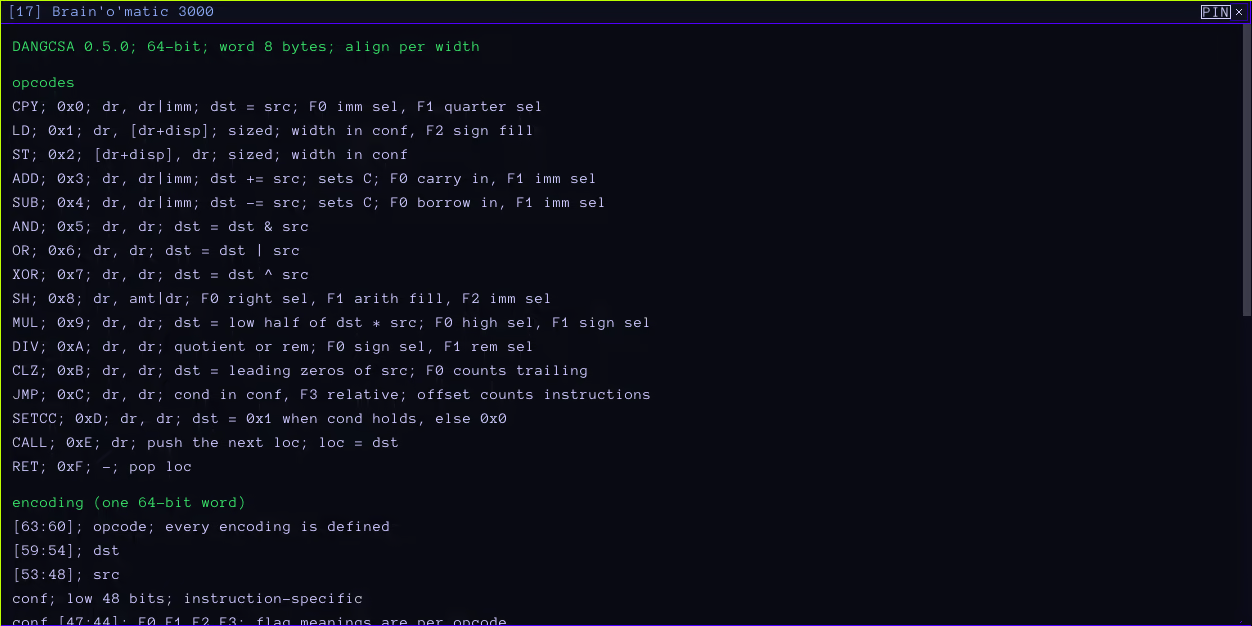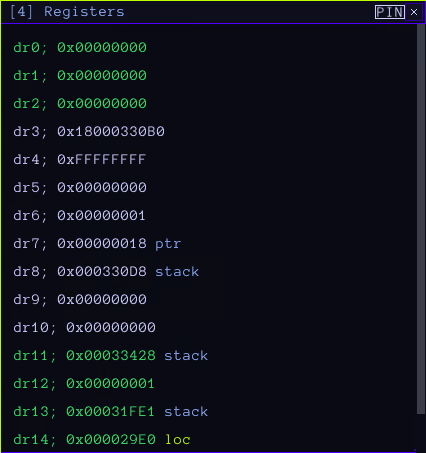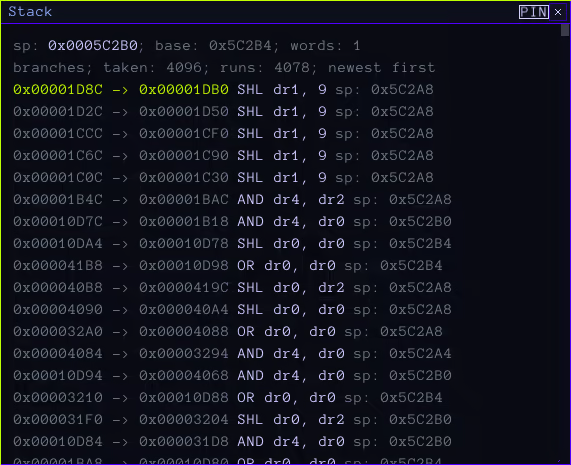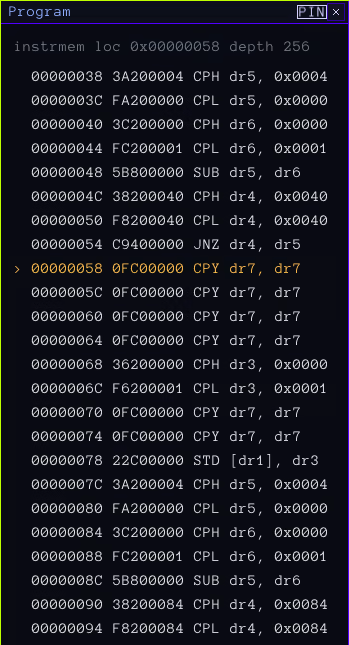

Crosstalk is a printed circuit board simulator where players build cities using electronic components, which follows electrical rules that will have to be dealt with in order to maintain city operations. It includes a sandbox mode (with optional co-op) and an adversarial mode, where players compete.

Sign in to add this item to your wishlist, follow it, or mark it as ignored

Coming Soon To Early Access

The developers of this game intend to release as a work in progress, developing with the feedback of players.

Note: Games in Early Access are not complete and may or may not change further. If you are not excited to play this game in its current state, then you should wait to see if the game progresses further in development. Learn more

What the developers have to say:

Why Early Access?

“We would like to iterate on the game on a frequent basis as we go instead of relying on standard patch cadence that would come with a 1.0 release. The input of players will help determine what is wanted and what isn't.”

Approximately how long will this game be in Early Access?

“As far as we can tell at the moment of writing, the Early Access stage will last well through 2027 and likely conclude within 2028 (earlier rather than later in the year).”

How is the full version planned to differ from the Early Access version?

“We have a lot planned for Crosstalk. We recognized the potential of it during our planned 1.0 release, which we had to postpone, noticing that given the game's current theme, a lot could be built on top of it. Concretely, one of the features that we want to work on is HDL compilation and FPGA synthesis, which would let people build entire working computers within Crosstalk.”

What is the current state of the Early Access version?

“The originally announced city-builder mode is what's coming first. It will let players build PCB cities by themselves or with others, and play in a competitive mode against a second team. It is heavily integrated with social features (Steam Chat, leaderboards, Steam Stats, Discord Social SDK, pair-play focused statistics) and has 78 achievements configured at the time of writing. It comes with FDTD solvers that enable the game to show true electrical values. We have an EDA-grade library with 70 components chosen specifically for this game's needs. There is an exporter that can be used to have a city design fabricated and assembled in the real world, with optional in-real-world functionality should a player design a city that is correctly wired up (read as: if it's wired right, it actually works when it comes from the factory!).”

Will the game be priced differently during and after Early Access?

“With releases containing brand new features during Early Access, we do plan to increase the price. At 1.0 and subsequent major version bumps, we plan to increase the price as well. We also plan to engage with seasonal discount events and Fests, where applicable. ”

How are you planning on involving the Community in your development process?

“We will interface with players via the Community Hub and the Discord server that we started for the game. People will be able to discuss ideas, new features, issues, and fan content (esp. the Workshop).”
Read more

Join the Crosstalk Playtest

Request access and you’ll get notified when the developer is ready for more participants.
This game is not yet available on Steam

Planned Release Date: September 2026

Interested?
Add to your wishlist and get notified when it becomes available.
 
See all discussions

Report bugs and leave feedback for this game on the discussion boards

About This Game

The mission statement of Crosstalk is that we would like it to bring back the joy of tinkering, designing things from near-scratch, and taking one's time with something, all while letting people connect and collaborate. We don't see that much anymore in computing.

Crosstalk, noun, engineering

"Crosstalk between signal channels denotes the interactive influence between two independent channels as a result of leakage currents and capacitive or inductive coupling. Crosstalk between the channels changes the signal by the value of the amplitude of the crosstalk signal."

- Siemens: SIMATIC ET 200AL Manual Collection

Crosstalk is a printed circuit board builder and simulator that lets players construct cities out of electronic components, all of which follow electrical rules, the results of which players will have to deal with to maintain the city's operations. It supports a networked mode, in which one either collaborates with other players (party submode) or competes against them (adversarial submode). Cities can be shared via the Workshop.

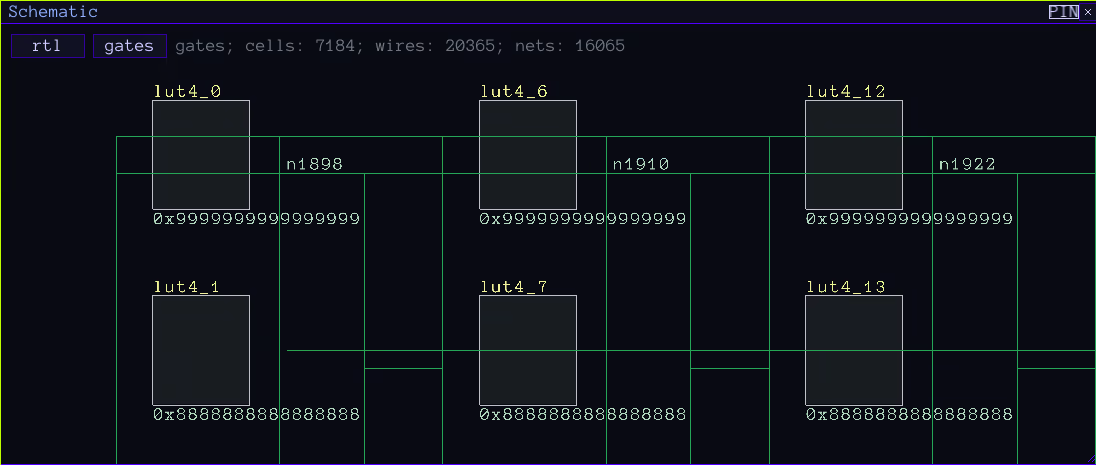
Cities built in Crosstalk represent structurally valid PCBs, which, combined with physical simulation, means that there's an educational element to playing. It also means that cities designed in Crosstalk can be fabricated using standard and widely available PCB fabrication and assembly services, and as such, brought into the real world. One could design a fully functional microcontroller board in Crosstalk and have it fabricated and assembled using a PCBA service without additional setup or utilities. One would take the Gerber, drill, and pick-and-place files and the bill of materials from the export and send these directly to a PCBA service.

Theory

Buildings represent electronic components; roads represent traces; metro tunnels represent vias. Every PCB design element and principle has a parallel in Crosstalk. Learning to play the game teaches, in effect, PCB design. The game comes with a professional component library that consists of 70 hand-picked components and their metadata.

What happens in and around the city is computed using Maxwell's equations, heat radiation, conduction, and convection, and many other principles. Many of these principles' standard methods of solving are integrated via an in-house finite-difference time-domain physics solver (for electromagnetics) and finite-volume/explicit forward Euler over a 6-neighbor face-flux stencil/discrete-ordinates radiative transfer equation/Newton cooling (thermodynamics), based on approximately 2700 A4 pages of theory.

Keeping the city up and running will involve several measures. One of those measures will be keeping its crime rate down. In Crosstalk, this means decoupling power pins of active components. Voltage changes outside of tolerance caused by current spikes are a very common occurrence that must be managed. Letting these voltage changes slide past unchecked causes brownouts and, in more extreme cases, physical damage. Placing housing units, which function as parallels to capacitors, around the city decreases the probability of petty crime and homelessness occurrence, which will, in turn, reduce the city's crime rate.

Sandbox mode

Sandbox mode is the default Crosstalk experience. One chooses a PCB size, difficulty (which scales starting funds and the degree to which nature is unrelenting), and starts building. As one builds, one contains oncoming trouble while staying solvent. Players can build anything from a town to a megacity. Under the "Easy" and "Medium" difficulty settings, pin attribution will not be enforced, so as long as buildings are powered and interconnected based on their roles, they will be able to operate. If a player chooses the "Hard" difficulty, the player will have to use specific pins for specific things, such as wiring power in via VIN, outputting it via VCC, grounding via GND and COM, looping back voltage feedback via FB, and so on.

Networked mode

Party submode

In this submode, one can team up with others over Steam Networking and manage a city together. It is structurally identical to Sandbox mode, but with networking enabled.

With larger designs, managing nature, the physics of electromagnetism and electricity, becomes complex, so players will need all the additional help that they can get. One can be joined by up to two other players.

Adversarial submode

Here, players compete against other players. One side maintains the city; the other, playing as nature, wreaks havoc. The city didn't manage its crime rate? That's an opportunity for the adversaries to strike.

Each side is able to play with up to 3 players at a time, resulting in a maximum total of 3 vs. 3 players.

System Requirements

    Minimum:
    • Requires a 64-bit processor and operating system
    • OS: Windows 10 1809
    • Processor: 2.4GHz quad-core
    • Memory: 8 GB RAM
    • Graphics: VRAM >=6Gi
    • Storage: 2 GB available space
    • Additional Notes: Vulkan >=1.3 required
    Recommended:
    • Requires a 64-bit processor and operating system
    • OS: Windows 11
    • Processor: 4.6GHz octa-core
    • Memory: 16 GB RAM
    • Graphics: VRAM >=12Gi
    • Network: Broadband Internet connection
    • Storage: 5 GB available space
    • Additional Notes: Vulkan >=1.3 required (discrete Vk device recommended)
There are no reviews for this product

You can write your own review for this product to share your experience with the community. Use the area above the purchase buttons on this page to write your review.

Review Filters