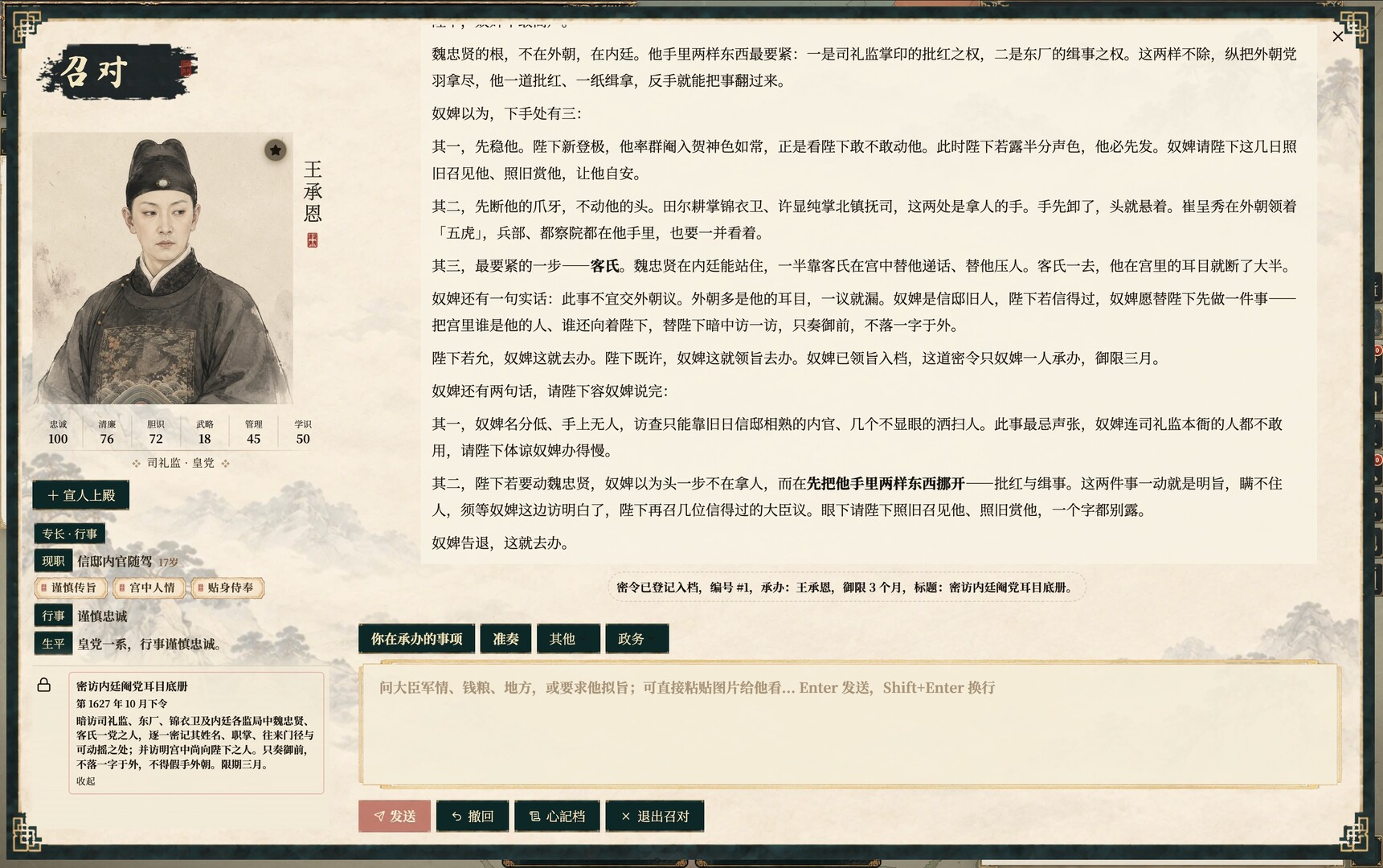


Each round lasts one month. At the start of every month, you review last month’s status: tax income, military expenditure, regional disasters, officials’ assignments and the actual execution of imperial decrees.

Sign in to add this item to your wishlist, follow it, or mark it as ignored

Coming Soon To Early Access

The developers of this game intend to release as a work in progress, developing with the feedback of players.

Note: Games in Early Access are not complete and may or may not change further. If you are not excited to play this game in its current state, then you should wait to see if the game progresses further in development. Learn more

What the developers have to say:

Why Early Access?

“本作是一款高自由度的历史模拟游戏,历史剧情推演、时代机制、文明玩法的打磨离不开真实玩家的体验反馈。我们选择抢先体验模式,核心是希望提前开放可完整游玩的游戏内容,邀请广大历史爱好者、模拟游戏玩家参与测试。通过收集玩家对历史设定、玩法逻辑、数值平衡、场景细节等方面的建议与反馈,持续优化游戏体验,修正设计短板,贴合玩家对真实历史模拟的核心需求,和社区共同打磨出更优质、更贴合玩家期待的完整版游戏。”

Approximately how long will this game be in Early Access?

“我们计划将游戏的抢先体验周期维持在6到12月左右。整个周期会根据社区反馈优化进度、新内容开发节奏以及游戏打磨完善程度灵活调整,确保游戏的历史模拟体系、核心玩法、细节内容均达到优质完整版标准后,再正式推出1.0版本。我们会持续在商店页、社区公告更新开发进度,让玩家实时掌握游戏更新动态。”

How is the full version planned to differ from the Early Access version?

“现阶段抢先体验版本已具备完整的核心历史模拟玩法、基础时代场景、文明推演机制,可满足玩家完整开局、模拟历史发展、体验核心剧情的游玩需求。我们计划在完整版中对游戏进行全方位升级优化,首先会拓展更多历史朝代、地域文明、经典历史事件模组,丰富玩家的游玩选择;其次将深度优化AI推演逻辑、历史随机事件体系,提升模拟的真实性与随机性,避免玩法同质化;同时会完善游戏画面细节、UI交互、操作逻辑,优化数值平衡与游戏流畅度。此外,我们计划新增自定义历史规则、剧情编辑、成就系统、云端存档等功能,优化新手引导与教程体系,修复抢先体验阶段玩家反馈的各类问题与BUG,全方位提升游戏的完整性、趣味性与沉浸感。所有开发规划均为团队预期计划,具体内容将根据社区玩家反馈动态调整优化。”

What is the current state of the Early Access version?

“已实现功能列表
核心:大臣聊天,下旨
朝堂:朝会入口,召集多位大臣庭议(吵架)。
吏部:任免大臣
省份:地块详情包括军事建筑经济人口
兵部:军队,军镇
户部:经济,国库内库收支
工部:建筑列表,科技列表
礼部:选妃,外交
后宫:后宫管理
目标:游戏规划
密令:玩家生成的指令月度推进
局势:玩家或者系统事件生成的局势,月度推进#”

Will the game be priced differently during and after Early Access?

“会有所不同,抢先体验因为产品的稳定性不够,价格会偏低一点,正式版会高出一点点,20%左右”

How are you planning on involving the Community in your development process?

“我们将把社区反馈作为游戏迭代开发的核心依据,搭建全方位的玩家互动渠道,让玩家深度参与游戏开发全过程。首先,我们会常驻Steam社区评论区、讨论板块,每日收集玩家关于历史设定、玩法体验、BUG问题、内容新增的建议与吐槽,逐一整理归档并纳入开发排期。其次,我们计划定期发布开发日志,同步每周、每月的更新内容、优化方向与后续开发计划,公开开发进度,接受玩家监督与讨论。同时,我们会定期开启社区投票活动,针对新增历史朝代、优化功能、玩法调整等核心内容,让玩家投票决定开发优先级。此外,我们会专门收集玩家发现的BUG、不合理的数值设定、不符合历史逻辑的细节问题,在版本更新中优先修复优化。对于优质的玩家创意、历史细节补充、玩法改良方案,我们会积极采纳并落地实现,同时在更新公告中致谢贡献玩家,与社区携手打造更贴合历史、更具可玩性的历史模拟作品。”
Read more
English language not supported

This product does not have support for your local language. Please review the supported language list below before purchasing

This game is not yet available on Steam

Planned Release Date: July 2026

Interested?
Add to your wishlist and get notified when it becomes available.
 
See all discussions

Report bugs and leave feedback for this game on the discussion boards

About This Game

You are the Chongzhen Emperor.

You know Beijing will fall seventeen years from now, and the tree atop Coal Hill is waiting for you. You also understand the Ming Empire will not collapse because of one single enemy. Its fatal woes lie in empty national coffers, endless fiscal bleeding from the Liaodong frontier, widespread refugee rebellions, vicious partisan struggles inside the court, lazy and perfunctory bureaucrats, unpaid garrison troops, and your helplessness after countless routine replies of "Noted".

But in this restarted timeline, you are allowed to summon any official face to face whenever you want.

Core Gameplay

The game runs on a monthly turn system, with one turn representing one month. At the start of each month, you read official memorandums, hold audiences with ministers and issue imperial edicts; all nationwide developments get calculated and settled at month’s end.

You may summon grand secretaries, Six Ministries civil servants, palace eunuchs, frontier generals, local provincial administrators and imperial spies. Every character holds personal biases and factional interests. You can question them, test their true intentions, or order them to draft imperial decrees.

The edict-making process works in three steps: draft text formed during conversations, followed by optional editing, deletion or final approval, before the edict is officially released and tied into monthly settlement.

Imperial orders rarely get enforced exactly as written. Shortage of state funds, declining imperial prestige or factional sabotage will twist implementation results away from your original intention.

AI-powered Systems

A Ming-style official court bulletin is automatically generated every month after settlement, recording current national conditions and real consequences brought by your previously issued decrees.

All reforms and ongoing crises become traceable agenda items that naturally shift monthly based on historical inertia. Your imperial decisions can speed up progress, reverse negative trends or adjust the overall difficulty of each issue.

An event memory system creates categorized memory entries covering individual figures, regions, court politics and foreign forces after each monthly wrap-up. These past records automatically pop up in later minister audiences to keep conversations logically consistent. Memories fade over time according to importance tiers: levels one through four come with limited valid duration, while tier-five key information gets permanently stored without decay.

Before monthly outcome calculation, dedicated AI units pull key terms from all decrees passed that month, match relevant historical background via preset tags, and feed these details into monthly situation simulation and scoring. This keeps the monthly bulletin’s storyline consistent and makes imperial archive filing more accurate.

Officials can look up past events by specific year and month, bypassing regular memory decay rules. Duplicated historical information gets merged and cleaned up, providing reliable evidence whenever you ask ministers about old affairs.

Character System

You can appoint historically proven civil servants who are not listed on the pre-set staffing roster by issuing direct imperial commands; the Minister of Personnel reviews candidates’ official seniority and immediately fills vacant court positions when approved.

Every official has a clear personal status: in office, dismissed from duty, imprisoned, exiled, retired or deceased. Famous historic officials join or leave the court automatically according to their real-life timelines.

If you ask any minister about another official’s current post and status, they must check the official court register to answer truthfully instead of relying on vague memory. The official roster is sorted strictly by bureaucratic rank.

Harem System

You can issue an imperial edict to launch imperial maiden selection. The Directorate of Ceremonial picks out a shortlist of candidates with distinct personalities and talents for your inspection; those you favor receive formal decrees to be conferred noble titles and enter the palace.

During private audiences, you can command your consorts to learn new skills or modify their dispositions. All character changes are saved into permanent memory, and their personalities will reflect these adjustments in future meetings.

A web-based harem panel lets you view all registered palace ladies, browse pending candidate rosters, confirm new palace enrollments, or reset an entire playthrough with a single click.

You may upload local image files to create exclusive custom portraits for each concubine card; these portraits save at archive level and reload automatically when you restart your game.

Economic System

Provincial finance is calculated separately across four core tax sources every month: land tax, Liaodong wartime surtax, salt tax and commercial tax. Corruption and local uprisings reduce the actual tax silver delivered to the central government; low imperial prestige further allows provincial authorities to embezzle reserved Liaodong military levies.

After all provincial tax revenue is compiled into the central treasury each month, government spending gets allocated following fixed priority ranking: nine frontier garrison supplies, official salaries, large-scale public projects, disaster relief, and troop stipends. You can temporarily divert money from the emperor’s private inner treasury to cover urgent fiscal emergencies.

Detailed revenue and expenditure logs are filed by fiscal category every month. A full end-of-month audit tallies exact incoming funds, total spent silver and outstanding unpaid balances for every single item.

World Map & Global Simulation

The game’s map covers the two imperial capitals and thirteen Ming provinces, tracking real-time shifts in population, public morale, civil unrest, natural disasters, man-made catastrophes, cultivated land, untaxed hidden farmland, tax revenue, grain reserves, gentry resistance and regional military pressure.

The military module records troop numbers, monthly upkeep costs, supply levels, soldier morale, training quality, equipment condition, unpaid payroll, troop mobility, personal loyalty and overall combat status.

Construction projects including imperial kilns, frontier forts, public granaries, craft workshops and river regulation works have graded development levels. Their maintenance fees and resource outputs are logged monthly, and any new construction needs formal imperial approval to start construction progress.

Outside forces — Later Jin/Qing, the Eight Banners, Mongolian tribes and Joseon Korea, alongside domestic peasant rebel armies — shift their strength and territory month by month.

Key fixed historical turning points such as Huang Taiji’s ascension as khan, the 1629 Jisi Invasion and the Qing imperial coronation are locked into the timeline. Your rulings can alter how these landmark events unfold.

All campaign progress saves locally inside the database file named data/ming_sim.db, enabling multiple independent new playthroughs.

AI Generated Content Disclosure

The developers describe how their game uses AI Generated Content like this:

This game uses generative artificial intelligence during gameplay to generate text and data based on player input and game context.

The game does not use generative AI to generate artwork, audio, voice, music, videos, or other visual or sound assets. AI-generated content is limited to text and data used as part of the gameplay experience.

System Requirements

    Minimum:
    • Requires a 64-bit processor and operating system
    • OS:
    • Processor:
    • Memory: 1024 MB RAM
    • Graphics:
    • Network: Broadband Internet connection
    • Storage: 500 MB available space
    Recommended:
    • Requires a 64-bit processor and operating system
    • OS:
    • Processor:
    • Memory: 4196 MB RAM
    • Graphics:
    • Network: Broadband Internet connection
    • Storage: 1024 MB available space
There are no reviews for this product

You can write your own review for this product to share your experience with the community. Use the area above the purchase buttons on this page to write your review.

Review Filters