
Your heroes are people. They form bonds, take grudges, fall in love, and die permanently. Run a guild of brilliant, emotionally unstable adventurers — and watch their story write itself.

Sign in to add this item to your wishlist, follow it, or mark it as ignored

Coming Soon To Early Access

The developers of this game intend to release as a work in progress, developing with the feedback of players.

Note: Games in Early Access are not complete and may or may not change further. If you are not excited to play this game in its current state, then you should wait to see if the game progresses further in development. Learn more

What the developers have to say:

Why Early Access?

“Hero's Guild has a complete core loop and a great many systems that talk to each other,
which means it also has a great many ways of being quietly wrong in a manner entirely
invisible to the person who wrote them.

What it needs now is a few hundred people playing it well, badly, and in ways that never
occurred to me. Early Access is how I find out which numbers are off, where progression
stalls without anyone noticing, which bits of the interface made sense only to their
author, and which systems players actually want more of — as opposed to the ones I
personally find fascinating, two lists that are under no obligation to overlap.”

Approximately how long will this game be in Early Access?

“Roughly 12 months, possibly longer, depending on feedback and development progress. As a solo developer, I'll remain in Early Access as long as needed to deliver the best possible experience. Development updates will be regular, and I'll communicate openly about progress and priorities.”

How is the full version planned to differ from the Early Access version?

“We plan to prioritize additions based on player feedback and our development roadmap. As with any Early Access title, plans may evolve as development progresses.
Key aspects we are focusing:
- Balance and progression refinements — tuning based on player feedback collected
during Early Access
- Quality of life improvements — UI polish, onboarding improvements, and
accessibility options

We intend to keep Early Access players updated on progress via patch notes.”

What is the current state of the Early Access version?

“Playable start to finish, with all core systems live.

Six hero classes share one large hexagonal passive tree, with fourteen ascendancy paths
unlocked by solo trial at level 25, skill gems with support linking, and a paragon system
for after the level cap. Heroes carry personalities, traits, convictions that drift with
what you ask of them, private ambitions they save toward, bonds and rivalries across many tiers, mental breaks, illnesses that can leave lasting complications, injuries down to individual body parts, prosthetics in three tiers, and retirement for the ones who last.

Seven dungeon environments with fog of war, branching layouts, environmental hazards and moral events that fire on who you brought. Combat is turn-based and resolves itself while you watch: set the tactics, pause, change your mind, spend command points, or call the retreat. Expeditions can also be sent unsupervised.

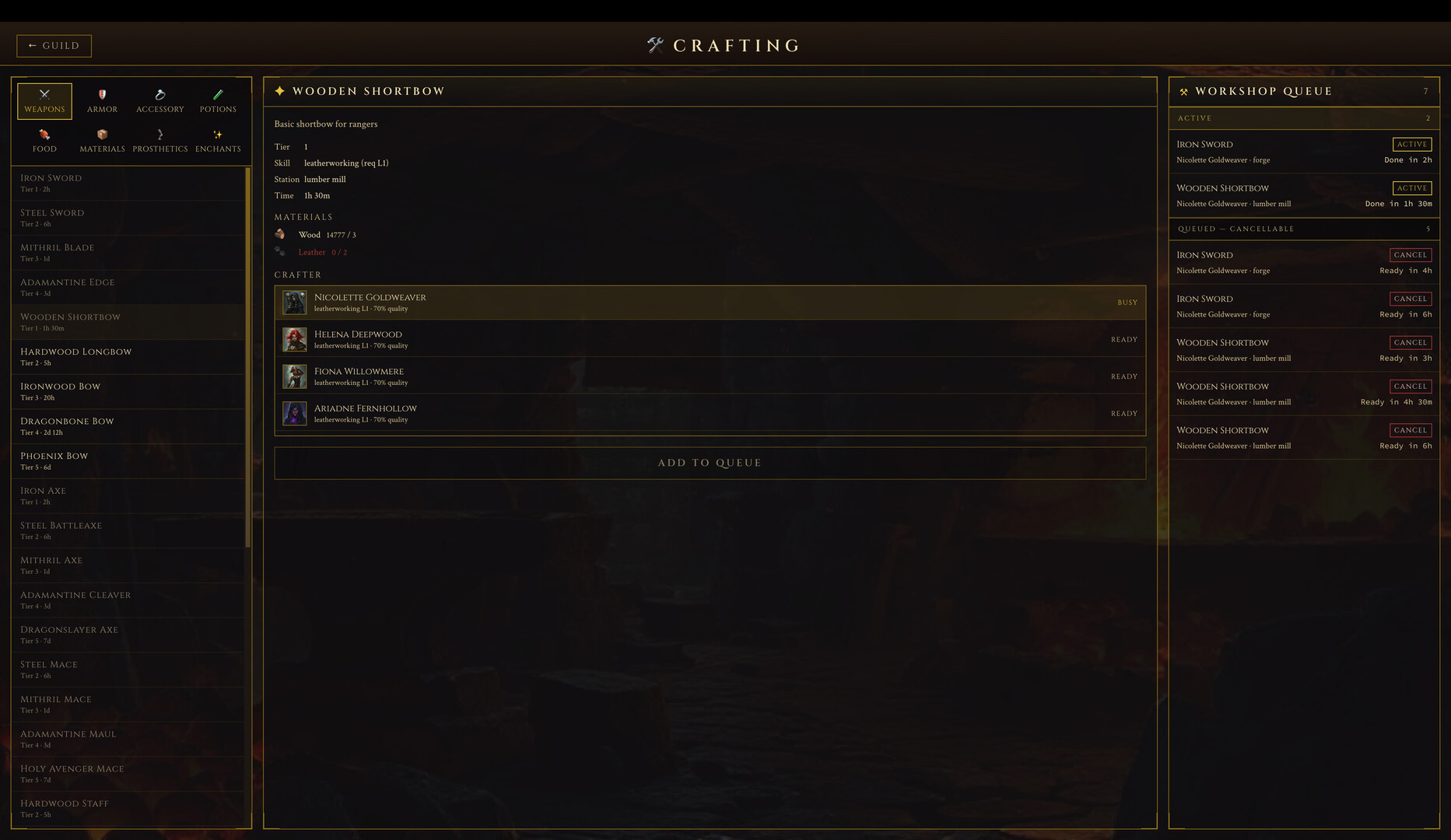
Guild facilities to build and upgrade, four crafting disciplines, a materials market with
dynamic pricing, hero quarters with adjacency, nightly tavern decisions, guild moral axes, crises, rival forges with scandals and boycotts, and a chronicle that writes each hero's autobiography as they live it.

Endgame: weekly heroic dungeons with modifiers, three raid bosses at two difficulties
each fought by multiple parties, the endless Abyssal Spire with leaderboards, quest
chains, prestige missions, and a custom dungeon editor with sharing, currently in beta.

Steam achievements, cloud saves, and a changelog that is already too long to read in one sitting.”

Will the game be priced differently during and after Early Access?

“We plan to keep the price the same throughout Early Access. We are currently leaning toward a price increase when the game leaves Early Access to reflect the additional content added during development.
Early supporters who purchase during Early Access will receive all updates at no additional cost. ”

How are you planning on involving the Community in your development process?

“Through the Steam discussion boards, primarily, because that is where the people who
bought it already are. I read everything. Bug reports get fixed, balance arguments get
taken seriously, and feature requests get prioritised by how many people independently arrive at the same one.

Updates are frequent. The patch notes explain what changed and why, including the
occasions when the reason was "a player was right and I was wrong."”
Read more

Download Hero's Guild Demo

This game is not yet available on Steam

Planned Release Date: October 2026

Interested?
Add to your wishlist and get notified when it becomes available.
 

Report bugs and leave feedback for this game on the discussion boards

See all discussions

About This Game

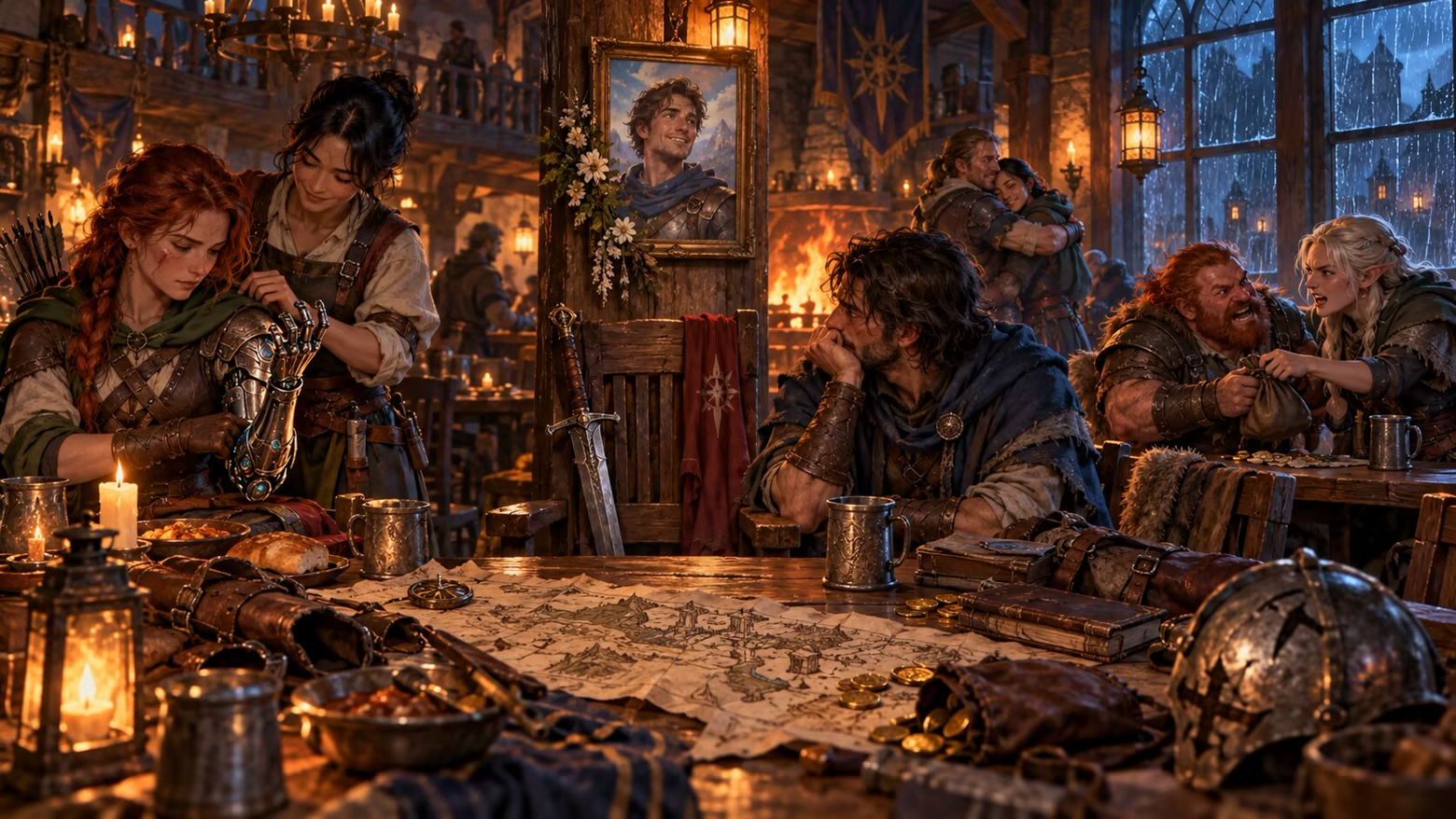
Your heroes are not expendable. They have names. They have friends. They have lovers. They have opinions about their equipment. And when they die—permanently—your guild will never quite be the same.

Hero's Guild is a guild management roguelike. Recruit heroes from the tavern, train them, argue with them about party composition, send them into dungeons that are actively trying to kill them, and watch as their lives become a story you didn't write and can't entirely control. The heroes have their own feelings about everything. They are not always helpful feelings.

HEROES WHO ARE, UNFORTUNATELY, PEOPLE


Every hero arrives with a personality. Not a stat page pretending to be a personality—an actual disposition that determines whether they'll make friends, start fights, fall in love with the worst possible candidate, or quietly hold a grudge for forty in-game days before exploding at a dinner party.

Relationships develop across many tiers, from outright hostility to the kind of devotion that produces either legendary teamwork or catastrophic grief when something goes wrong. Heroes argue. They reconcile. They fall in love, get married at your chapel, and name their swords after each other. Or they develop a blood feud that makes party composition a diplomatic negotiation.

When mood breaks, so do heroes. Push them too hard and they'll desert, go berserk, confess secrets that unravel friendships, or simply take a personal day at the worst possible time. The tavern offers drinks, feasts, gambling nights, and a bard—all valid therapeutic approaches. None of them guaranteed.

THEY WANT THINGS, AND THEY DON'T TELL YOU


Every hero is quietly saving for something. A better cloak. A small house. A name that outlasts them. They never mention it, and they go on wanting it whether or not you ever notice.

They also hold convictions—about mercy, about money, about whether loyalty is a virtue or a tactical error—and those convictions drift according to what you actually make them do. Order a party to leave a wounded stranger in a crypt and they will remember it. Not as a debuff. As a change of mind.

YOU COMMAND. YOU DO NOT PUPPET.


Combat is turn-based, and it resolves itself in front of you. Heroes pick their own targets and their own spells according to the tactics you set—Reckless, Aggressive, Balanced, Cautious, Survival—and according to who they happen to be fighting beside, and whether they can stand them.

Your job is to intervene. Pause whenever you like. Run it at single, double or quadruple speed. Change the tactical preset mid-fight, once it becomes clear that Balanced was an act of optimism. And spend command points—a small budget, refreshed each floor, never quite enough—on a battle cry, a shield wall, an emergency heal, a cleanse, a guaranteed round of crits, or the order to leave right now with whatever you're still holding.

That last one is the most important button in the game, and by far the hardest to press.

Or hand the expedition over entirely and let it run unsupervised while you deal with the guild. Nobody will intervene on your heroes' behalf. Events will proceed regardless.

PERMADEATH THAT MEANS SOMETHING


Death is permanent. But it isn't random, and it is never meaningless.

When a hero falls, their friends grieve. Lovers may never recover. After three days, you hold a burial ceremony. Their name joins the memorial. The guild carries on, slightly emptier.

But heroes protect the people they care about. Send close friends into battle and they may intervene—stepping between a companion and a killing blow. Devoted lovers will sacrifice themselves without being asked. The relationships you build are not decorative. They are the difference between a hero coming home and a hero becoming a plaque.

THE BODY REMEMBERS


Combat leaves marks. Heroes have individual body parts—eyes, arms, legs, organs—and each one can be damaged, destroyed, and eventually replaced. A shattered arm reduces effectiveness. A destroyed eye impairs accuracy. A wounded leg means your fastest rogue now arrives second.

Three tiers of prosthetics offer escalating solutions. A peg leg gets someone walking. A mechanical arm restores function. An enchanted replacement exceeds the original—though the hero wearing it will remain cross about the troll that necessitated it.

Heroes also fall ill. Some illnesses pass. Some leave something chronic behind, which the hero then carries for the rest of a career that is now measurably shorter. The infirmary treats, the ward isolates, and the plague that arrives the week before a raid is not a scripted event—it simply arrived.

And some of them drink. The tavern is therapy until it stops being therapy, at which point there is a detox ward, a long unpleasant fortnight, and a hero who may or may not thank you.

A PASSIVE TREE THE SIZE OF YOUR AMBITION


Six classes. One enormous hexagonal passive tree connecting all of them. Each hero starts at their class node and works outward, spending a point every level. By endgame they'll have invested in roughly a quarter of what's available—enough to feel dangerously specialized, never enough to feel safe.

Minor nodes, major notables, and keystones that fundamentally change how a hero operates—at a cost, because every keystone has a drawback and the tree has opinions about balance. Cross-class bridges let your Warrior pick up spell damage if you'll spend the routing points. Respec is free. Experimentation is encouraged. Regret is also free.

ASCENDANCY: CHOOSE WHAT YOU BECOME


At level 25, each hero faces a solo tower trial. Survive, and they choose an ascendancy—a specialization that reshapes their role entirely. Fourteen paths across six classes, from the Champion (a Warrior who has concluded that not dying is a viable combat strategy) to the Puppeteer (a Necromancer who believes delegation should include the dead).

Four trials. Four points. Ten nodes per path, of which you will ever fill four. Permanent enough to matter, reversible enough not to panic about.

DUNGEONS WITH DECISIONS


Seven environments. Forests where the ambushes come in threes. Crypts where the Cleric's specialized training finally justifies the recruitment cost. Volcanoes where fire resistance was obvious and somebody still forgot. Fog of war keeps the map dark until you're already committed.

Moral events live inside dungeons. A wounded traveler. A sealed coffin. An imprisoned mage whose eyes could be grateful or murderous. Each offers choices with immediate and lasting consequences. Some only fire when a particular hero is present—the right trait, the wrong mood, a specific bond. The dungeon pays attention to who you brought.

Environmental hazards test composition. Toxic gas wants a Cleric. A collapsing ceiling wants a Ranger. Bring the right class and the problem resolves quietly. Bring the wrong party and everyone bleeds through anyway, slightly poorer and measurably less healthy.

ENDGAME: THE CEILING KEEPS GOING UP


Heroic Dungeons — Weekly rotating challenges with modifiers that demand specific builds. Entry-level content for guilds that have stopped being entry-level.

World Bosses — Raid bosses fought by several parties at once, with telegraphed mechanics you are expected to answer rather than survive by accident. The Ancient Dragon, the Skeletal Lich and the Void Titan have no interest whatsoever in your relationship chart, which is the only mercy any of them offers.

The Abyssal Spire — An endless tower where enemies start at level 100 and climb from there. Four heroes. No permadeath, but a leaderboard that remembers exactly how far you got, and therefore where you failed. The Spire doesn't end. You do.

Quest Chains — Story campaigns, class-specific arcs, and weekly bounties, with finale rewards that include named legendary items and—in two cases—a hero who simply turns up and joins, pre-equipped and opinionated.

Prestige Missions — World threats, legendary hunts, and contracts that pay extraordinarily well because somebody has to fight the Elder Dragon and it is plainly not going to be the people offering the contract.

Custom Dungeons (beta) — Build your own dungeons, place the enemies and the traps yourself, and share them with other guilds. In beta, which here means it works and is still being argued with.

THE GUILD IS A CHARACTER


Your guild develops a moral identity across three axes—Valor, Wealth and Order—tracked with the quiet persistence of a very thorough accountant. Every significant decision nudges them. A guild that hoards gold attracts merchants and their temptations. A guild fixated on order eventually meets a problem that order alone cannot solve.

Nightly tavern events demand your attention, literally. Limited attention points, too many situations, and the ones you ignore tonight will be waiting tomorrow, slightly worse. Heroes are in conflict. Someone needs encouragement. A romance is either starting or ending, depending on the next five minutes.

Context-aware events scan your roster continuously. A rivalry at boiling point. A veteran gone unacknowledged. A near-death hero reconsidering their career. They use their names. They have deadlines. Ignore them and the game resolves it for you, defaulting to the least interesting option available.

CHRONICLES: EVERY HERO WRITES THEIR OWN STORY


Each hero keeps a chronicle—a running autobiography assembled from their achievements, their relationships, the dungeons they survived, the friends they lost and the tavern decisions they'd rather not discuss. It writes itself. It reads like a life. By endgame it is a complete narrative that nobody scripted.

Heroes who live long enough retire, which is its own kind of ending, and the guild throws them a party whether or not it can afford one.

EQUIPMENT WITH OPINIONS


Heroes develop attachment to their gear—from merely Comfortable to genuinely Soulbound. Unequip a soulbound weapon and watch their mood crater with the quiet devastation of someone who has been personally betrayed.

Famous forges craft equipment with distinct styles. Heroes develop brand loyalty. And boycotts.

"Thalia refuses to wear Grimforge armor. Says it's 'unethical.' Meanwhile, Garrett won't touch anything that isn't Kothric-made—calls everything else 'flimsy elf-craft.'"

Forge scandals break. Loyal customers suffer. Rival-brand enthusiasts feel vindicated. The economy has feelings. The feelings have consequences.

BUILD YOUR GUILD


Facilities to construct and upgrade. A tavern for recruitment and morale. Forges, workshops and alchemy labs for crafting. A chapel for blessings and burials. An infirmary for before the chapel is needed. Hero quarters with adjacency bonuses, because where your heroes sleep affects how they wake up.

A materials market with dynamic pricing, because even dungeon loot has to be traded for something useful eventually.

Rise through guild ranks to unlock expedition slots, better recruits, and the kind of mission that requires a very specific answer to "are you sure?"

THE ROSTER PUZZLE


You're not a god moving chess pieces. You're a guild master herding cats—brilliant, deadly, emotionally unstable cats who sometimes fall in love with each other and sometimes try to kill each other.

"I had to send Aldric and Theron together even though they hate each other, because Elena refused to go back to the Crypt (her brother died there), Marcus was hungover, and Sofia took a personal day. It was a disaster—they fought the whole time—but they made it. Barely. Now Theron has 'grudging respect.' Aldric still hates him. "

"My best ranger lost her arm to a troll. Took three weeks to craft a prosthetic, but now she's got an enchanted arm that's actually BETTER than the original. She's still bitter about the troll though."

This isn't a bug. This is the game.

INSPIRED BY THE BEST


If you love the psychological tension of Darkest Dungeon, the emergent relationships of RimWorld, the deep build-crafting of Path of Exile and the strategic management of Guild of Dungeoneering—Hero's Guild combines those inspirations into something that frequently surprises even the person running it.

Your guild awaits. Your heroes await. Their drama—extensive, personal and largely unauthorized—also awaits.

AI Generated Content Disclosure

The developers describe how their game uses AI Generated Content like this:

- Art assets
- Store description - We wrote it together (with AI assistance)
- Marketing materials
- In-game narrative text — AI assistance with phrasing and grammar, as English is not my first language

Mature Content Description

The developers describe the content like this:

Hero's Guild contains fantasy violence (combat with monsters), permanent character death, and mature themes including grief and loss when heroes die. The tavern features alcohol consumption and gambling activities. Heroes can suffer mental breaks from stress. All content is presented in a non-graphic, stylized manner appropriate for teen audiences.

System Requirements

Windows
macOS
SteamOS + Linux
    Minimum:
    • Requires a 64-bit processor and operating system
    • OS: Windows 10
    • Processor: Intel Core i3 / AMD equivalent
    • Memory: 4 GB RAM
    • Graphics: Integrated graphics
    • DirectX: Version 11
    • Storage: 600 MB available space
    Recommended:
    • Requires a 64-bit processor and operating system
    • OS: Windows 10/11
    • Processor: Intel Core i5 / AMD equivalent
    • Memory: 8 GB RAM
    • Graphics: Dedicated graphics
    • DirectX: Version 11
    • Storage: 1 GB available space
    Minimum:
    • Requires an Apple processor
    • OS: macOS 10.12 (Sierra) or later
    • Processor: Intel Core i3 / Apple M1
    • Memory: 4 GB RAM
    • Graphics: Integrated graphics
    • Storage: 600 MB available space
    Recommended:
    • Requires an Apple processor
    • OS: macOS 12 (Monterey) or later
    • Processor: Intel Core i5 / Apple M1
    • Memory: 8 GB RAM
    • Graphics: Dedicated graphics
    • Storage: 1 GB available space
    Minimum:
    • OS: Ubuntu 18.04 or equivalent
    • Processor: Intel Core i3 / AMD equivalent
    • Memory: 4 GB RAM
    • Graphics: Integrated graphics
    • Storage: 600 MB available space
    Recommended:
    • OS: Ubuntu 20.04 or equivalent
    • Processor: Intel Core i5 / AMD equivalent
    • Memory: 8 GB RAM
    • Graphics: Dedicated graphics
    • Storage: 1 GB available space
Review Filters