
Cultist is card game about begining of the religions and the way they grow, interact and even become immortal. Can you outgrow the world that contains yourself and become much bigger?

Sign in to add this item to your wishlist, follow it, or mark it as ignored

Coming Soon To Early Access

The developers of this game intend to release as a work in progress, developing with the feedback of players.

Note: Games in Early Access are not complete and may or may not change further. If you are not excited to play this game in its current state, then you should wait to see if the game progresses further in development. Learn more

What the developers have to say:

Why Early Access?

“We are choosing Early Access because we want to actively shape the game alongside our community. Currently, some of our graphic assets are still works in progress, the UI/UX needs further refinement, and we plan to add several more cards. Early Access will allow us to gather valuable player feedback to perfect these elements before the full release.”

Approximately how long will this game be in Early Access?

“We plan to keep the game in Early Access until the end of 2026. However, this timeline may be adjusted depending on the feedback we receive and the development progress of our planned features.”

How is the full version planned to differ from the Early Access version?

“In the full version, we plan to significantly improve the UI/UX to provide a much more comfortable and intuitive playing environment. We also aim to transition from the current Steam invite-based multiplayer to a dedicated lobby-based multiplayer system, and we plan to introduce a Ranked Match system. Additionally, we plan to continuously update the game with new religion-themed cards for free.”

What is the current state of the Early Access version?

“Currently, the initial concept phase is complete, and the core gameplay with basic multiplayer functionality has been successfully implemented and is fully playable.

- Turn-based 2-3 person Steam-multiplayer and local multiplayer
- Fully functional deck building feature
- 38 Early Access cards with unique design
- 4 Pre-made deck for each deck archetypes”

Will the game be priced differently during and after Early Access?

“No, the pricing will remain the same. The base game and all future additional cards will be provided completely free of charge. Only an optional Supporter Artbook DLC will be available for purchase.”

How are you planning on involving the Community in your development process?

“We will actively review community feedback through the Steam Discussions. We plan to focus specifically on adjusting game balance, ensuring historical and thematic accuracy, and improving translation quality based on the input we receive from our players, reflecting these improvements in regular updates.”
Read more
This game is not yet available on Steam

Planned Release Date: 2026

Interested?
Add to your wishlist and get notified when it becomes available.
 
See all discussions

Report bugs and leave feedback for this game on the discussion boards

About This Game

Cultist is a turn-based card game with an anthropological theme that captures the religions and history of the ancient Mediterranean and Middle Eastern world. Through the game, players can become powerful religions and ideas that endure the trials of time, or become mere traces left in relics.

About Cultist

The cards in the game each represent diverse doctrines and ideas befitting their historical background. They grow and develop based on the participation of new cultists. What begins as a simple Beliefs, or merely a collection of those, expands through play into cults and sects, eventually branching into forms resembling actual classical religions.

The overall flow of the game varies each time according to the cards used and their sequence, but the common theme lies in the interactions, commonalities, and mutual influences among early religions.

Religion and It's cultists

Cultists are the source that provides you with the doctrines that strengthen you, but they also serve as the substance that sustains you as an idea itself. When a Cultist is flipped over and used as doctrine, it can no longer function as a Cultist; and after the first turn, any religion that loses all of its Cultists is defeated. Holding many Cultists is a way to protect yourself from other aggressive religions and ideas, and at the same time an excellent strategy for adding compelling ideas to your religious community.

There are various ways to add Cultists.

1. The basic method

By default, every turn each player has one opportunity to draw cards at the start of their turn. At this point, they choose one of the following:

  a. Draw Cards: Look at three cards from your deck and add one to your religion. Discard the remaining two.

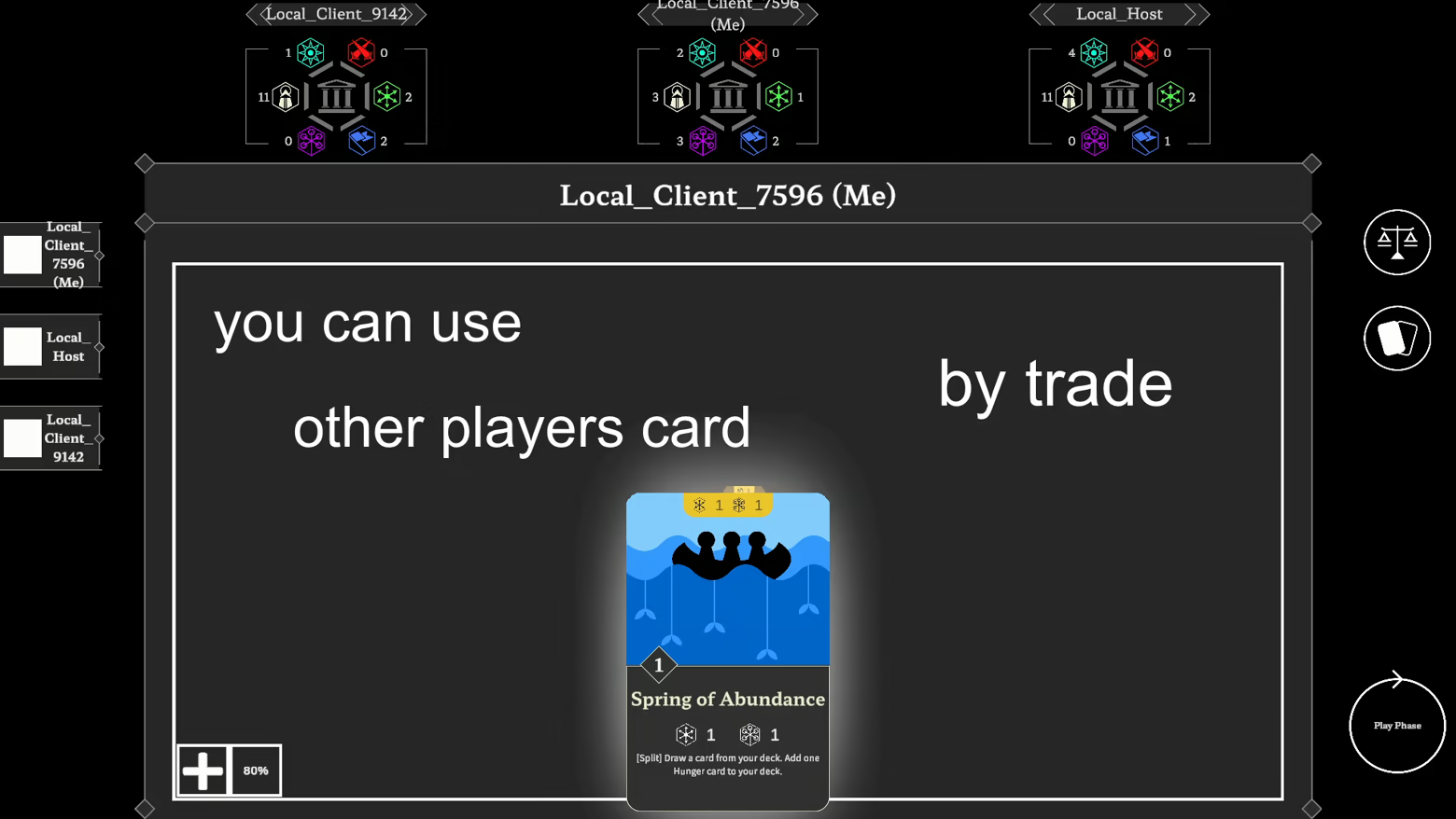
  b. Trade: Take one card of your choice from among the discarded cards.

2. Additional methods

Some cards allow you to draw additional cards in various situations, such as every turn or when a card is flipped. When the text states "perform an additional Draw Cards," follow action a; when it states "perform an additional Trade," follow action b. Unlike the basic method described above, these additional methods do not have to be performed at the start of the turn; once their conditions are met, this opportunity may be used at any point before the turn ends. Be cautious, however—cards that allow you to gain additional cards can be dangerous.

Deck Building

The Early Access version of this game comes with four pre-built decks that will help you get a feel for play.

However, building your own deck will deepen your understanding of the cards and help to find unconventional strategies. A deck consists of 31 cards including 1 starting card, and you may include up to 3 copies of any given non-starting card. There are no other restrictions on card selection: you may use cards from a wide range of religious themes, or focus on a concentrated build. But be careful—if you don't check the required symbols, you may find that cards you've added to your deck can't actually be played. Always check the types and number of symbols a card provides, and consider whether they can meet the symbol requirements of your other cards.

A deck consists of 31 cards including 1 starting card, and you may include up to 3 copies of any given non-starting card. There are no other restrictions on card selection: you may use cards from a wide range of religious themes, or focus on a concentrated build. But be careful—if you don't check the required symbols, you may find that cards you've added to your deck can't actually be played. Always check the types and number of symbols a card provides, and consider whether they can meet the symbol requirements of your other cards.

Card Mechanics: Sacrifice and Destroy

Besides drawing additional cards, flipping cards produces various effects on the field, and you must consider these factors when building a deck.

Sacrifice

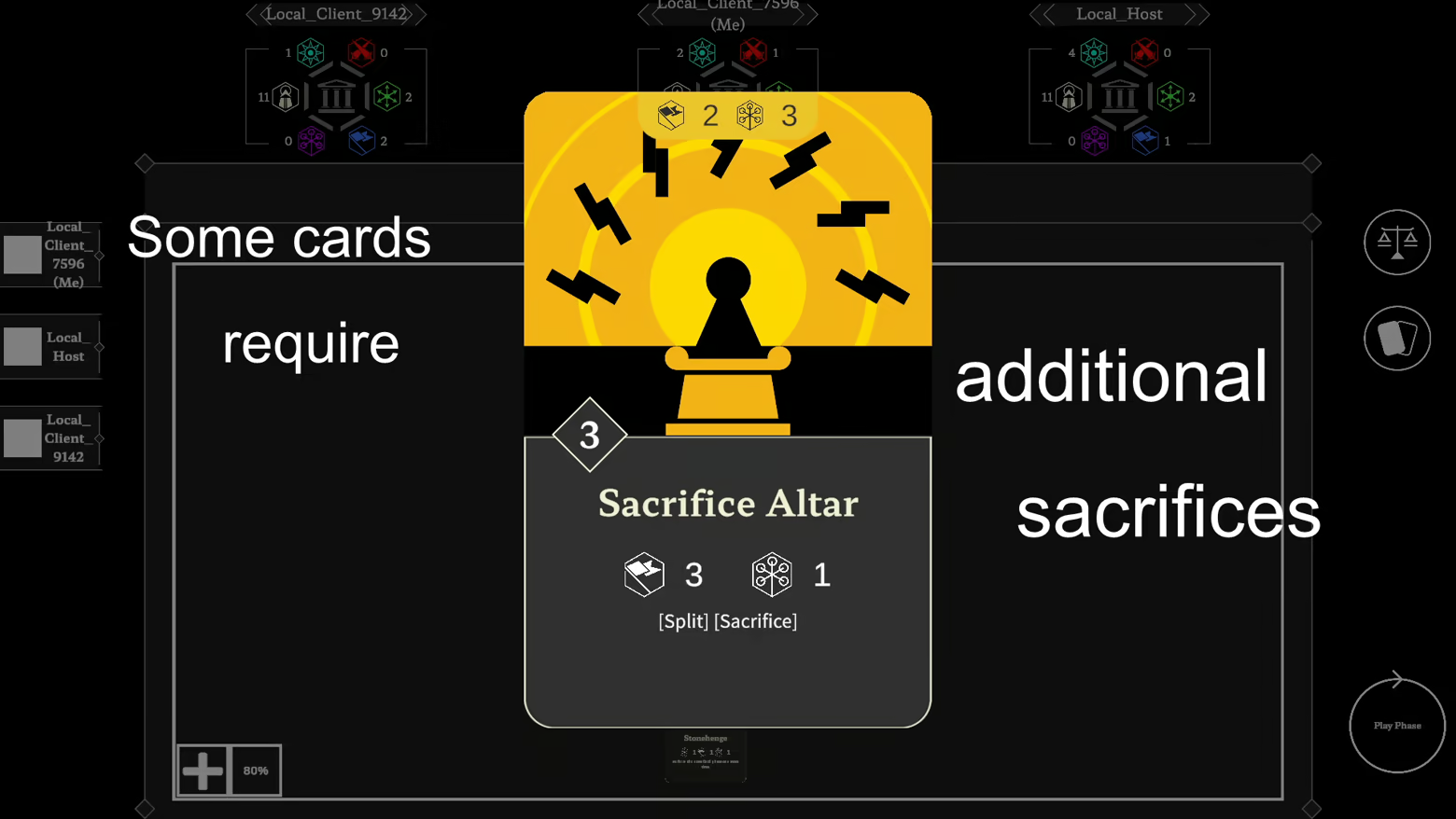
Some cards require Sacrifice. Sacrifice is performed on Cultist cards you own, and once triggered, the selected Cultist card is immediately destroyed. Cards and effects that can be used by sacrificing a Cultist card carry powerful effects capable of turning the tide of the game.

Destroy

Some cards have a direct impact on other players by destroying their Cultist cards. Because this is an extremely powerful mechanic, such cards may require additional conditions—for example, possessing greater Military Power than the opponent, or holding another combo card.

Don't worry. Cultist cards that have been sacrificed or destroyed are not removed from the game; they move into the trade pile, where they may be introduced to other players.

In addition, some cards carry various keywords, and these provide important information for play.

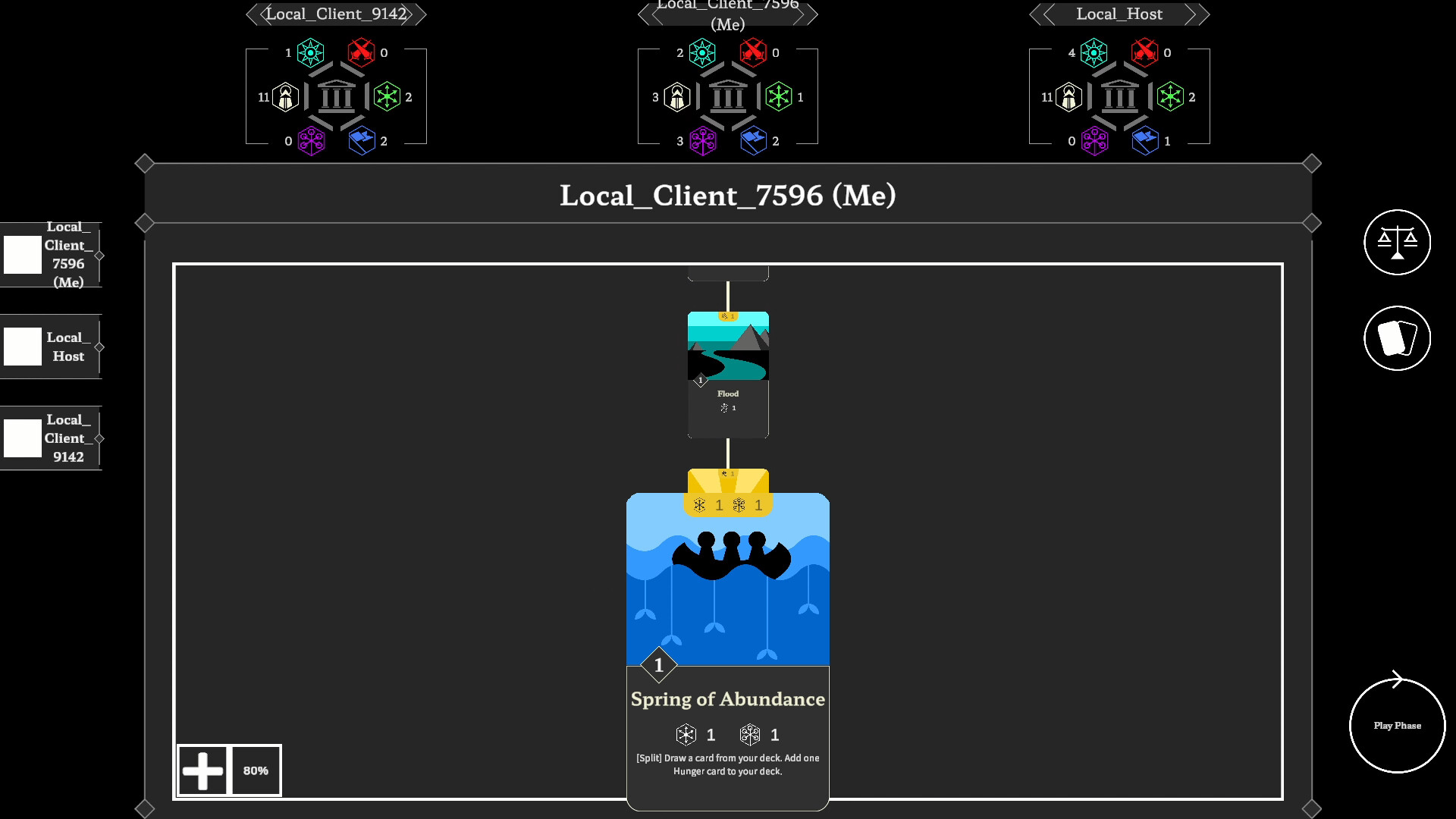
  • The [Split] keyword opens up space to form a new sect when the card is flipped. Through different sects, you can efficiently strengthen your religion and reduce the risks of certain cards. You can have up to 3 sects.

  • The [Feat] keyword is used on cards with very powerful effects, and only one such card may exist in a flipped state on a single player's field. Using these at the right moment is crucial.

  • The [Echo] keyword takes effect when an opponent declares destroy on this card while it is unflipped. In that case, instead of being destroyed, the card is flipped without cost and immediately provides a benefit to the player holding it. This is a powerful bluff, and punishes plays that destroy opponents' card.

  • The [Crisis] keyword triggers while the card is in the deck: if a card with this keyword appears during the Draw Cards phase, it must be selected.

  • The [Revelation] keyword triggers when deck have been exhausted; cards with this keyword can only be drawn one at a time, and once acquired, must be flipped immediately to use their effect.

  • Cards with the [Sacrifice] keyword require sacrificing another Cultist card in order to be flipped.

  • Ultimately, you must build a powerful deck that can win either by completing the Pantheon or by eliminating all of the other players' Cultist cards.

Symbols and the Pantheon

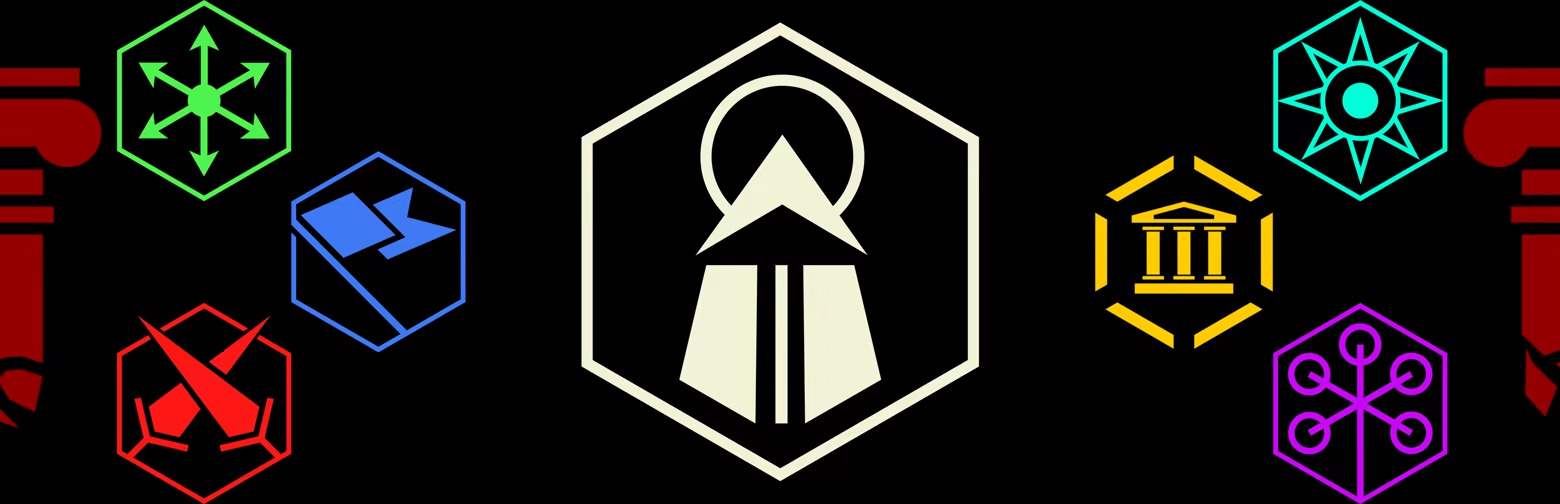
The cards have various symbols matching their contents and effects. Each symbol is one of the following: Influence, Unity, Polytheistic, Monotheistic, or Military Power. These respectively indicate how expansionistic a religion is, how politically unified it is, how strongly polytheistic or monotheistic it is, and how militarily strong it is.

To flip and activate most cards, you must possess enough of these symbols. The top portion of a card shows the types and number of symbols required, while the bottom shows the types and number of symbols you gain by holding the card flipped. These symbols do not disappear while the card is held flipped; they are considered continuously possessed.

Monotheistic

Monotheistic cards consist mainly of Abrahamic religions and the cards that influenced them. Compared to polytheistic cards, they have a more exclusive character; they grow stronger as the game progresses, but the symbols they require also increase steeply. Late-game cards generally have high Military Power and make it easy to win by destroying opponents' Cultists. However, gaining Pantheons is difficult. Early-game cards are designed to defend opponents' interference and enable steady growth.

Polytheistic

Polytheistic cards consist of different faiths from various cultural regions. They appear separately in the early stages, but as the game progresses they fuse together and develop composite divinities. In the game, polytheistic cards have relatively low symbol requirements but come with various restrictive conditions. Resolving these restrictions may require using cards with different religious cultures together. The low symbol requirements buy time to score cards from other religious cultures. Victory is typically achieved by gaining Pantheons with the powerful combo play.

Unity

Unity indicates how well a religion can rally its members together. A religion with high Unity manages the dissatisfaction of its members and makes remarkable feats possible through individual sacrifice. In the game, Unity is allotted to cards representing exclusive religious cards whose growth is driven by strong cohesion. Most cards that require Unity have a high-risk, high-reward structure, and are designed to enable rapid, aggressive development based on a few key cards.

Influence

Influence indicates how expansionistic a religion is. An open religion that spreads explosively in a short period of time can be considered a religion of high Influence. In the game, Influence is concentrated on the cards of religions that have continuously changed by absorbing other cultures, rather than religions that grew through internal cohesion. Cards that require Influence do not produce powerful effects in a short time, but they stabilize the card supply and can demonstrate their effect when combined with other cards over the long term.

Military Power

Military Power indicates how much influence one can project over other religious communities. A player with strong Military Power can interfere more frequently with other players. They can destroy Cultist cards, restrict certain plays, and gain more advantages in turn order. Because Military Power cards are divided among cards of different religious cultures, achieving high Military Power may require various kinds of symbols. They are not distributed evenly and the timing at which they can be acquired also differs, so they must be considered first when designing a deck.

Pantheon

Some cards possess feats and influence that endure through the passage of time. These are represented by a temple-shaped Pantheon icon, and holding seven or more allows you to win after the end of a turn. Unlike other symbols, Pantheons are not required to activate cards, but they are necessary for victory, which can make them relatively difficult to acquire.

In the game there are diverse beliefs and the diverse religions that can be built from them. These religions are not sharply distinguished from one another and may follow different historical trajectories depending on the players' moment-to-moment choices that may be either constructive or self-destructive. The various ideas are contained within the cards.

Can you outgrow the world that contains yourself and become much bigger?

AI Generated Content Disclosure

The developers describe how their game uses AI Generated Content like this:

Proofreading in-game description

System Requirements

    Minimum:
    • Requires a 64-bit processor and operating system
    • OS: Windows 10 64-bit
    • Processor: Intel Core i5 or AMD Ryzen 5 (2.5 GHz or better)
    • Memory: 4 GB RAM
    • Graphics: DirectX 11 compatible graphics card
    • DirectX: Version 11
    • Storage: 3 GB available space
    Recommended:
    • Requires a 64-bit processor and operating system
    • OS: Windows 10 64-bit
    • Processor: Intel Core i5 or AMD Ryzen 5 (2.5 GHz or better)
    • Memory: 4 MB RAM
    • Graphics: DirectX 11 compatible graphics card
    • DirectX: Version 11
    • Storage: 3 GB available space
There are no reviews for this product

You can write your own review for this product to share your experience with the community. Use the area above the purchase buttons on this page to write your review.