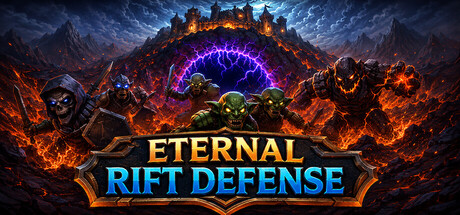


An MMOARPG tower defense where your hero supports your towers with abilities on the field. Share an overworld, run rifts solo or up to four-player co-op against Vaelgrym's legions. Level gear and complete sets to empower towers and abilities. Special modes: ranked PvP and one-life Hardcore.

Sign in to add this item to your wishlist, follow it, or mark it as ignored

Download Eternal Rift Defense Demo

This game is not yet available on Steam

Planned Release Date: Oct 28, 2026

This game plans to unlock in approximately 7 weeks

Interested?
Add to your wishlist and get notified when it becomes available.
 

About This Game

The moon bled. Then the Cinder King came down from the mountains.

Vaelgrym's flames took the forests, then the kingdoms, then the city itself. And when there was nothing left standing to burn, he tore open rifts between worlds and called his legions through them.

The rifts are still open. The moon is still bleeding. The legions keep coming through, and the heroes who go in to stop them are all that stands in their way.

An MMOARPG built on tower defense

You don't hover above the battlefield here. You stand on it: a hero on the ground, in a persistent world you share with everyone else still fighting.

A world between the rifts

Everyone lands in the same overworld, a hub you actually walk around, with world chat, guilds, parties, friends, vendors and quest-givers. When you're ready to fight you take a rift, alone or with a small group you pulled together in the hub. The rift is yours. The world is everyone's.

Link your Discord and voice takes care of itself. Form a party and you are already in a call together. Real Discord voice, with noise suppression, per-person volume and mute where you would expect them. Nobody has to go set up a channel first.

The loot is the point

Every rift is a loot run. Gear drops in rising tiers of rarity, scaled to how deep you're playing and how hard you've built your character for finding it.

Then you level it. A piece keeps climbing, rolling new affixes as it goes, so the drop you liked early is a measurably different item by the time you're finished with it. Or take the risk. Cursed Shards drop in the rifts, and spending one forces an extra affix onto a piece. It can just as easily unmake the item into something else entirely.

  • Sets are what you're chasing. Assemble a matching set and it pays three ways: standing buffs you carry into every rift, upgrades that turn your hero's abilities into stronger versions of themselves, and an aura that burns brighter the deeper the set goes. Everyone in the hub can see it, and read exactly how far you've taken it.

  • Every enemy type drops its own set. The piece you're still missing tells you exactly what to go hunting for.

Build the maze

Eleven towers, and the walls are half the game. Other towers build on top of a wall at a discount, so the shape of your maze and the shape of your defense are the same decision.

  • Damage. Arrow hits ground and air. Cannon trades range for splash. Wizard is the anti-air answer. Coin is the single-target killer, and it deals true damage.

  • Control. Ice slows, Tesla stuns, Poison crits hard, and Fire scales with upgrades harder than anything else you can build.

  • Infrastructure. Support speeds up every tower around it, Research generates the technology you'll spend, and Wall decides where the legions have to walk.

Stand on your towers

Towers gain levels mid-rift, and you level them by standing on them. Your hero and your slotted pet both pour XP into whatever they're perched on. So you're never parked safely behind the line. The towers that matter are the ones you're willing to stand on while the wave arrives.

Four heroes, four ways to hold a lane

Every class carries its own passive stat profile. The Knight is the toughest thing on the field and the slowest with it, the Archer the quickest, the Mage the most fragile. Each also brings two abilities that change what your defense can do:

  • Knight. Hold the Line slows every enemy on the map at once. Emergency Repairs mines a crystal for free.

  • Archer. Kill Zone marks a patch of ground, and everything crossing it takes extra damage. Marked Prey does the same to a single target.

  • Engineer. Blueprint Swap trades two towers' positions mid-wave. Optimized Construction hands you a free wall.

  • Mage. Arcane Surge teleports you forward. Mana Infusion pours experience straight into a tower.

And none of that is fixed. Collect your class set and the abilities themselves grow into something else. The Engineer's free wall comes up as a Cannon instead, the Knight's crystal salvage starts raising a Research tower, the Archer's mark lingers, and the Mage's infusion runs deeper. The hero you finish the game with is not the one you started it with.

Then spec into it

Three talent trees decide what kind of defender you are before a wave ever spawns: Support, Specialist and Resource. Lean into economy and your walls get cheaper, your waves pay better, and your gold starts earning interest. Lean into damage and your shots pierce, your fire spreads wider, your ice freezes what it touches. Go deep enough and the tree stops tuning numbers and starts changing the rules, unlocking towers you could not otherwise build, or starting every tower you place a level higher.

Seasonal Arena

Ranked 1v1, and you never touch the other player. You spend wood to summon monsters into their rift and try to overwhelm their defenses and break their castle before they break yours. Upgrade the units you send, and drop a boss on them when you want it finished.

Play your placement and the ladder sorts you into Bronze, Silver, Gold, Platinum or Diamond. Your MMR is public, and so is everyone else's. Reach Diamond before the season closes and the season reward is yours.

And you bring your character in exactly as you built it. The gear you farmed out of the rifts is the gear you compete with. There is no separate arena loadout, and nothing gets flattened at the door. Every hour spent hunting a set piece is an hour spent on the ladder.

Fifty rifts, five worlds

Twenty-five battlefields, each fought twice. As a rift it is you against the portals. The campaign keeps every bit of that, the same towers, the same waves, the same defense to hold, then sets a second front on top of it: a bot opponent across the map with a castle of its own, so you defend your lane and spend wood sending monsters at theirs at the same time. The maze it builds against you grows larger and better equipped the deeper you go.

You begin on open farmland holding a single portal and end in burning ruins with four of them open at once, by way of vine-choked jungle temples, desert strongholds and a whiteout in the mountains. Twenty-one enemy types come through those portals, from goblins and orcs to gyrocopters, liches, minotaurs and the Dragonlords that answer to Vaelgrym.

Daily and Weekly Rifts

Two endless-wave rifts run on their own clocks, each with a hazard rolled fresh for the day or the week. You're scored on the furthest wave you reach, and they pay rewards the campaign doesn't.

One life. Forever.

Hardcore is a choice you make when you roll a multiplayer character, and you make it once. It cannot be switched on or off later. That hero lives with a single life per rift, and the Arena stays shut to them: until they have proved themselves, hardcore is PvE all the way down. Lose a portal level and they fall out of the online world permanently. Leaderboards, co-op, guild, all gone with them.

Take every rift without falling and the hero comes out the other side Cooked: permanently buffed, permanently marked, wearing a skull beside their name that everyone in the hub can see, and at last allowed into the Arena. It is the only way in, and there is no second attempt.

Cosmetics only

The in-game store sells cosmetics. Nothing in it makes your towers hit harder or your gear roll better. Power comes out of rifts, not out of a wallet.

After release

Ten-player raids against Vaelgrym's superbosses are in development, and the seasonal leaderboard fills out in full. Both come after launch, not with it.

Or play it alone

Single-player characters run the entire game locally. No account, no internet, no cloud. It's a per-character choice, and nothing stops you keeping one of each.

Languages

Full interface and subtitles in English, French, Italian, German, Spanish, Polish and Portuguese. Voice acting is English.

AI Generated Content Disclosure

The developers describe how their game uses AI Generated Content like this:

Eternal Rift Defense uses AI-assisted tools during development to help generate and refine certain code, audio, visual assets, and design elements. All AI-assisted content is reviewed, modified, and validated by the developers to ensure quality, security, and consistency with the game’s design.

System Requirements

Windows
macOS
    Minimum:
    • OS: Windows 10 (64-bit)
    • Processor: Quad-core, 2.5 GHz
    • Memory: 8 GB RAM
    • Graphics: Vulkan 1.0 GPU with 2 GB VRAM (GTX 1050, RX 560)
    • Storage: 6 GB available space
    • Additional Notes: Requires a 64-bit processor and operating system. Broadband connection required for multiplayer; single-player works fully offline.
    Recommended:
    • OS: Windows 11 (64-bit)
    • Processor: 6-core, 3.5 GHz
    • Memory: 16 MB RAM
    • Graphics: RTX 2060 / RX 5700 or better
    • Network: Broadband Internet connection
    • Storage: 6 MB available space
    Minimum:
    • OS: macOS 11.0 (Apple Silicon) / 10.12 (Intel)
    • Processor: Apple M1, or quad-core Intel Core i5
    • Memory: 8 GB RAM
    • Graphics: Metal-capable GPU
    • Storage: 6 GB available space
    • Additional Notes:
    Recommended:
    • OS: macOS 13.0 or later
    • Processor: Apple M2 or better
    • Memory: 16 MB RAM
    • Graphics: Apple M2 integrated or better
    • Network: Broadband Internet connection
    • Storage: 6 MB available space
Review Filters